
The old Newtowne across the Charles from Boston, where the Continental Army took shape on the Common, the first press in the colonies printed its first books, and East Cambridge once made most of the fish netting in America.
Then and now
The same town 147 years apart. Click either map to look closer.
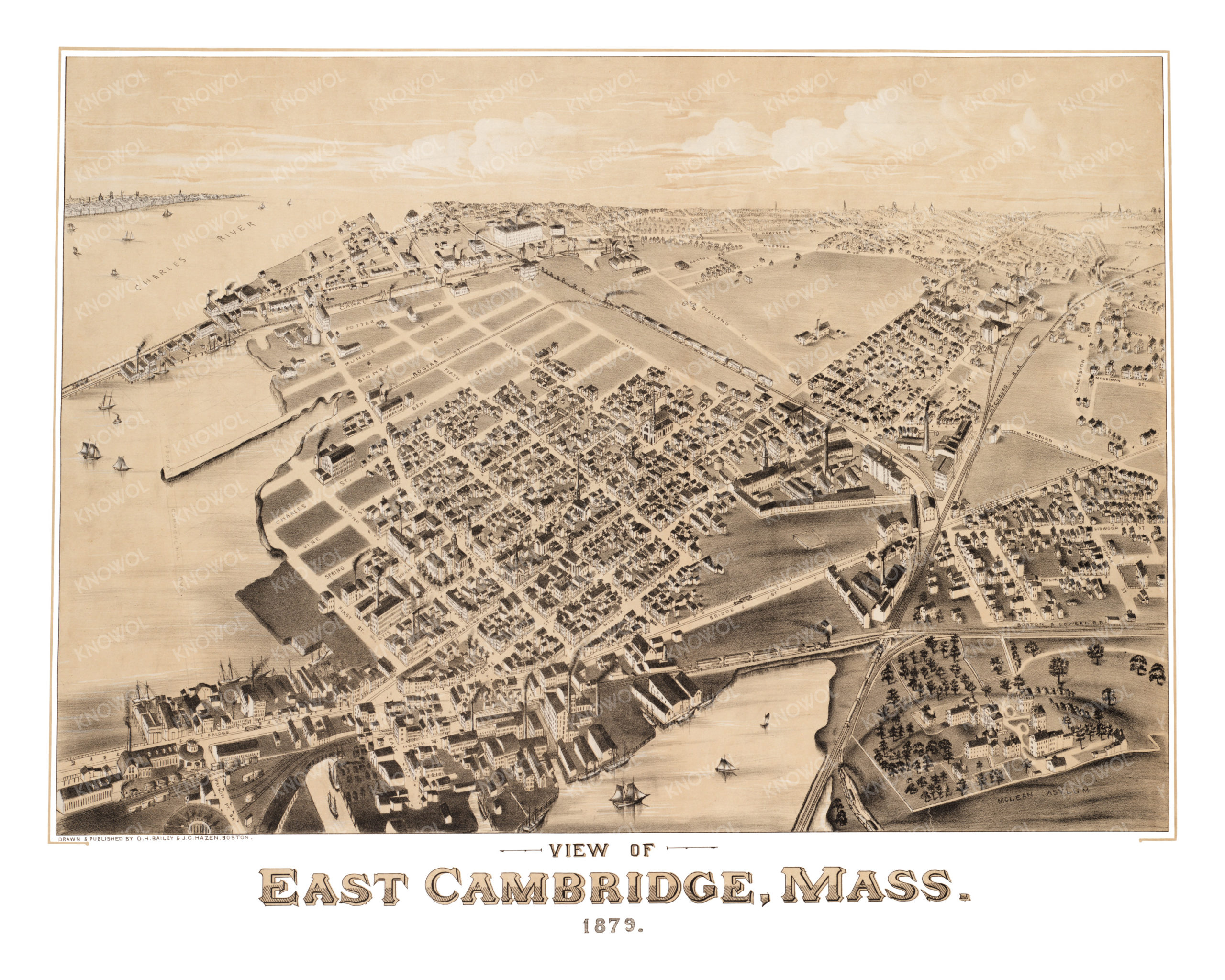
East Cambridge in 1879
By O.H. Bailey & J.C. Hazen
A bird's-eye view of East Cambridge, one neighborhood of the city, with the Charles River, the Fitchburg, Boston & Lowell and Boston & Albany railroads and the McLean Asylum. Commercial Avenue wasn't built yet, so the map sketches its proposed path over the river.4
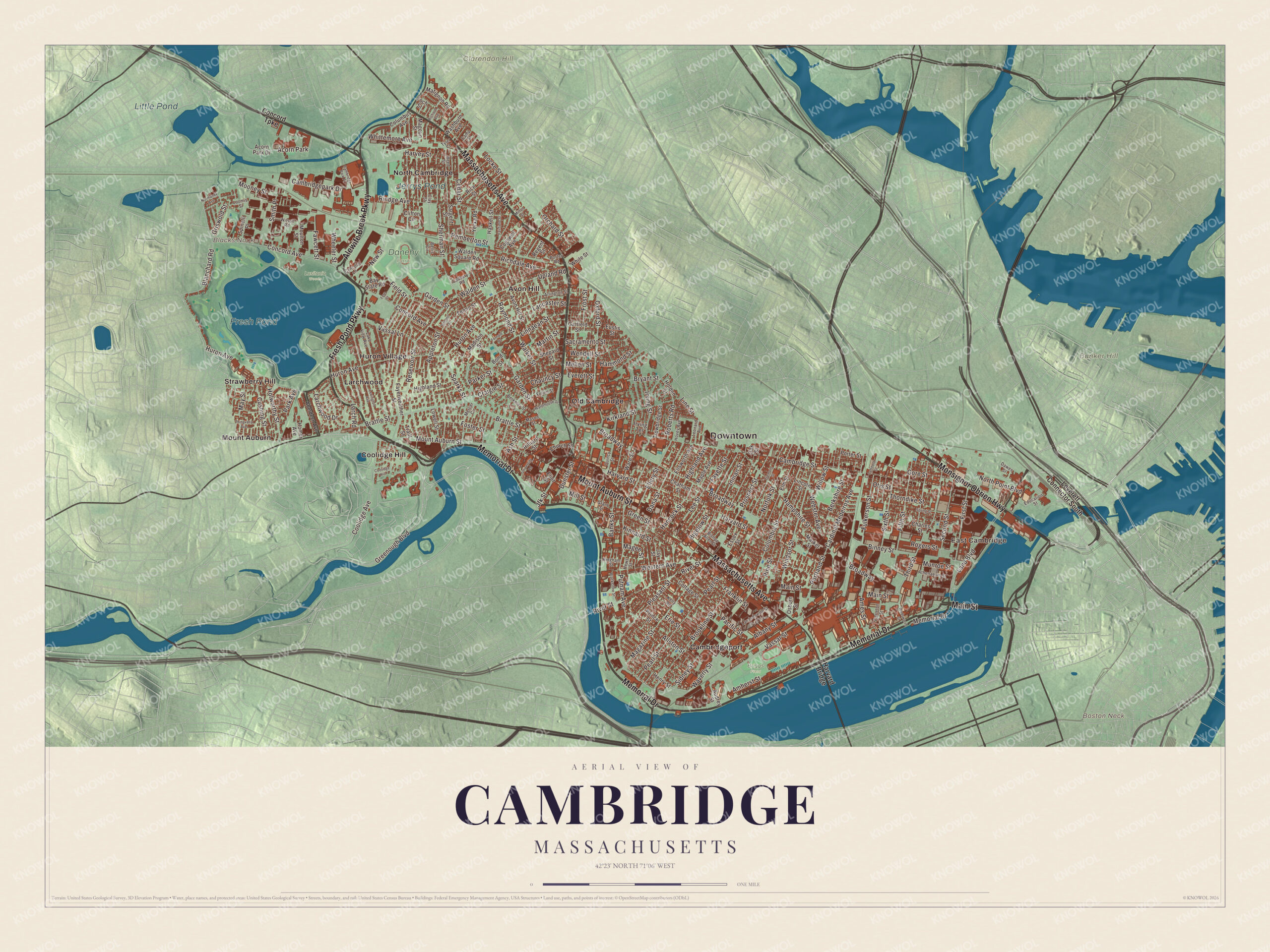
Cambridge today
By KNOWOL
The whole city between the Charles and Alewife Brook, with Memorial Drive, Mount Auburn Street, Main Street and Fresh Pond Parkway, and Fresh Pond, Jerrys Pond, Avon Hill, Coolidge Hill and Huron Village.2
The story of Cambridge
Nets, flowerpots and pumps
When Cambridge turned fifty as a city in 1896, its speakers admitted that people far away were surprised to hear it called a manufacturing city. Then they gave the list. In 1842 all the fish netting used in America had come from England. By 1896 most of it was made in East Cambridge, along with fishing twine sold around the world. The potteries on Walden Street had turned out seven million flowerpots the year before, and only Chicago and Kansas City packed more pork. Most of the steel railroad bridges in New England were built here, the United States Navy came here for its pumps, and Cambridge pumping engines were at work in Honolulu, Sydney and St. Petersburg. The American Net and Twine factory still stands on Second Street.56
How East Cambridge was sold
East Cambridge began as Lechmere Point, cut off from the rest of town by wood, swamp and marsh. Andrew Craigie spent ten or twelve years quietly buying it up, often in the names of relatives and friends, for what the city's 1913 history guessed was no more than twenty thousand dollars. In 1808 he sold it to a stock company for three hundred and sixty thousand. Craigie Bridge to Boston followed in 1809, and in 1810 the Lechmere Point Corporation laid out the streets. Sales were slow, only ten lots in three years. When the county courts moved to East Cambridge, the 1877 history says, it was a sore grievance to Old Cambridge, and the three villages stayed rivals for half a century.789
Where the army began
Cambridge Common was set aside in 1630 as pasture, woodlot and training ground. After Lexington and Concord it filled with patriot soldiers, and in July 1775 George Washington took command of the new Continental Army there. He made his headquarters in the Vassall house on Brattle Street, later Longfellow's home, and that November his soldiers threw up the earthwork now called Fort Washington, the only fortification left from the Siege of Boston. The habit stuck. A speaker at the city's 75th birthday in 1921 said Cambridge sent the first company of volunteers to preserve the Union, and that more than eight thousand of its sons enlisted in the First World War while the Common became a training camp again.21011
Through the years
23 moments from 1630 to today.
- 1630In December the site is chosen because it lies safely upriver from Boston Harbor.2
- 1631The first houses of the "newe towne" go up in the spring.2
- 1636The colony founds a college here, later named Harvard College.2
- 1638Newtowne takes the name Cambridge, after the English university.2
- 1639Stephen Daye sets up the first printing press in America at Cambridge, and the first books in the country come from it.12
- 1681The Cooper-Frost-Austin House, now the oldest house in the city, is built.13
- 1688Cambridge Village, today's Newton, is set off as a place of its own.1
- 1760Christ Church goes up on Garden Street, designed by Peter Harrison.14
- 1775George Washington takes command of the Continental Army on Cambridge Common in July.2
- 1775In November his soldiers build the earthwork now called Fort Washington.10
- 1792The West Boston Bridge ties Cambridge directly to Boston.1
- 1809Craigie Bridge is built after Andrew Craigie sells his Lechmere Point land to a stock company.7
- 1810The Lechmere Point Corporation lays out the streets of East Cambridge. Only ten lots sell in three years.7
- 1818The New England Glass Company is founded in East Cambridge.1
- 1831Mount Auburn Cemetery is dedicated, the first garden cemetery in the country.2
- 1839Judge Dana's mansion burns, and his heirs cut Dana Hill into house lots.15
- 1846Cambridge becomes a city.2
- 1865The city takes over the waterworks, and Fresh Pond becomes its water supply.2
- 1889Maria Baldwin becomes principal of the Agassiz School.2
- 1895The potteries on Walden Street turn out seven million flowerpots.5
- 1896At the city's fiftieth birthday, speakers note that most of America's fish netting is made in East Cambridge.5
- 1916MIT moves across the river from Boston.2
- 1969Bolt, Beranek and Newman builds the first network router in Cambridge Highlands.2
Places to see
Places worth a visit in Cambridge today.
- Cambridge CommonOld Cambridge. Where Washington took command in 1775.
- Longfellow House, Washington's Headquarters105 Brattle Street. Washington's headquarters, then Longfellow's home.Visit their website
- Brattle StreetOld Cambridge. Still called Tory Row.
- Harvard SquareOld Cambridge. Site of the original Newtowne village.
- Mount Auburn CemeteryMount Auburn Street. America's first garden cemetery, 1831.Visit their website
- Fresh PondWest Cambridge. The city's water supply since 1865.Visit their website
- East CambridgeLechmere. Once an island at high tide.
- Avon HillNorth of Harvard Square. Fine Victorian houses, once Jones Hill.
- Jerrys PondNorth Cambridge. An old brickyard clay pit.
- Memorial DriveAlong the Charles. Named in 1923 for World War I soldiers.
On the National Register
20 of the 208 places in Cambridge on the National Register of Historic Places that still stand today, oldest first, and why each one matters. See the full list of National Register places in Cambridge.3
-
Cooper-Frost-Austin House
The oldest house still standing in Cambridge, built about 1681 and owned by one family line for 250 years. Historic New England runs it as a museum.13
-
Hooper-Lee-Nichols House
Built in 1685 by Dr. Richard Hooper as a farmhouse and enlarged many times since, it's the second-oldest house in the city. It's now the headquarters of History Cambridge, the old Cambridge Historical Society.16
-
Massachusetts Hall, Harvard University
National Historic Landmark
The oldest surviving building at Harvard College and the second-oldest academic building in the United States. It was built as a dormitory for 64 students, and 640 American soldiers were quartered in it during the Siege of Boston.17
-
Longfellow National Historic Site
National Historic Landmark
Built in 1759 for John Vassall Jr., the house was George Washington's headquarters during the early months of the Revolution and then Henry Wadsworth Longfellow's home for almost 50 years. It's now a National Historic Site honoring both.18
-
Christ Church
National Historic Landmark
One of the few buildings that can be firmly credited to Peter Harrison, the first formally trained architect to work in the British colonies. The congregation was founded in 1759 by members of King's Chapel who lived in Cambridge.14
-
Elmwood
National Historic Landmark
Built about 1767 for Thomas Oliver, the royal lieutenant governor, it later belonged to Elbridge Gerry, signer of the Declaration of Independence and Vice President. James Russell Lowell was born and lived here, and it's now the home of Harvard's president.19
-
Fort Washington
Built by Continental soldiers on George Washington's orders in November 1775. It's the oldest surviving fortification from the Revolutionary War and the only one left from the Siege of Boston.10
-
Memorial Hall, Harvard University
National Historic Landmark
A High Victorian Gothic hall built in memory of the Harvard men who fought for the Union in the Civil War, with Sanders Theatre, the great dining hall and a memorial transept. Oliver Wendell Holmes wrote a hymn for the laying of its cornerstone in 1870.20
-
American Net and Twine Company Factory
Built in 1875 by the nation's first manufacturer of cotton fishing nets. In 1896 the city boasted that most of the fish netting used in America was made in East Cambridge.6
-
Cambridge Public Library
The main library, grown out of the Cambridge Athenaeum, was built on Broadway in 1888 and greatly enlarged with a modern addition in 2009.21
-
Arthur D. Little, Inc. Building
National Historic Landmark
Built in 1917 for the Arthur D. Little Company, the first business in the nation set up as a consulting laboratory. It stands beside the MIT campus on Memorial Drive.22
-
New England Confectionery Company Factory
The Necco candy factory on Massachusetts Avenue, built as the company's only plant and at the time the largest candy factory in the world. Its water tower, once painted like a roll of Necco Wafers, still stands.23
-
Asa Gray House
National Historic Landmark
The earliest known work of architect Ithiel Town, designed in 1810. Its most famous resident was the botanist Asa Gray, who published the first complete work on American plants and defended Darwin's theory.24
-
Margaret Fuller House
National Historic Landmark
The birthplace and childhood home of the writer Margaret Fuller, a Federal-style house in the old Cambridgeport neighborhood now called The Port. In 1902 it became a settlement house helping immigrant families.25
-
Cambridge Common Historic District
Centered on the Common, a center of town life since the founding. It saw the election for governor of the colony in 1636 and served as a barracks site for the Continental Army.26
-
Mount Auburn Cemetery
National Historic Landmark
The first rural or garden cemetery in the United States, dedicated in 1831 and set with monuments in a rolling landscaped terrain. It marked a clean break with the old burying grounds and church graveyards.27
-
Maria Baldwin House
National Historic Landmark
The home of educator Maria Louise Baldwin while she led Cambridge's Agassiz School, the first African American woman to serve as a principal in a Massachusetts school. The school now bears her name.28
-
East Cambridge Historic District
The old center of East Cambridge, with the Middlesex County court buildings begun in the 1810s and a cluster of Greek Revival workers' houses on Otis, Thorndike, Spring and Sciarappa Streets.29
-
Old Cambridgeport Historic District
Some of the oldest houses north of Massachusetts Avenue in Cambridgeport, on Cherry, Harvard and Washington Streets, among them the Samuel Fay House of 1805 and the Margaret Fuller House.30
-
Mary Fisk Stoughton House
National Historic Landmark
Henry Hobson Richardson designed this house in 1882 in what's now called the Shingle Style, with shingles stretched over its shapes like a skin. It helped make the style popular and foreshadowed the work of Frank Lloyd Wright.31
In their words
“He is quite content to say 'I am from Cambridge and the world will understand.'”
Professor Albert Bushnell Hart at the city's 75th anniversary, 192132
“Indeed, the whole city is under the highest state of cultivation ; and beauty, more than profit, seems to guide the owner of the soil.”
A gazetteer of the state of Massachusetts, 187433
“persons at a distance are apt to show surprise when we speak of it as a manufacturing city.”
Cambridge fifty years a city, 1846-1896, on the city's factories5
Nearby towns
Sources
- Cambridge, Massachusetts, Wikipedia
- Map of Cambridge, Massachusetts in 2026, KNOWOL
- National Register of Historic Places listings in Cambridge, Massachusetts, Wikipedia
- Beautifully restored map of East Cambridge, MA from 1879, KNOWOL
- Cambridge fifty years a city, 1846-1896 (1897), on the city's manufactures, Internet Archive
- American Net and Twine Company Factory, Wikipedia
- A history of Cambridge, Massachusetts, 1630-1913 (1913), on Andrew Craigie and East Cambridge, Internet Archive
- History of Cambridge, Massachusetts, 1630-1877 (1877), on the rival villages, Internet Archive
- Publications of the Cambridge Historical Society (1906), on Cambridge in 1830, Internet Archive
- Fort Washington, Wikipedia
- Cambridge seventy-five years a city, 1846-1921 (1922), on Cambridge in the wars, Internet Archive
- Middlesex County and its people (1927), on printing in Cambridge, Internet Archive
- Cooper-Frost-Austin House, Wikipedia
- Christ Church, Wikipedia
- History of Middlesex County, Massachusetts (1880), on Dana Hill, Internet Archive
- Hooper-Lee-Nichols House, Wikipedia
- Massachusetts Hall, Harvard University, Wikipedia
- Longfellow National Historic Site, Wikipedia
- Elmwood, Wikipedia
- Memorial Hall, Harvard University, Wikipedia
- Cambridge Public Library, Wikipedia
- Arthur D. Little, Inc. Building, Wikipedia
- New England Confectionery Company Factory, Wikipedia
- Asa Gray House, Wikipedia
- Margaret Fuller House, Wikipedia
- Cambridge Common Historic District, Wikipedia
- Mount Auburn Cemetery, Wikipedia
- Maria Baldwin House, Wikipedia
- East Cambridge Historic District, Wikipedia
- Old Cambridgeport Historic District, Wikipedia
- Mary Fisk Stoughton House, Wikipedia
- Cambridge seventy-five years a city, 1846-1921 (1922), Albert Bushnell Hart's remarks, Internet Archive
- A gazetteer of the state of Massachusetts (1874), on Cambridge, Internet Archive