
A granite city that climbs from Mount Hope Bay to the Watuppa Ponds, grown from eighteen houses beside the falls of the Quequechan into the Spindle City, with the motto it raised from the ashes of 1843: We'll Try.
Then and now
The same town 149 years apart. Click either map to look closer.
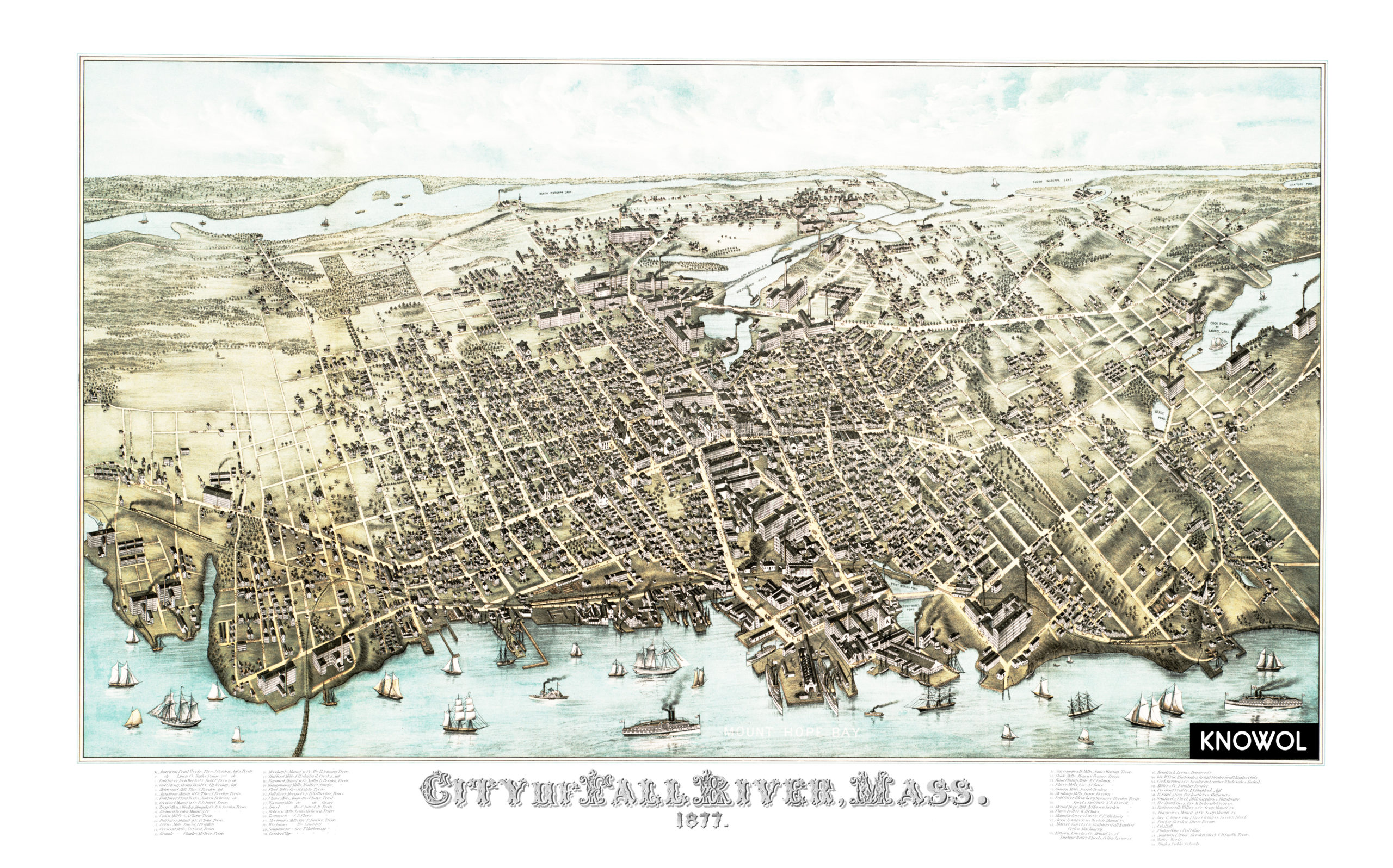
Fall River in 1877
By J.C. Hazen
The Spindle City in 1877, a city of mills, printers and manufacturers, with landmarks such as the Fall River Iron Works, the Fall River Print Works and Fall River Manufacturing.4
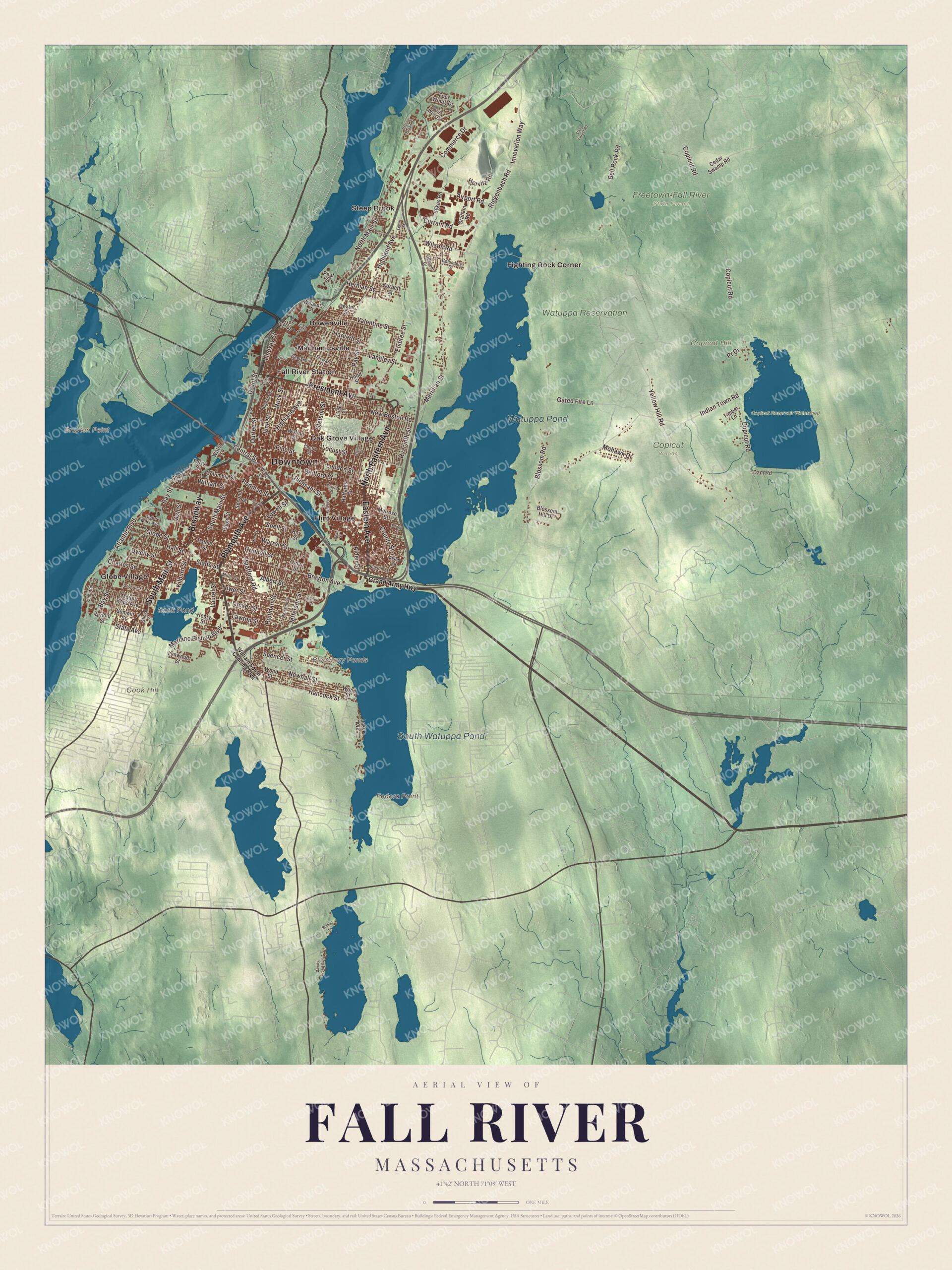
Fall River today
By KNOWOL
Shaded hills rising from the Taunton River and Mount Hope Bay to the Watuppa Ponds, with South Main Street, President Avenue, Plymouth Avenue, Eastern Avenue and Broadway, Cook Pond, Copicut Hill, the Watuppa Reservation, Flint Village and Globe Village.5
The story of Fall River
Eighteen houses by the falls
When Fall River became a town in 1803, the village by the falls had just eighteen houses and about a hundred people. The water had been working for a long time already. A 1911 history says Col. Benjamin Church and his brother Caleb had a saw mill on the Quequechan before 1691. A tannery on the hill was sold in 1801 to Enoch French, and the hill still carries his name. The first post office opened in 1811, then moved to Steep Brook, a rival village, until 1816. Out east, people then living could remember crossing the Narrows of Watuppa Pond, on the road to New Bedford, on stepping stones.2678
Silver dollars under the clock
Fall River's mill story starts small. In 1811 Col. Joseph Durfee built a little wooden factory in Globe Village, and by 1829 it had become a print works. In 1813 David Anthony, a Somerset man of 26 who had learned the trade under Samuel Slater, started the Fall River Manufactory, three stories of stone and wood built for 1,500 spindles. There was no bank yet, so the silver dollars paid in for shares sat on the bottom of an old clock. His mechanic, Dexter Wheeler, built the power looms, and in 1817 the first weavers went to work for $2.50 a week, making yard-wide cloth that sold for 25 cents a yard.910111213
The Sunday the town burned
On Sunday, July 2, 1843, about three in the afternoon, people had just gathered in church when fire broke out downtown. There'd been no rain for weeks and the wind was blowing a gale, and soon twenty or thirty buildings were burning at once. About two hundred buildings were lost, three churches and a big hotel among them, and the fire only stopped when the wind changed. Somewhere in the ruins someone hung a banner that said We'll Try, and it became the city's motto. In 1892 a state history wrote that Fall River had come through fires and hard times and risen to still greater importance.14115
Through the years
25 moments from 1656 to today.
- 1656The state's list of settlement dates gives 1656 for the first European settlement.5
- 1691By this year Col. Benjamin Church and his brother Caleb have a saw mill on the Quequechan, a 1911 history says.6
- 1707About this year a reservation for Native families in South Freetown, now East Fall River, is surveyed and divided into lots.16
- 1714The Churches sell their land and water rights to Richard and Joseph Borden.1
- 1778Col. Joseph Durfee's militia stands at the bridge over the stream and turns back a British raid.17
- 1801Enoch French buys the tannery on the hill that's still called French's Hill.6
- 1803Fall River is set off from Freetown as a town, with eighteen houses and about a hundred people.2
- 1804The town changes its name to Troy. It goes back to Fall River in 1834.1
- 1811Col. Joseph Durfee builds the Globe Manufactory, and the first post office opens.7
- 1813The Fall River Manufactory starts up in October, the first cotton spinning mill in the village.10
- 1817Power looms arrive at the Fall River Manufactory, and the first weavers earn $2.50 a week.13
- 1821Col. Richard Borden and Maj. Bradford Durfee start the Fall River Iron Works.1
- 1843On a dry, windy Sunday afternoon in July, fire burns some two hundred buildings in the center of town.14
- 1847Steamboats begin running to New York, the start of the Fall River Line.1
- 1854Fall River becomes a city of about 12,000 people, with James Buffington as mayor.1
- 1859The Union Mills become the first large steam-powered mill in the city.1
- 1861The Supreme Court moves the state line, and Fall River, Rhode Island, joins the Massachusetts city.1
- 1866The Fall River Steamboat Company puts freight boats on the New York route.18
- 1868Fall River passes Lowell as the leading textile city in America.1
- 1874Notre-Dame de Lourdes parish opens in Flint Village and starts the city's first parochial school.19
- 1877J.C. Hazen publishes his map of Fall River.4
- 1920The city's population peaks at 120,485.1
- 1928The worst fire in the city's history wipes out much of downtown.1
- 1930Fall River's Bert Patenaude scores the first hat-trick in World Cup history.5
- 1958Irving Fradkin founds Dollars for Scholars here, and Fall River becomes the Scholarship City.1
Places to see
Places worth a visit in Fall River today.
- Battleship CoveThe waterfront. Museum ships led by USS Massachusetts.Visit their website
- Fall River Heritage State ParkThe waterfront. Boardwalk, concert meadow and antique carousel.Visit their website
- Braga BridgeTaunton River. High over Battleship Cove.
- Kennedy ParkSouth Main Street. Olmsted park laid out in 1868.
- North ParkPresident Avenue. One of three Olmsted parks.
- Flint MillsAlden Street. The mill that named Flint Village.
- Globe VillageSouth End. Where Durfee's first mill rose in 1811.
- Cook PondSouth End. The Globe Manufactory's mill pond.
- North Watuppa PondEast of the city. City drinking water since 1873.
- Copicut HillEast of the city. Highest point in Fall River.
On the National Register
22 of the 105 places in Fall River on the National Register of Historic Places that still stand today, oldest first, and why each one matters. See the full list of National Register places in Fall River.3
-
Borden-Winslow House
It was built c. 1740 in the Steep Brook area, then still part of Freetown, making it possibly the oldest extant house in Fall River. Of particular interest is the fine Georgian pediment doorway, which includes a six-light transom within its entablature.20
-
Lafayette-Durfee House
A house of the Durfee family, built before about 1750. Joseph Durfee commanded men at the 1778 fight in Fall River, and the house was moved to Cherry Street about 1872. A foundation now keeps it and gives tours.21
-
American Printing Co. and Metacomet Mill
The Metacomet Mill, built in 1847 by Colonel Richard Borden for the manufacture of cotton textiles, is the oldest remaining textile mill in Fall River, Massachusetts. The adjacent American Printing Company Mill No. 7 (also known as Fall River Iron Works Mill No.7) was constructed in 1906 for the production of cotton print cloth.22
-
Fall River Waterworks
Built of local granite between 1872 and 1875 on the shore of North Watuppa Pond, with a pumping station, intake house and a 121-foot standpipe tower. It still supplies water to the city and several neighboring towns.23
-
Academy Building
The Borden family built it as a memorial to Nathaniel Briggs Borden, and it opened in January 1876 with the second largest theatre in Massachusetts. The Boston Symphony Orchestra played there many times in the 1880s, and it also held the city's first telephone exchange.24
-
Borden Flats Light Station
A sparkplug lighthouse lit in 1881 on a reef in Mount Hope Bay at the mouth of the Taunton River. The Hurricane of 1938 left it with a tilt you can still see.25
-
B.M.C. Durfee High School
Mary B. Young gave the school to the city in memory of her son, Bradford Matthew Chaloner Durfee, and it was dedicated in 1887. It stands on a hill seen for miles, which is why Durfee's teams are still the Hilltoppers, and it's now a courthouse.26
-
PT Boat ''796'' (torpedo boat)
National Historic Landmark
PT-796 is a 78-foot PT boat built by Higgins Industries of New Orleans in 1945. It was designated a National Historic Landmark in 1986 as one of a very few surviving World War II PT boats.27
-
Al Mac's Diner-Restaurant
It is an example of the stainless steel diners in Massachusetts, with rectangular massing, a flat roof, a projecting center entry vestibule, and rear kitchen wing. The diner was built in 1953 and added to the National Register of Historic Places in 1999.28
-
U.S.S. ''Joseph P. Kennedy Jr.'' (DD-850)
National Historic Landmark
A Gearing-class destroyer launched at Quincy in 1945 and named for President Kennedy's older brother, a naval aviator. She served in the blockade of Cuba during the Cuban Missile Crisis and is a museum ship at Battleship Cove.29
-
U.S.S. ''Lionfish''
National Historic Landmark
A Balao-class submarine launched in 1943 that made two war patrols in Japanese waters in 1945, ending the war on lifeguard duty rescuing downed fliers. She's on display at Battleship Cove.30
-
U.S.S. ''Massachusetts''
National Historic Landmark
The battleship Massachusetts dueled the French battleship Jean Bart off North Africa in 1942 and then guarded the fast carriers across the Pacific until the war's end. She's preserved at Battleship Cove as a museum ship, kept much as she was in wartime.31
-
Central Congregational Church
Designed by Hartwell and Swasey and built in 1875, it was the home church of the Borden family, and Lizzie Borden taught Sunday school here. It's now an event hall called The Historic Abbey.32
-
Downtown Fall River Historic District
The banks and business blocks of North Main Street and its side streets. Many were rebuilt in 1928 and 1929 after the Great Fire of 1928 swept the area.33
-
Durfee Mills
Built of native Fall River granite between 1866 and 1904, with seven-story Italianate towers, it was the city's largest and finest mill complex of its day. It was named for Bradford Durfee, credited with starting the city's industry.34
-
Flint Mills
Founded in 1872 and named for its first president, John D. Flint, the mill gave Flint Village its name. The first mill burned in 1882 and was rebuilt in 1883, and a second mill followed in 1909.35
-
Highlands Historic District
Over 1,400 acres on the old Rodman Farm ridge, where mill owners built their homes after the 1843 fire. Its houses date mostly from 1840 to 1925, and it takes in North Park, designed by the Olmsted Brothers.36
-
Kennedy Park
Frederick Law Olmsted and Calvert Vaux designed it in 1868 as South Park, on land that was part of Rhode Island until 1862. It slopes down toward Mount Hope Bay and was renamed for President Kennedy in 1963.37
-
Oak Grove Cemetery
A rural garden cemetery laid out in 1855 by the mill architect Josiah Brown, entered through a granite Gothic arch. Col. Richard Borden and Lizzie Borden are among those buried here, near the city's Civil War monument.38
-
St. Anne's Church and Parish Complex
Napoleon Bourassa designed the church in blue Vermont marble, with steeples 160 feet high, and the upper church was dedicated on July 4, 1906. For generations it drew pilgrims to the shrine of Saint Anne.39
-
Union Mills
The Union Mills company was incorporated in 1859, and was the first large steam-powered mill built in the city, having installed Corliss steam engines. The buildings are constructed from local Fall River granite.40
-
Torpedo Boat ''PT-617''
National Historic Landmark
The only surviving 80-foot Elco PT boat, the same type as the famous PT-109, launched in 1945. She's shown at the PT Boat Museum at Battleship Cove.41
In their words
“Fall River is, in every sense, the embodiment of the sagacity, energy and successful industry of her own people.”
Massachusetts of today, 189215
“Along its whole course the mills stand like the buildings in a city street.”
Massachusetts of today, 1892, on the Quequechan River15
“Notwithstanding people may sometimes say we have no history, we are makers of history”
A Fall River speaker at Freetown's Old Home Festival, 190242
Nearby towns
Sources
- Fall River, Massachusetts, Wikipedia
- History of Fall River, with notices of Freetown and Tiverton (1862), on the village in 1803, Internet Archive
- National Register of Historic Places listings in Fall River, Massachusetts, Wikipedia
- Amazing old map of Fall River, Massachusetts from 1877, restored by KNOWOL
- Map of Fall River, Massachusetts in 2026, KNOWOL
- History of Fall River, Massachusetts (1911), on the early mills and French's Hill, Internet Archive
- Our county and its people: a descriptive and biographical record of Bristol County, Massachusetts (1899), on the post office and Steep Brook, Internet Archive
- History of Fall River, with notices of Freetown and Tiverton (1862), on the river, the harbor and Watuppa Pond, Internet Archive
- History of Bristol County, Massachusetts (1883), on the Globe Village mill, Internet Archive
- History of Fall River, Massachusetts (1911), on David Anthony and the first mills, Internet Archive
- Massachusetts of today (1892), on Joseph A. Bowen and the first mill's shares, Internet Archive
- Fall River and its industries (1877), on the Fall River Manufactory and Dexter Wheeler, Internet Archive
- History of Fall River, Massachusetts (1911), on the first power looms, Internet Archive
- A gazetteer of Massachusetts (1847), on the fire of 1843, Internet Archive
- Massachusetts of today (1892), on Fall River, Internet Archive
- History of Plymouth County, Massachusetts (1884), on the reservation in South Freetown, Internet Archive
- A history of the town of Freetown, Massachusetts (1902), on the 1778 raid, Internet Archive
- Our country and its people; a descriptive and biographical record of Bristol County, Massachusetts (1899), on the steamboat company, Internet Archive
- A history of Bristol County, Massachusetts, Vol. 1 (1924), on the French-Canadian parishes, Internet Archive
- Borden-Winslow House, Wikipedia
- Lafayette-Durfee House, Wikipedia
- American Printing Co. and Metacomet Mill, Wikipedia
- Fall River Waterworks, Wikipedia
- Academy Building, Wikipedia
- Borden Flats Light Station, Wikipedia
- B.M.C. Durfee High School, Wikipedia
- PT Boat ''796'' (torpedo boat), Wikipedia
- Al Mac's Diner-Restaurant, Wikipedia
- U.S.S. ''Joseph P. Kennedy Jr.'' (DD-850), Wikipedia
- U.S.S. ''Lionfish'', Wikipedia
- U.S.S. ''Massachusetts'', Wikipedia
- Central Congregational Church, Wikipedia
- Downtown Fall River Historic District, Wikipedia
- Durfee Mills, Wikipedia
- Flint Mills, Wikipedia
- Highlands Historic District, Wikipedia
- Kennedy Park, Wikipedia
- Oak Grove Cemetery, Wikipedia
- St. Anne's Church and Parish Complex, Wikipedia
- Union Mills, Wikipedia
- Torpedo Boat ''PT-617'', Wikipedia
- A history of the town of Freetown, Massachusetts, with an account of the Old Home Festival (1902), a Fall River speech, Internet Archive