
A city of hills on the Mystic, once Charlestown's pasture beyond the Neck, where the Old Powder House still stands and Prospect Hill held the American line through the siege of Boston.
Somerville on the map
Click the map to look closer.
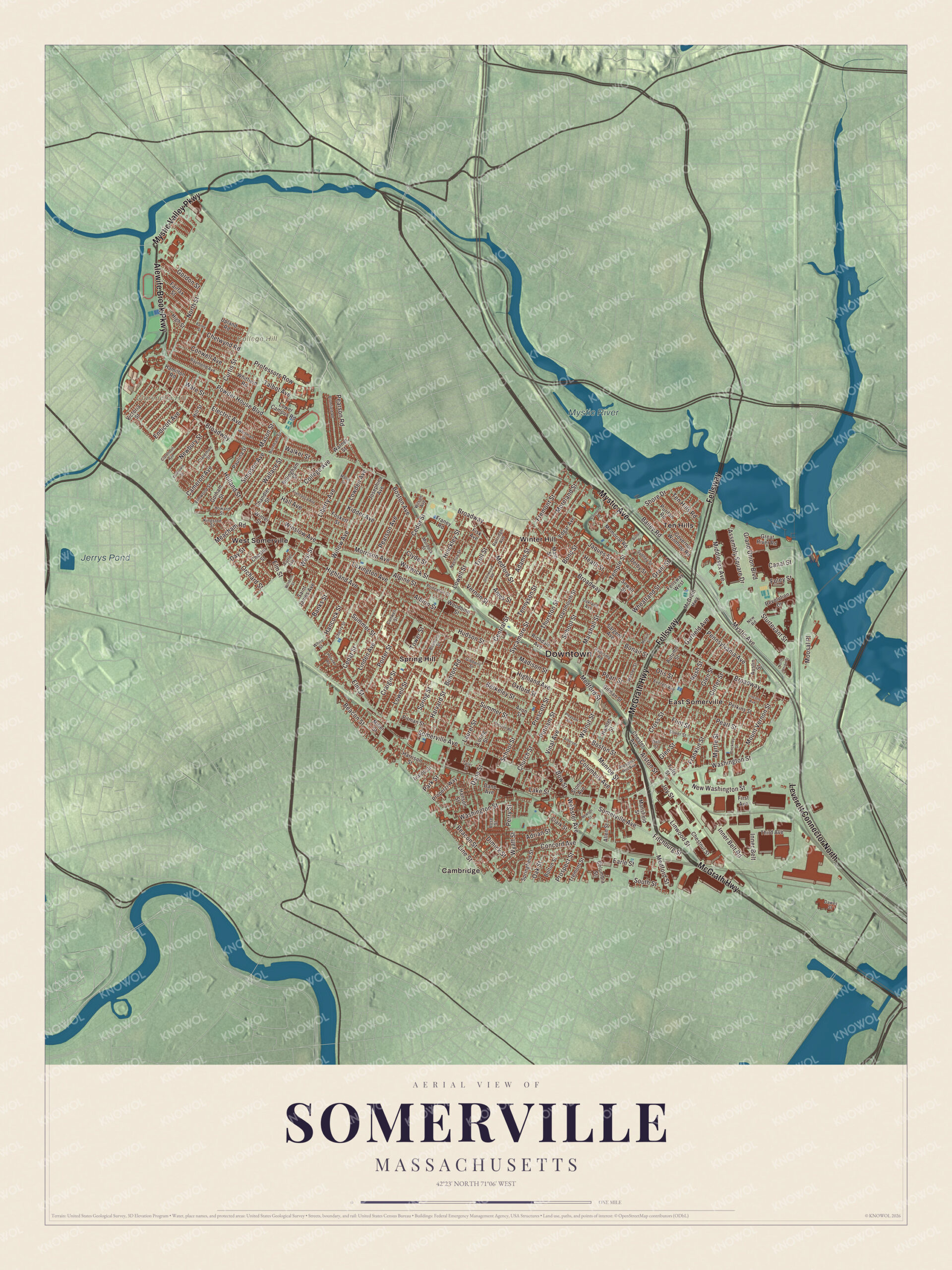
Somerville today
By KNOWOL
Winter Hill, Spring Hill and Clarendon Hill rising between McGrath Highway, Powder House Boulevard and the Mystic River, with Ten Hills and East Somerville on one side and West Somerville on the other, drawn from USGS elevation data and Census Bureau streets.2
The story of Somerville
Ploughed Hill and Milk Row
For two centuries this was the part of Charlestown beyond the Neck. An 1880 county history says that when the Revolution came, no more than about 250 people lived here, in a little over thirty houses along the Cambridge, Winter Hill and Milk Row roads. Most were farmers, many of them big producers of milk, and a few fished for alewives when the run came. Winter, Prospect, Spring, Central and Walnut hills were pasture, dotted with red cedars. Mount Benedict was known as Ploughed Hill, because farmers ploughed it in a circle, turning every furrow down the slope. Willis' Creek, later the Miller's River, rose at the foot of Spring Hill and ran clear through the meadows to the Charles.25
The hills of the siege
After Bunker Hill, Somerville's hills became the American front line around Boston. On July 18, 1775, Putnam's flag, a scarlet standard with the Massachusetts motto An Appeal to Heaven, was raised on Prospect Hill, and on August 1 a mast seventy-six feet tall, taken from a schooner burned at Chelsea, went up on the hill. On the night of August 26, about two thousand men under General Sullivan dug in on Ploughed Hill while the British fired from Bunker Hill and from boats in the Mystic. An 1874 gazetteer says British cannonballs were still being dug up there. On January 1, 1776, the flag of the United Colonies flew over Prospect Hill, and in the winter of 1777 and 1778 the captured army of General Burgoyne camped on Winter Hill.6782910
The first soldiers' monument
When the Civil War began, Somerville was a town of about nine thousand people. It sent forty officers and 1,085 men, 147 more than it was asked for, and ninety-eight of them died. At home, women's aid societies sewed clothing for soldiers in camp and hospital, cooked for the sick and held fairs, and Somerville raised more than $200,000 for the Union cause. In the summer of 1863 the Somerville Light Infantry took money left over from the fund raised when it marched off in April 1861 and put up a marble shaft, topped by an eagle, in the cemetery on Somerville Avenue. An 1890 county history calls it the first soldiers' monument erected in Massachusetts. It still stands in the Milk Row Cemetery.11312131415
Through the years
25 moments from 1630 to today.
- 1630John Woolrich, a trader, comes out from the Charlestown peninsula and settles near today's Dane Street.2
- 1631Governor John Winthrop is granted 600 acres here, named Ten Hills Farm for its ten small knolls.2
- 1639The woman sachem of the Mystic people deeds the land that becomes Somerville to the English.2
- 1703John Mallet builds a stone windmill, later the Old Powder House, in 1703 or 1704.2
- 1747The mill is sold to the colony and becomes a gunpowder magazine.2
- 1774On September 1, General Gage's soldiers carry off 250 half barrels of gunpowder from the Powder House.9
- 1775On April 19, Lord Percy's retreating column crosses into Somerville at Elm and Beech streets under fire.16
- 1775On July 18, Putnam's flag, with the motto An Appeal to Heaven, is raised on Prospect Hill.6
- 1775On the night of August 26, about two thousand men under General Sullivan fortify Ploughed Hill.7
- 1776On January 1, the flag of the United Colonies is raised on Prospect Hill.2
- 1777Companies raised to guard General Burgoyne's surrendered army are stationed at Winter Hill through the winter of 1777 and 1778.10
- 1804The Milk Row Cemetery is laid out on land given by Samuel Tufts.15
- 1842On March 3, Somerville becomes a town, set off from Charlestown.2
- 1852Tufts College is chartered on Walnut Hill, on land given by Charles Tufts.2
- 1863The Somerville Light Infantry puts up a soldiers' monument, called the first in Massachusetts.3
- 1866The town buys its first steam fire engine.17
- 1872Somerville becomes a city, with George O. Brastow as its first mayor.18
- 1877The world's first permanent home telephone line is run to Charles Williams Jr.'s house on Arlington Street.19
- 1885The city builds a redoubt on Central Hill and arms it with four 8-inch siege guns.9
- 1892The Sons of the Revolution put a bronze tablet on the Old Powder House, and the mayor accepts it for the city.20
- 1898Somerville holds a six-day historic festival, Ye Olden Times at the Foot of Prospect Hill.6
- 1903The stone tower on Prospect Hill is built.2
- 1914Joseph Hobbs builds the Somerville Theatre in Davis Square for stage shows, vaudeville and movies.21
- 1926Ford opens a plant at Assembly Square.2
- 1941The Worcester Lunch Car Company builds the Rosebud diner near Davis Square.22
Places to see
Places worth a visit in Somerville today.
- Old Powder HouseNathan Tufts Park. Mallet's windmill, a powder magazine from 1747.
- Prospect HillNear Union Square. The Citadel, with its 1903 stone tower.
- Ten HillsOn the Mystic River. Winthrop's farm, granted in 1631.
- Winter HillBroadway. Where Revere galloped up Broadway.
- Spring HillCentral Somerville. One of the Seven Hills.
- College HillWest Somerville. Records point to a settlement nearby.
- Union SquareSomerville Avenue. Home of the What the Fluff? festival.
- Assembly SquareOn the Mystic River. Ford opened a plant here in 1926.
- Tufts CollegeWalnut Hill. Chartered in 1852 on Charles Tufts's land.Visit their website
- Alewife Brook ParkwayWest Somerville. A parkway planned in the 1890s.
On the National Register
20 of the 81 places in Somerville on the National Register of Historic Places that still stand today, oldest first, and why each one matters. See the full list of National Register places in Somerville.4
-
Powder House Park
The park around the Old Powder House, a stone windmill built by John Mallet in 1703 or 1704 and sold to the colony in 1747 as a gunpowder magazine. The British carried off its powder in 1774, setting off the Powder Alarm. Nathan Tufts's descendants gave the Powder House and its farm to the city in 1890.23
-
Peter and Oliver Tufts House
Built about 1714, it is one of the oldest houses on Winter Hill. General Charles Lee of the Continental Army made it his headquarters in 1775 and 1776, and in the 1800s it belonged to the Tufts family who developed the city's brickyards.24
-
House at 6 Kent Court
A Georgian house with a steep gambrel roof and a rear leanto, built in 1750 and one of the oldest buildings in the city. It was probably moved here, perhaps from Somerville Avenue, around 1900.25
-
Adams-Magoun House
Joseph Adams built this house in 1783 as the farmhouse of a 71-acre farm on Winter Hill. It is the best preserved of the city's few 18th-century buildings.26
-
House at 72R Dane Street
Built around 1790 on a small lane off Dane Street, it is one of Somerville's oldest buildings and stands near the site of the city's earliest settlement.27
-
Samuel Ireland House
A small five-bay cottage built about 1792 by Samuel Ireland, a farmer. It is the oldest documented house in eastern Somerville.28
-
Middlesex Canal Historic and Archaeological District
The 27-mile barge canal, built from 1793 to 1803, that carried boats between the Merrimack River and Boston and was studied by the engineers of the Erie Canal. The district takes in its traces in eight towns.29
-
Old Cemetery
Also called the Milk Row Cemetery, it was laid out in 1804 on land given by Samuel Tufts and is the city's oldest cemetery. Its Civil War monument of 1863, put up by the Somerville Light Infantry, is reputed to be one of the first in the nation.15
-
Cooper-Davenport Tavern Wing
John Davenport built this wing about 1806 onto Jonathan Cooper's tavern of 1757. When the old tavern came down for St. James Episcopal Church, the wing was moved to Eustis Street about 1888.30
-
Spring Hill Historic District
Spring Hill is a glacial drumlin in central Somerville that stayed farmland until the middle of the 1800s. Most of its houses went up between the 1840s and the early 1900s, from Greek Revival and Italianate to Queen Anne, with triple-deckers filling the last lots.31
-
Bow Street Historic District
A bend of the old road from Charlestown to Menotomy on the west side of Union Square, built up with shops and homes as Union Square grew in the 1800s.32
-
Somerville High School
Built in 1852 and enlarged several times, it was the city's first high school and first public library, and it is now Somerville City Hall.33
-
Charles Williams Jr. House
Charles Williams Jr. made telegraph instruments in Boston, and Alexander Graham Bell and Thomas Watson worked on the telephone in his shop. In 1877 the first permanent home telephone service in the world joined this house to that shop.19
-
Mystic Water Works
Charlestown built this brick pumping station in 1862 to 1865 when it dammed the Mystic Lakes for water, and Somerville tapped the same lines for its first city water. It was listed twice, as the Mystic Water Works in 1989 and as the Mystic Pumping Station in 1990.34
-
West Somerville Branch Library
The city's first branch library, a Classical Revival granite building of 1909 near Davis Square, built with help from Andrew Carnegie.35
-
Alewife Brook Parkway
Planned by landscape architect Charles Eliot as one of the pleasure roads of the Metropolitan Park System of Greater Boston, it runs from Fresh Pond in Cambridge through West Somerville to the Mystic River. It was finished by 1916.36
-
Central Library
The main branch of the Somerville Public Library, a Renaissance Revival brick building designed by Edward Lippincott Tilton and built in 1914 with help from Andrew Carnegie.37
-
Somerville Theatre
Part of the Hobbs Building that Joseph Hobbs put up in Davis Square in 1914, designed for stage shows, vaudeville, opera and movies. It still shows films and hosts concerts.21
-
First Universalist Church
The Romanesque church building was built between 1916 and 1923 to a design by Ralph Adams Cram, and is the only example of his work in Somerville.38
-
The Rosebud
A diner built in 1941 by the Worcester Lunch Car Company for the Nichols and Perivolaris families, near Davis Square.22
In their words
“Somerville, one of Boston's bed-chambers, is built on seven hills, three miles from the capitol.”
Massachusetts of today, 189239
“For several years Somerville has ranked number one in the whole list of towns and cities in the Commonwealth, judged by the amount of money appropriated for each scholar.”
Mayor George O. Brastow's inaugural address, in the History of Middlesex County, 189018
“I rejoice that this precious relic of the patriotic past has come into the possession of our city.”
Mayor William H. Hodgkins on the Old Powder House, 189220
Nearby towns
Sources
- Somerville, Massachusetts, Wikipedia
- Map of Somerville, Massachusetts in 2026, KNOWOL
- History of Middlesex County, Massachusetts (1890), on Somerville's soldiers, Internet Archive
- National Register of Historic Places listings in Somerville, Massachusetts, Wikipedia
- History of Middlesex County, Massachusetts (1880), on early Somerville, Internet Archive
- Ye olden times at the foot of Prospect Hill: handbook of the historic festival in Somerville, Massachusetts (1898), on the Prospect Hill flags, Internet Archive
- History of Middlesex County, Massachusetts (1880), on Ploughed Hill in the siege, Internet Archive
- Gazetteer of the state of Massachusetts (1874), on Somerville's hills, Internet Archive
- Guide to metropolitan Boston (1899), on Somerville, Internet Archive
- Massachusetts soldiers and sailors of the revolutionary war (1896), on the guards of Burgoyne's army at Winter Hill, Internet Archive
- Ye olden times at the foot of Prospect Hill (1898), on Somerville in the Civil War, Internet Archive
- History of Middlesex County, Massachusetts (1880), on Somerville in the Civil War, Internet Archive
- Ye olden times at the foot of Prospect Hill (1898), on the city's Civil War record, Internet Archive
- Monuments, tablets and other memorials erected in Massachusetts to commemorate the services of her sons in the war of the rebellion (1910), on Somerville, Internet Archive
- Old Cemetery, Wikipedia
- The battle of April 19, 1775, in Lexington, Concord, Lincoln, Arlington, Cambridge, Somerville and Charlestown, Massachusetts (1912), Internet Archive
- Somerville, past and present (1897), on water, fire engines and sewers, Internet Archive
- History of Middlesex County, Massachusetts (1890), on the first city government, Internet Archive
- Charles Williams Jr. House, Wikipedia
- Register of members of the Society of Sons of the Revolution in the Commonwealth of Massachusetts (1893), on the Old Powder House tablet, Internet Archive
- Somerville Theatre, Wikipedia
- The Rosebud, Wikipedia
- Powder House Park, Wikipedia
- Peter and Oliver Tufts House, Wikipedia
- House at 6 Kent Court, Wikipedia
- Adams-Magoun House, Wikipedia
- House at 72R Dane Street, Wikipedia
- Samuel Ireland House, Wikipedia
- Middlesex Canal Historic and Archaeological District, Wikipedia
- Cooper-Davenport Tavern Wing, Wikipedia
- Spring Hill Historic District, Wikipedia
- Bow Street Historic District, Wikipedia
- Somerville High School, Wikipedia
- Mystic Water Works, Wikipedia
- West Somerville Branch Library, Wikipedia
- Alewife Brook Parkway, Wikipedia
- Central Library, Wikipedia
- First Universalist Church, Wikipedia
- Massachusetts of today: a memorial of the state, historical and biographical (1892), on Somerville, Internet Archive