
The Berkshire county seat where the two branches of the Housatonic meet, a wool and electric town grown from Pontoosuck Plantation, where Herman Melville wrote Moby-Dick and a great elm on the common was saved from the axe in 1790.
Pittsfield then and now
The same town 150 years apart. Click either map to look closer.
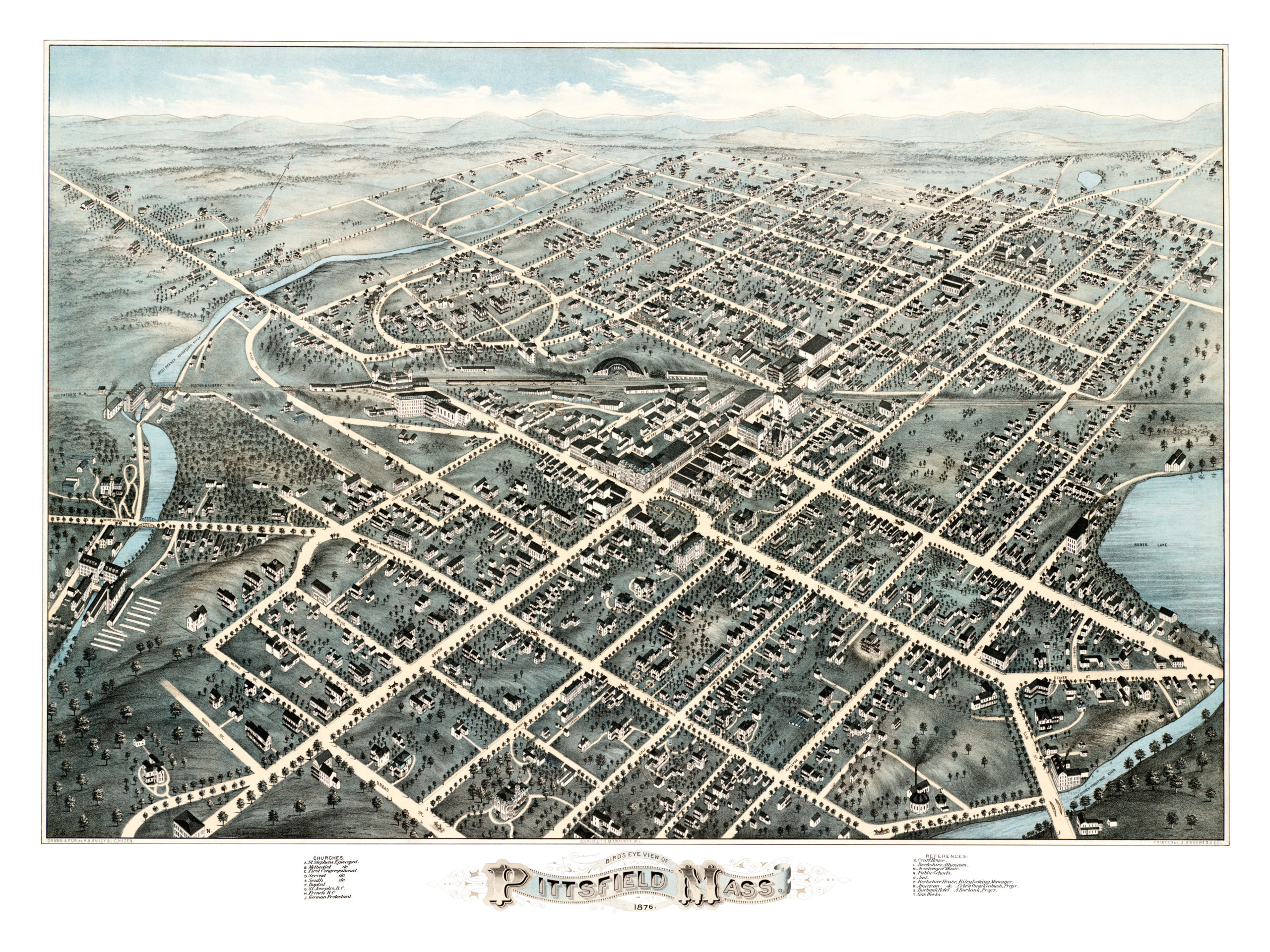
The bird's-eye view
By H.H. Bailey and J.C. Hazen
Pittsfield drawn as if from the sky in 1876, with the Berkshire Atheneum, the Academy of Music, the Burbank Hotel, the Berkshire House and Silver Lake.5
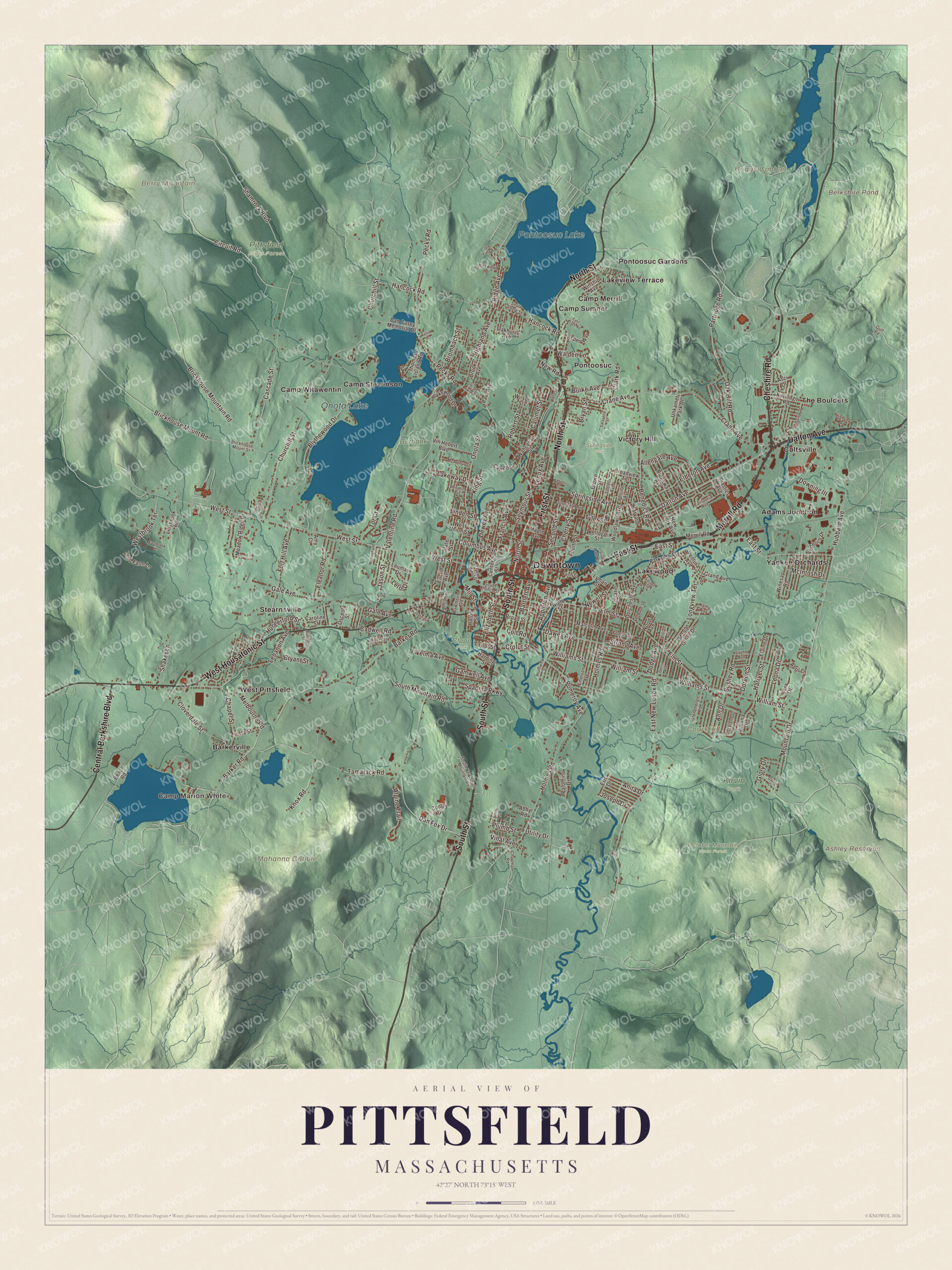
Pittsfield today
By KNOWOL
The valley where the east and west branches of the Housatonic meet, shaded from elevation data, with South Street, East Street, Dalton Avenue and North Street, Onota and Pontoosuc lakes, Berry Mountain and Court Hill.6
The history of Pittsfield, Massachusetts
The elm on the common
When Pittsfield placed its new meeting house in 1790, the plan meant felling a tall elm the first settlers had spared. The axe had already struck when Mrs. Williams, whose husband John Chandler Williams owned the house beside the square, threw herself between the tree and the axe. He then offered the town land for a common, the ground of today's park. In 1807 Elkanah Watson showed two Merino sheep under that elm, and the crowd they drew is said to have started the county's cattle shows. In 1857 the town sent Boston word that the Old Elm of Pittsfield Park sent greetings to the Old Elm of Boston Common. When the tree finally came down in the 1860s, the scars of three axe strokes from 1790 were found inside it.7289
Wool, from one carding machine to Pontoosuc
Pittsfield's wool business started small. Jacob Ensign, who built the town's first fulling mill, owned the shore of what settlers called Ensign's Pond; it's Silver Lake now. In 1801 Arthur Scholfield, an English machinist who'd had to leave his tools behind, advertised a carding machine half a mile west of the meeting house, and an 1885 magazine called it the first built in the United States. The Pontoosuc woolen factory went up on the outlet of a lake then called Shoonkeekmoonkeek, and the lake took the factory's name. Its manager Thaddeus Clapp made a score of trips to California to buy wool, shipped around the Horn. Out at Taconic, Pomeroy's factory made two thousand stand of arms a year.101112131415
Holmes, Melville and the summer hills
Pittsfield's hills drew writers. Oliver Wendell Holmes came by way of his mother's family, the Wendells, since Jacob Wendell had bought the land known as Pontoosuck in 1738. Holmes built a country house on a rise about two miles east of the town, on land that had been part of his ancestor's estate, and spent seven summers there, writing, it's said, a large part of The Autocrat of the Breakfast Table. Herman Melville bought the 160-acre farm called Arrowhead in 1850 and spent twelve years farming and writing there, Moby-Dick among the books. Holmes later wrote to a friend that he could never pay his debt to Pittsfield for giving his children their mother, and himself seven blessed seasons.161617
Pittsfield, Massachusetts through the years
25 moments from 1738 to today.
- 1738Colonel Jacob Wendell of Boston buys 24,000 acres here, land known as Pontoosuck.1
- 1752Solomon Deming moves to Pontoosuc from Wethersfield, Connecticut, and builds his house in the eastern part of the town.18
- 1753The settlement is incorporated as Pontoosuck Plantation.1
- 1761Pittsfield is incorporated as a town and named for William Pitt.1
- 1762Joseph Keeler builds a saw and grist mill at the outlet of Pontoosuc Lake.19
- 1778Ebenezer White takes over the town's mill privilege on a lease for 999 years.19
- 1790Mrs. Williams throws herself between the great elm and the axe, and her husband gives the town land for a common.7
- 1791A town bylaw bans playing baseball within 80 yards of the new meeting house.1
- 1801Arthur Scholfield advertises his wool carding machine in the Pittsfield Sun.11
- 1807Elkanah Watson shows a pair of Merino sheep under the great elm on the public square.2
- 1810Samuel H. Wheeler of Lanesborough and 26 other farmers invite the county to a stock show in the village on October 1.2
- 1811Sixty yoke of oxen pull a plough in the Berkshire Agricultural Society's procession, before a crowd of three or four thousand.20
- 1825Lafayette is received in the old town hall and speaks to the people from an upper window.21
- 1826The Shakers build their round stone barn, 270 feet around, at the Shaker village that reaches into Pittsfield from Hancock.22
- 1832The Old Town Hall is built on Park Square.23
- 1846Pittsfield's Black residents form the Second Congregational Church and build a meeting house.24
- 1848About this year Allen B. Wilson, short of money, stops in Pittsfield and builds his first sewing machine in his evenings.25
- 1850Herman Melville buys the 160-acre farm called Arrowhead.6
- 1859Amherst beats Williams 73 to 32 in Pittsfield in the first intercollegiate baseball game.1
- 1861Pittsfield's Allen Guard is the first company from western Massachusetts to answer the first call for troops.26
- 1876H.H. Bailey and J.C. Hazen publish their bird's-eye view of Pittsfield.5
- 1891Electric trolleys start running from Park Square to Pontoosuc Lake, and 3,700 people ride the first Sunday.27
- 1903The Colonial Theatre opens at 111 South Street.6
- 1911Pittsfield celebrates the 150th anniversary of its incorporation with three days of events starting July 2.28
- 1919Wahconah Park is built, with its diamond facing west.29
Places to see in Pittsfield, Massachusetts
Places worth a visit in Pittsfield today.
- Arrowhead780 Holmes Road. Melville's farmhouse, where he wrote Moby-Dick.Visit their website
- Berkshire AthenaeumOne Wendell Avenue. Public library with Melville collections.Visit their website
- Colonial Theatre111 South Street. Opened 1903, restored and reopened 2006.Visit their website
- Wahconah ParkWahconah Street. Ballpark of 1919, diamond facing west.
- Canoe Meadows Wildlife SanctuaryAlong the Housatonic. Mass Audubon meadows on the river.Visit their website
- Onota LakeWest side of the city. Feeds the west branch of the Housatonic.
- Pontoosuc LakeNorth end, into Lanesborough. Swimming, boating and fishing.
- Pittsfield State ForestWestern edge of the city. 11,000 acres, more than 30 miles of trails.Visit their website
- Berry MountainIn Pittsfield State Forest. East slopes in Pittsfield, summits in Hancock.
- Hancock Shaker VillageU.S. Route 20, on the Hancock line. Shaker village museum with round barn.Visit their website
Pittsfield on the National Register of Historic Places
All 24 places in Pittsfield on the National Register of Historic Places that still stand today, oldest first, and why each one matters.4
-
Herman Melville House
National Historic Landmark
Arrowhead was built in the 1780s by Captain David Bush as a farmhouse and inn. Herman Melville bought it in 1850 and wrote Moby-Dick here, and the Berkshire County Historical Society has kept it as a house museum since 1975.17
-
Hancock Shaker Village
National Historic Landmark
A Shaker community in Hancock and Pittsfield, organized in 1790 and active until 1960, and now an open-air museum. Its round stone barn of 1826 is one of the few surviving round barns in the state.30
-
Old Town Hall
This 1832 building served for 135 years as the center of municipal government. Built in the Federal style to serve as the town hall, it became City Hall when Pittsfield became a city in 1891, serving in that role until 1968.23
-
Morewood School
Built in 1843, it was converted to a vacation cottage in the 1980s after serving for 130 years as a schoolhouse. It was listed on the National Register of Historic Places in 1984.31
-
Samuel Harrison House
Built about 1850, it was for many years home to Rev. Samuel Harrison, a regionally-prominent African-American minister (1818 to 1900) who served as chaplain to the 54th Massachusetts Infantry Regiment during the American Civil War. It was listed on the National Register of Historic Places in 2006.32
-
Pittsfield Cemetery
A rural cemetery of winding lanes laid out in 1850, when the old burying ground at North and East Streets was full. Thomas Allen Jr. gave its memorial arch and main gate in 1885, and the Olmsted Brothers planned its later sections.33
-
Berkshire Life Insurance Company Building
It is located in the heart of downtown Pittsfield, facing Park Square across North Street. Built in 1868, it is one of a trio of Second Empire buildings designed by Louis Weissbein, a Boston architect, whose style influenced later construction in the city.34
-
A.H. Rice Silk Mill
Built in 1876 to house a woolen mill, this multi-section brick building was purchased in 1887 by William Bainbridge Rice, who established his silk-processing operation here. The premises were expanded in 1895 after Rice acquired a New Jersey silkworks and moved its equipment here.35
-
Eaton, Crane & Pike Company Factory
The oldest part, with its clock tower, was built in 1883 by the Terry Clock Company. The company later known as Eaton, Crane & Pike made stationery here until the plant closed in 1987, and it now holds homes and light industry.36
-
William Russell Allen House
Built in 1886, it was the first local design of H. Neill Wilson, and is an important example of Shingle style architecture in Berkshire. It is also a rare surviving reminder of East Street's residential past.37
-
Wollison, Shipton Building
Designed by architect H. Neil Wilson, it was built in 1888 when the area north of Park Square developed as a commercial and retail part of downtown Pittsfield.38
-
Old Central Fire Station
Built in 1895, it is the city's oldest surviving fire station, and a prominent local example of Romanesque architecture. The station was listed on the National Register of Historic Places in 1977, and was included in an expansion of Pittsfield's Park Square Historic District in 1991.39
-
Pilgrim Memorial Church and Parish House
The church was designed by H. Neill Wilson, and was completed in 1897. It is a good local example of Gothic and Romanesque architecture, and was the first church built to serve the mill workers in the city's north end.40
-
Old Central High School
Built in 1898 as Pittsfield High School after the old high school burned, from a design chosen out of 130 entries. It became a junior high in 1931 and the first home of Berkshire Community College in 1961, and now holds homes.41
-
Springside Park
The city's largest park, 237.5 acres on the north side, begun with land that former mayor Kelton Miller and his wife Eva gave the city in 1910.42
-
Charles Whittlesey Power House
Built about 1912, this Tudor Revival house and its landscaped setting are a rare local example of the country house style propounded by the English architect Edwin Lutyens. The house was built for Charles Whittlesey Power, a local businessman who also served one term as mayor of Pittsfield.43
-
Allen Hotel
Built in 1915 and first operated as the Park Hotel, it is a significant local example of Renaissance Revival architecture, designed by the prominent local architect Joseph McArthur Vance. It was individually listed on the National Register of Historic Places in 1975, and included in an expansion of Pittsfield's Park Square Historic District in 1991.44
-
Frank Howard Building
This 1916 Classical Revival commercial building was designed by Joseph McArthur Vance, a prominent local architect, and is the best preserved of his works.45
-
South Mountain Concert Hall
Elizabeth Sprague Coolidge built this timber-frame hall on her estate in 1918 for chamber music, using timbers from an old textile mill and pews from a church. Works by Bartók, Stravinsky, Ravel and Schoenberg had world premiere performances here.46
-
Wahconah Park
A city ballpark built in 1919 with its diamond facing due west, so some umpires have paused games at sunset to keep the sun out of the batters' eyes. In July 2025 the Parks Commission voted to take down its 1950 wooden grandstand and rebuild it.29
-
Providence Court
The Colonial Revival building was constructed in 1926, and was the first Roman Catholic hospital in Berkshire County. St. Luke's merged with Pittsfield General Hospital in 1967 to form Berkshire Medical Center, in the nation's first mergers between religious and non-sectarian hospitals.47
-
Park Square Historic District
The heart of Pittsfield around Park Square, where North, South, East and West Streets meet. It takes in the Old Town Hall, the county courthouse, the Berkshire Athenaeum and the First Church, and since 1991, 39 more downtown buildings.48
-
Upper North Street Commercial District
Representing an expansion of Pittsfield's historic downtown area northward from Park Square in the late 19th century, the district encompasses primarily commercial buildings fronting on North Street between Columbus and Madison Avenues on the west side, and between Eagle and Maplewood Avenues on the east side.49
-
White Terrace Apartments
Apartment buildings at 592 to 596 North Street and 2 to 8 White Terrace, added to the National Register on August 24, 2026.4
Pittsfield in their words
“I can never pay my debt to Pittsfield for giving my children their mother, and myself seven blessed seasons, and seventy times seven granaries full of hoarded reminiscences.”
Oliver Wendell Holmes, in a letter quoted in In olde Massachusetts, 190716
“Pittsfield people think well of Pittsfield, not with loud boasting, at least, in the typical Pittsfield man, but with an air of satisfaction which recalls the princes in 'Cymbeline'.”
Dr. Smart, speaking at the First Church during the city's 150th anniversary in 1911 (The history of Pittsfield, 1916)28
“At a great distance below us Pittsfield appeared beautiful in this plain and the whole afforded a rich scene”
William Loughton Smith of South Carolina, coming over the hills from Washington on his 1790 journey (Massachusetts Historical Society Proceedings, 1917)50
Towns near Pittsfield, Massachusetts
Sources for the history of Pittsfield
- Pittsfield, Massachusetts, Wikipedia
- History of western Massachusetts (1855), on Elkanah Watson's merinos and the first cattle show, Internet Archive
- Massachusetts of today: a memorial of the state (1892), on Pittsfield, Internet Archive
- National Register of Historic Places listings in Berkshire County, Massachusetts, Wikipedia
- Beautifully restored old map of Pittsfield, MA from 1876, restored by KNOWOL
- Map of Pittsfield, Massachusetts in 2026, KNOWOL (USGS elevation, Census Bureau roads)
- The history of Pittsfield (Berkshire County), Massachusetts, 1734 to 1800 (1869), on the salvation of the Elm, Internet Archive
- Memorial of the inauguration of the statue of Franklin (1857), on Pittsfield's message, Internet Archive
- Historic homes and institutions and genealogical and personal memoirs of Berkshire County, Massachusetts (1906), on the Old Elm, Internet Archive
- The history of Pittsfield (Berkshire County), Massachusetts, 1734 to 1800 (1869), on Silver Lake, Internet Archive
- The Bay State Monthly, May 1885, on Arthur Scholfield's carding machine, Internet Archive
- Western Massachusetts; a history, 1636-1925 (1926), on the Pittsfield Factory, Internet Archive
- The history of Pittsfield (Berkshire County), Massachusetts (1869), on the Pontoosuc factory, Internet Archive
- Historic homes and institutions and genealogical and personal memoirs of Berkshire County, Massachusetts (1906), on Thaddeus Clapp, Internet Archive
- Western Massachusetts : a history, 1636-1925 (1926), on early mills and the Taconic musket factory, Internet Archive
- In olde Massachusetts: sketches of old times and places (1907), on Oliver Wendell Holmes in Pittsfield, Internet Archive
- Herman Melville House, Wikipedia
- History of western Massachusetts (1855), on the first settlement of Pontoosuc, Internet Archive
- The history of Pittsfield (Berkshire County), Massachusetts, 1734 to 1800 (1869), on the early mills, Internet Archive
- History of western Massachusetts (1855), on the Berkshire Agricultural Society's first year, Internet Archive
- Pittsfield, Massachusetts, 1761-1911; 150th anniversary celebration: official program and souvenir (1911), Internet Archive
- A history of the county of Berkshire, Massachusetts, in two parts (1829), on the Shaker village, Internet Archive
- Old Town Hall, Wikipedia
- History of western Massachusetts (1855), on the Second Congregational Church of Pittsfield, Internet Archive
- From the Hub to the Hudson (1870), on Allen B. Wilson's sewing machine, Internet Archive
- The Tenth regiment, Massachusetts volunteer infantry, 1861-1864 (1909), on the Allen Guard and Pollock Guard, Internet Archive
- The history of Pittsfield, Massachusetts, from the year 1876 to the year 1916 (1916), on the first trolleys, Internet Archive
- The history of Pittsfield, Massachusetts, from the year 1876 to the year 1916 (1916), on the 1911 anniversary, Internet Archive
- Wahconah Park, Wikipedia
- Hancock Shaker Village, Wikipedia
- Morewood School, Wikipedia
- Samuel Harrison House, Wikipedia
- Pittsfield Cemetery, Wikipedia
- Berkshire Life Insurance Company Building, Wikipedia
- A.H. Rice Silk Mill, Wikipedia
- Eaton, Crane & Pike Company Factory, Wikipedia
- William Russell Allen House, Wikipedia
- Wollison, Shipton Building, Wikipedia
- Old Central Fire Station, Wikipedia
- Pilgrim Memorial Church and Parish House, Wikipedia
- Old Central High School, Wikipedia
- Springside Park, Wikipedia
- Charles Whittlesey Power House, Wikipedia
- Allen Hotel, Wikipedia
- Frank Howard Building, Wikipedia
- South Mountain Concert Hall, Wikipedia
- Providence Court, Wikipedia
- Park Square Historic District, Wikipedia
- Upper North Street Commercial District, Wikipedia
- Massachusetts Historical Society, Proceedings 1917-1918, vol. 51 (1917), Journal of William Loughton Smith, 1790-1791, Internet Archive