
A farming and shore town on Mount Hope Bay, founded in 1667 by John Myles's Baptist church from Swansea in Wales, where Mason Barney built 149 vessels at Barneyville and Gardner's Neck turned from old farms to summer cottages.
Swansea, Massachusetts on the map
Click the map to look closer.
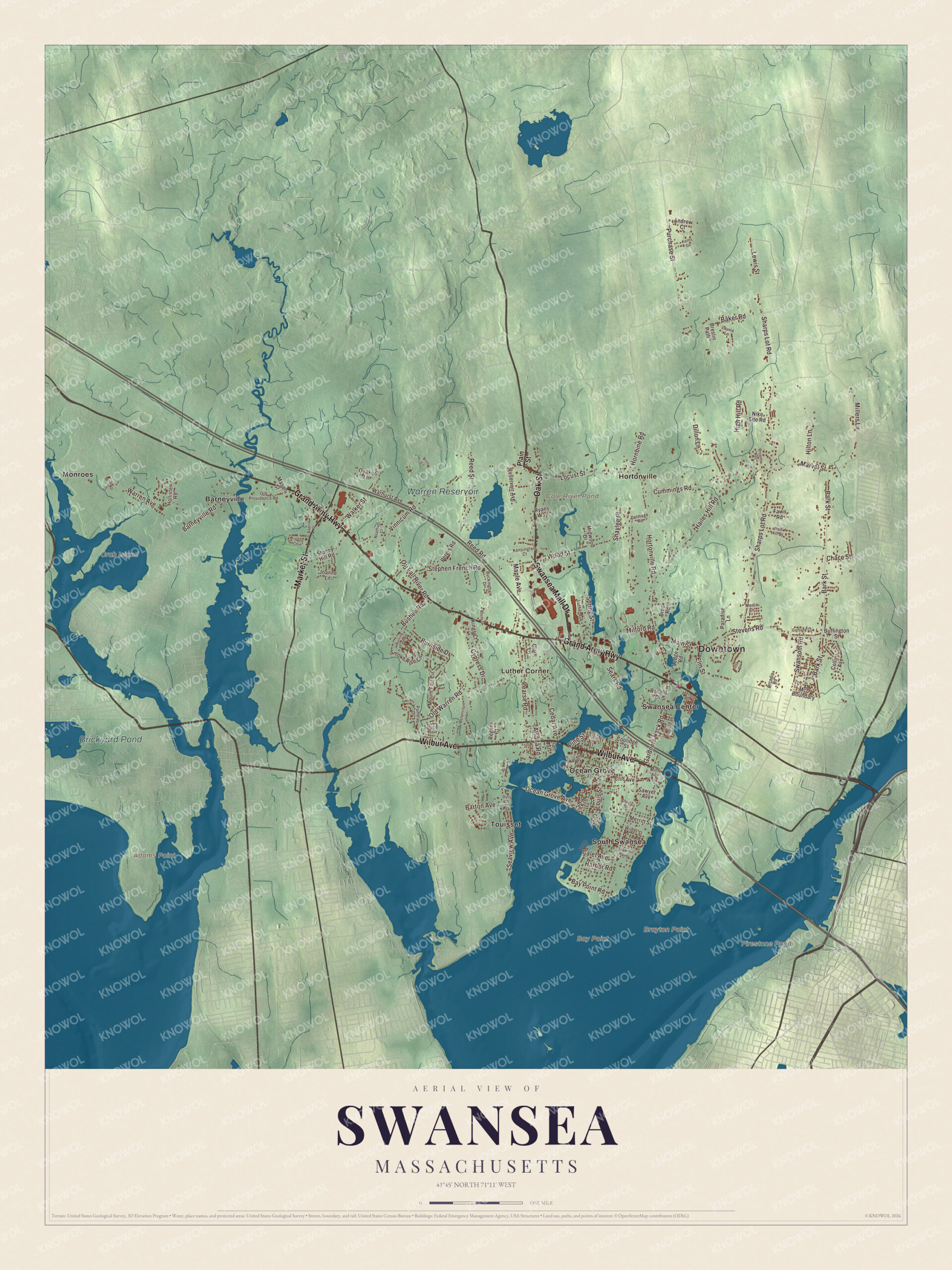
Swansea today
By KNOWOL
The whole town as it looks today, from Barneyville and Hortonville down to Ocean Grove, South Swansea and Bay Point on the shore, with Grand Army Highway, Market Street, Cole River Pond, Brickyard Pond and Crab Island.5
The history of Swansea, Massachusetts
The stone house on Gardner's Neck
The neck between the Lee's and Cole's rivers was called Mattapoisett. In March 1623 Edward Winslow and John Hampden stopped there with the sachem Corbitant. Philip conveyed the neck to William Brenton of Newport in 1664, and Jared Bourne farmed it from a stone house. When King Philip's War began in June 1675, about seventy people, most of them women and children, sheltered there. Six men going to a barn for corn were killed or mortally wounded, and the town's 1917 history says the war's first blood was shed on that neck. Soldiers took everyone down Mount Hope Bay to Rhode Island. Samuel Gardner and Ralph Chapman bought the neck in 1693. Neighbors long remembered that the stone house had nine outside double doors, so a horse could drag a back log in one door and walk out the other.6789
Barney's shipyard and the button shop
Barneyville grew up where the road crossed the Palmer River at Miles' Bridge. In 1749, unable to afford a new bridge, the town was allowed to run a lottery to rebuild it. Jonathan Barney built small vessels on the river, and in 1802 his son Mason, not yet twenty and not able to use the tools himself, signed a contract to build a ship. In half a century Mason Barney built 149 vessels, from fishing smacks to a ship of 1,060 tons, sometimes employing 250 men. The panic of 1857 left him with two big ships and no buyers, and the yard closed. In 1879 Daniel R. Child opened a small shop on the old shipyard lot making collar buttons and sleeve links, and by the 1920s, as the North Swansea Manufacturing Company, it employed fifty to sixty hands.1011312
A town built on tolerance
Swansea began as a refuge. John Myles led a Baptist church in Swansea, Wales, until the law of 1662 pushed dissenting ministers out of their pulpits. He came to Rehoboth and in 1663 gathered the first Baptist church in Massachusetts. The colony's court fined its leaders and told them to move, so they settled at Wannamoisett, and in 1667 the new town took the name of Myles's old home. Capt. Thomas Willett, later mayor of New York, was its other founder, and the town took in Baptists and others alike. In 1717, when some asked for a tax to pay a Puritan minister, town meeting voted that people should keep their liberty of conscience. The church Myles founded later settled in North Swansea, where its Greek Revival chapel of 1848 stands on Baptist Street.131142
Swansea, Massachusetts through the years
25 moments from 1623 to today.
- 1623Edward Winslow and John Hampden visit the sachem Corbitant on Mattapoisett, today's Gardner's Neck.6
- 1663John Myles gathers the first Baptist church in Massachusetts, at Rehoboth.2
- 1664Philip conveys the Mattapoisett lands to William Brenton of Newport.6
- 1667Swansea is incorporated as a town and named for Swansea in Wales.1
- 1669Hugh Cole buys 500 acres on Touisset Neck from Philip, beside the river that takes his name.15
- 1673The town votes to set up a school teaching Latin, Greek and Hebrew, with Pastor Myles as schoolmaster.16
- 1675King Philip's War begins at Swansea on June 20, and within days much of the town is burned.1
- 1681Town meeting unanimously throws out a plan to make the highest land rank hereditary.1
- 1690The Benjamin Cole House goes up on Old Warren Road, the oldest documented building in Swansea.17
- 1693Samuel Gardner and Ralph Chapman buy the Mattapoisett neck, later called Gardner's Neck.8
- 1717Barrington is set off from Swansea, and the town votes that its people should keep liberty of conscience.114
- 1718Every householder is told to kill six blackbirds or squirrels a year, or pay a fine.18
- 1749The province lets Swansea run a lottery to rebuild Miles' Bridge over the Palmer River.11
- 1790Shawomet is set off as the town of Somerset.13
- 1800Swansea's first post office opens on July 1 at Reuben Chace's house, The Buttonwood.19
- 1802Mason Barney, not yet twenty, contracts to build his first ship at Barneyville.3
- 1806Oliver Chace builds the Swansea Factory, a cotton mill, at what becomes Hortonville.2021
- 1815John Brown Luther builds his brick store at Luther's Corner.22
- 1833The Church of Christ's Greek Revival meetinghouse is finished on today's Route 6.23
- 1857The financial panic leaves Mason Barney with two unsold ships, and shipbuilding in Swansea ends.3
- 1879Daniel R. Child opens a collar button shop on the old Barneyville shipyard lot.12
- 1891The stone Town Hall, the gift of Frank S. Stevens, is dedicated on September 9.24
- 1896The Swansea Free Public Library opens on September 26.25
- 1916The South Swansea chapel on Gardner's Neck is dedicated on September 10.26
- 1985Swansea lets Mark Hoyle, a student with AIDS, attend public school, a first in the country.1
Places to see in Swansea, Massachusetts
Places worth a visit in Swansea today.
- BarneyvilleNorthwest, on the Palmer River. Mason Barney's old shipbuilding village.
- HortonvilleNorthern Swansea. Once called Swansea Factory.
- Luther CornerWestern Swansea. Old stagecoach stop and business center.
- South SwanseaGardner's Neck. Old Mattapoisett, later a summer resort.
- Bay PointGardner's Neck. Shore at the end of the neck.
- Ocean GroveNear the Somerset line. A densely settled neighborhood.
- Grand Army HighwayU.S. Route 6. Passes the church of 1833.
- Market StreetAn old county road. Short's Tavern and the Luther House.
- Hortonville RoadNorth toward Rehoboth. Old road from Gardner's Neck to Rehoboth.
- Swansea Mall DriveRoutes 6 and 118. Site of the former Swansea Mall.
Swansea on the National Register of Historic Places
All 28 places in Swansea on the National Register of Historic Places that still stand today, oldest first, and why each one matters.4
-
Benjamin Cole House
Built in 1690, it is the oldest documented building in Swansea. Benjamin Cole was a grandson of James Cole, for whom Cole's Hill in Plymouth is named, and the farm was worked for many years by the Wilbur family.17
-
Martin House and Farm
John Martin built the oldest part in 1728, and the gambrel roof was added about 1814. His descendants farmed here until 1934, when it was left to the National Society of the Colonial Dames of America, who run it as a house museum.27
-
Hortonville Historic District
Settled in the 1700s by the Hale, Martin and Eddy families, the village was called Swansea Factory for the mills on the Cole River, then Hortonville for Nathaniel Horton, who helped it get a post office. Its oldest house, at 397 Locust Street, dates to 1736, and the old Hortonville School is Greek Revival of about 1838.21
-
Bend of the Lane
Also called the Harlow Luther House, its main block of about 1740 is a well-preserved example of plain Georgian building, with ells added about 1850 and 1930. Its owners included its builder, Harlow Luther, and Victor Gardner, of the family that settled Gardner's Neck.28
-
Luther House
A gambrel-roofed house built about 1740, probably by Hezekiah Luther, son of the first John Luther to settle here. Luthers owned it until the mid-1900s.29
-
Short's Tavern
Built about 1742 as a farmhouse, it was bought in 1851 by James Short, who ran a tavern here on what was then a major county road.30
-
Barneyville Historic District
Jonathan Barney started a shipyard on the Palmer River in the 1770s, and it did best under his son Mason until demand for metal hulls ended it in the late 1850s; a jewelry factory then ran on the yard until the 1920s. The district holds Jonathan Barney's house of about 1750, Mason Barney's Federal house and the site of the Rev. John Myles's house.10
-
John Brown IV House
A gambrel-roofed farmhouse built about 1752 for the Browns, prominent local farmers and landowners. The entry porch and the window above it were added in the early 1900s.31
-
Simcock House
A vernacular Georgian house of about 1765, unusual for its three unevenly spaced bays around a large central chimney. Little is known of its history before the 1800s.32
-
Samuel Gardner House
Built about 1768 by a Samuel Gardner of the family that settled Gardner's Neck and gave it their name. It is a well-preserved gambrel-roofed farmhouse of the 1700s.33
-
Norton House
A Georgian house of about 1779 with a Federal fan over the door, one of the older well-kept houses in northern Swansea. In the early 1900s it belonged to Benjamin Norton, part owner of the jewelry works in Barneyville.34
-
Swansea Village Historic District
The town's municipal center since the late 1700s, on land the Eddy family owned until about 1720; their family graveyard is in the district. A meetinghouse, library and town hall grew up around the junction of Main, Elm and Stephens.35
-
Deacon John Buffington House
A plain Georgian house, probably built about 1790. Its first known owner was John Buffington, of a locally prominent family.36
-
Hooper House
A gambrel-roofed farmhouse of about 1790 on what was once a main road from Gardner's Neck to Rehoboth. The property keeps an 1890 barn, a stone wellhouse and an early two-car garage of the 1920s.37
-
Joseph Gardner House
A Cape built about 1795 by Joseph Gardner, grandson of Samuel Gardner, one of the early owners of the neck. About 1877 it was enlarged for summer use as Gardner's Neck became a resort.38
-
Luther's Corner
Swansea's business center in the first half of the 1800s, a stagecoach stop on Old Warren Road between Fall River and Providence. The Luther Store, the James Luther Tavern of about 1800 and the John Brown Luther House stand here; the green with its bandstand was taken out in 1901 for a streetcar line.39
-
Smuggler's House
A Cape farmhouse of about 1800, little changed since. The story goes that it was used to store smuggled goods during the War of 1812.40
-
Walkden Farm
A well-preserved Federal farmhouse of about 1800, five bays wide around a large central chimney, with a barn of about 1885.41
-
Luther Store
John Brown Luther built this brick store in 1815, and his family ran it until 1903; it also held the post office and library. It keeps its mahogany counters and the owner's desk, and the Swansea Historical Society has run it as a museum since 1941.22
-
Church of Christ, Swansea
The congregation's first recorded services were held in 1680 and it organized in 1693. This Greek Revival church went up in 1830 to 1833, after the roof blew off the first meetinghouse, and the church is known for never having had a legal tie to the town or its taxes.23
-
First Baptist Church and Society
The church John Myles brought from Swansea, Wales, gathered at Rehoboth in 1663 as the first Baptist church in Massachusetts. Its Greek Revival chapel of 1848 is the congregation's fifth building, and the cemetery beside it dates to 1731.2
-
William P. Mason House
Built about 1860, it served Barneyville at different times as a hotel, tavern and post office, until about 1930.42
-
Colony Historic District
Seven Shingle and Colonial Revival summer cottages, built mostly between 1896 and 1930, most of them along Mattapoisett Road. They show how Swansea's shore became a summer resort around 1900.43
-
Francis L. Gardner House
Fall River architect Edward I. Marvell designed this Colonial Revival house in 1903 for Francis L. Gardner, a selectman for many years. His family's market garden sold fresh produce to the passenger ships at Fall River.44
-
Bark Street School
Built in 1905 to replace a one-room schoolhouse, with two classrooms added about 1930, it is the town's last wood-frame school building. It now serves as an annex to Town Hall.45
-
J. V. Johnson House
A Craftsman bungalow built in 1913 by local contractor Albert Leeming, unusual in town for its stone walls, tile roof and terra cotta panels. Its first owner owned a local soda maker, the Cliquot Club Soda Company.46
-
South Swansea Union Church
Swansea's best Shingle-style church, finished in September 1916 for a congregation that began as a Sunday school in 1910 as Gardner's Neck filled with new houses. It is now the South Swansea Baptist Church.47
-
Harold H. Anthony House
Designed by R. Clipston Sturgis and built in 1922 for Harold Anthony, it was rare in Swansea as a brick house by a major architect, and it started the turn of Gardner's Neck summer houses into year-round homes. The house was gutted and its outside much changed after 2021.48
Swansea in their words
“This diversity of opinion resulted in a town where a larger measure of religious liberty was enjoyed than anywhere else in the colony.”
John S. Brayton, address at the Town Hall dedication of 1891, in the History of Swansea, 191749
“The sails of the good substantial vessels, which in the course of a half a century he built, whitened almost every sea.”
John S. Brayton on Mason Barney, in the History of Swansea, 19173
“Swansea is a most attractive town, and Gardner's Neck very lovely with old farms and new summer cottages.”
Old paths and legends of New England, 190350
Towns near Swansea, Massachusetts
Sources for the history of Swansea
- Swansea, Massachusetts, Wikipedia
- First Baptist Church and Society, Wikipedia
- History of Swansea, Massachusetts, 1667-1917 (1917), on Mason Barney's shipyard, Internet Archive
- National Register of Historic Places listings in Bristol County, Massachusetts, Wikipedia
- Map of Swansea, Massachusetts in 2026, KNOWOL
- A history of Bristol County, Massachusetts (Vol. 2) (1924), on Corbitant and the Mattapoisett lands, Internet Archive
- History of Swansea, Massachusetts, 1667-1917 (1917), on the opening of King Philip's War, Internet Archive
- History of Swansea, Massachusetts, 1667-1917 (1917), on Samuel Gardner's purchase of the neck, Internet Archive
- History of Swansea, Massachusetts, 1667-1917 (1917), Job Gardner on the Bourne garrison house, Internet Archive
- Barneyville Historic District, Wikipedia
- History of Swansea, Massachusetts, 1667-1917 (1917), on Miles' Bridge and its lottery, Internet Archive
- A history of Bristol County, Massachusetts (Vol. 2) (1924), on the North Swansea Manufacturing Company, Internet Archive
- History of Swansea, Massachusetts, 1667-1917 (1917), John S. Brayton's historical address, Internet Archive
- History of Swansea, Massachusetts, 1667-1917 (1917), on the town vote of 1717, Internet Archive
- History of Swansea, Massachusetts, 1667-1917 (1917), on Hugh Cole, Internet Archive
- History of Swansea, Massachusetts, 1667-1917 (1917), on the pioneer schools, Internet Archive
- Benjamin Cole House, Wikipedia
- History of Swansea, Massachusetts, 1667-1917 (1917), on the town votes of 1718 and 1749, Internet Archive
- A history of Bristol County, Massachusetts (Vol. 2) (1924), on Swansea's post offices, Internet Archive
- A history of Bristol County, Massachusetts (Vol. 2) (1924), on the Swansea Factory, Internet Archive
- Hortonville Historic District, Wikipedia
- Luther Store, Wikipedia
- Church of Christ, Swansea, Wikipedia
- A history of Bristol County, Massachusetts (Vol. 2) (1924), on the Town Hall, Internet Archive
- History of Swansea, Massachusetts, 1667-1917 (1917), on the Swansea Free Public Library, Internet Archive
- History of Swansea, Massachusetts, 1667-1917 (1917), on the South Swansea chapel, Internet Archive
- Martin House and Farm, Wikipedia
- Bend of the Lane, Wikipedia
- Luther House, Wikipedia
- Short's Tavern, Wikipedia
- John Brown IV House, Wikipedia
- Simcock House, Wikipedia
- Samuel Gardner House, Wikipedia
- Norton House, Wikipedia
- Swansea Village Historic District, Wikipedia
- Deacon John Buffington House, Wikipedia
- Hooper House, Wikipedia
- Joseph Gardner House, Wikipedia
- Luther's Corner, Wikipedia
- Smuggler's House, Wikipedia
- Walkden Farm, Wikipedia
- William P. Mason House, Wikipedia
- Colony Historic District, Wikipedia
- Francis L. Gardner House, Wikipedia
- Bark Street School, Wikipedia
- J. V. Johnson House, Wikipedia
- South Swansea Union Church, Wikipedia
- Harold H. Anthony House, Wikipedia
- History of Swansea, Massachusetts, 1667-1917 (1917), on religious liberty in the early town, Internet Archive
- Old paths and legends of New England (1903), on Swansea and Gardner's Neck, Internet Archive