
A hill town on the New Hampshire line, granted as Ipswich Canada, where pine became shingles and turned pails along Miller's River and Morton Converse's toy shops made Winchendon Toy Town.
Winchendon then and now
The same town 148 years apart. Click either map to look closer.
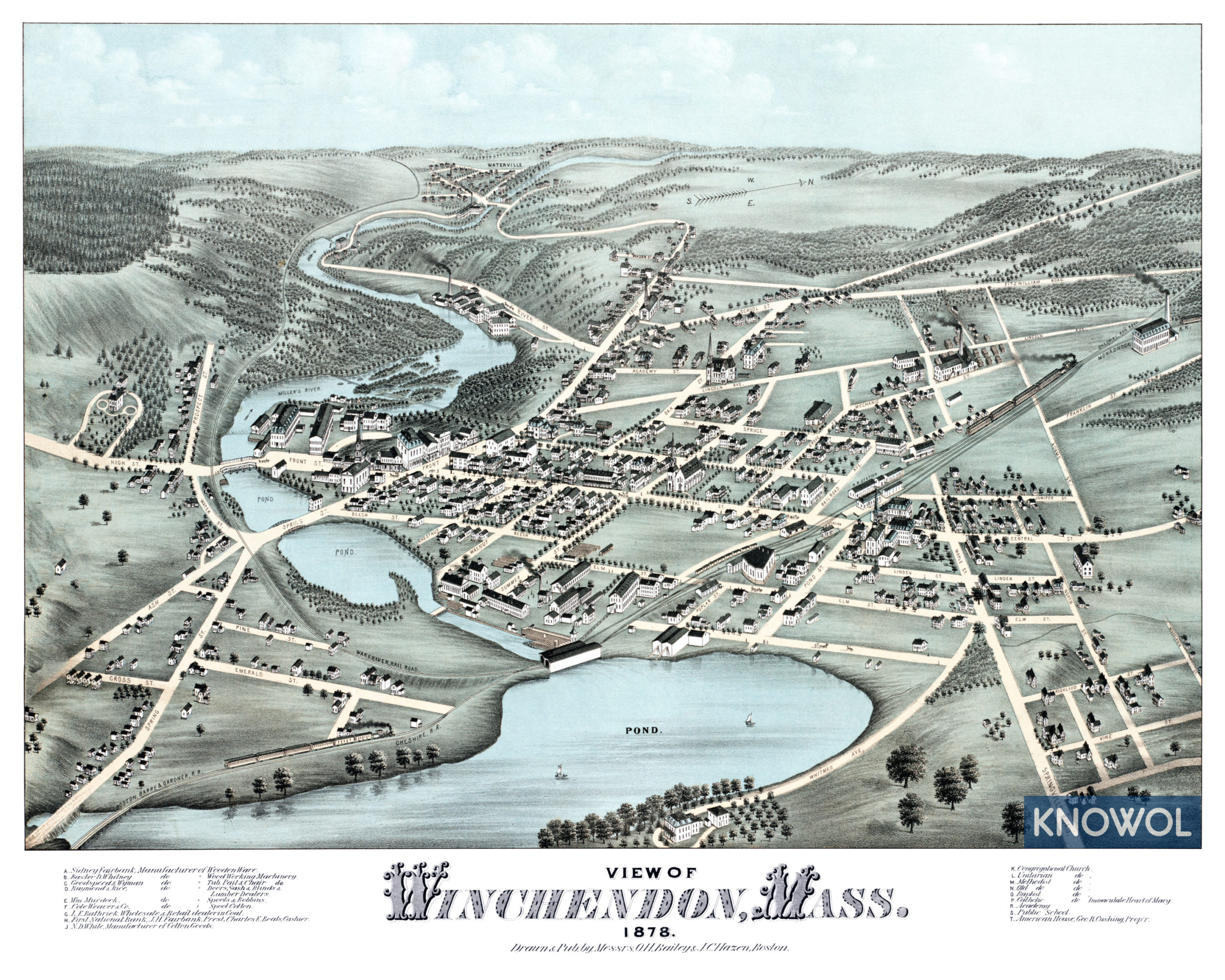
Winchendon in 1878
By O.H. Bailey and J.C. Hazen
A bird's-eye view of the town in 1878, with Whitney's Wood Working Machinery, Fairbank's Wooden Ware, Murdock Spools and Bobbins, White Cotton Goods, Raymond and Rice Lumber, the Cheshire Railroad and Miller's River.5
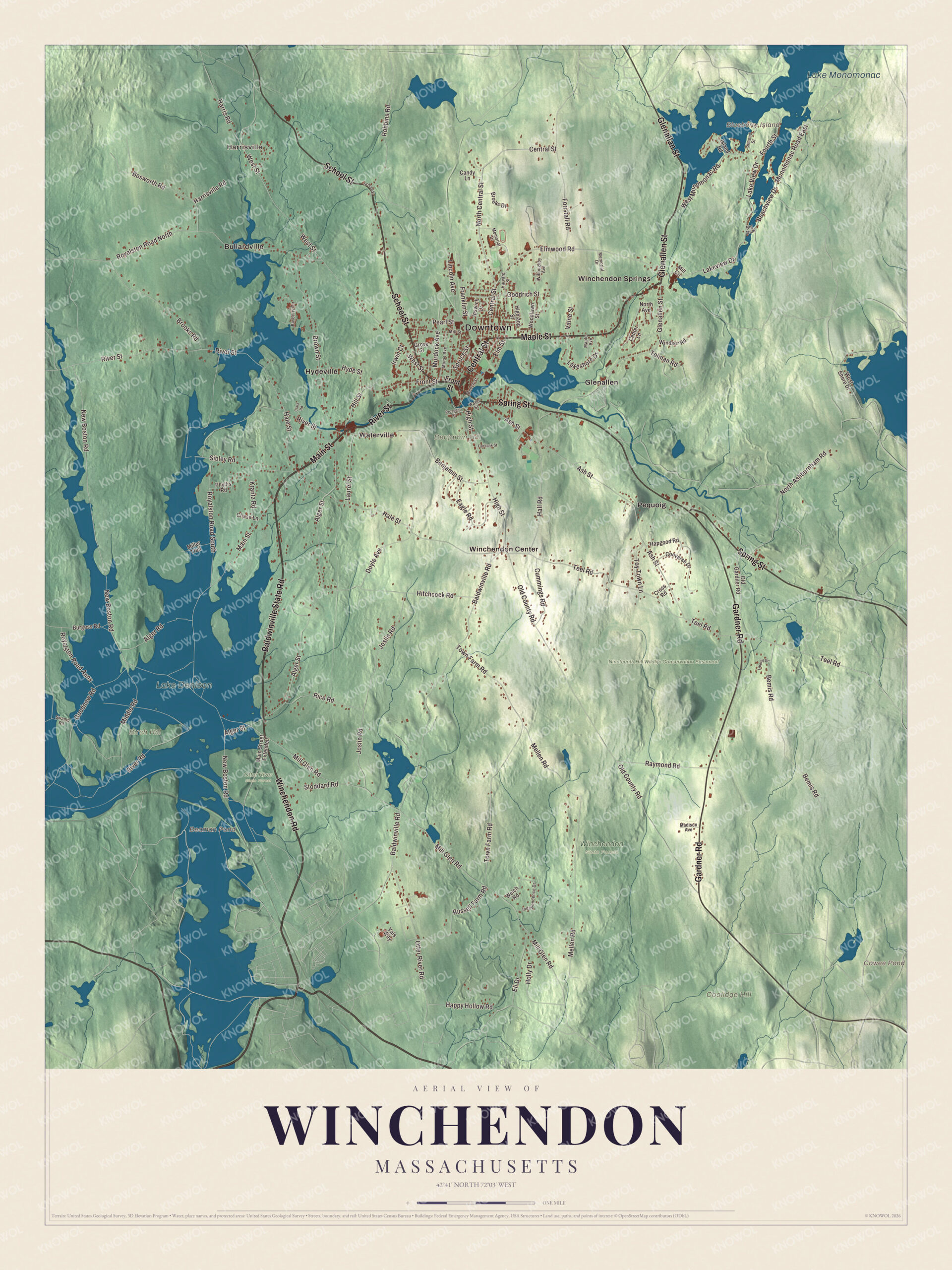
Winchendon today
By KNOWOL
Every street from Downtown and Harrisville out to Waterville, Bullardville and Hydeville, with Lake Monomonac, Lake Denison, Beaman Pond, Cowee Pond, Benjamin Hill and Birch Hill named on the artwork.6
The history of Winchendon, Massachusetts
Shingle Town and the turned pail
Pine once covered about as much of Winchendon as every other tree put together, and the first farmers split so many shingles from it that outsiders called the place Shingle Town. The wood split so true that when the 1792 meeting-house at the Centre was rebuilt in 1852, its old clapboards went back up, better than new sawed boards. Then three Winchendon men gave the world the turned pail. Deacon Reuben Hyde's cylinder saw cut curved staves, though he sold his patent for fifty dollars. William Murdock perfected the lathe, and his brother Elisha began turning out pails and tubs at Waterville in 1834. By 1874 a state gazetteer counted as many as 898,000 pails and 171,500 tubs made here in a single year.7892
How Winchendon became Toy Town
Morton E. Converse, a Civil War veteran from Rindge, New Hampshire, moved to Winchendon in 1878 and teamed up with Orlando Mason, and the two began making toys in a small way at Waterville. By 1879 they were turning out pretty wooden tea sets for children on machines Converse invented. Until then most wooden toys had come from Germany. By 1889 the firm had 150 hands, and an 1891 guide called it the largest wood toy factory in the world, making drums, dolls' beds, children's furniture and a bean bag game called Faba Baga. Converse became known as the Toy King of the World, and in 1912 he built Clyde, a 12-foot rocking horse. So many toys came from here that Winchendon became Toy Town.1011931
Poor as poverty, merry as grigs
Ipswich Canada was granted in 1735 to the heirs of Ipswich men who went on the 1690 expedition to Canada, but war kept families away, and in 1752 the proprietors paid a bounty to each of the first ten men who would build a house here. Wolves made sheep hard to raise, and meat was often scarce. Mrs. Brown, the second minister's wife, came into town on an ox-sled through deep snow and said the people were poor as poverty, but merry as grigs. At Bunker Hill, Capt. Abel Wilder fired his gun nineteen times. On July 4, 1776, the town voted to back independence. And when nobody would follow the recruiting drummer in Shays' Rebellion, William Whitney called out to his son, Turn out, Phin, and Phin stepped forward.121314
Winchendon, Massachusetts through the years
24 moments from 1690 to today.
- 1690Men of Ipswich go on the expedition against Canada whose heirs will later be granted this land.1
- 1735On June 10 the General Court grants the township, called Ipswich Canada, to Lt. Abraham Tilton and others.1
- 1752The proprietors offer a bounty to each of the first ten men who build a house and settle a family here.12
- 1752The common is laid out on the highest ground in town, and Richard Day's house goes up facing it.15
- 1755With war on the frontier, the settlers ask the General Court for help, unable to farm their fields safely.16
- 1762Daniel Stimpson is ordained on December 15 as the first minister.17
- 1764Winchendon is incorporated on June 14, and Gov. Francis Bernard signs the act.12
- 1775Capt. Abel Wilder's company fights at Bunker Hill, where he fires his gun nineteen times.13
- 1776On July 4 the town votes unanimously to back independence if Congress declares it.13
- 1786In Shays' Rebellion no one follows the recruiting drummer until Phinehas Whitney steps out at his father's call.14
- 1796Lorenzo Dow, nineteen years old, preaches the first Methodist sermon in town.18
- 1834Elisha Murdock begins making turned pails and tubs at his mill in Waterville.8
- 1843Ephraim Murdock Sr. founds Winchendon Academy.19
- 1847The railroad reaches the Village, and the stagecoaches and long freight teams soon disappear.20
- 1852An April flood on Miller's River carries off dams and bridges from the Village down the valley.21
- 1852The 1792 meeting-house at the Centre is rebuilt smaller, with its old hand-split clapboards put back up.7
- 1874The state gazetteer reports as many as 898,000 pails and 171,500 tubs made here in a year.2
- 1878Mason and Converse begin making toys in a small way at Waterville.11
- 1878O.H. Bailey and J.C. Hazen publish their bird's-eye view of Winchendon.5
- 1887The Murdock School is built with money given by Capt. Ephraim Murdock Jr.22
- 1887William Brewster spends three June days studying the birds of Winchendon, and returns for a week in 1888.23
- 1912Morton Converse builds Clyde, a 12-foot gray rocking horse made from nine pine trees.1
- 1914Clyde joins the parade for the town's 150th anniversary.1
- 1956White Brothers closes its Spring Village textile business.1
Places to see in Winchendon, Massachusetts
Places worth a visit in Winchendon today.
- DowntownAlong Miller's River. Once Morse's Village, the mill-town center.
- WatervilleA mile west of Downtown. Where Murdock began turning pails, 1834.
- HydevilleOn Miller's River below Waterville. The Hyde family mill of 1851.
- HarrisvilleNorthwest, on Stuart's brook. Old wooden ware and sawmill village.
- BullardvilleNorthwest, on Stuart's brook. Pail and bobbin shops by the brook.
- Lake MonomonacOn the Rindge, New Hampshire line. Shared with Rindge, feeds Miller's River.
- Lake DenisonOff Route 202. State recreation area with a beach.Visit their website
- Birch HillSouthwest, above New Boston. Overlooks the old New Boston village.
- Benjamin HillMiddle of town. One of the town's central hills.
Winchendon on the National Register of Historic Places
All 3 places in Winchendon on the National Register of Historic Places that still stand today, oldest first, and why each one matters.4
-
Old Centre Historic District
The town's first center, laid out in 1752 around a triangular common on the highest ground in town. Richard Day's house of about 1752, the oldest in town, still faces the common, with the 1850 First Congregational Church and the town's first cemetery nearby.15
-
Winchendon Village Historic District
First known as Morse's Village, it grew up around the dams and mills on the Millers River and boomed after the railroad arrived in the 1840s. Central Street became the business hub and Front Street filled with the fine houses of mill owners; the town hall was built here by 1850, and later the 1913 Beals Memorial Library.24
-
Murdock School
Built in 1887 with money given by Capt. Ephraim Murdock Jr., whose trust fund once gave Winchendon students a free college-preparatory education. Henry M. Francis designed it in a rich Romanesque style with a tall square tower, and it served as the town's high school until the early 1960s.22
Winchendon in their words
“they were poor as poverty, but merry as grigs.”
Mrs. Brown, the minister's wife, on the town in the Revolution, from the History of Worcester County, 187913
“the northern part of the town is a bee-hive in industry.”
History of Worcester County, 1879, on Winchendon's mills and shops9
“The upturned fills of sleighs looked like a young forest divested of foliage.”
History of Worcester County, 1879, on the tavern yards before the railroad came20
Towns near Winchendon, Massachusetts
Sources for the history of Winchendon
- Winchendon, Massachusetts, Wikipedia
- Gazetteer of the State of Massachusetts (1874), on Winchendon, Internet Archive
- Biographical history of Massachusetts (1913), on Morton E. Converse, Internet Archive
- National Register of Historic Places listings in northern Worcester County, Massachusetts, Wikipedia
- Beautifully detailed map of Winchendon, MA from 1878, restored by KNOWOL
- Map of Winchendon, Massachusetts in 2026, KNOWOL
- History of Worcester County, Massachusetts (1879), on Shingle Town and the old meeting-house, Internet Archive
- History of Worcester County, Massachusetts (1889), on Elisha Murdock and the turned pail, Internet Archive
- History of Worcester County, Massachusetts (1879), on Winchendon's shops and inventors, Internet Archive
- History of Worcester County, Massachusetts (1889), on Morton E. Converse, Internet Archive
- Inland Massachusetts illustrated (1891), on Morton E. Converse and Co., Internet Archive
- History of Worcester County, Massachusetts (1879), on the grant and settling of Winchendon, Internet Archive
- History of Worcester County, Massachusetts (1879), on early hardships and the Revolution, Internet Archive
- History of Worcester County, Massachusetts (1879), on Shays' Rebellion in Winchendon, Internet Archive
- Old Centre Historic District, Wikipedia
- An historical discourse on the First Congregational Church in Templeton (1857), on Ipswich Canada in 1755, Internet Archive
- History of Worcester County, Massachusetts (1879), on Winchendon's first church, Internet Archive
- History of Worcester County, Massachusetts (1879), on Lorenzo Dow and the Methodists, Internet Archive
- History of Worcester County, Massachusetts (1879), on Winchendon Academy, Internet Archive
- History of Worcester County, Massachusetts (1879), on the taverns and the railroad, Internet Archive
- History of the town of Winchendon by Abijah P. Marvin (1868), on the flood of 1852, Internet Archive
- Murdock School, Wikipedia
- Notes on the Birds of Winchendon, Worcester County, Massachusetts, by William Brewster (1888), Internet Archive
- Winchendon Village Historic District, Wikipedia