
A mill town at the falls of the Ware River, pieced together from a Salem shipbuilder's grant and John Read's Manor of Peace, that once made prize-winning flannel and now reaches north into the Quabbin.
Ware then and now
The same town 148 years apart. Click either map to look closer.
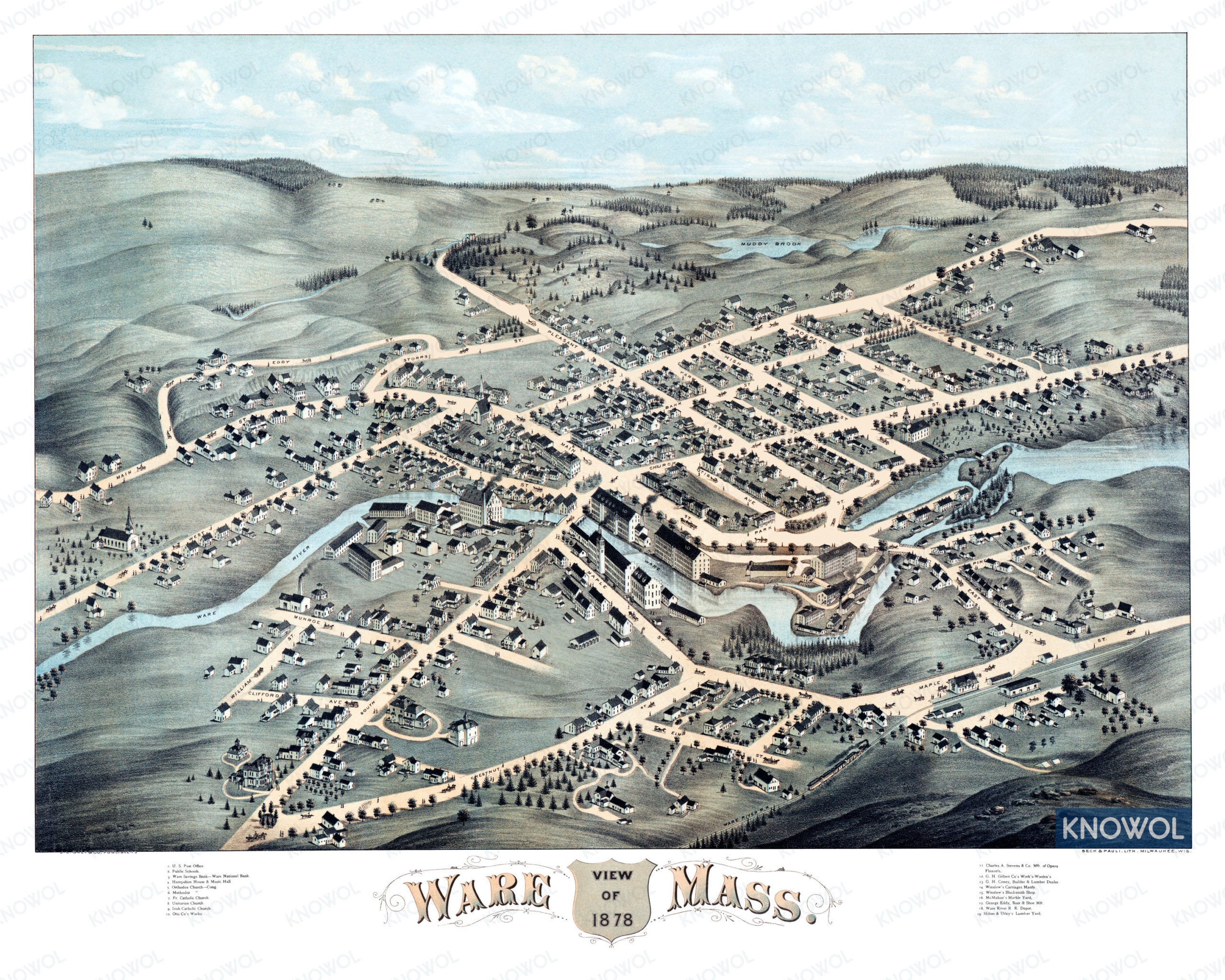
Ware in 1878
By Beck & Pauli
Ware village drawn from above in 1878, with the Otis Works, Charles A. Stevens's opera flannel mill, the Ware River Railroad depot, the Ware Savings Bank, Hampshire Music Hall and Hilton and Utley's lumber yard.5
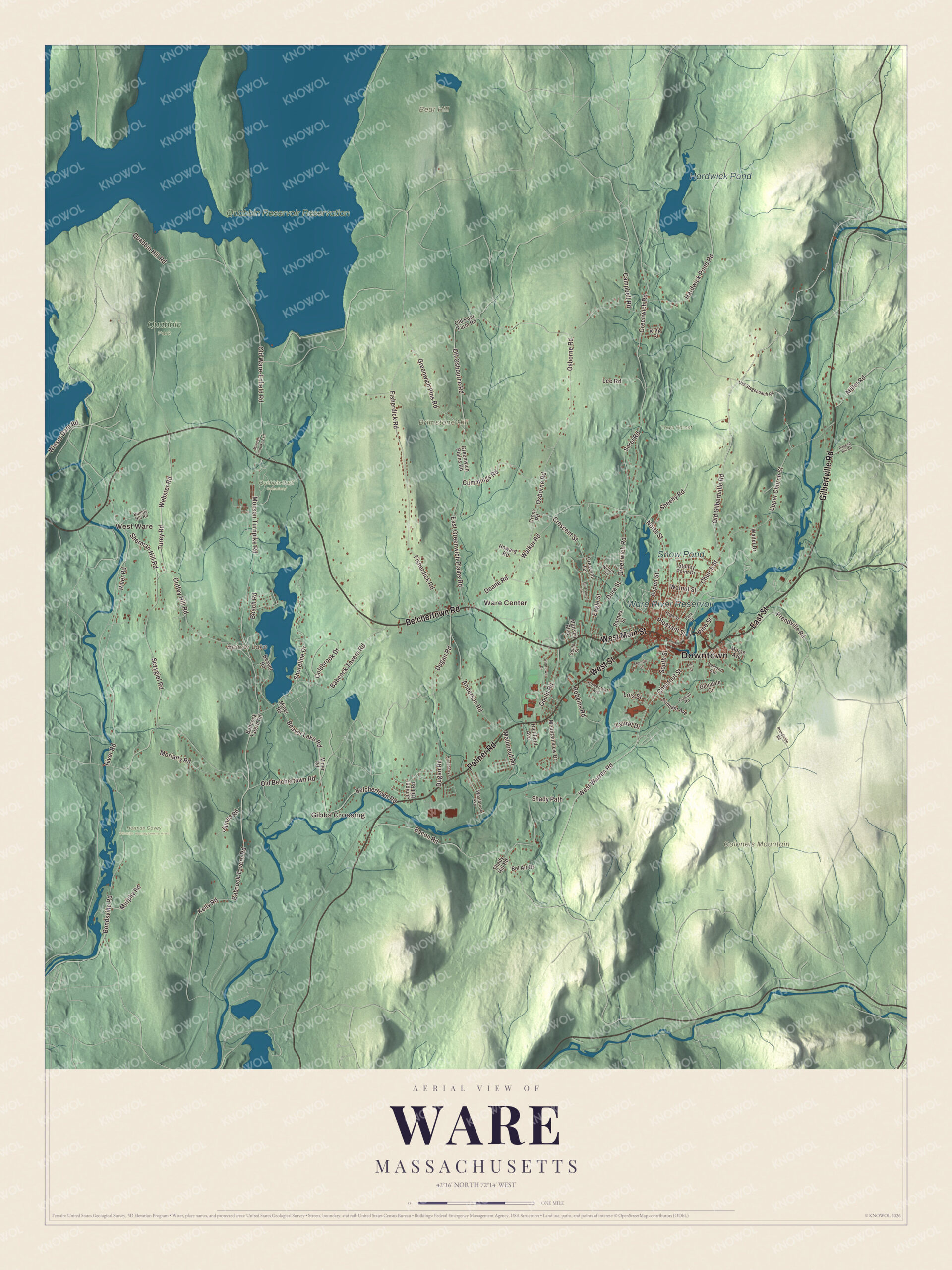
Ware today
By KNOWOL
Ware's streets, buildings, ponds and terrain in one view, from downtown and Gibbs Crossing out to West Ware and Ware Center, with Quabbin Park, Beaver Lake, Snow Pond, Brimstone Hill and Colonels Mountain named on the map.6
The history of Ware, Massachusetts
Cider, toddy and the Muddy Brook bridge
The early meetinghouse at Ware Centre was also the town house, and the town met constantly. Arthur Chase's 1911 history counts seventeen meetings and adjourned meetings in a single year. Sessions often adjourned to a tavern, where a barrel of cider or a keg of apple jack helped settle tax abatements and counterfeit bills. One night a group from the east part of town came home saying the spring freshets had carried off the Muddy Brook bridge, so they'd forded the stream. By morning the bridge was right where it always stood. John Downing kept one of the best-known taverns from 1754, a stage stop between Boston and Albany. Years after his widow died, a boy sheltering there from a storm called for Granny Downing to bring a hot toddy, and a rattle of toddy sticks sent everyone running.2
Seventy feet of falling water
The Ware River drops more than 70 feet at the village, and that fall made Ware a mill town. Jabez Olmstead built mills there in 1729. In 1813 Alpheus Demond and Col. Thomas Denney bought the mills and about 400 acres, the whole village site, for $4,500. Boston money followed, and the Ware Company was incorporated in 1823 with $600,000. In 1847 William Hyde said $700,000 had been planted here and yielded nothing but disappointment. Then things turned. After a fire in 1845 the Otis Company built a stone mill on the fall below, and that mill, Otis Company Mill No. 1, still stands. Gilbert & Stevens flannel won the top prize at London's World's Fair in 1851, and in 1870 Charles A. Stevens built a mill people called the Ware Opera-House, for the opera flannels made inside.378
A peace offering and a shipbuilder's son
Ware was stitched together from old grants. Five hundred acres at the falls, where the village stands, were granted in 1673 to Richard Hollingsworth of Salem, because his father was said to be the first builder of vessels in the colonies. The western 10,000 acres were part of the Equivalent Lands that Massachusetts gave Connecticut to settle a long border quarrel. Connecticut sold them in 1716 for a little more than a farthing an acre and put the money into Yale College. John Read's share became the Manor of Peace, a name William Hyde explained in 1847 as a peace offering to Connecticut. Before settlers came, Brookfield farmers grazed the land and burned it over, and it got so bare that from Coy's Hill you could spot a stray animal anywhere in the valley.9710
Ware, Massachusetts through the years
25 moments from 1673 to today.
- 1673Richard Hollingsworth of Salem is granted 500 acres where the village now stands, in honor of a father called the first builder of vessels in the colonies.9
- 1716Connecticut sells its Equivalent Lands, John Read's future Manor of Peace among them, for a little more than a farthing an acre, and the money goes to Yale College.7
- 1717European settlement begins, by the town's recorded history.6
- 1729Capt. Jabez Olmstead builds the first grist and saw mills at the falls of the Ware River.1
- 1742Ware River Precinct is formed, taking in land that had been part of the Elbow Tract.2
- 1754John Downing is licensed as an innholder; almanacs later list his tavern as the Ware stop for Boston and Albany stages.2
- 1761Ware River Parish becomes the District of Ware in November.2
- 1762The first town meeting is held on March 9.11
- 1775Ware becomes a full town.6
- 1787A church council takes up the quarrel between Rev. Benjamin Judd and church members who backed Shays' Rebellion.2
- 1813Alpheus Demond and Col. Thomas Denney buy the mills and about 400 acres, the whole village site, for $4,500.3
- 1815Ware's first post office opens in the Babcock Tavern.2
- 1823The Ware Company is incorporated with $600,000, much of it from Boston investors.3
- 1845Fire destroys the Ware Company's 1824 mill, and a new brick mill and a stone mill on the fall below go up the same year.3
- 1847A new town hall opens in the village, as town meetings move from Ware Centre.7
- 1847The Village Gazette, Ware's first newspaper, prints its first issue on July 7.12
- 1851Gilbert & Stevens flannel wins the highest prize, a gold medal, at the World's Fair in London.3
- 1867The town spends $2,000 on a soldiers' monument with four bronze tablets.13
- 1870Charles A. Stevens builds the mill known as the Ware Opera-House, named for the opera flannels made inside.3
- 1878Beck & Pauli publish their bird's-eye view of Ware.5
- 1885The Romanesque Revival town hall is built at Main and West Streets.14
- 1886The covered bridge to Gilbertville is built across the Ware River.15
- 1911Rev. Arthur Chase's History of Ware is published for the town's 150th anniversary.2
- 1924Mary Lane Hospital opens to the public in September.16
- 1938Much of Enfield and Greenwich, emptied for the Quabbin Reservoir, becomes part of Ware.1
Places to see in Ware, Massachusetts
Places worth a visit in Ware today.
- DowntownOn the Ware River. The old factory village at the falls.
- Ware CenterRoute 9, west of downtown. Ware's first meetinghouse and town center.
- West WareOn the Swift River. Once known as Slab City.
- Gibbs CrossingPalmer Road. On the route of the old Bay Road.
- Beaver LakeBeaver Brook. Dammed for mills soon after settlement.
- Snow PondMuddy Brook. Once the pond for Snow's Mills.
- Hardwick PondNortheast, toward Hardwick. Where Muddy Brook begins.
- Brimstone HillNorth of Ware Center. A ridge reaching 850 feet.
- Colonels MountainSoutheast, toward Warren. An old trail crossed it from Warren.
- Quabbin ParkRoute 9, west. The Quabbin Reservation's southern end.Visit their website
Ware on the National Register of Historic Places
All 6 places in Ware on the National Register of Historic Places that still stand today, oldest first, and why each one matters.4
-
Ware Center Historic District
Ware's first town center, laid out in 1760 around the first meetinghouse. Most of its buildings date from 1760 to 1860, and it kept its Georgian and Federal look after business moved to the factory village in the 1820s.17
-
Ware Millyard Historic District
The 19th-century mill complex and workers' village at the falls of the Ware River. Investors bought the water rights in 1821, their company laid out the streets, and the mills and tenement houses date from the 1840s to the 1880s. The mill was the region's largest employer for nearly a century.18
-
Otis Company Mill No. 1
A five-story stone mill built in 1845, probably by Belchertown mill builder Nathaniel Dudley Goodell. It's the only stone mill in Ware and one of the best-preserved stone mills in western Massachusetts, built before water turbines came in.8
-
Church Street Historic District
This mainly residential street north of the mills holds Greek Revival houses built before about 1850 and some of Ware's finest late 19th century Queen Anne houses, built as the town prospered from its industry.19
-
Ware Town Hall
Built in 1885 to a design by Hartwell and Richardson, it's a prominent local example of Romanesque Revival architecture in red brick and sandstone, enlarged in 1904 and 1935. It followed the first town hall of 1847, which burned in 1860.14
-
Ware-Hardwick Covered Bridge
A lattice truss covered bridge of 1886 over the Ware River between Ware and Gilbertville in Hardwick, one of a small number of 19th-century covered bridges left in the state. It survived a major flood in the 1930s, closed in 2002 and reopened in October 2010.15
Ware in their words
“We have passed through deep waters, and through fire, and are looking better now than ever.”
William Hyde, at the opening of the new town hall, 18477
“I rejoice to see you, my children, enjoying the liberty for which we fought.”
Lafayette in Ware, as Cynthia Loomis remembered it, The historic trees of Massachusetts, 191920
“The original Indian name of the locality or river is Nenameseck, but the early settlers, being more practical than poetic, adopted the name Wear”
Directory and handbook of the town of Ware, 189221
Towns near Ware, Massachusetts
Sources for the history of Ware
- Ware, Massachusetts, Wikipedia
- History of Ware, Massachusetts, by Arthur Chase (1911)
- History of the Connecticut Valley in Massachusetts (1879)
- National Register of Historic Places listings in Hampshire County, Massachusetts, Wikipedia
- Beautifully restored map of Ware, Massachusetts from 1878, restored by KNOWOL
- Map of Ware, Massachusetts in 2026, KNOWOL
- An address, delivered at the opening of the new Townhall, Ware, Mass., March 31, 1847, by William Hyde (1847)
- Otis Company Mill No. 1, Wikipedia
- History of western Massachusetts, by Josiah Gilbert Holland (1855)
- History of western Massachusetts, by Josiah Gilbert Holland (1855)
- History of western Massachusetts, by Josiah Gilbert Holland (1855)
- History of western Massachusetts, by Josiah Gilbert Holland (1855)
- Monuments, tablets and other memorials erected in Massachusetts to commemorate the service of her sons in the war of the rebellion (1910)
- Ware Town Hall, Wikipedia
- Ware-Hardwick Covered Bridge, Wikipedia
- Western Massachusetts, a history, 1636-1925 (1926)
- Ware Center Historic District, Wikipedia
- Ware Millyard Historic District, Wikipedia
- Church Street Historic District, Wikipedia
- The historic trees of Massachusetts (1919)
- Directory and handbook of the town of Ware, Massachusetts, with two maps (1892)