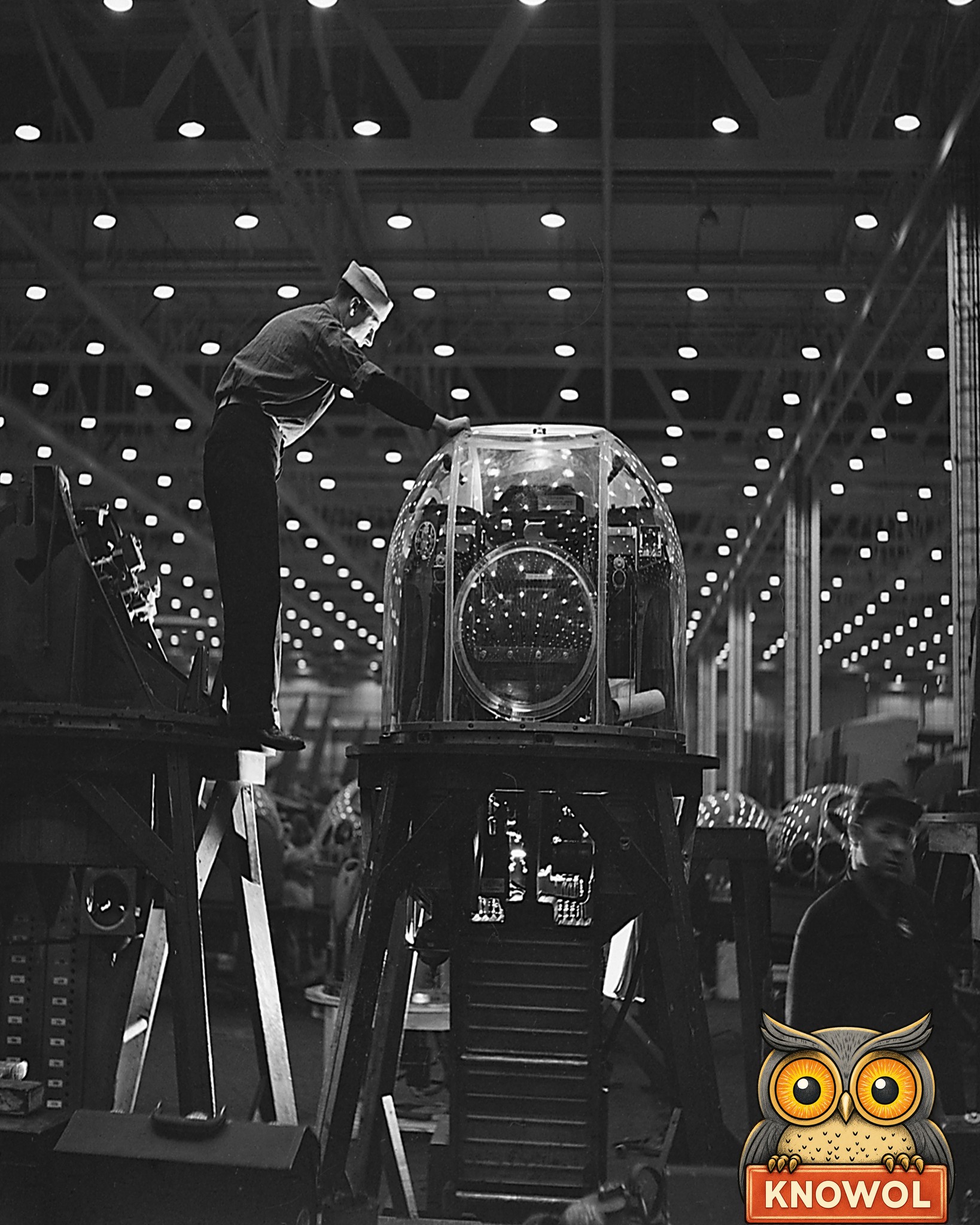
A machine gun turret on its test stand at the Glenn L. Martin aircraft plant near Baltimore, February 1943. U.S. Navy, National Archives. Click the photo to see it larger. The KNOWOL logo doesn’t appear on prints.
Under rows of lights that run back as far as the eye can see, a worker in a white cap stands on a wooden platform and reaches across the top of a glass dome. Inside the dome is a machine gun turret, built at the Glenn L. Martin aircraft plant near Baltimore and set up on a tall stand. The Navy’s caption, dated February 1943, explains what’s happening: “Machine gun turrets are completely assembled and ched operated before installed in the carcass of PBM.” In plain words, every turret was put together and test-run on a stand like this one before it went into the hull of a PBM, the Martin flying boat the Navy called the Mariner.
Tested Before It Flew
The turret sits on a wooden frame as tall as a man, with its machinery hanging below it. Through the clear dome you can see the round window at its front and the gear packed inside. Behind it, more turrets and parts fill the factory floor, and a second worker at the right looks straight at the camera.
The caption’s word for the plane’s body is “carcass,” the hull before it was finished. A turret that already worked on the stand could go into that hull ready to fight. On the PBM-3C, the Mariner model built in these years, twin .50-caliber machine guns sat in both the nose turret and the top, or dorsal, turret.
The PBM Mariner
Martin designed the Mariner in the late 1930s to work alongside the Navy’s Catalina and Coronado flying boats. The Navy ordered it before the prototype had even flown, and that first plane took off on February 18, 1939. The Mariner entered Navy service in September 1940. It had a gull wing and twin tail fins, and it landed on the water on its boat-shaped hull.
Mariners were built to hunt submarines. As the submarine threat faded late in the war, they flew night raids on Japanese shipping, bombed enemy bases on Pacific islands and rescued downed fliers from the sea. During the invasion of Okinawa in 1945, Mariners pulled B-29 crews and carrier pilots out of the water. Martin built 1,366 Mariners in all, for the U.S. Navy, the U.S. Coast Guard, the Royal Australian Air Force and the Argentine Navy.
Martin’s War
The Glenn L. Martin Company built its plant at Middle River, northeast of Baltimore, in 1929. During World War II it ranked 14th among American companies in the value of its war production contracts. Besides the Mariners, Martin built 1,585 B-26 Marauder bombers and, at a new plant near Omaha, Nebraska, 531 B-29 Superfortresses. Two of those Omaha B-29s were the Enola Gay and Bockscar, which dropped the atomic bombs on Hiroshima and Nagasaki in August 1945.
About This Photo
- Archive title: “Construction of aircraft at the Glenn L. Martin plant at Baltimore, MD. Machine gun turrets are completely assembled and ched operated before installed in the carcass of PBM.”
- Date: February 1943
- Place: Glenn L. Martin Company plant, Baltimore, Maryland (the plant stood at Middle River, Baltimore County)
- Photographer: U.S. Navy (the record doesn’t give a name)
- Collection: General Photographic Files, General Records of the Department of the Navy (Record Group 80), National Archives at College Park, Maryland
- Photo number: Archives number 80-G-412756, National Archives Identifier 520744. The negative number TR-2623 is written along the left edge of the original print.
- Rights: Public domain, a work of the U.S. government
- Restoration: KNOWOL, 2026, from the Archives’ scan of the print
KNOWOL prints this restored photo on luster photo paper in 8 x 10 and 16 x 20 inch sizes, plain or in a black or white wood frame. Click here to get your copy of the Glenn L. Martin plant gun turret photo.

Sources