
A Scots-Irish hill town that asked to be called Glasgow, got a governor's ship's name instead, and lived for a century on butter, cheese and the taverns of the old road between Boston and Albany.
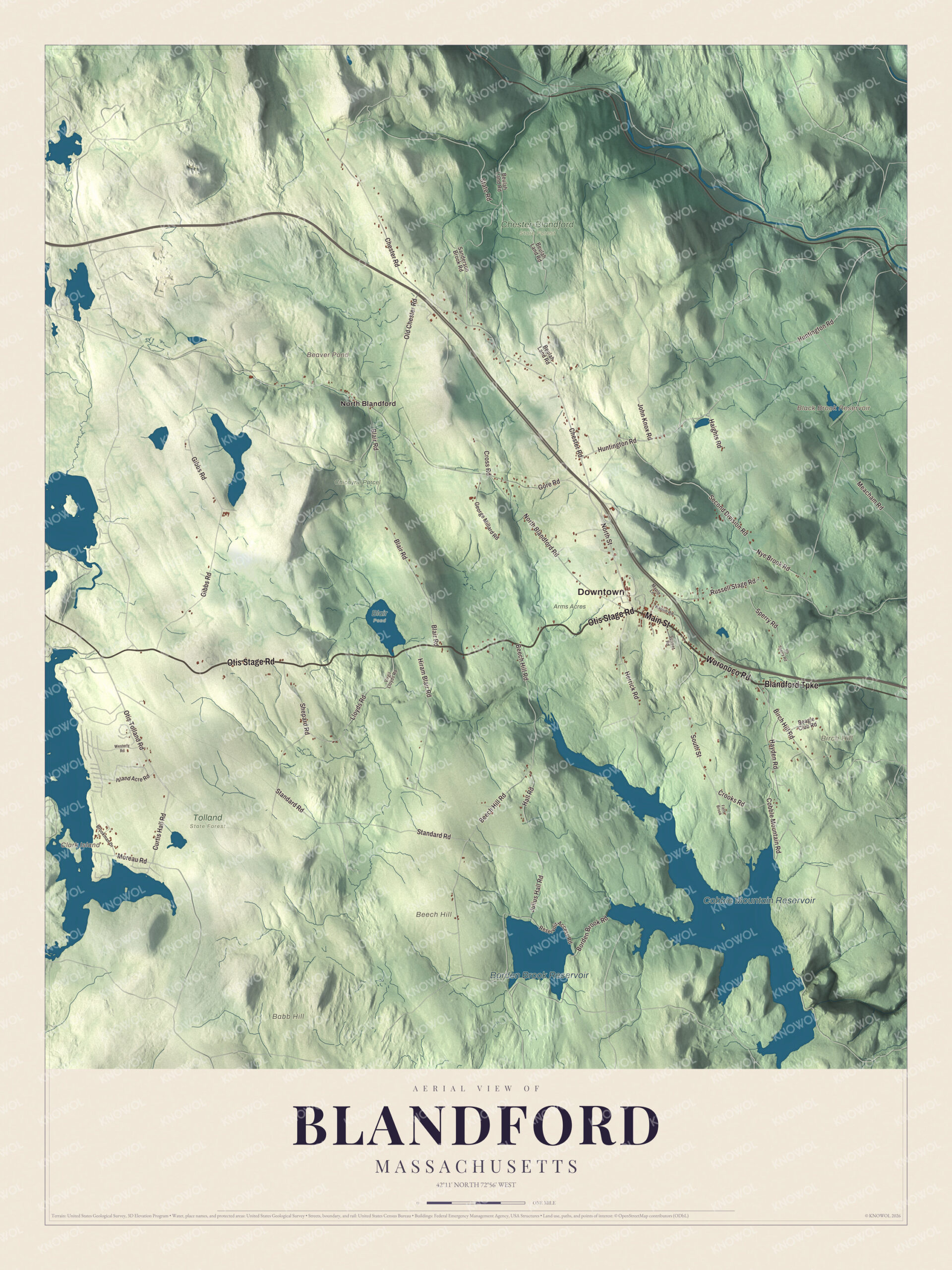
Blandford, Massachusetts on the map
Click the map to look closer.
Blandford today
By KNOWOL
Blandford's hill country shaded from USGS elevation data, with Main Street, North Street, the Blandford Turnpike, Otis Stage Road, Cobble Mountain, Borden Brook and Black Brook reservoirs, Beaver Pond, and Babb, Beech and Birch hills.4
The history of Blandford, Massachusetts
Mr. Collins and the cheese
For its first seventy years Blandford grew grain and wool, and Hartford was its market town, a long, hard haul away. About 1807 Amos M. Collins, a Connecticut merchant, moved to town with a different idea. He wanted butter and cheese, so he bought a large drove of cows for the farmers and agreed to take his pay in cheese. Nobody knew how to make it, so Collins went from house to house and taught them. He stayed nine years, made $25,000 and moved to Hartford, which later made him mayor. Orrin Sage bought the town's cheese for more than thirty years after him. By 1874 the butter and cheese from these hillside pastures were called superior, and North Blandford had once turned potatoes into starch by the ton.5678
Thirty-eight taverners
Blandford sat on the province's main road between Boston and Albany, so it had more tavern and stage-coach lore than most towns, enough for its pastor, Sumner Gilbert Wood, to fill a book in 1908. The roads were hard going. A traveler about 1790 called the forest track toward Becket the most execrable road ever traveled by a carriage, and between 1800 and 1850 the town spent $53,360 on its highways. The taverns did a steady trade, and town meetings often broke for an hour to visit one. In 1850 William H. Gibbs counted 38 taverners since the town began and found only three who got rich by it. At an 1897 reunion a speaker told of a cellar where 200 barrels of cider waited each winter to become brandy. Its owner was a preacher.91011122
Glasgow in the snow
Blandford's land was a trade. When a 1713 survey put Suffield in Connecticut, Massachusetts paid its landowners with a tract six miles square out west, and in 1735 Scots-Irish families who had first settled in Hopkinton began to move onto it. They had already gathered their church in Hopkinton, with Rev. Thomas Prince of Boston's Old South Church officiating. A family history says they reached the center of Glasgow in late April and met a three-day snowstorm that left three or four feet on the ground. They wanted the town named Glasgow, but Governor Shirley named it for his ship, the Blandford, and the bell promised by Glasgow, Scotland, never came. The church had a lively start, too: once a pastor was carried to the pulpit in triumph after a fight at the doors.131415116
Blandford, Massachusetts through the years
25 moments from 1713 to today.
- 1713The boundary survey puts Suffield in Connecticut, leaving its landowners owed land in Massachusetts.13
- 1732Massachusetts grants them an equivalent tract six miles square, the land that is now Blandford.13
- 1735The settlers gather their church in Hopkinton before they leave, with Rev. Thomas Prince of Boston officiating.14
- 1735Hugh Black, the first settler, arrives in the fall, and James Baird soon after.1
- 1740The proprietors put up the first meeting house, which for 13 years has no real floor.1
- 1741Governor Shirley incorporates the town as Blandford, not the Glasgow its settlers asked for.1
- 1745Dr. Ashley, the town's first physician, is practicing here.12
- 1749During King George's War all but four families leave for safety, then return and build three forts.1
- 1756Town meeting votes three pounds to hire a schoolmaster, its first school money.14
- 1760About this year John Watson builds the first tannery near the center.12
- 1772Rev. Joseph Patrick is publicly admonished at his own ordination for riding in on a Sabbath evening.17
- 1775At the Lexington alarm, 36 men from Blandford and Chester march under Captain John Ferguson.1
- 1791Isaac G. Gibbs buys the first single wagon in town, and it frightens the horses at church.18
- 1800The church turns Congregational, and the Eighth Massachusetts Turnpike is laid out through town.1
- 1805Widow Jane Taggart leaves $1,200 to school district No. 3.14
- 1805The Blandford and Russell Turnpike is incorporated, mostly by Blandford men.11
- 1807Amos M. Collins arrives and teaches the farmers, house by house, to make cheese.5
- 1822Isaac Damon builds the White Church on North Street.19
- 1845The First Methodist church builds its meeting house at North Blandford.20
- 1853Blandford's share of Chester Village, today's Huntington village, is annexed to Norwich.21
- 1860Blandford-born George Ashmun presides over the Republican convention in Chicago.22
- 1891The Porter Memorial Library is established.1
- 1908Rev. Sumner Gilbert Wood publishes The Taverns and Turnpikes of Blandford.9
- 1912Springfield takes land at North Blandford for its water supply.23
- 1917A trolley line from East Lee to Huntington opens through Blandford, and runs only until October 1918.1
Places to see in Blandford, Massachusetts
Places worth a visit in Blandford today.
- White ChurchNorth Street. Isaac Damon's Federal church of 1822.Visit their website
- Porter Memorial LibraryMain Street. The town library since 1891.Visit their website
- Blandford FairgroundsNorth Street. Home of the Labor Day fair.Visit their website
- Blandford Club17 North Street. Nine holes of golf since 1909.
- Main StreetBlandford Center. Route 23 through the old center.
- Glasgow RoadNear the center. Keeps the name the settlers wanted.
- North BlandfordThree miles from the center. Old mill village, trolley ruins nearby.
- Cobble Mountain ReservoirLittle River. Springfield's main water supply.
Blandford on the National Register of Historic Places
All 1 places in Blandford on the National Register of Historic Places that still stand today, oldest first, and why each one matters.3
-
First Congregational Church of Blandford
Known in town as the White Church, it was built in 1822 by Isaac Damon, who drew on designs by Charles Bulfinch and Asher Benjamin. Its pulpit first stood by the door so latecomers would be seen. The Blandford Historical Society restored it in the 1990s and runs it as an event venue.19
Blandford in their words
“He may place one foot on Orion and the other on Arcturus, and seize the Pleiades by the hair and wring all the water from their dripping urns; but he can't wash out that town line of Blandford.”
Lawyer Bishop, later a judge, to the court in a Springfield land case, from George F. Hoar's Autobiography of seventy years, 190324
“From a very poor town, Blandford has been transformed to one of the most thrifty in the County.”
History of Western Massachusetts, 1855, on the cheese trade Amos Collins began6
“The Central Congregational church-edifice stands on the very summit of the hills, and commands a most enchanting prospect.”
Gazetteer of the state of Massachusetts, 18747
Towns near Blandford, Massachusetts
Sources for the history of Blandford
- Blandford, Massachusetts, Wikipedia
- "Our county and its people": a history of Hampden County, Massachusetts (1902), on temperance and taverners, Internet Archive
- National Register of Historic Places listings in Hampden County, Massachusetts, Wikipedia
- Map of Blandford, Massachusetts in 2026, KNOWOL
- History of western Massachusetts (1855), on Amos Collins and cheese, Internet Archive
- History of Western Massachusetts (1855), on Collins and Orrin Sage, Internet Archive
- Gazetteer of the state of Massachusetts (1874), Internet Archive
- "Our county and its people": A history of Hampden County, Massachusetts (1902), on North Blandford, Internet Archive
- The Essex antiquarian, review of The Taverns and Turnpikes of Blandford (1908), Internet Archive
- Journal of William Loughton Smith, 1790-1791, in Massachusetts Historical Society Proceedings, Vol. 51 (1917), Internet Archive
- "Our county and its people": a history of Hampden County, Massachusetts (1902), on Blandford's roads, Internet Archive
- History of the Connecticut Valley in Massachusetts (1879), on Blandford's taverns and firsts, Internet Archive
- History of western Massachusetts (1855), on the Suffield equivalent lands, Internet Archive
- History of western Massachusetts (1855), on Blandford's schools and first church, Internet Archive
- Biographical review: Hampshire County, Massachusetts (1896), on the Gibbs family, Internet Archive
- John Keep of Longmeadow, Massachusetts, 1676-1680, and his descendants (1899), Internet Archive
- History of western Massachusetts (1855), on Blandford's ministers, Internet Archive
- Genealogical and personal memoirs relating to the families of the state of Massachusetts (1910), on the Gibbs family, Internet Archive
- First Congregational Church of Blandford, Wikipedia
- "Our county and its people": A history of Hampden County, Massachusetts (1902), on the churches at North Blandford, Internet Archive
- "Our county and its people": a history of Hampden County, Massachusetts (1902), on Chester Village, Internet Archive
- Antiquities, historicals and graduates of Northampton (1882), on the Ashmuns, Internet Archive
- Municipal register of the City of Springfield, water commissioners' report for 1919, Internet Archive
- Autobiography of seventy years, George F. Hoar (1903), Internet Archive