
The old mother town at the mouth of the Merrimack, settled in 1635 at a landing on the Parker River, where Byfield's falls turned the first incorporated woolen mill in Massachusetts and the Dummer farm became a school.
Newbury, Massachusetts on the map
Click the map to look closer.
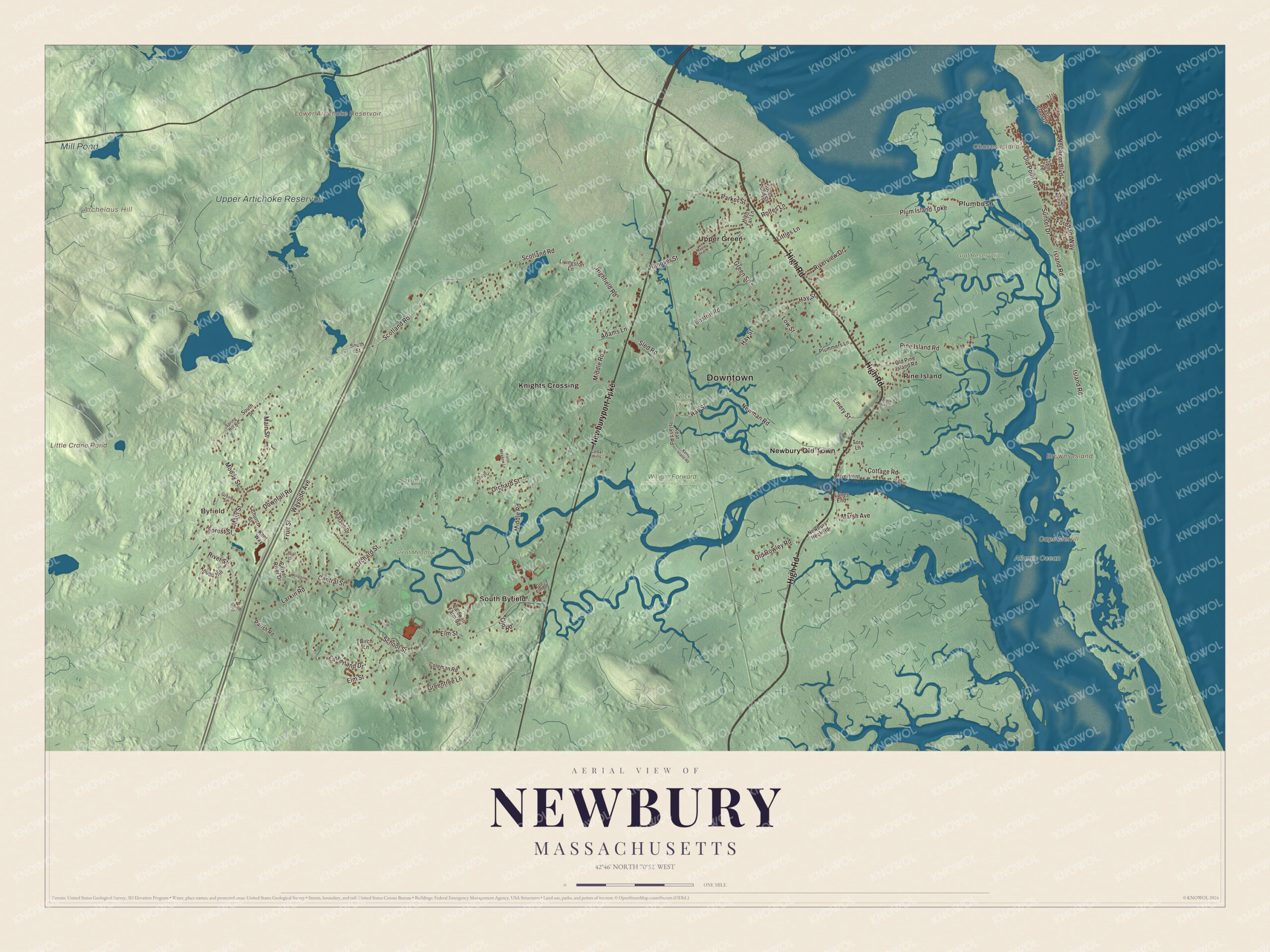
Newbury today
By KNOWOL
High Road, the Newburyport Turnpike and the Plum Island Turnpike across a town of marsh and farmland, from Byfield to Old Town and Plum Island, with Great Meadow, Archelaus Hill, Browns Island and Chaces Island.5
The history of Newbury, Massachusetts
The mill people paid to see
In 1794 Newburyport money built a woolen mill at the falls of the Parker River in Byfield. A 1926 history calls it the first company incorporated for that business in the state, and says its carding machines, the first made in this country, were set up in Lord Timothy Dexter's stable before they came out. Sarah Anna Emery was seven that year, and at ninety she still remembered the stir. Visitors paid ten cents to walk through, and that first winter sleighing parties came from every nearby town and from as far as Hampstead, New Hampshire. On the same dam the inventor Jacob Perkins cut nails by machine in Capt. Paul Moody's old mill house, and later Paul Pillsbury invented a machine for making wooden shoe pegs at Byfield.627
Master Moody and the Dummer farm
When the land was first divided, Richard Dummer got the biggest grant in town, 1,080 acres. The Dummer name stayed in Byfield, and William Dummer, the acting governor, died there in 1761 and left his house and farm at Byfield for a grammar school. He thought hard about the master. The Byfield minister and five freeholders would choose him, but once chosen he could be removed only by the Overseers of Harvard College. The little schoolhouse went up in 1762, and Samuel Moody, the famous Master Moody, taught there for seventeen years. Across Middle Street the Hale family boarded some of his students, among them the future Admiral Edward Preble. The school is now The Governor's Academy.3891011
From the Lower Green to the Upper Green
Newbury began at a landing on the Parker River in 1635, and the first meetinghouse stood on the Lower Green near the river. In 1642 the town laid out a training ground about two and a half miles north, and in 1646 the meetinghouse moved there, to what became the Upper Green. The Rev. James Noyes built his house nearby, and it still stands on Parker Street. The Coffin House on High Road followed in 1678. In September 1775 Benedict Arnold's men camped beside the green on their way to Quebec. In 1905 descendants put up a monument back on the Lower Green, with the names of seventy settlers who came between 1635 and 1650.1121351415
Newbury, Massachusetts through the years
23 moments from 1635 to today.
- 1635About 100 settlers from Wiltshire reach the river now called the Parker and begin the town.1
- 1636The first water-powered mill goes up at the falls in Byfield.1
- 1642The Upper Green is laid out as a militia training ground.12
- 1646The meetinghouse moves from the Lower Green to the Upper Green, and the First Parish burying ground is laid out.12
- 1649The General Court gives Newbury two-fifths of Plum Island.5
- 1678The Coffin House is begun on High Road.5
- 1687Peter Cheney sets up a fulling mill, later run by the Pearson family.2
- 1690About this year the stone farmhouse now called the Spencer-Peirce-Little Farm is standing.16
- 1702The Byfield Parish Church is gathered in South Byfield. The parish carries the name of Judge Nathaniel Byfield, a friend of Judge Samuel Sewall.1718
- 1711Schoolmaster Richard Brown leaves after eleven years, saying he was paid with abuse, ingratitude and contempt.19
- 1716Atkinson the hatter builds the Little House on Hanover Street.15
- 1762The little schoolhouse on the Dummer farm is built, and Master Samuel Moody begins seventeen years of teaching.8
- 1764Newburyport is set off from Newbury, and Joseph Hale builds his house near the academy.1
- 1775Benedict Arnold's troops camp by the green from September 15 to 19 on their way to Quebec.14
- 1794The Newburyport Woolen Company opens at the Byfield falls, the first company incorporated for that business in the state.2
- 1819West Newbury is set off as its own town.1
- 1847A state gazetteer describes the cave called the Devil's Den and a floating island in a pond.20
- 1850The railroad reaches Newbury and brings tourists to Plum Island.1
- 1878Silver is found in a field, and the Chipman Silver Mine opens.1
- 1888The town runs seven schools, from the Lower Green to Byfield, with about 240 pupils.21
- 1898The inventor E. Moody Boynton buys the Hale house in Byfield.10
- 1905A monument naming seventy first settlers is dedicated on the Lower Green on June 17.15
- 1925The Chipman Silver Mine closes.1
Places to see in Newbury, Massachusetts
Places worth a visit in Newbury today.
- Coffin HouseHigh Road. Begun in 1678, Coffin family until 1929.Visit their website
- The Governor's AcademyByfield. The Dummer Charity School of 1763.Visit their website
- Byfield fallsParker River at Central Street. Site of the 1636 mill and 1794 woolen mill.
- Old Town HillNewbury Old Town. Reservation above the Parker River marshes.Visit their website
- Parker River National Wildlife RefugePlum Island. Protected marsh, dunes and beach.Visit their website
- Plum IslandPlum Island Sound. A Victorian seaside resort after 1850.
- Great MeadowNewbury. Open meadow printed on the map.
- Archelaus HillNewbury. One of the old town's named hills.
- Graf ReservationNewbury. Conservation land printed on the map.
Newbury on the National Register of Historic Places
All 5 places in Newbury on the National Register of Historic Places that still stand today, oldest first, and why each one matters.4
-
Hale-Boynton House
Built in 1764 for Joseph Hale, whose family kept a tavern for travelers at the nearby river crossing, it boarded early students of the Dummer school, among them Admiral Edward Preble. The inventor E. Moody Boynton, known for his bicycle railroad, bought it in 1898, and it is now Boynton House at The Governor's Academy.10
-
Spencer-Pierce-Little House
National Historic Landmark
A National Historic Landmark and the only 17th-century stone house in New England with its outer walls intact, on John Spencer's 1635 grant beside the Merrimack and Plum Island Sound. Daniel Peirce bought the farm in 1651, the Little family in 1861, and it is now a Historic New England museum with about 230 acres still farmed.16
-
Newbury Historic District
The town center around the Upper Green, laid out in 1642 as a training ground, where the meetinghouse and the First Parish burying ground came in 1646. Benedict Arnold's troops camped here in 1775, and the district runs up High Road past the Coffin and Swett-Ilsley houses to the Newburyport line.12
-
Abraham Adams House
Abraham Adams, a farmer and sea captain married to a granddaughter of Judge Samuel Sewall, built the main block between 1705 and 1707. Surrounded by hayfields until the 1980s, it was long known as High Fields, and it keeps First and Second Period features inside.22
-
James Noyes House
The Rev. James Noyes, who led settlers from Wiltshire with his cousin Thomas Parker, built this house near the Upper Green after the meetinghouse moved there. It dates from the later 1600s, was one room deep at first, and gained a rear ell around 1800.23
Newbury in their words
“Never shall I forget the awe with which I entered what then appeared the vast and imposing edifice.”
Sarah Anna Emery, Reminiscences of a nonagenarian, 1879, on the Byfield woolen mill6
“Very many of those destined to be the most distinguished men of Massachusetts in the various walks of life, were his pupils.”
A Lowell Institute lecture, 1869, on Master Samuel Moody of the Dummer school8
“Alas! that through indifference, parsimony, or other even less worthy cause, this pride of the old town is lost to its fame.”
The wheelman's hand-book of Essex County, 1886, on the old shell road of Newbury24
Towns near Newbury, Massachusetts
Sources for the history of Newbury
- Newbury, Massachusetts, Wikipedia
- The early history of Newburyport, Massachusetts (1926), on the Byfield mills, Internet Archive
- History of Newburyport (1854), on the first land grants, Internet Archive
- National Register of Historic Places listings in Essex County, Massachusetts, Wikipedia
- Map of Newbury, Massachusetts in 2026, KNOWOL
- Reminiscences of a nonagenarian (1879), on the Byfield woolen mill, Internet Archive
- Reminiscences of a nonagenarian (1879), on Jacob Perkins at Byfield, Internet Archive
- Lectures delivered in a course before the Lowell Institute (1869), on Master Moody, Internet Archive
- Essex Institute historical collections, on Gov. William Dummer's will, Internet Archive
- Hale-Boynton House, Wikipedia
- The Governor's Academy, Wikipedia
- Newbury Historic District, Wikipedia
- The Massachusetts magazine (1908), on the Noyes family in Newbury, Internet Archive
- The early history of Newburyport, Massachusetts (1926), on Newbury's old houses and green, Internet Archive
- Landmarks "in the Old Bay State" by William R. Comer (1911), Internet Archive
- Spencer-Pierce-Little House, Wikipedia
- Essex Institute historical collections, Byfield Parish records, Internet Archive
- Old paths and legends of New England (1903), on Byfield's name, Internet Archive
- Municipal history of Essex County in Massachusetts (1922), on Newbury's early schools, Internet Archive
- A gazetteer of Massachusetts (1847), Internet Archive
- History of Essex County, Massachusetts (1888), on Newbury's schools, Internet Archive
- Abraham Adams House, Wikipedia
- James Noyes House, Wikipedia
- The wheelman's hand-book of Essex County, Massachusetts (1886), Internet Archive