
A hill and orchard town on the Nashua, made in 1732 from parts of Lancaster, Groton and Stow, where the Shakers gathered at the Square House, the Alcotts tried Fruitlands and Bare Hill Pond lies in the middle of town.
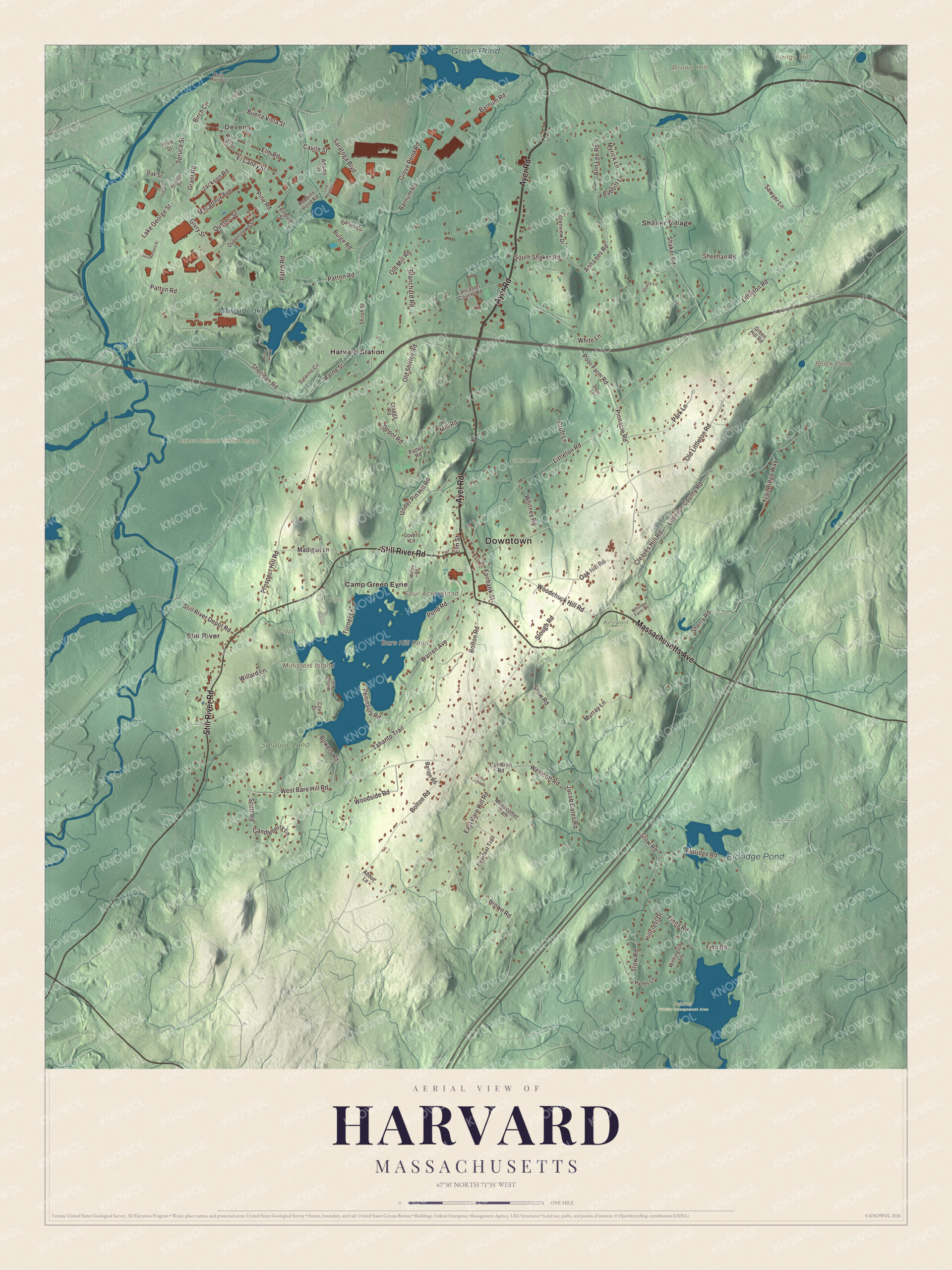
Harvard, Massachusetts on the map
Click the map to look closer.
Harvard today
By KNOWOL
Harvard as it looks today, with Ayer Road, Massachusetts Avenue and Still River Road, Bare Hill Pond and its islands, Mirror Lake, Brown Hill and the Oxbow National Wildlife Refuge, out to Devens.3
The history of Harvard, Massachusetts
Bass by train and ox team
Out in Shabikin, the old name for the Devens side of town, lies Hell Pond. The 1894 town history says people supposed it got its name from its depth, often said to be over a hundred feet, though trustworthy residents had sounded it at eighty-five to ninety. It's really two ponds, with no stream running in or out of either. On April 6, 1872, Warren Hapgood and a few neighbors stocked the larger one with black bass. Thomas Peirce brought sixteen big bass in tanks by train from Wareham to Ayer, and Jonathan F. Hapgood met him there with an ox team and had the fish in the pond that same day. The same book thought even more of Bare Hill Pond, saying many of Europe's famous lakes couldn't equal it. It awaits its poet, the author wrote.4
Pencils upstairs, paper below
Harvard lived by farming, but its brooks and clay kept a few trades going. The oldest was the corn mill in the Old Mill district, built in 1673 when that land still belonged to Groton. An 1880 county history says it was so busy that Groton made the miller keep two days a week for grinding Groton grain only. About 1831 the firm of Stacy and Sawyer built a large mill below the upper dam on a brook, with machinery for wrapping paper in the basement and a lead-pencil factory upstairs, run by Benjamin Ball of Concord. The pencils were good, but the firm fell into debt and gave up its property in 1839. Down at Still River, the brick-yard beside the railway got new owners in 1852 and grew into a thriving business.5671
The dissenters of Still River
Still River, on the west side of town, has long gone its own way. On June 27, 1776, fourteen people there formed a Baptist church, and its first pastor, Dr. Isaiah Parker, later turned Universalist. In 1804 the Still River press printed two of his sermons, and the town history says his voice carried so well that on summer days, with the windows open, his old congregation in the Baptist meetinghouse got the benefit of his preaching too. When Mother Ann Lee and the Shaker elders first came to Harvard in 1781, they found shelter at the John Willard house in the south end of the village. The Square House where they gathered became the heart of the Shaker Village, and the Baptists' 1832 meetinghouse still stands as the home of the Harvard Historical Society.89101112
Harvard, Massachusetts through the years
25 moments from 1655 to today.
- 1655Planters already call the wide meadows north of Still River the Plumtrees.13
- 1658The road between Lancaster and Groton is formally laid out, and settlers begin to farm along it.1
- 1673Groton's only corn mill is built in what's now Harvard's Old Mill district.5
- 1697James Houghton builds a garrison house near Still River.14
- 1732Harvard is incorporated, taking about eighteen square miles from Lancaster along with land from Groton and Stow.15
- 1733The church is formed, and Lancaster's proprietors give the minister, John Seccombe, the two islands in Bare Hill Pond.16
- 1734The town counts five districts: Oak Hill, Bare Hill, Still River, Old Mill and Shabikin.1
- 1754The name Shabikin first appears in the town records, in the hand of clerk William Willard.17
- 1769Shadrack Ireland's followers build the Square House.1
- 1776On June 27, fourteen people form a Baptist church.8
- 1781Mother Ann Lee and the Shaker elders first come to Harvard and stay at the John Willard house in Still River.10
- 1782Captain Thaddeus Pollard, a blacksmith who came from Bolton with his goods on a handcart, builds his Still River house.10
- 1787Harvard-born clockmaker Levi Hutchins makes what he claimed was the first American alarm clock.3
- 1804Two of Dr. Isaiah Parker's Universalist sermons are printed at the Still River press.9
- 1831About this year Stacy and Sawyer build a mill with paper making below and a lead-pencil factory above.6
- 1832The Still River Baptists build the meetinghouse that's now home to the Harvard Historical Society.12
- 1843Bronson Alcott and Charles Lane start Fruitlands on Prospect Hill. It lasts seven months.1
- 1852New owners take over the brick-yard beside the railway at Still River.7
- 1856Harvard's public library opens.1
- 1872Sixteen black bass come by train and ox team to stock Hell Pond.4
- 1877Margaret Bromfield Blanchard's will founds the Bromfield School.18
- 1914Clara Endicott Sears opens the Fruitlands farmhouse as a museum.1
- 1917The Army's Fort Devens opens in Shabikin.3
- 1931Harvard College builds the Oak Ridge Observatory on Pinnacle Road.1
- 1996Fort Devens closes.1
Places to see in Harvard, Massachusetts
Places worth a visit in Harvard today.
- Bare Hill PondMiddle of town. 320 acres, with a beach and islands.
- Ministers IslandBare Hill Pond. One of the pond's small islands.
- Fruitlands MuseumProspect Hill. The Alcotts' farmhouse, now a museum.Visit their website
- Harvard Shaker VillageShaker Road. Shaker community gathered in the 1780s.
- Still RiverWest side. Village by the Nashua and Bolton Flats.
- Oak Ridge ObservatoryPinnacle Road. Harvard College's hilltop observatory of 1931.
- Oxbow National Wildlife RefugeAlong the Nashua. Floodplain forest and wetland.Visit their website
- Mirror LakeDevens. A small lake on the north side.
- DevensNorth. The old Fort Devens, shared with Ayer and Shirley.
Harvard on the National Register of Historic Places
All 7 places in Harvard on the National Register of Historic Places that still stand today, oldest first, and why each one matters.2
-
Harvard Center Historic District
The triangular town common, laid out when Harvard was founded in 1732, ringed by houses, churches and civic buildings, among them a stone animal pound, a small powder house, the 1872 town hall, the 1878 Bromfield School and the 1886 public library.19
-
Harvard Shaker Village Historic District
The surviving Church and South family buildings of the Shaker community that grew up after Mother Ann Lee's visits in the early 1780s and was gathered into gospel order in 1791. It peaked at about 200 members in the 1850s and closed in 1918; the buildings are now private homes.20
-
Still River Baptist Church
Built in 1832 by the Still River Baptist Society, founded in 1776. Since 1966 it has been the home of the Harvard Historical Society, and it still holds an 1870 Stevens and Company organ.12
-
Fruitlands
National Historic Landmark
The farmhouse where Bronson Alcott and Charles Lane ran their Fruitlands community for seven months in 1843, eating no animal foods and using no animal labor. Restored to look as it did in the 1840s, it's now part of Fruitlands Museum.21
-
Frederick Fiske and Gretchen Osgood Warren House
Known to the family as The Hutch, this shingled summer house of 1894 belonged to Fiske and Gretchen Osgood Warren, who organized Tahanto, an enclave of single tax land spread across parts of Harvard.22
-
Fruitlands Museums Historic District
Clara Endicott Sears bought the property in 1910 and opened the Fruitlands farmhouse as a museum in 1914. The grounds also hold a Shaker house moved from Harvard Shaker Village, a museum of Native American history and a gallery of 19th-century landscape paintings.23
-
Fort Devens Historic District
The core of the old Army post, with Georgian Revival barracks, offices and warehouses built from 1929 to 1939 in a rough U around the former parade ground, now Rogers Field. A Civilian Conservation Corps camp was here from 1933 to 1937.24
Harvard in their words
“Wilful Wilders, Laughing Joslins, Wrestling Carters, and Whistling Whitcombs.”
History of the town of Harvard, 1894, on the town's old family nicknames25
“Many of the tourist-haunted lakes of Europe, in beauty of outline, picturesque setting, or in the charm and extent of landscape visible from the heights that look down upon it, do not equal this sheet of water”
History of the town of Harvard, 1894, on Bare Hill Pond4
“The land is mountainous, yet fruitful.”
A Harvard minister writing to the Massachusetts Historical Society, printed 179226
Towns near Harvard, Massachusetts
Sources for the history of Harvard
- Harvard, Massachusetts, Wikipedia
- National Register of Historic Places listings in northern Worcester County, Massachusetts, Wikipedia
- Map of Harvard, Massachusetts in 2026, KNOWOL
- History of the town of Harvard, Massachusetts. 1732-1893 (1894), on Bare Hill Pond and Hell Pond, Internet Archive
- History of Middlesex County, Massachusetts (1880), on the Old Mill, Internet Archive
- History of the town of Harvard, Massachusetts. 1732-1893 (1894), on the paper and pencil mill, Internet Archive
- History of the town of Harvard, Massachusetts. 1732-1893 (1894), on brick-making, Internet Archive
- History of the town of Harvard, Massachusetts. 1732-1893 (1894), on the Baptist church, Internet Archive
- History of the town of Harvard, Massachusetts. 1732-1893 (1894), on Dr. Isaiah Parker, Internet Archive
- History of the town of Harvard, Massachusetts. 1732-1893 (1894), on the old houses of Still River, Internet Archive
- History of the town of Shirley, Massachusetts (1883), on the Square House, Internet Archive
- Still River Baptist Church, Wikipedia
- History of the town of Harvard, Massachusetts. 1732-1893 (1894), on the old meadow names, Internet Archive
- The Houghton genealogy (1912), on the Houghton garrison, Internet Archive
- History of Worcester County, Massachusetts (1889), on the making of Harvard, Internet Archive
- History of the town of Lancaster, Massachusetts (1879), on Bare Hill Pond's islands, Internet Archive
- History of the town of Harvard, Massachusetts. 1732-1893 (1894), on Shabikin, Internet Archive
- History of Worcester County, Massachusetts (1879), on the Bromfield School, Internet Archive
- Harvard Center Historic District, Wikipedia
- Harvard Shaker Village Historic District, Wikipedia
- Fruitlands, Wikipedia
- Frederick Fiske and Gretchen Osgood Warren House, Wikipedia
- Fruitlands Museums Historic District, Wikipedia
- Fort Devens Historic District, Wikipedia
- History of the town of Harvard, Massachusetts. 1732-1893 (1894), on nicknames, Internet Archive
- Collections of the Massachusetts Historical Society (1792), letter on Harvard, Internet Archive