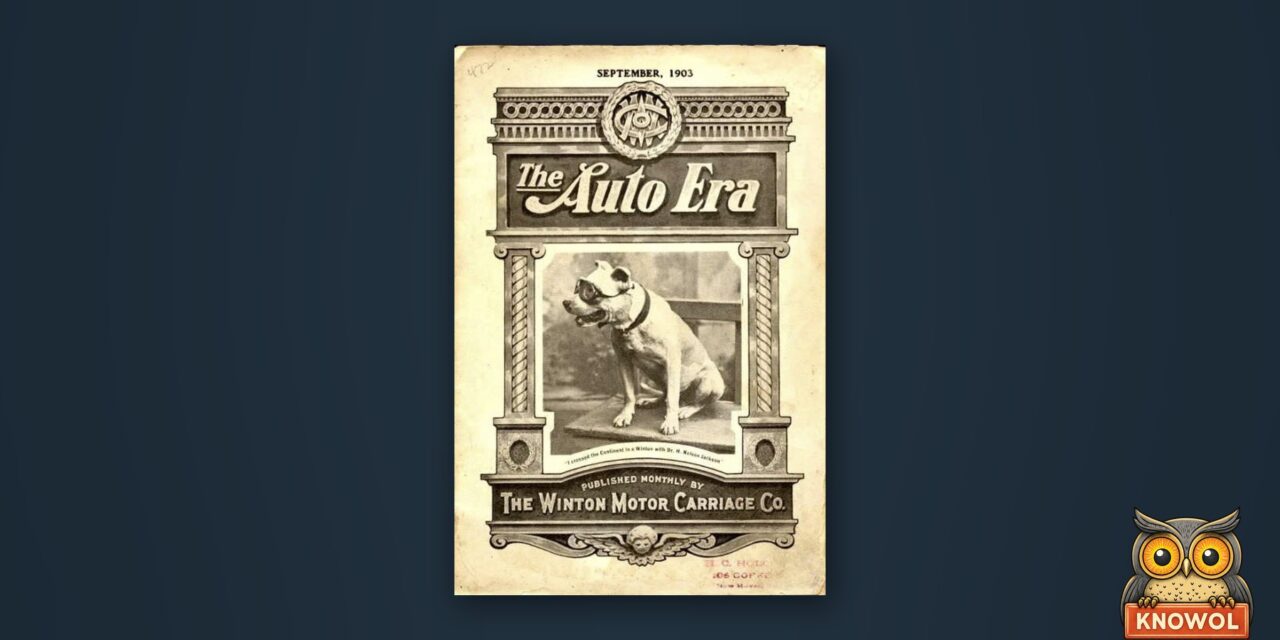
At about 4 o’clock on Sunday morning, July 26, 1903, an automobile white with dust pulled up in front of the Holland House hotel in New York City. Its owner, Dr. Horatio Nelson Jackson of Burlington, Vermont, and his mechanic, Sewall K. Crocker, beat the dust out of their canvas suits and took off their goggles. Then they took the goggles off Bud, the bulldog riding with them. The three of them had just made the first trip across the United States by automobile.
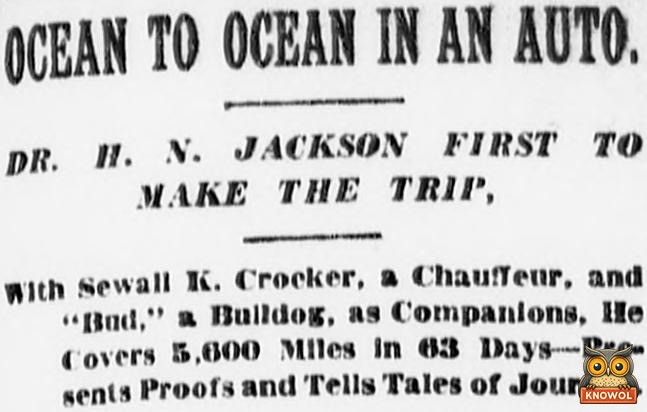
“Ocean to Ocean in an Auto,” The Sun, New York, July 27, 1903. Library of Congress, Chronicling America. Click the clipping to read it full size.
Told it could not be done
The trip started with an argument. That spring Jackson, a young doctor trained at the University of Vermont, was visiting San Francisco with his wife. At the University Club he heard a group of men agree that nobody could cross the country in an automobile, since every attempt so far had failed. Jackson decided to try. It was his first year of driving, so he teamed up with Crocker, a 22-year-old former bicycle racer from Tacoma, Washington, who had worked in a gasoline engine factory.
No new cars were for sale on the West Coast, so Jackson paid a private owner a bonus to sell him his Winton, a 20-horsepower touring car. He took out the back seat to make room for sleeping bags, guns, fishing tackle, an axe, a spade and a block and tackle with 150 feet of rope. He named the car the Vermont, after his wife’s home state. They left San Francisco at midday on May 23.
Where nobody had seen a car
Much of the West had no roads fit for an automobile. Jackson said that along 3,000 miles of the route, nobody had ever seen one. People telephoned and wired ahead that it was coming, and crowds gathered to watch it pass. Cowboys rode 60 miles to get a look. In California, a red-headed woman with a white horse sent them 54 miles out of their way, just so her folks could see an automobile.
At midnight on June 13 they reached Caldwell, Idaho, after eight hours of steady rain. “Here ‘Bud,’ the bull dog, became our future travelling companion,” Jackson wrote. A New York paper told it another way: Bud ran after the car for two miles until they took him aboard. Soon Bud had auto goggles of his own. “The dog has a pair of goggles to protect its eyes from the dust,” the Barre Daily Times reported.
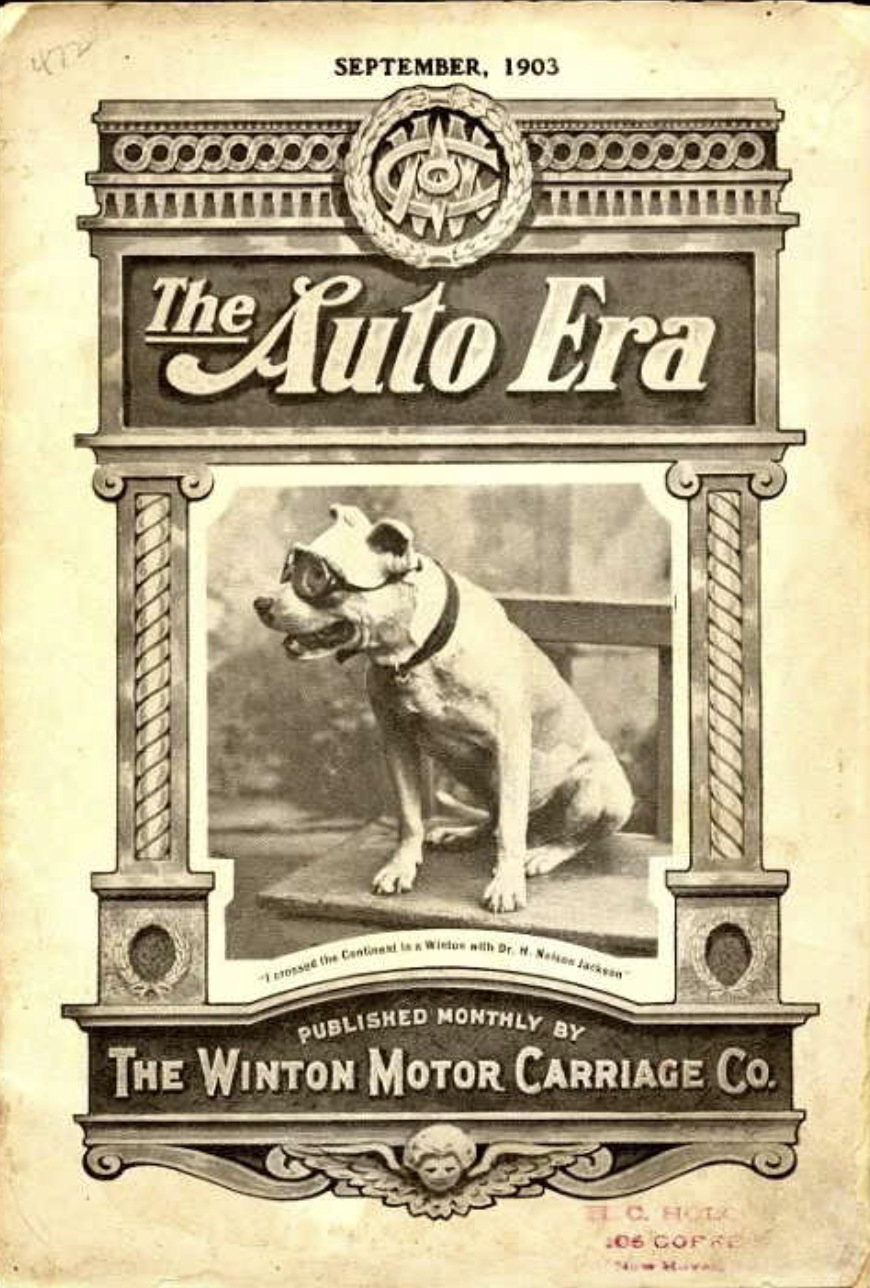
Bud in his goggles on the cover of The Auto Era, the Winton company’s magazine, September 1903. The caption reads “I crossed the Continent in a Winton with Dr. H. Nelson Jackson.” Wikimedia Commons, public domain. Click the picture to see it full size.
Hard luck on the trail
The car sank in streams and sat for days waiting for parts. In Wyoming, by Jackson’s account, the men lost their cooking outfit and their food and went 36 hours without eating. At last they came upon a lonely sheepherder, who cooked them mutton and canned corn and would not take a cent. Jackson gave him his rifle instead, and wrote that “had he asked for anything we had, with the exception of the car, I think we would have given it to him.”
At Medicine Bow, the only storekeeper saw they were low on gasoline and charged them five dollars and a quarter for five gallons. Jackson called it a hold-up, but he paid. At Cheyenne, told that the mountains were behind them, he telegraphed home with great pride: “just watch us now.” About 18 miles later there was a sudden crash. A connecting rod had “literally tied itself in a knot around the main shaft,” and his next telegram home said they were stuck for five days.
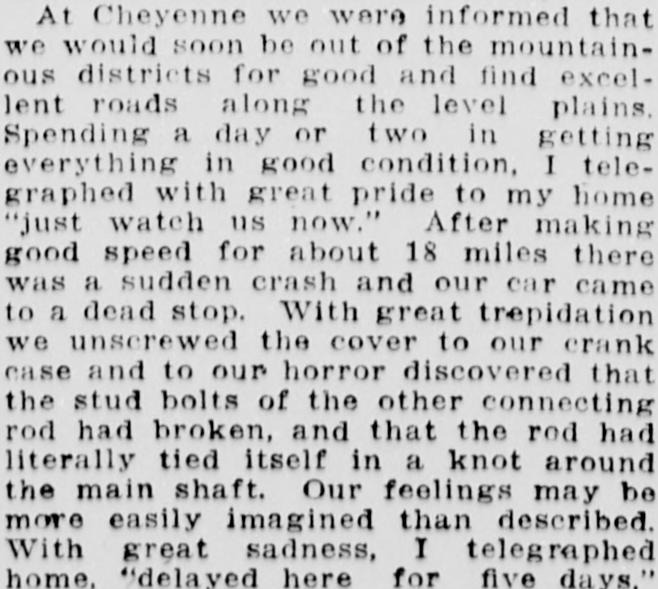
Jackson’s own account of the breakdown after Cheyenne, printed in the Burlington Weekly Free Press, Burlington, Vermont, August 20, 1903. Library of Congress, Chronicling America. Click the clipping to read it full size.
Proof for the doubters
They reached New York 63 days after leaving San Francisco. Nineteen of those days went to resting, repairs and waiting for supplies. Jackson had dropped from 225 pounds to 204, all of it, he said with a laugh, from around his middle. When a reporter from The Sun asked whether the trip was real, Jackson’s father, a Congregational minister from Burlington, brought out the newspaper clippings his son had mailed home from Idaho, Wyoming and Nebraska.
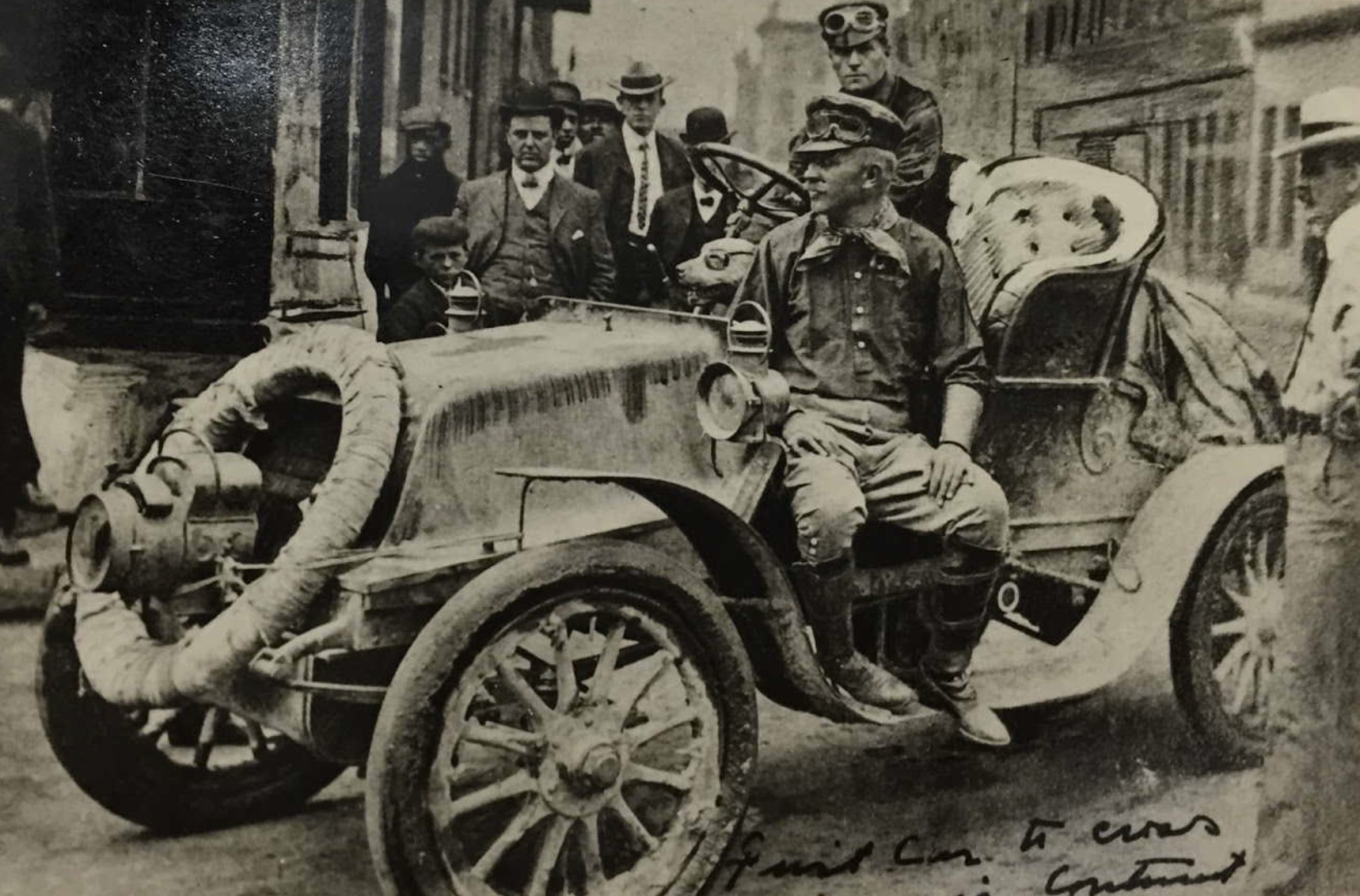
Jackson, Crocker and Bud, wearing his goggles, with the mud-covered Winton and a crowd of onlookers during the 1903 trip. Wikimedia Commons, public domain. Click the picture to see it full size.
The last miles home
Crocker stayed in New York, where he had taken a good job. Jackson started for Vermont with his wife, and the last leg was no easier. A clutch broke at Hudson, and another gave out near Albany. They pulled into Burlington about five o’clock on a Friday afternoon in August. Through some 6,000 miles of mountains, deserts and mud, the Burlington Free Press noted, the car’s chain had never broken “until just as they were going into the stable Friday afternoon.”
Bud lived the rest of his life in the Jackson home in Burlington. Years later Jackson gave the Vermont to the Smithsonian Institution, along with a small pair of driving goggles. Each lens is two and a quarter inches across.
Sources
- The Sun (New York), July 27, 1903, page 5.
- The San Francisco Call, July 26, 1903, page 33.
- The Barre Daily Times (Barre, Vt.), July 28, 1903, page 1.
- Burlington Weekly Free Press (Burlington, Vt.), July 30, 1903, page 4 (reprinting the New York American) and August 20, 1903, page 12 (with Jackson’s own letter about the trip).
- Smithsonian National Museum of American History, Bud’s Driving Goggles and Winton Touring Car, 1903.
- All newspaper images: Library of Congress, Chronicling America.
- Cover: Bud on the cover of The Auto Era, the Winton Motor Carriage Company’s magazine, September 1903, via Wikimedia Commons. Public domain.