On Saturday afternoon, October 9, 1909, in an old exhibit hall at the State Fair grounds in Birmingham, Alabama, E. T. Odom ran the motor of the aeroplane he had built and tried its moving wings. The doors stayed shut. The next morning the Birmingham Age-Herald printed a flashlight photograph of the machine, with Odom beside it, and wrote that “it seemed like a captive bird ready to fly if the doors were opened.”
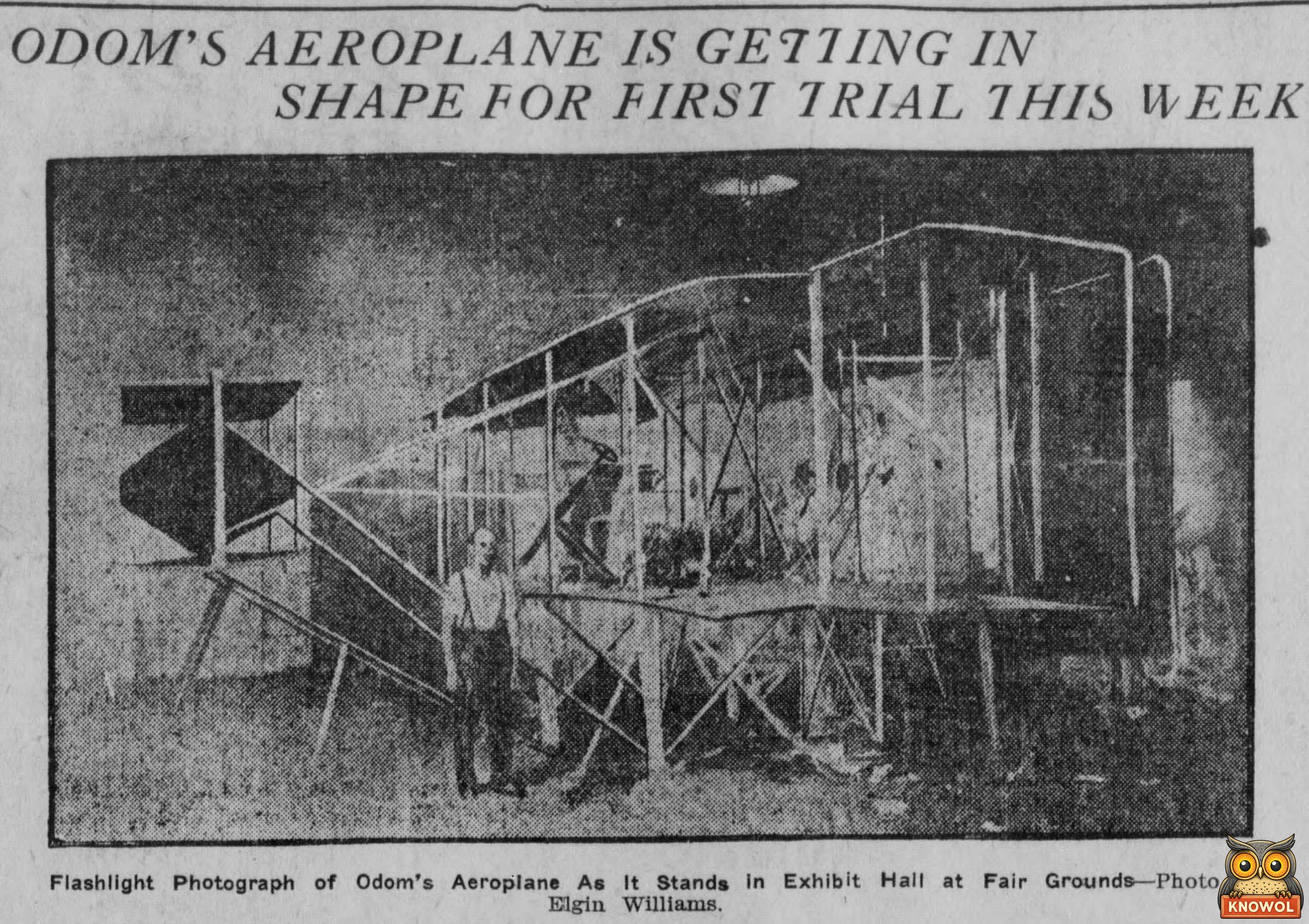
“Odom’s Aeroplane Is Getting in Shape for First Trial This Week,” with a flashlight photograph by Elgin Williams. Mr. Odom stands near the front of his machine. The Birmingham Age-Herald, Birmingham, Alabama, October 10, 1909, page 5. Library of Congress, Chronicling America. Click the clipping to read it full size.
Somewhere in Birmingham
Odom had been at it for months, and in secret. “Somewhere in Birmingham, nobody knows just where, E. T. Odom is industriously working out his plans for an aeroplane,” the Age-Herald reported that August. Local capitalists had put up money, and Odom had left his job with the Seals Piano Company. A reporter finally found him through his father-in-law. Odom said he had hoped to fly at East Lake on Labor Day, but his machinery was late. Within a month, he promised, he would fly to the city and circle the Brown-Marx building downtown.
The Montgomery Advertiser reported 106 yards of rubberized cloth for wings 38 feet from tip to tip, and in September said he had put in “all the money he had and could get hold of.”
The seventy-seventh aeroplane
The Age-Herald admitted that Alabamians had only read about successful flights, none of them farther south than the Potomac. So the paper was proud. An Italian prince had just counted the world’s flying machines at 36 dirigible balloons and 76 aeroplanes, the paper said, and then it added one: “Mr. Odom’s aeroplane is the seventy-seventh.”
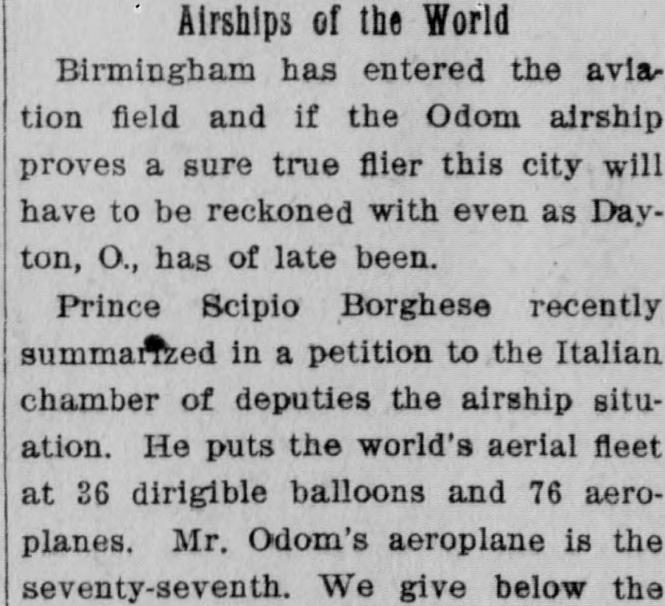
“Airships of the World,” The Birmingham Age-Herald, Birmingham, Alabama, October 15, 1909, page 4. Library of Congress, Chronicling America. Click the clipping to read it full size.
Two wheels off the ground
The first flight kept slipping. In March 1910 Odom said his engine had broken down on a Monday at the fair grounds, just after he hitched an automobile to the machine to give it a running start. The Friday before had gone better, he said, for “without the automobile start I was able to get two of the wheels of my machine off the ground.” All he needed now was a stronger engine.
A Wright pilot in Odom’s shed
In October 1910 the State Fair brought a real Wright aeroplane to Birmingham. Its pilot was Philip O. Parmalee (the paper spelled it Parmelee), a former Buick tester whom the Wright brothers had trained at their camp near Dayton, Ohio. He had been to Birmingham before, he told the Age-Herald, and one Sunday he went out to see Odom’s machine. He found the place locked, so he sprang the door and squirmed through. He had spied on the Wrights too. “I went to Montgomery to watch the Wrights,” he said, “and my first glance of their machine was through a knot hole which I enlarged with my knife.”
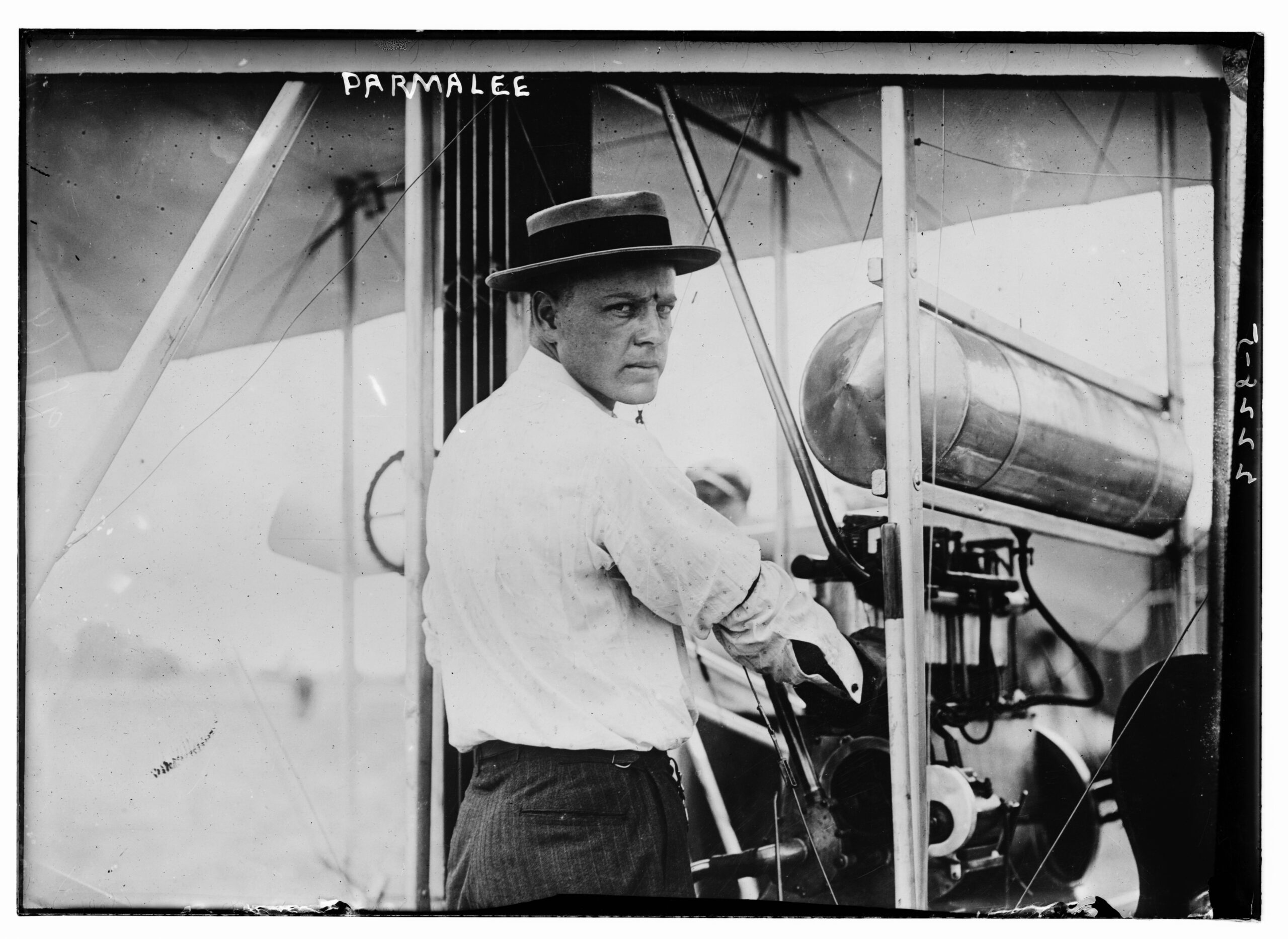
Phil Parmalee, the Wright exhibition pilot who flew at the 1910 Alabama State Fair in Birmingham, standing in an aeroplane beside its engine, around 1910. Bain News Service. Library of Congress, Prints and Photographs Division, no known restrictions. Click the picture to see it full size.
Now Parmalee spent much of his time in Odom’s shed, on the opposite side of the fair field, and the two men talked aeroplane history. Odom was building a second machine, because the first had been too heavy and too large. Parmalee thought it would fly. He wasn’t so sure Odom could land it.
Twenty-five or fifty feet
On Friday, October 14, 1910, after Parmalee’s long afternoon flight, Odom climbed into the Wright machine as his passenger. With two aboard, Parmalee “was unable to get any higher than 25 or 50 feet,” the Age-Herald reported. He skimmed the length of the field and came down. The next day, taking off for a race against an automobile, he came “very near smashing the machine against Odom’s aeroplane shed.” Some of its planes clipped the building and broke, but they were mended in time for a flight during the football game.
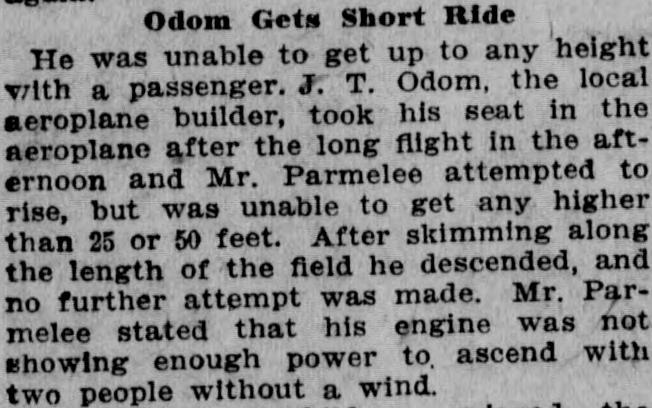
“Odom Gets Short Ride,” The Birmingham Age-Herald, Birmingham, Alabama, October 15, 1910, page 1. Library of Congress, Chronicling America. Click the clipping to read it full size.
Fifty cents at the gate
The day Odom got his ride, 40,000 people packed the fair grounds, the biggest crowd the Alabama State Fair had ever had. The gates took in $12,000, which the paper reckoned at about 24,000 full admissions, or 50 cents for a grown-up, and more than half the crowd were children on half fare. Vendors sold whips until Chief Bodeker made them stop. About 30 little children got lost that day. Nurses at police headquarters gave them candy and chewing gum, and Rube Shields lined them up on the race track and introduced them to the grandstand until their families claimed them. He also ran a rooster race for about 50 boys. The winner got a new suit of clothes.
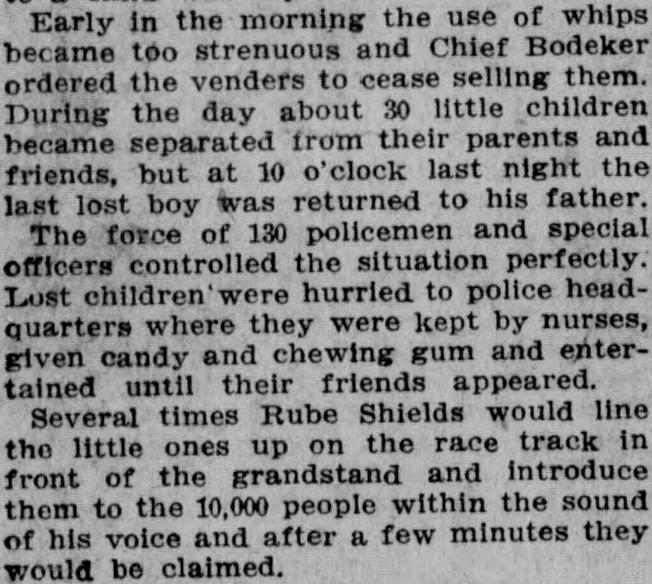
The lost children of fair day, The Birmingham Age-Herald, Birmingham, Alabama, October 15, 1910, page 1. Library of Congress, Chronicling America. Click the clipping to read it full size.
The man beside the machine
None of the Alabama papers in the Library of Congress collection report Odom’s second machine in the air, and nothing says he ever circled the Brown-Marx building. But in 1909, when Alabama knew aeroplanes only from the papers, a Birmingham man spent all he had on one and stood beside it for his picture. A year later, on the same fair field, he finally left the ground, 25 or 50 feet up, in the seat of a Wright machine flown by the young man who had once squirmed through his locked door to see it.
Sources
- The Birmingham Age-Herald (Birmingham, Ala.), August 27, 1909, page 2 (“Odom Is Working on an Airship”), October 10, 1909, page 5 (“Odom’s Aeroplane Is Getting in Shape for First Trial This Week,” with the photograph, and “Birmingham Flying Machine”), October 15, 1909, page 4 (“Airships of the World”), March 30, 1910, page 4 (“Odom Makes Aeroplane Trials”), October 9, 1910, page 8 (Parmalee and Odom), October 15, 1910, page 1 (“Today Is Last Chance To See Great State Fair”) and October 16, 1910, page 5 (Odom’s aeroplane shed).
- The Montgomery Advertiser (Montgomery, Ala.), August 4, 1909, page 11 (“Birmingham Man Will Try to Fly”) and September 19, 1909, page 14 (“Will Risk Life on Success of Aeroplane”).
- All newspaper images: Library of Congress, Chronicling America. Published 1909 and 1910, public domain.
- Photograph: “Parmalee,” Bain News Service, about 1910, George Grantham Bain Collection, Library of Congress Prints and Photographs, no known restrictions on publication. His full name is from the Library’s Bain photograph “[Philip O. Parmalee, aviator of Wright camp]” (2002721534).
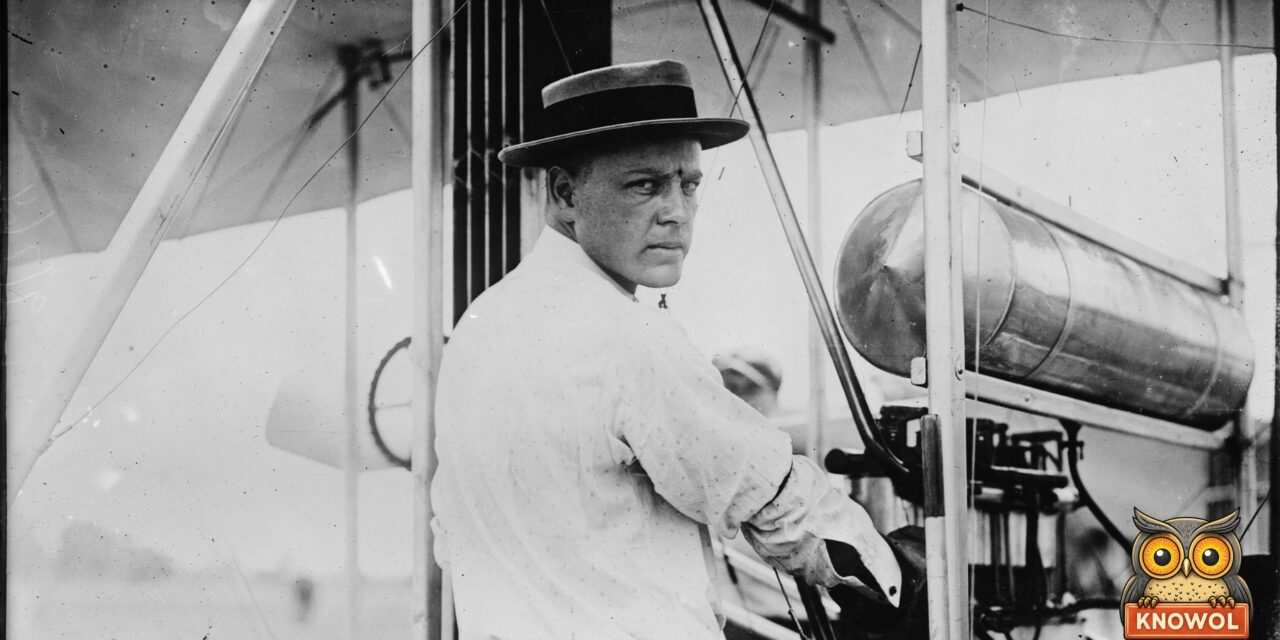
- Cover: “Parmalee,” Bain News Service, about 1910 (cropped). George Grantham Bain Collection, Library of Congress Prints and Photographs. No known restrictions on publication.