On Saturday, February 12, 1910, the El Paso Herald printed a big photograph and a letter for the children of El Paso, Texas. “EL PASO has a kissing deer. We have had the kissing bug, the kissing girl, the kissing boy and other things kissing and kissable, but never before a kissing deer,” it began. And this one, the paper said, “belongs to the El Paso ‘zoo’ at Washington Park, and the ‘zoo’ belongs to all El Paso.”
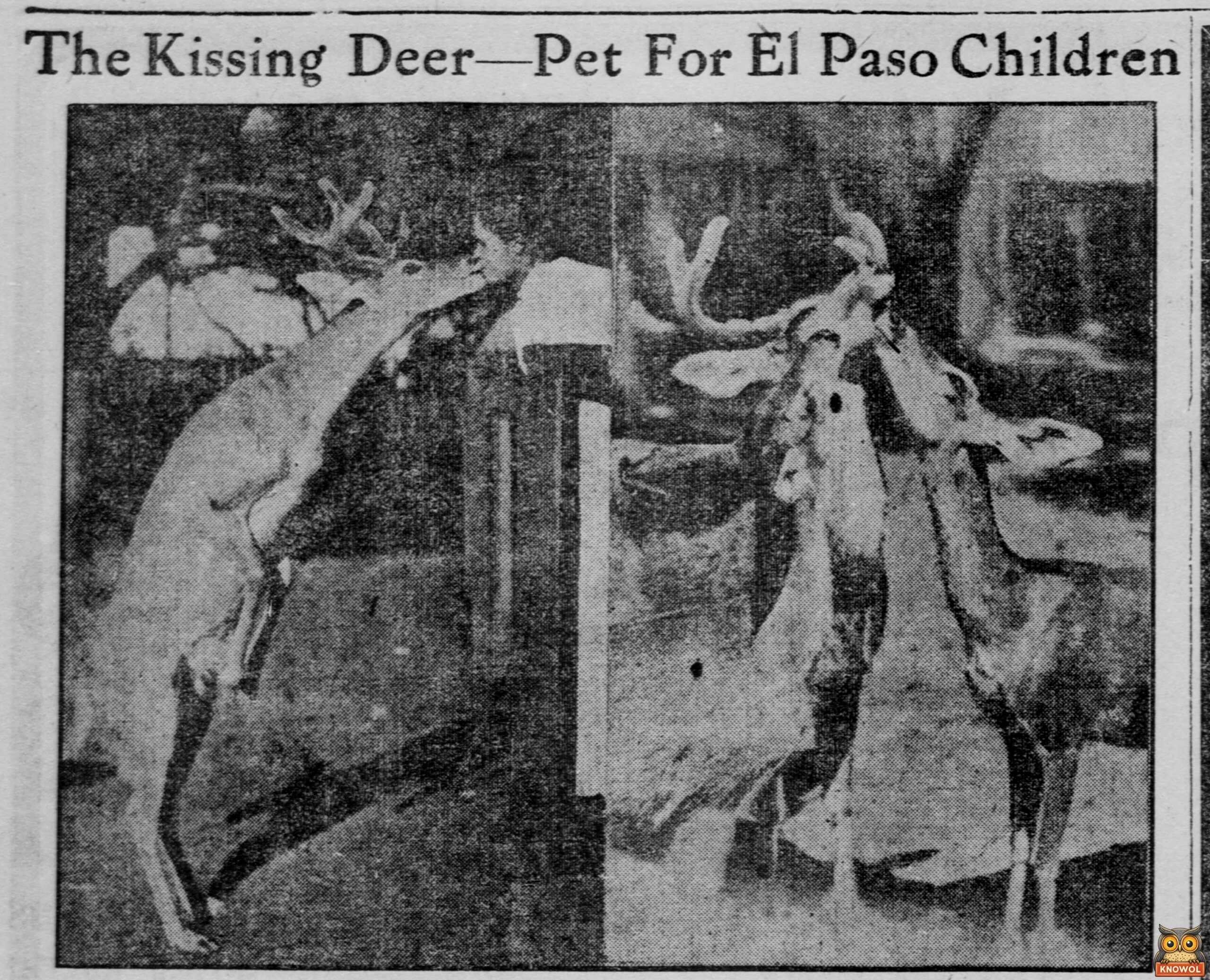
The Herald’s headline and photograph of the pet deer at Washington Park. The El Paso Herald, El Paso, Texas, February 12, 1910, page 23. Library of Congress, Chronicling America. Click the clipping to read it full size.
A railroad garden in Mexico
The deer came from Moctezuma, in Chihuahua, where J. L. Vaughan was the Mexican Central’s agent and his wife, Abbie, the station’s operator. Trains stopped there for 20 minutes so passengers could eat dinner, and years later the Herald remembered how much those travelers enjoyed the Vaughans’ pretty garden and their little flock of pet deer.
In January 1910 Vaughan wrote to a city alderman that he was about to leave Moctezuma and wanted his pets to go to someone who would care for them. On January 18 the city council said yes, “believing that they would form the nucleus of a zoo that will gradually grow.” The next day’s front page told El Paso it would soon have a zoo of real live animals, five of them to start.
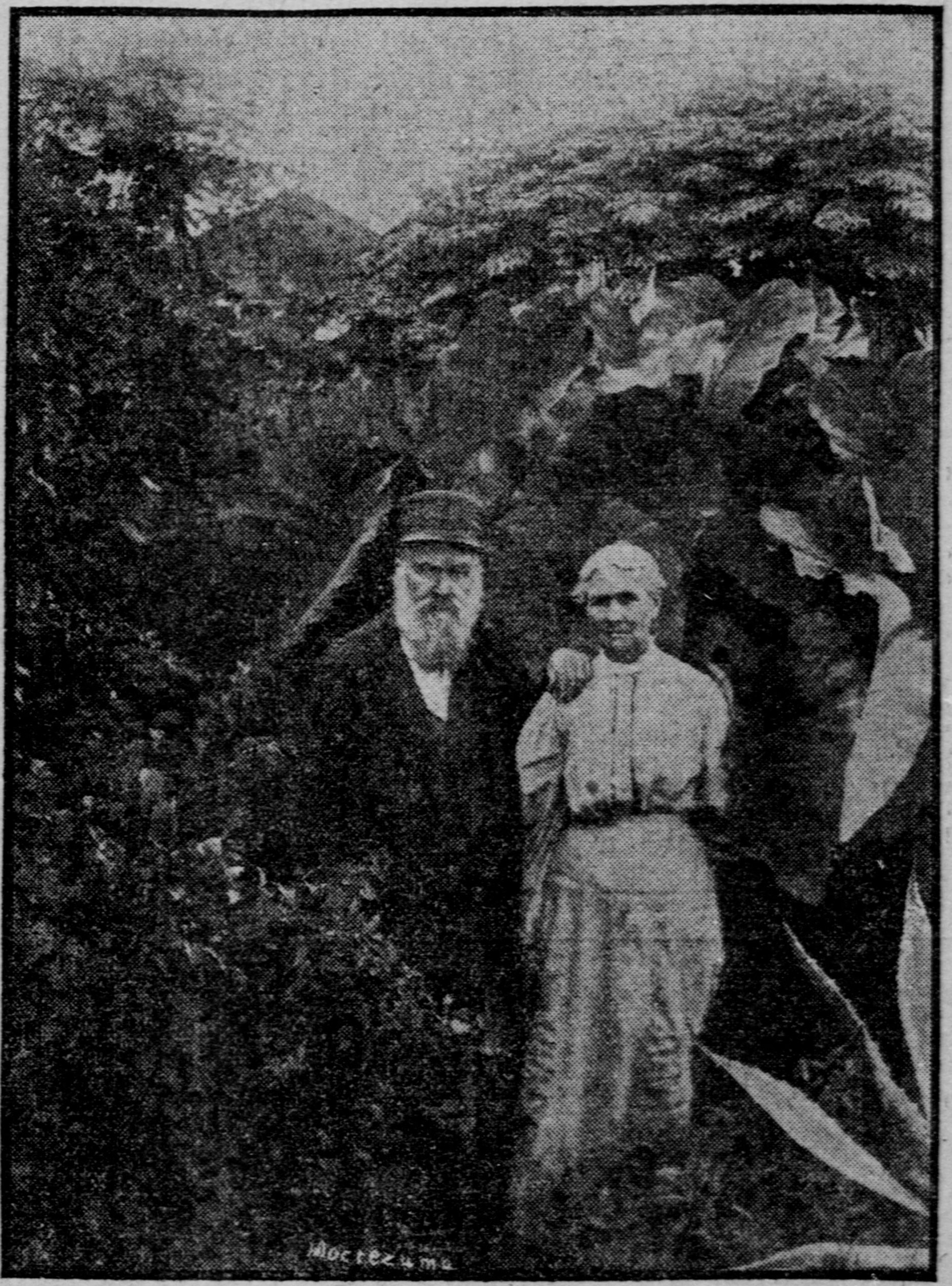
The photograph printed with the news of the gift: an older couple in a garden, marked “Moctezuma.” The page gives no names, but they are almost surely J. L. and Abbie Vaughan. The El Paso Herald, January 19, 1910, page 1. Library of Congress, Chronicling America. Click the picture to see it full size.
Their son George went south to fetch the deer, and on January 28 the paper reported them safely arrived, the first installment for the El Paso zoo. Soon, it promised, they would be “frolicking about in Washington park, where all the little boys and girls of El Paso may see them.”
Dear Children of El Paso
On February 11 the Herald promised a story about “the pet in the Washington Park ‘zoo’ that likes to kiss the girls,” with a picture of it up on its hind legs like a person. Beside that picture, the next day, ran Vaughan’s letter.
Dear Children of El Paso:
In introducing to you, through the El Paso Herald, the pet deer, it may be well to give a little history of them.
They are called by the Mexicans the “colo blanco” (white tail) deer. These were born and raised at Moctezuma on the Mexican Central. Their parents and grandparents are dead and buried in the garden at Moctezuma.
Teddy, the big buck, was born in 1901. When his horns dropped off in May, Vaughan warned, he’d be too embarrassed to let anyone see him. Betty was the biggest doe. Her daughter Tintzey was so little that “Grandma,” Mrs. Vaughan, raised her with a nursing bottle, and after a run in the garden Tintzey would put her head in Grandma’s lap “and expect to get praise for being the smartest deer in the country.” Betty’s fawns, Billy and Baby, made five.
Then he told the children what his deer had taught.
You would not think a deer could be a preacher and a teacher, but he can. I have many times seen people look at them and say “How sweet and pretty,” and men say: “I will never shoot another deer,” so there was a lesson of humanity preached, and a lesson of love for God’s creatures taught.
He still loved to hunt, he wrote, but he hunted with a camera now, and his trophies were snapshots of animals. Then he said goodbye.
The parting with the pets and companions of years has not been without regret, and we will be lonely without them, but we are glad to know they will be well taken care of, and will have many friends in the children of El Paso.
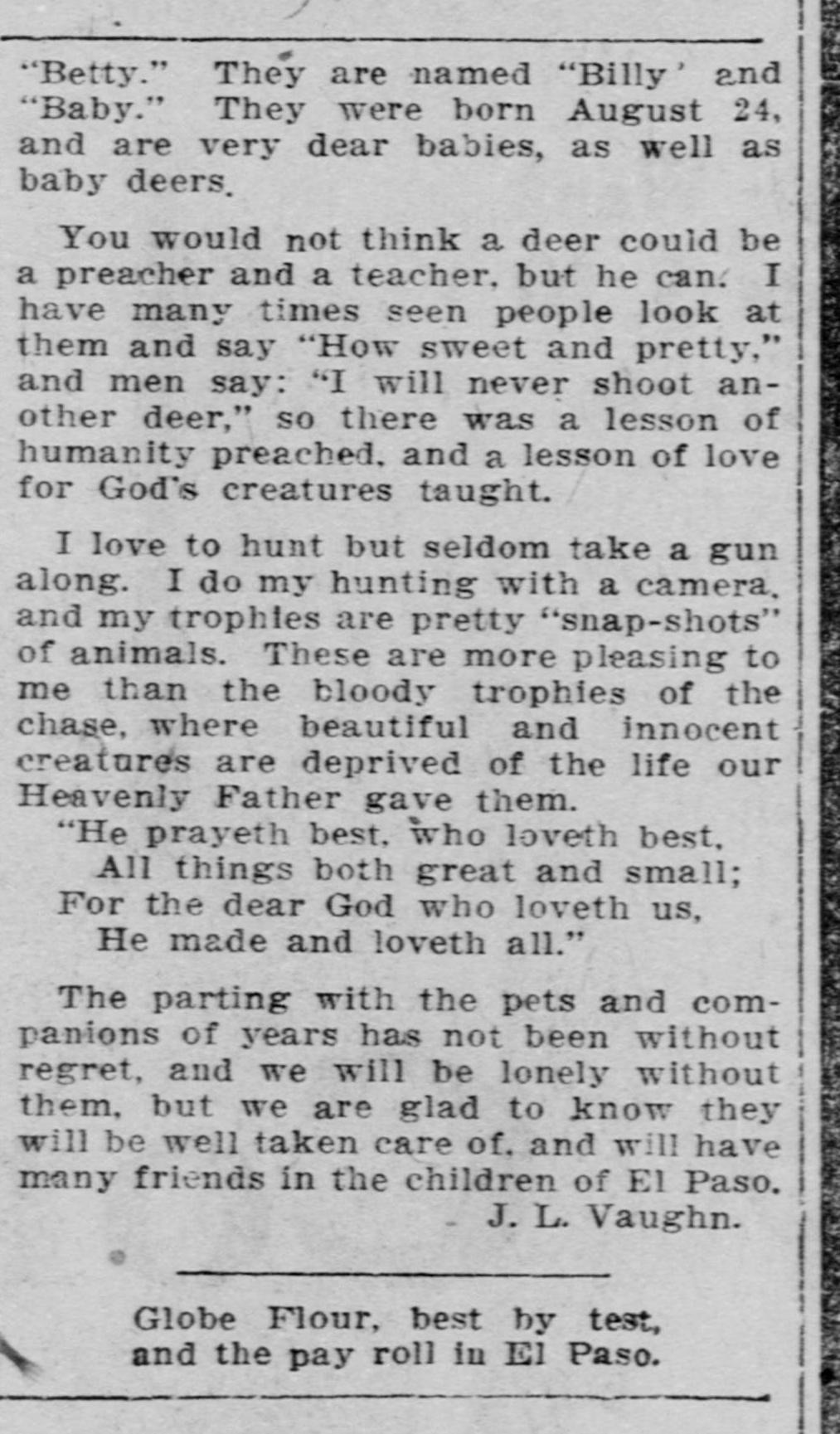
The end of J. L. Vaughn’s letter (the Herald spelled the name both ways). The El Paso Herald, February 12, 1910, page 23. Library of Congress, Chronicling America. Click the clipping to read it full size.
Monday prices at the Boston Store
The same page carried the Boston Store’s spring sale. On Monday, women’s tailored suits worth up to $27.50 were $19.75, women’s wash dresses were $1.98 and up, and girls’ wash dresses in middy blouse, Mary Jane and jumper styles were 69 cents and up. Fine wash fabrics marked 50 cents went for 25.
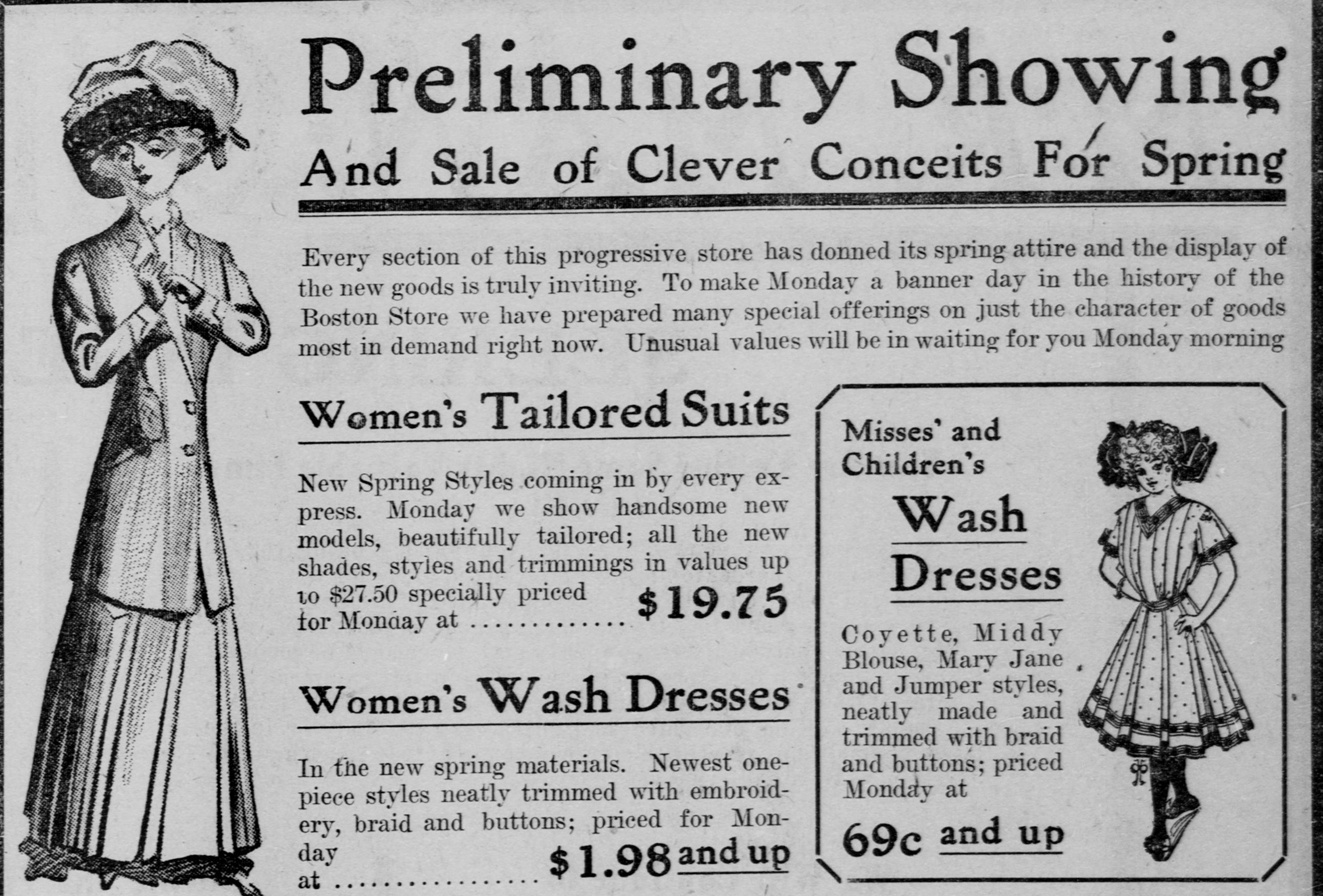
The Boston Store’s “Preliminary Showing And Sale of Clever Conceits For Spring,” on the same page as the kissing deer. The El Paso Herald, February 12, 1910, page 23. Library of Congress, Chronicling America. Click the clipping to read it full size.
Elk, camels and a fountain
By April the councilmen had bigger dreams. Architect S. E. Patton drew a zoo with iron cages along the front, an aviary for when enough birds were collected, and in the rear “the runs for the deer, elk, camels and other animals.” In the middle, a fountain would throw a shower of spray by day and light up with electric effects at night. It all cost too much to build at once, so the city planned to add on as money came in.
Where the deer led
The Vaughans moved to El Paso themselves in January 1912, “when the war became too bad,” the Herald said in 1916. The war was the Mexican Revolution. The El Paso Museum of History dates the city’s zoo from that council vote of January 18, 1910, to take five deer at Washington Park, and the El Paso Zoo stands on that ground today. It began with a railroad garden, five tame deer and a letter to the children.
Sources
- The El Paso Herald (El Paso, Tex.), January 19, 1910, page 1 (“Pet Deer for Washington Park”), January 25, 1910, page 10 (“To Bring Deer to City”), January 28, 1910, page 11 (“Pet Deer for El Paso ‘Zoo'”), February 11, 1910, page 1 (notice of the kissing deer picture), February 12, 1910, page 23 (“The Kissing Deer,” with the photograph, J. L. Vaughn’s letter and the Boston Store advertisement), April 2, 1910, page 9 (“City to Have a Pretentious Collection of Animals If Plans Are Carried Out”) and May 30, 1916, page 14 (the Vaughans of Elsinore, Calif.).
- El Paso Museum of History, DigiE, “Washington Gardens“: the council’s January 18, 1910, vote to accept five deer for Washington Park to start a zoological garden, and Washington Gardens as the El Paso Zoo’s location today.
- All newspaper images: Library of Congress, Chronicling America. Published 1910, public domain.
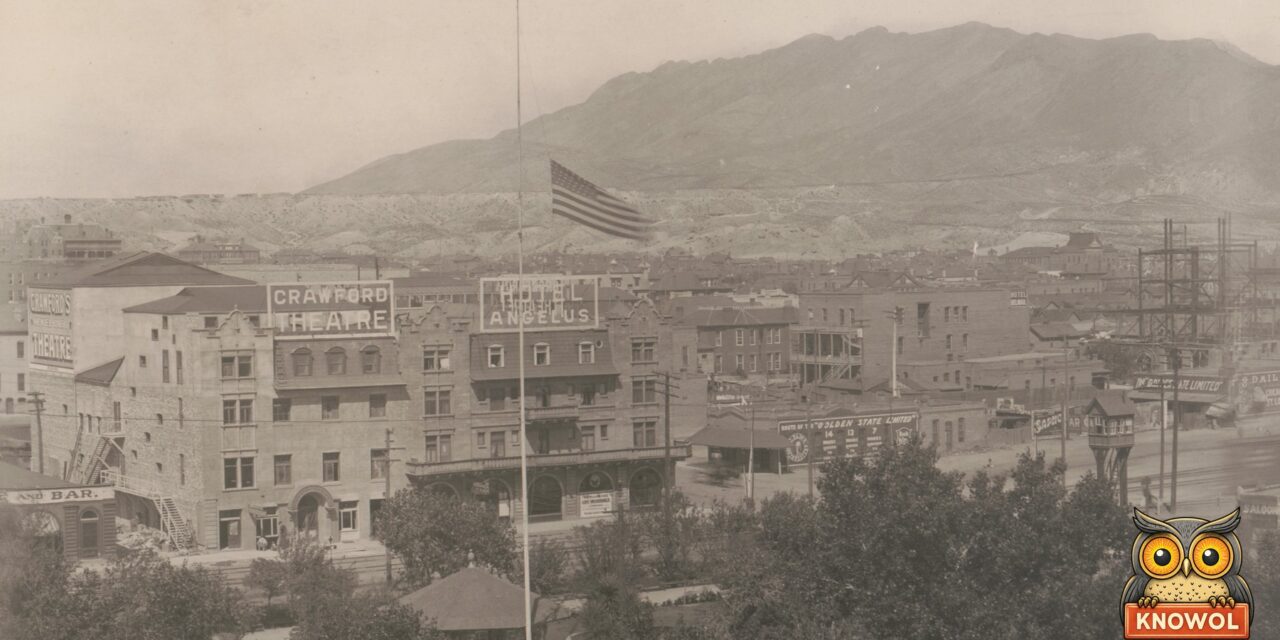
- Cover: “El Paso, Texas, showing Oregon St., the park and the Hotel Orndorff,” panoramic photograph, 1907 (cropped). Library of Congress Prints and Photographs. No known restrictions on publication.