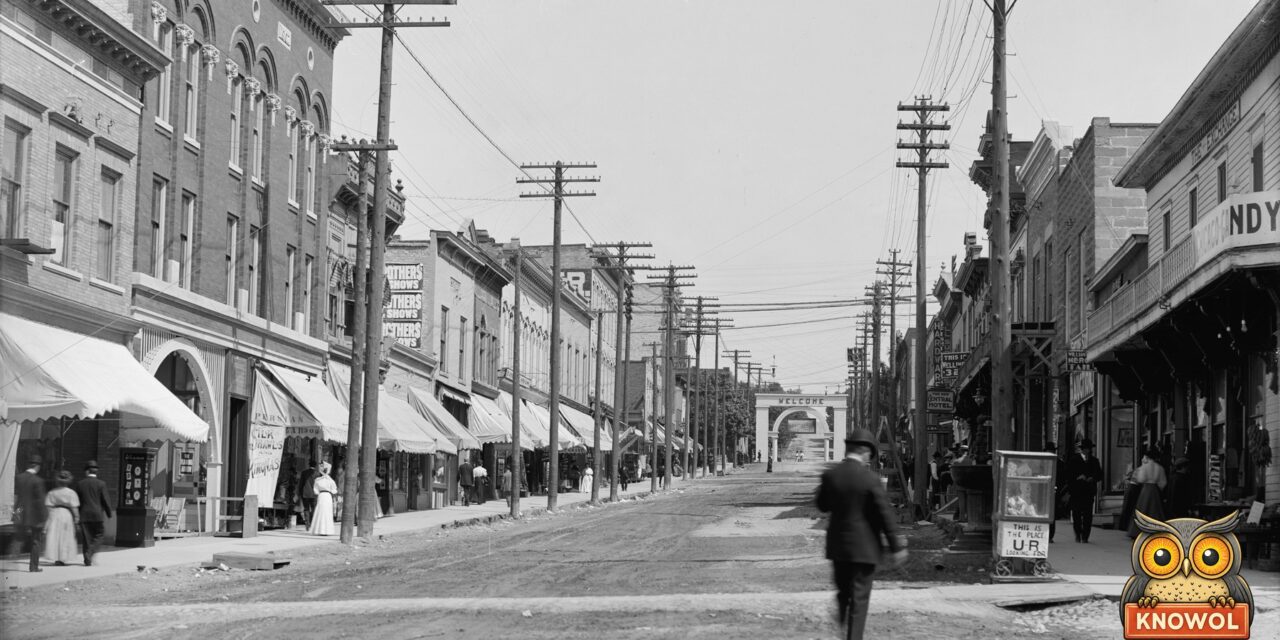
On Thursday, June 25, 1914, the Elks of Michigan paraded through Petoskey, Michigan, and a sea serpent paraded with them. W. Lee Cusser came home to Belding and told his paper about it. The Little Traverse Bay sea serpent, the Belding Banner reported, “was mounted on the trucks of three automobiles. It was fully one hundred feet in length and beautifully tinted.” The cars were hidden so well that no part of them showed.
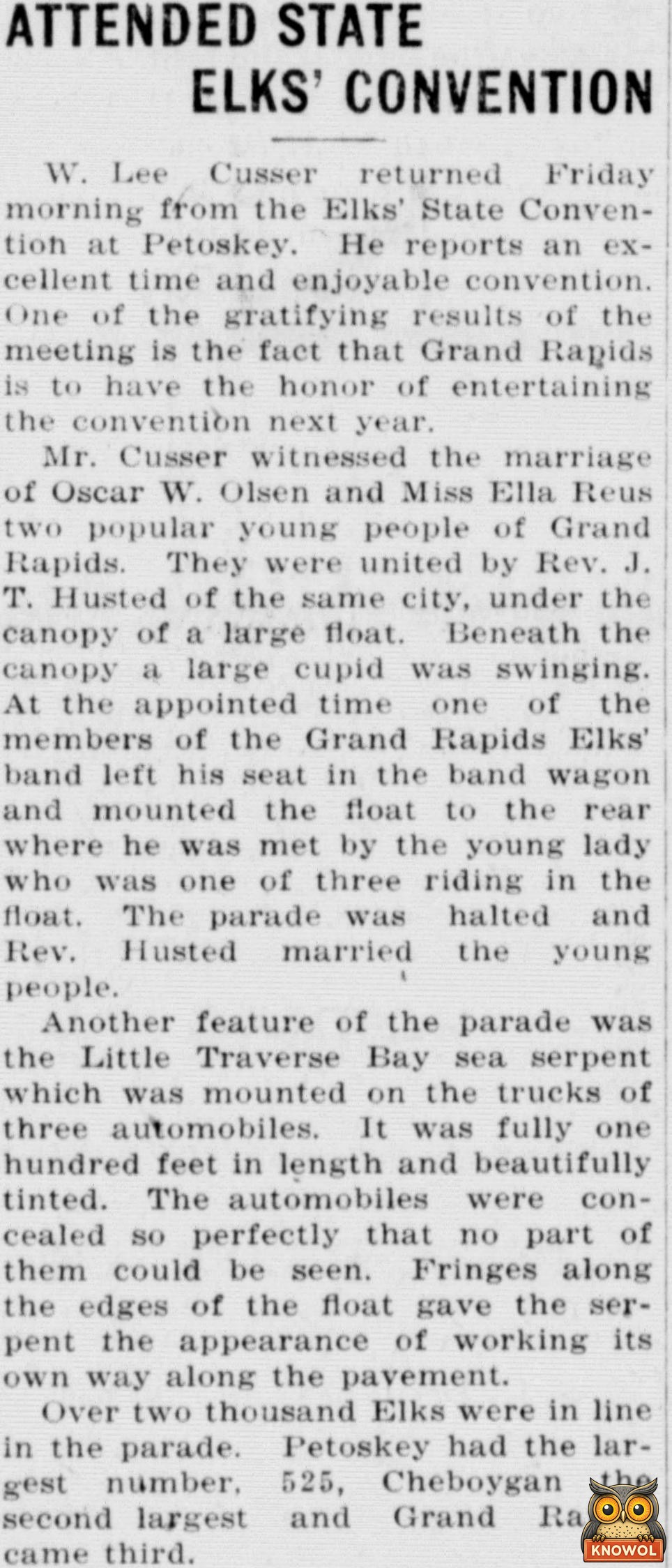
“Attended State Elks’ Convention,” Belding Banner, Belding, Michigan, July 1, 1914, page 1. Library of Congress, Chronicling America. Click the clipping to read it full size.
A monster with a past
Petoskey had a sea serpent once before, or thought it did. In February 1895 the Yale Expositor reported the answer: “The huge sea serpent which has so excited Petoskey’s Prohibitionists turns out to be an old sail floating upon a spar.”
That didn’t quite settle it. By June the papers had a new answer. “The famous Petoskey sea serpent now turns out to be a cedar log which was partly buried in the sand,” the Belding Banner wrote. “This does not explain how a Detroit paper secured a very life-like picture of the monster ‘by an artist on the spot.'”
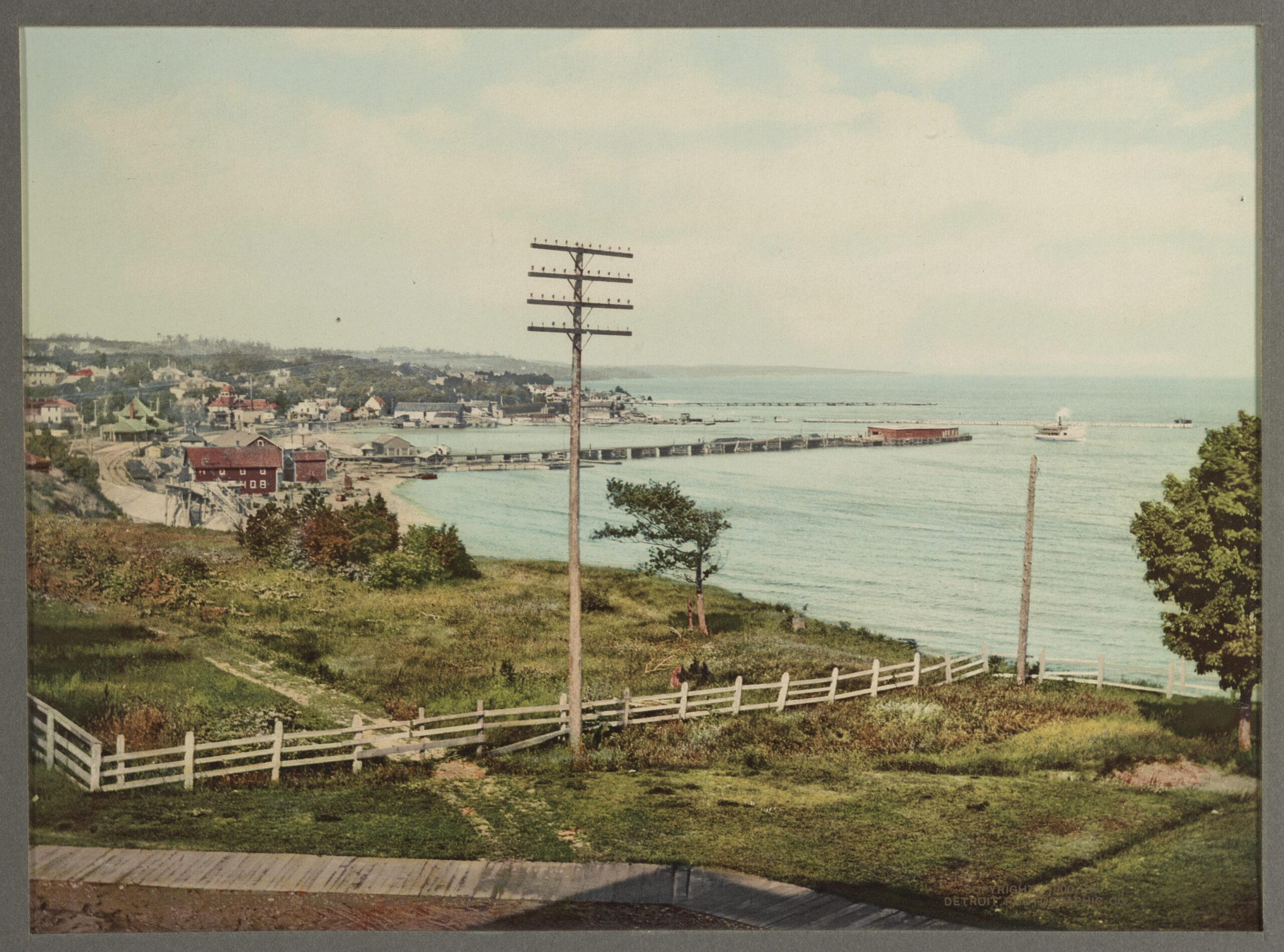
Petoskey’s harbor on Little Traverse Bay, the bay the 1914 serpent was named for, about 1900. Detroit Publishing Co. Library of Congress, Prints and Photographs Division, no known restrictions on publication. Click the picture to see it full size.
Captured and tamed
Nineteen years later, Petoskey’s Elks lodge brought the monster back. The Elks, a men’s club with lodges all over the country, held their Michigan convention in Petoskey on June 23, 24 and 25, 1914. The printed program promised a grand street pageant on the last day, “introducing for the first time the famous Petoskey sea serpent, 110 feet long, captured and tamed expressly for this occasion by Past Exalted Ruler George W. McCabe.”
In May the Charlevoix County Herald, in nearby East Jordan, described the serpent weeks before the parade. It was 108 feet long, the paper said, with wings and a seven-foot tongue, and it “can spit smoke and fire, and is a ‘regular’ dragon in every way.” East Jordan’s fifteen or so Elks belonged to the Petoskey lodge, and they would march behind the serpent in purple and white suits with 200 Petoskey Elks.
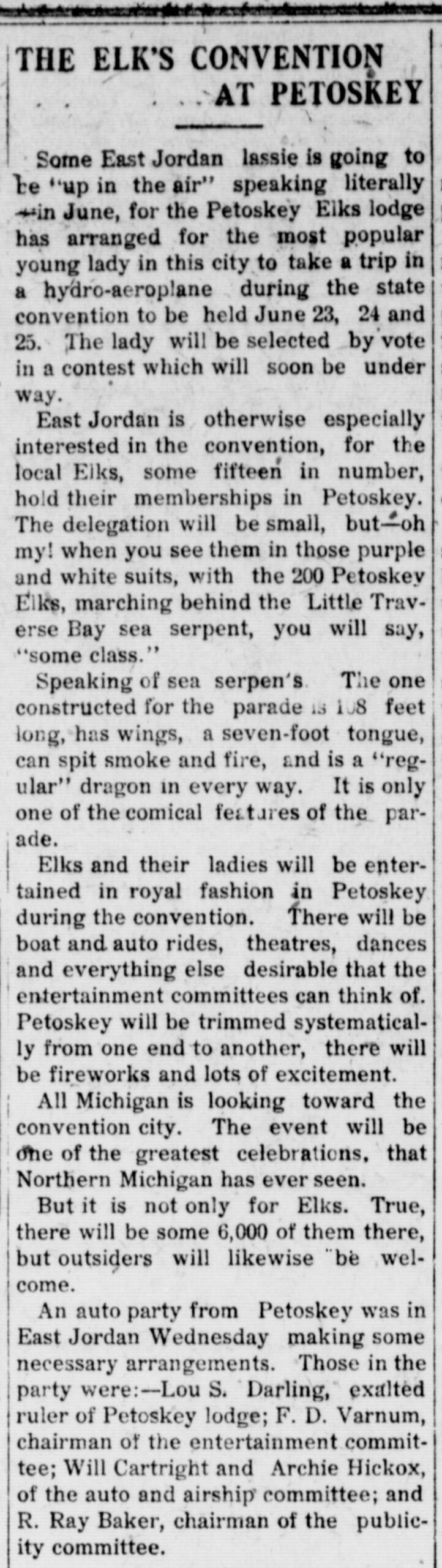
“The Elk’s Convention at Petoskey,” Charlevoix County Herald, East Jordan, Michigan, May 16, 1914, page 8. Library of Congress, Chronicling America. Click the clipping to read it full size.
Up in the air
The serpent wasn’t the only wonder. The lodge arranged for the most popular young lady in East Jordan, picked by a vote, to ride in a hydro-aeroplane, an airplane that took off and landed on water. “Some East Jordan lassie is going to be ‘up in the air’ speaking literally,” the Herald wrote. The lodge even had an auto and airship committee. The program listed a hydro-aeroplane flight over Little Traverse Bay, and on June 24 the Detroit Times reported more flights, while visiting ladies took automobile rides around the bay.
A wedding in the parade
More than 2,000 Elks marched on the last day, and Petoskey had the most, 525. The parade even stopped for a wedding. At the appointed time a member of the Grand Rapids Elks’ band left his seat in the band wagon and climbed onto a float, where his bride was riding under a canopy with a large cupid swinging beneath it. The parade halted, and the Rev. J. T. Husted married Oscar W. Olsen and Miss Ella Reus, two young people from Grand Rapids.
And there was the serpent on its hidden automobiles. Fringes along its edges, the Banner said, “gave the serpent the appearance of working its own way along the pavement.”
The serpent’s last parade
The Elks voted to meet in Grand Rapids in 1915, and the serpent went too. The L’Anse Sentinel reported that Petoskey’s lodge would bring its 110-foot serpent to the Elks’ parade there, held on Friday, June 4, 1915.
It was the monster’s last march. “The famous Petoskey sea serpent, which has been a feature of parades in almost every city in Michigan, was set on fire at the conclusion of the Elks’ parade at Grand Rapids Friday afternoon and destroyed,” the Yale Expositor reported. It burned just outside the ball park, and the fire department came out to keep the flames from spreading. The paper didn’t say who set it.
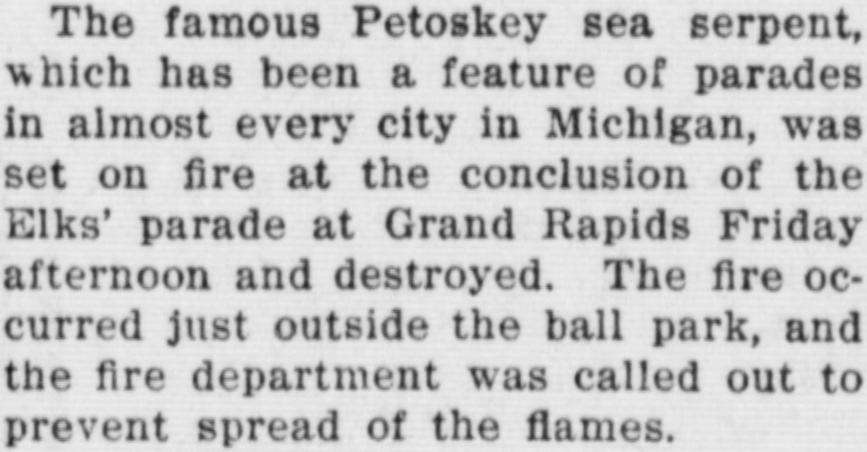
The Yale Expositor, Yale, Michigan, June 10, 1915, page 2. Library of Congress, Chronicling America. Click the clipping to read it full size.
In 1895, Petoskey’s sea serpent turned out to be an old sail, and then a cedar log in the sand. So in 1914 the town built one for real, with wings, a seven-foot tongue and smoke, and for a year it wound its way through parades all over Michigan.
Sources
- Belding Banner (Belding, Mich.), June 13, 1895, page 2 and July 1, 1914, page 1 (“Attended State Elks’ Convention”).
- The Yale Expositor (Yale, Mich.), February 1, 1895, page 6, June 14, 1895, page 6 and June 10, 1915, page 2.
- Charlevoix County Herald (East Jordan, Mich.), May 16, 1914, page 8 (“The Elk’s Convention at Petoskey”).
- The Calumet News (Calumet, Mich.), May 23, 1914, page 3 (the convention program).
- The Detroit Times (Detroit, Mich.), June 24, 1914, page 4.
- The L’Anse Sentinel (L’Anse, Mich.), May 22, 1915, page 3.
- Newspaper images from the Library of Congress, Chronicling America. Published 1895 to 1915, public domain.
- Photograph: Detroit Publishing Co., “Petoskey Harbor, Michigan,” about 1900, Library of Congress, Prints and Photographs Division, no known restrictions on publication.
- Cover: Detroit Publishing Co., “[Lake Street, Petoskey, Mich.],” about 1908 (cropped). Library of Congress Prints and Photographs Division, 2016814600. No known restrictions on publication.