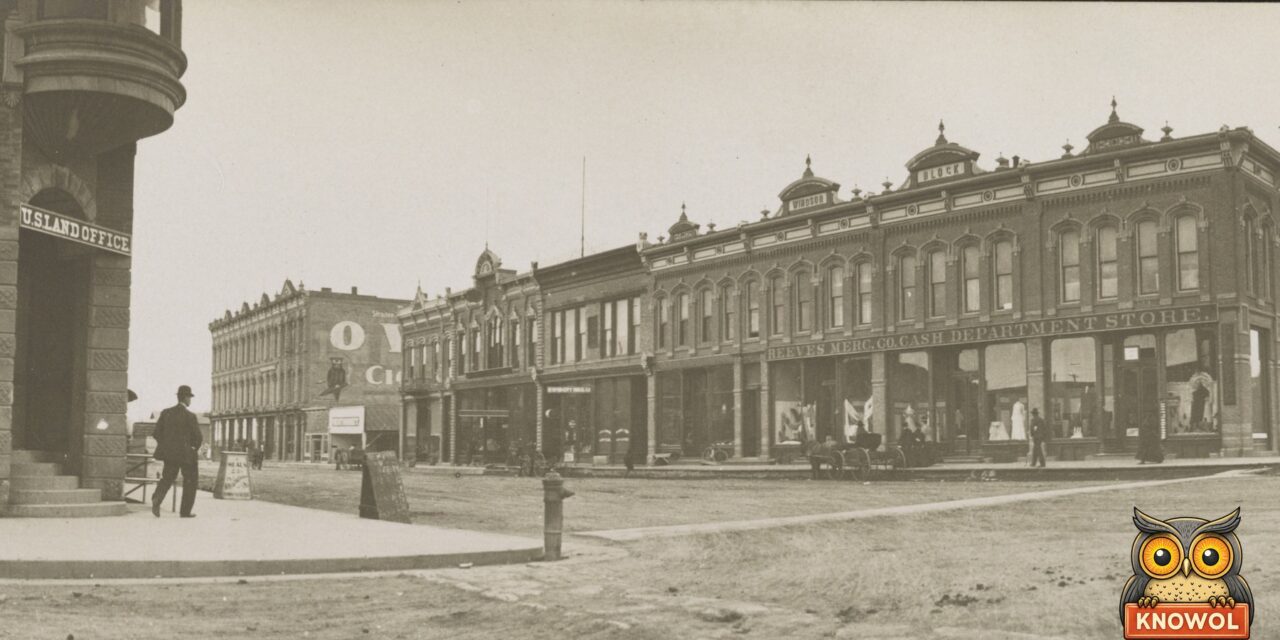
On the morning of October 24, 1911, in a packed hall in Gregory, South Dakota, two little girls reached into a stack of 53,000 envelopes and pulled one out together. The judge opened it and read the name: Mary J. Kendall of Rapid City. She had just won the first pick of about 3,000 homestead claims. The Omaha Bee put it at the top of its front page the next morning: “WOMAN’S NAME IN FIRST ENVELOPE.”
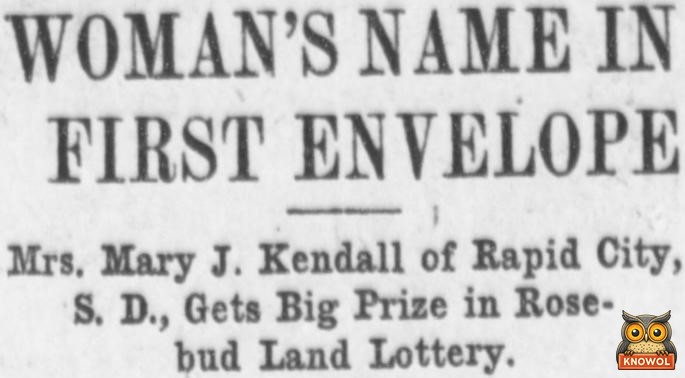
“Woman’s Name in First Envelope,” the Omaha Daily Bee, Omaha, Nebraska, October 25, 1911, page 1. Library of Congress, Chronicling America. Click the clipping to read it full size.
Just before the drawing
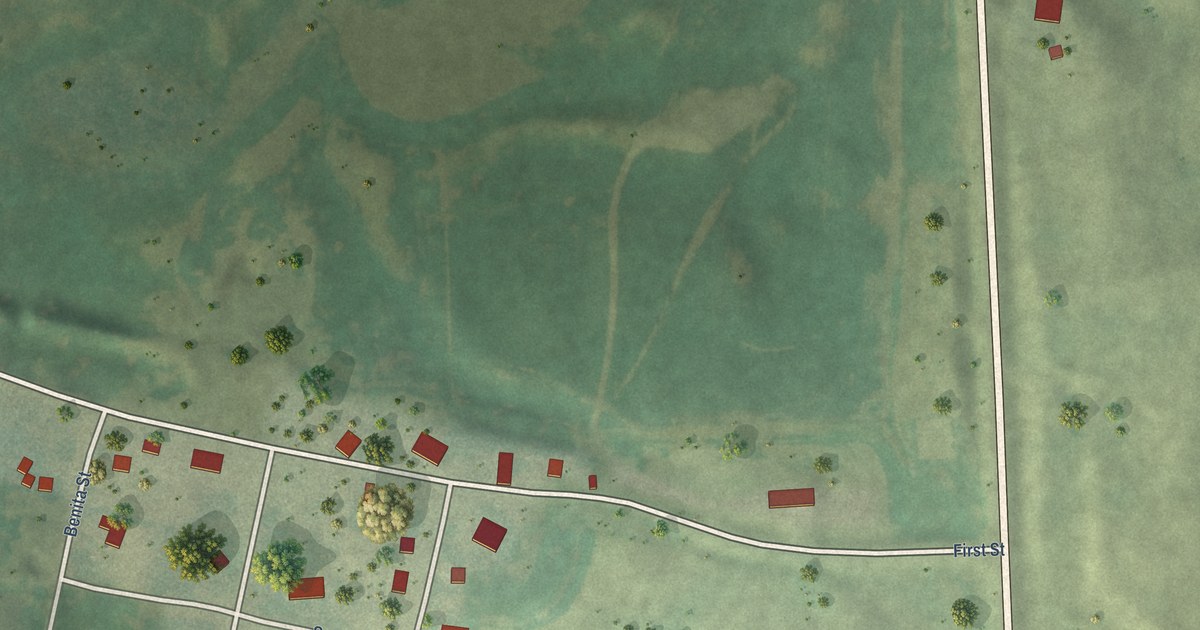
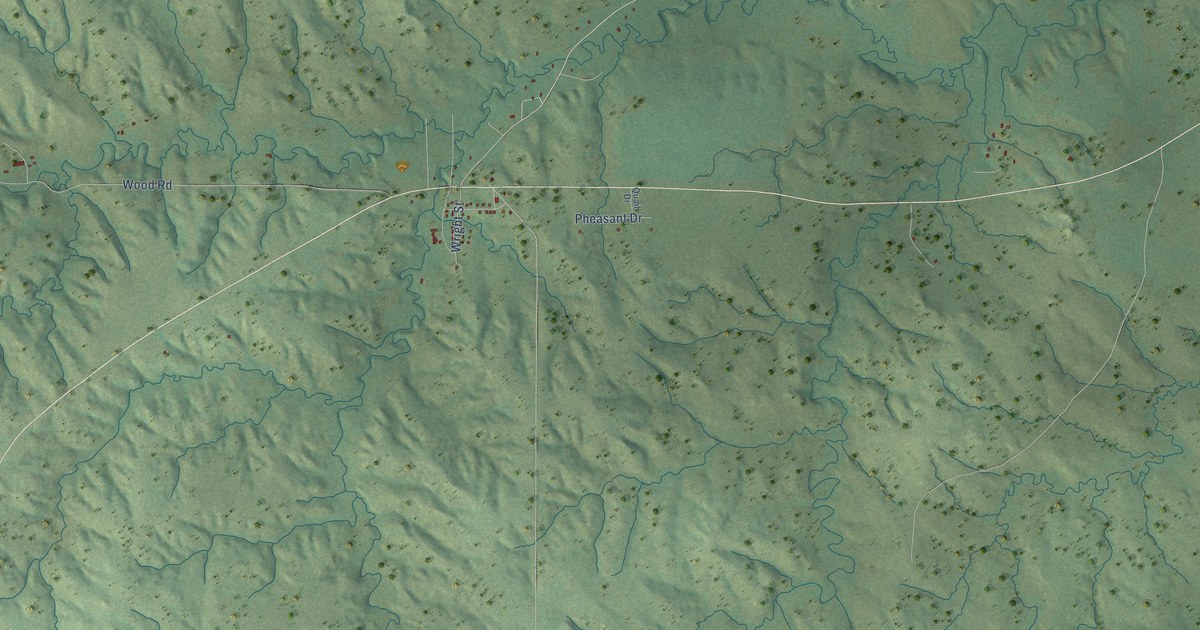
The land had been part of the Rosebud and Pine Ridge reservations, and the government was opening it to homesteaders by lottery. The Miller Press later put it at about a million acres in Mellette County. Fifty-three thousand people had registered for a chance at a 160-acre claim, and only the first few thousand names drawn would get one.
The opening was short and a little sentimental. A chorus of girls sang a song for the occasion, “Just Before the Drawing, Sweetheart.” Judge James Witten, who ran the drawing, gave an address. The plan had been for the two girls, Virginia Foster of Dallas and Dorothy Slaughter of Gregory, to draw lots for the honor of picking the first envelope. At the last moment the judge let them do it together. No. 1 was the first choice of the whole tract, and the Bee figured it was worth $10,000. When Judge Witten called Mary Kendall’s name, the hall cheered.
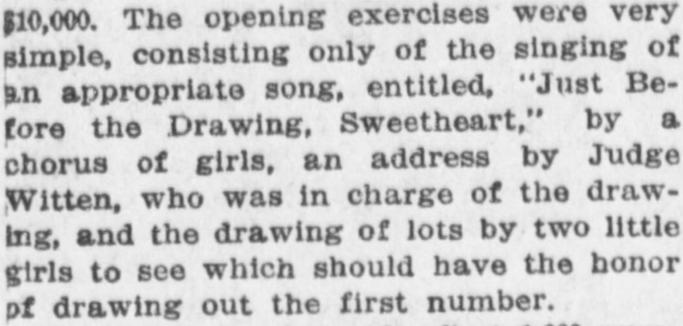
The Omaha Daily Bee, Omaha, Nebraska, October 25, 1911, page 1. Library of Congress, Chronicling America. Click the clipping to read it full size.
A telegram on St. Joseph Street
Mary wasn’t in Gregory. She lived on St. Joseph Street in Rapid City, and the news came by telegram. Her husband, Stacy R. Kendall, couldn’t walk. He sold fruit and vegetables and ran a box ball room, and that didn’t bring in much. For six months, the Madison Daily Leader reported, Mary had “woven carpets by day, herded and milked cows and cared for her husband at night.”
She ran to him with the telegram in her hand and fell to her knees beside his invalid chair. With tears running down his face, he put his hand on her head and said, “There, Mary, I told you God would remember us some time and he has.”
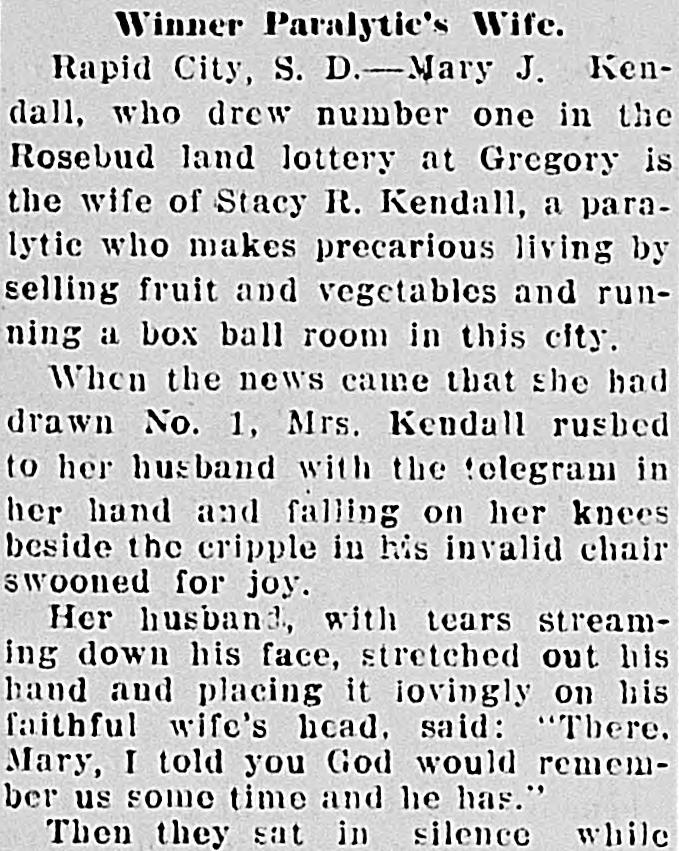
“Winner Paralytic’s Wife,” the Mitchell Capital, Mitchell, South Dakota, October 26, 1911, page 4. Library of Congress, Chronicling America. Click the clipping to read it full size.
The Kendalls were Indiana people who had come to the Black Hills about fifteen years before. Stacy prospected for gold around Custer and Keystone and never struck it. In May 1906 their daughter Lily lay dying at the sisters’ school in Sturgis, and he went there to nurse her. Worn out from sitting up with her, he walked into the hills for some fresh air, fell from a cliff in a spring blizzard, and lay 23 hours under two feet of snow before anyone found him. He was paralyzed from the waist down and hadn’t worked since.
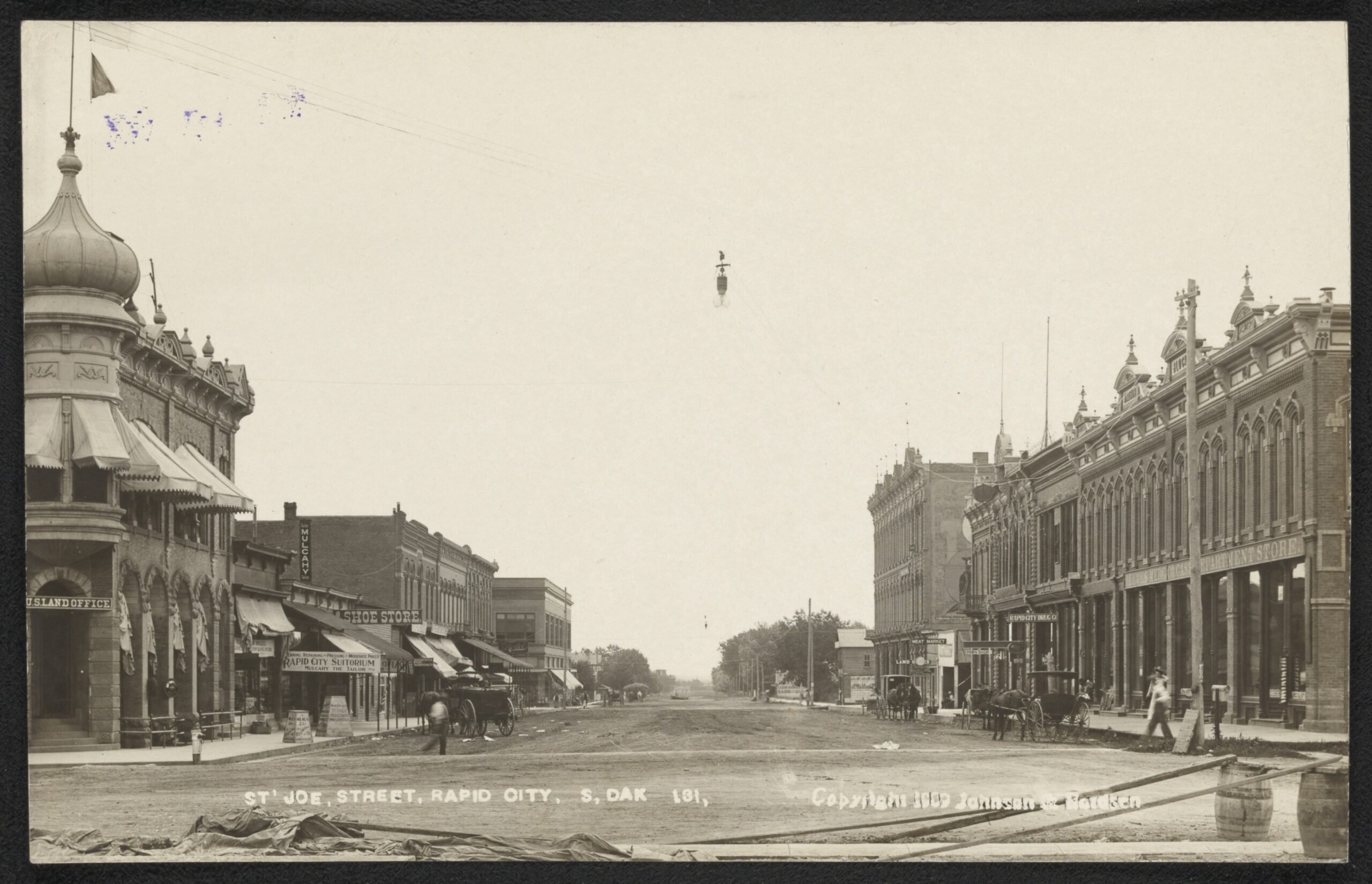
St. Joe Street, Rapid City, South Dakota, the street the Kendalls lived on, with the U.S. Land Office at left, on a 1909 postcard by Johnson and Bordsen. Library of Congress. Click the picture to see it full size.
Box ball and a $2,000 offer
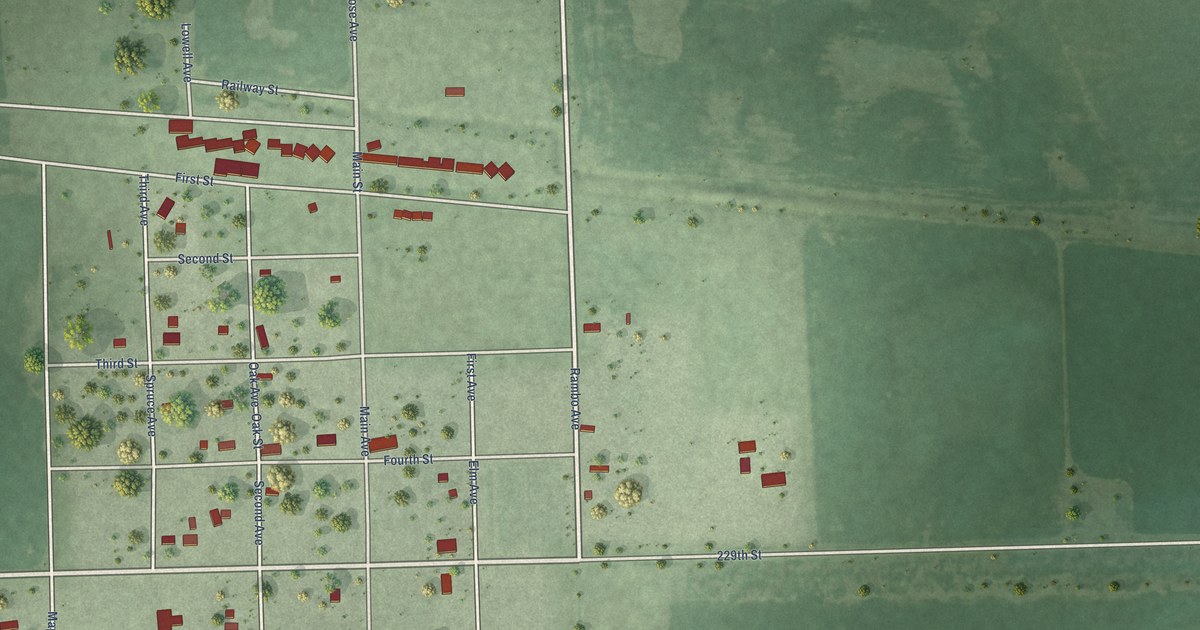
Box ball was a short indoor bowling game, and in those years it was spreading through the pool halls of South Dakota. A 1908 ad in the Mitchell Capital made it sound easy: “$50 starts you in the Box Ball Alley business.” In Wood, a little town in the same Mellette County lands, the Palace Pool Hall put one in at the end of 1912, and the local paper noted it was the first one the town had ever had.

A box ball advertisement in the Mitchell Capital, Mitchell, South Dakota, July 3, 1908. Library of Congress, Chronicling America. Click the clipping to read it full size.
A good number in the drawing was worth real money the minute it was called. A newspaperman named Martin T. Bowes drew No. 1013 that first day, and the Bee reported, “He says he was offered $2,000 for his relinquishment on the spot.” A relinquishment was a winner’s paper giving up the right to a claim, so somebody else could file on it.
What she did with No. 1
Mary looked the land over and picked a 160-acre farm “after a careful inspection of the opened lands,” the Miller Press said. But a homestead had to be lived on and improved before it was yours, and the Kendalls couldn’t do it. By June 1912 she had sold her relinquishment to J. G. Renwich of Harrisonville, Missouri. Nobody published the price.
The Reporter and Farmer in Webster, South Dakota, told the end of the story in a few lines. The Kendalls were poor, it said, and Mrs. Kendall still supported the family selling fruit and vegetables on the streets of Rapid City. “With the money received they can now build a house and pay for it and live in comfort.”
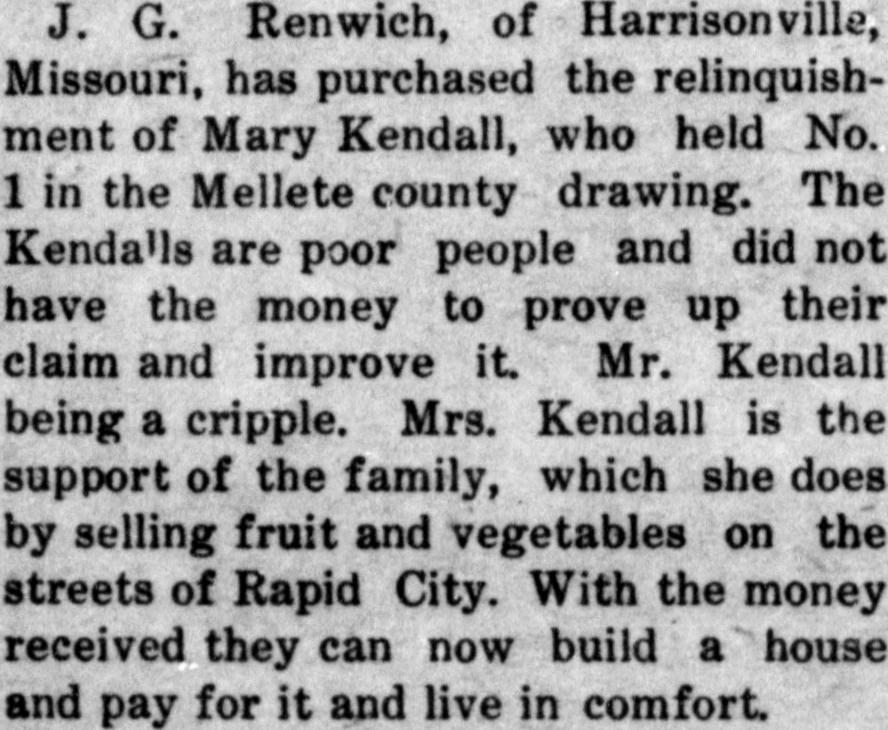
The Reporter and Farmer, Webster, South Dakota, June 6, 1912, page 6. Library of Congress, Chronicling America. Click the clipping to read it full size.
Sources
- Omaha Daily Bee (Omaha, Neb.), October 25, 1911, page 1 (the drawing) and October 26, 1911, page 5 (the cheer; Martin T. Bowes).
- The Mitchell Capital (Mitchell, S.D.), October 26, 1911, page 4 (“Winner Paralytic’s Wife”) and July 3, 1908, page 9 (box ball advertisement).
- The Madison Daily Leader (Madison, S.D.), October 26, 1911, page 2 (“First Prize in Land Lottery Goes to a Worthy Home”).
- The Miller Press (Miller, S.D.), June 6, 1912, page 3 (“Claim No. 1 Sold”).
- Reporter and Farmer (Webster, S.D.), June 6, 1912, page 6, and Philip Weekly Review (Philip, S.D.), June 13, 1912, page 1 (the relinquishment sold to J. G. Renwich).
- The Mellette County Pioneer (Wood, S.D.), December 20, 1912, page 1 (“Installs a Box Ball Alley”).
- All newspaper images: Library of Congress, Chronicling America. No known copyright restrictions.
- Photograph: “St. Joe Street, Rapid City, S. Dak.,” real photo postcard, copyright 1909 by Johnson and Bordsen, Library of Congress Prints and Photographs. Published 1909, public domain.
- Cover: “Corner of St. Joe & 7th Street looking east & south, Rapid City, S. Dak.,” photograph, about 1909 (cropped). Library of Congress Prints and Photographs Division, 2013647005. No known restrictions on publication.