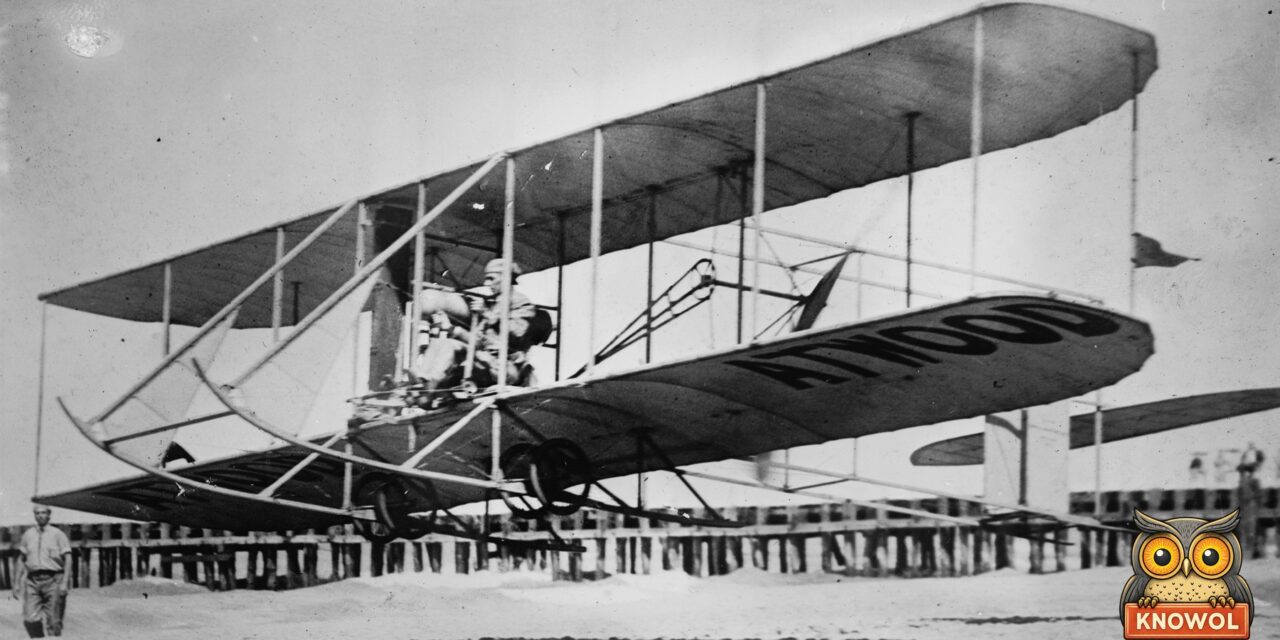
At 6:17 on the evening of Monday, June 19, 1911, Harrison H. King was standing in the back of an automobile by the Varick park fence in Manchester, New Hampshire, when he spotted a tiny thing in the sky to the south, over Maple Street. “There she comes,” he shouted. Two men started waving The Union’s white flag, and on the circus grounds a crowd that Police Sergeant Peter Callaghan put at 10,000 people turned to watch Harry N. Atwood fly in.
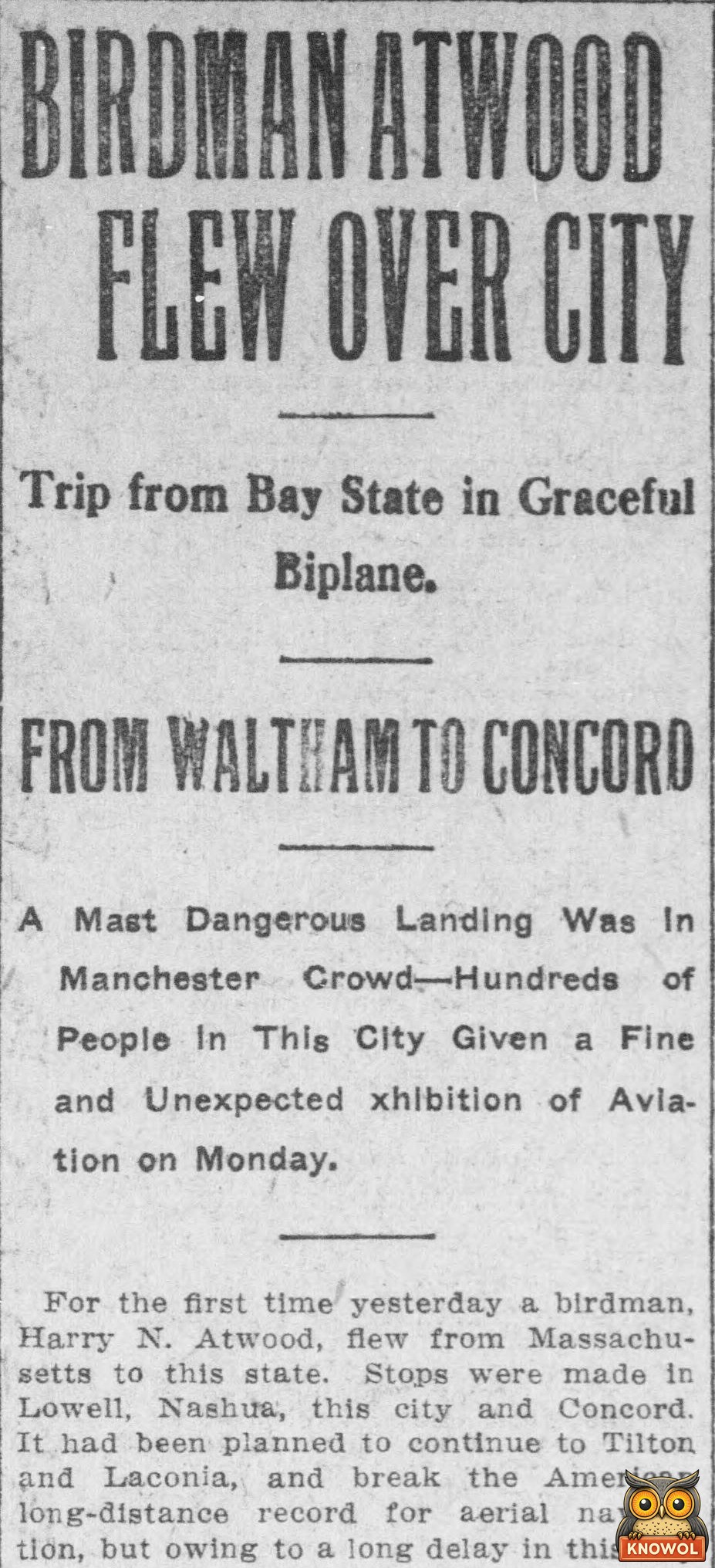
“Birdman Atwood Flew Over City,” New Hampshire Farmer and Weekly Union, Manchester, New Hampshire, June 21, 1911, page 5. Library of Congress, Chronicling America. Click the clipping to read it full size.
Up the Merrimack from Waltham
That afternoon Atwood, a young Massachusetts flier, had taken off from an aviation meet in Waltham in a Burgess-Wright biplane. He carried greetings from Governor Eugene N. Foss of Massachusetts to Governor Robert P. Bass of New Hampshire. He followed the Merrimack River north, stopping at Lowell and Nashua and changing passengers at every stop. The Union called it the first time a birdman had flown from Massachusetts into the state. Even the Daily Kennebec Journal, up in Augusta, Maine, ran the news under the headline “A Remarkable Flight.”
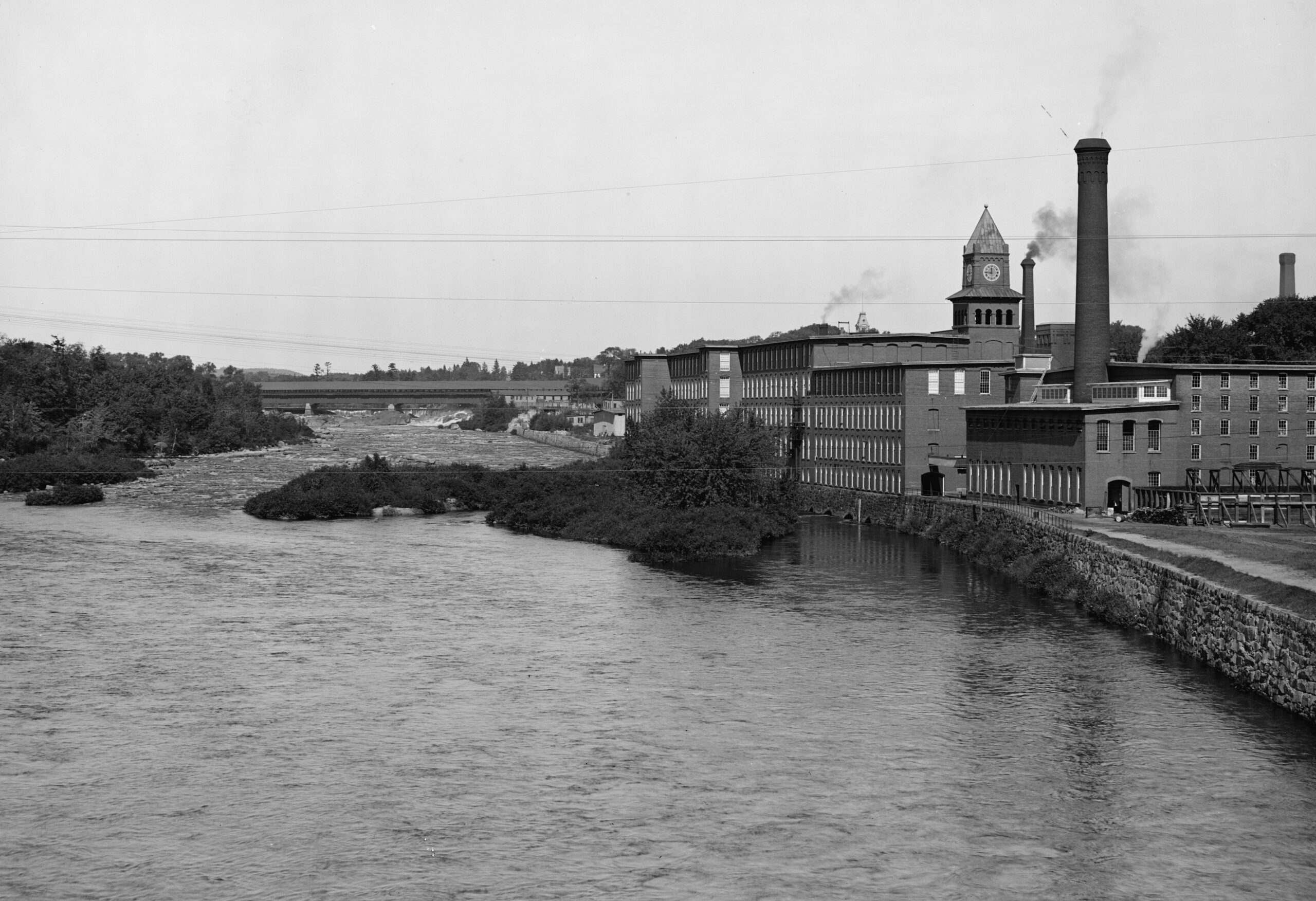
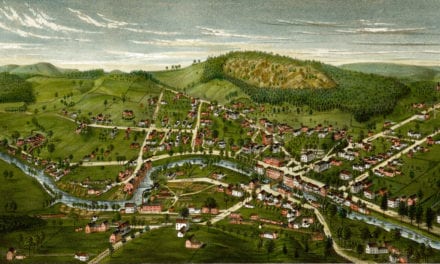
The Merrimack River and its mills at Manchester, New Hampshire, the river Atwood followed north from Massachusetts. Detroit Publishing Co., between 1900 and 1920. Library of Congress, no known restrictions on publication. Click the picture to see it full size.
A field full of people
The Evening Union had printed the news that afternoon, and its readers hurried to the circus grounds. Nobody kept the landing field clear. Joseph Toye of Boston, who rode in from Nashua, said the park looked empty from far off but turned out to be packed with people. Atwood yelled that they’d never be able to land there, so they skimmed over the roof of a tenement house and came down at the far end of the field.
“This is the worst and most dangerous landing I ever made,” Atwood told The Union. When he tried to take off again, the crowd closed in, and he waited half an hour for Sergeant Callaghan’s officers to clear a path.
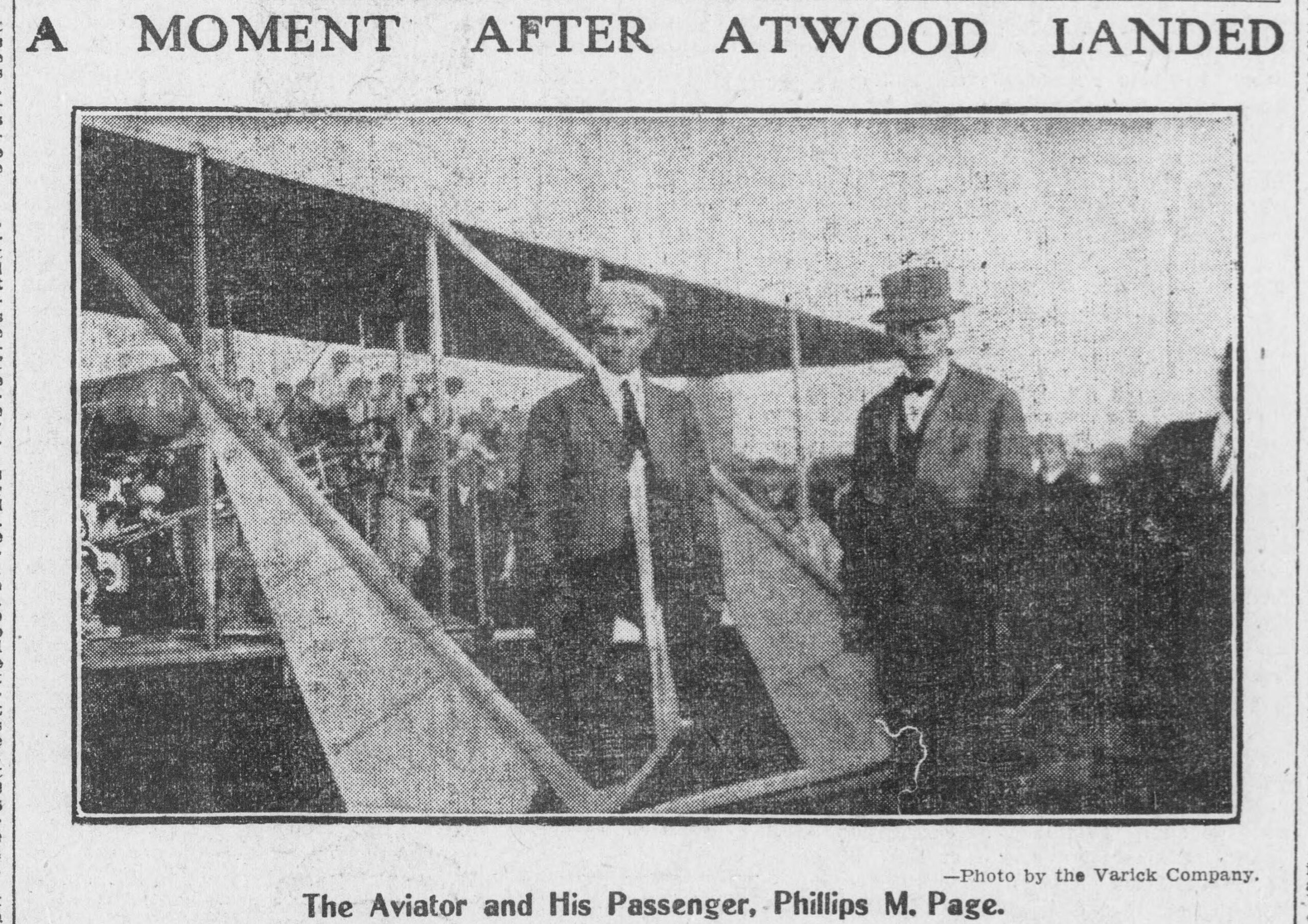
“A Moment After Atwood Landed”: the aviator and his passenger, Phillips M. Page, on the circus grounds in Manchester. Photo by the Varick Company, New Hampshire Farmer and Weekly Union, June 21, 1911, page 5. Library of Congress, Chronicling America. Click the picture to see it full size.
Mail from the sky
Atwood climbed down and handed a letter to The Union’s reporter. “I want to give you the first aerial message ever sent in New Hampshire,” he said. It was a note from the paper’s man in Nashua, saying 800 people had watched the landing there. Nashua’s mayor sent one to Manchester’s mayor, too, and The Union printed it whole:
Hon. Edward C. Smith, Mayor of Manchester, N. H.
Greetings from the Second to the Queen city. “Above all things” send an answer by aerial post.
WILLIAM H. BARRY, Mayor.
A salesman’s postcards
Not all the mail was so grand. Atwood also brought a letter for Clarence Murphy, the day clerk at the New Manchester hotel, and “postcards from an enterprising drummer to all of his local customers, informing them that he will call upon them today.” A drummer was a traveling salesman, and this one sent word ahead to his customers by flying machine.
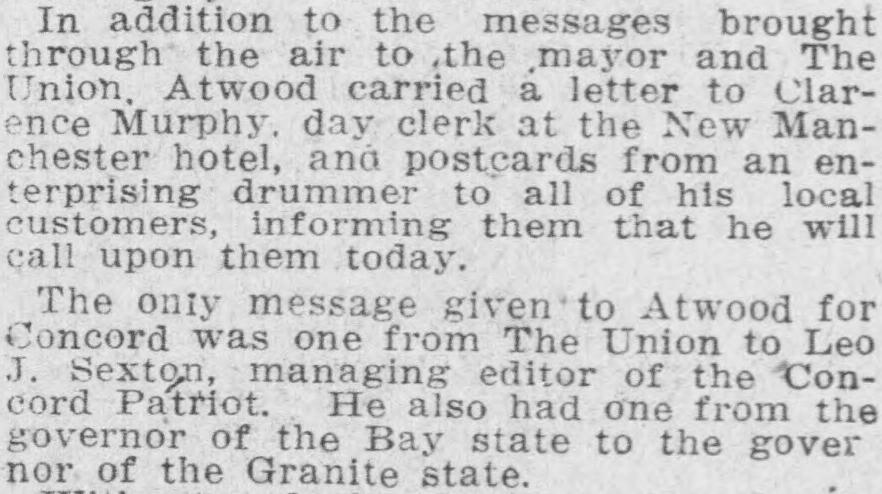
The letter and the drummer’s postcards that came by air. New Hampshire Farmer and Weekly Union, Manchester, New Hampshire, June 21, 1911, page 5. Library of Congress, Chronicling America. Click the clipping to read it full size.
Cold feet and cameras
Toye loved the ride. From 2,000 feet up, he said, houses looked like children’s blocks. A week later The Union told a funnier side of the trip. Atwood said all amateur passengers got cold feet. His passengers had planned to take pictures from the air, but the first one left his camera behind to hang on with both fists, and so did the man from Lowell. Toye had left his back in Nashua.
Phillips M. Page, who rode on to Concord, had lugged a big camera around Manchester all day, promising everybody from the mayor down a bird’s-eye picture. After that landing, he handed it to The Union’s man. “Here, take this camera, will you, please, and send it to me in Boston. I don’t think I will need it.”
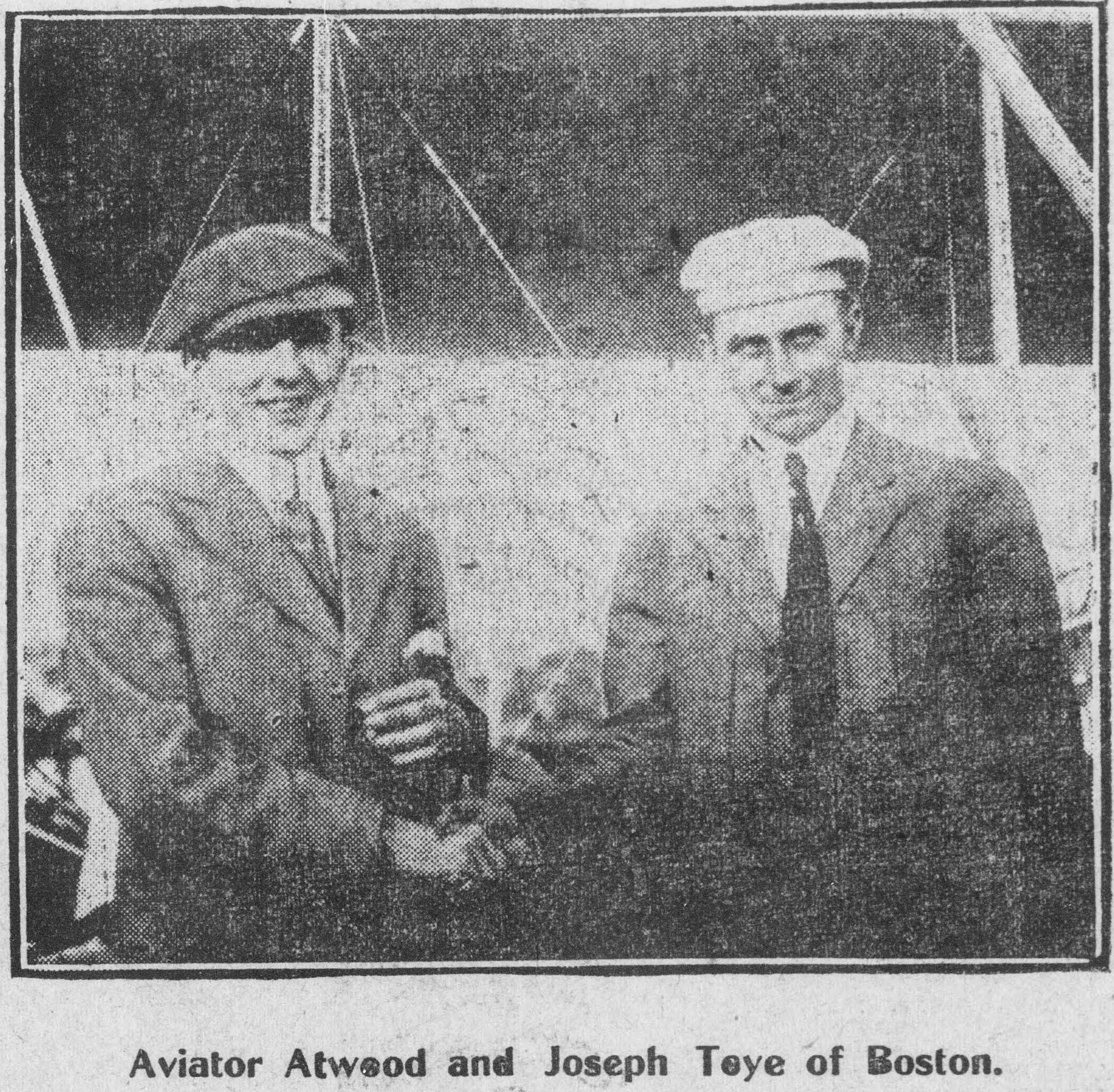
“Aviator Atwood and Joseph Toye of Boston,” who rode with him from Nashua to Manchester. New Hampshire Farmer and Weekly Union, June 21, 1911, page 5. Library of Congress, Chronicling America. Click the picture to see it full size.
A picture over the lakes
Atwood and Page reached Concord at dark. Next morning Atwood flew on to the Tilton fair grounds, where a Boston newspaperman, O. G. Draper, had waited about eighteen hours for his turn. Strong wind off the lakes kept them from Laconia, where a big crowd stood waiting, and Atwood came down with great difficulty on Dr. Frank H. Sargent’s estate in Pittsfield. Draper climbed out with a camera on a string around his neck. Inside, The Union reported, was the film of “the first photograph ever taken from an aeroplane in New Hampshire.” Draper said it was a bit of lake scenery, and he expected it to come out all right.
Home on wheels
On Saturday morning, June 24, the biplane came back through Manchester on its way to Boston, folded up on a truck. “It trundled along quite humbly behind an automobile.” It stopped at Lowell and Chestnut streets for gasoline, and a crowd gathered at once. When it started south again, the small boys running after it were soon left behind. Five days earlier, 10,000 people had waited on the circus grounds for that same machine to come down out of the sky.
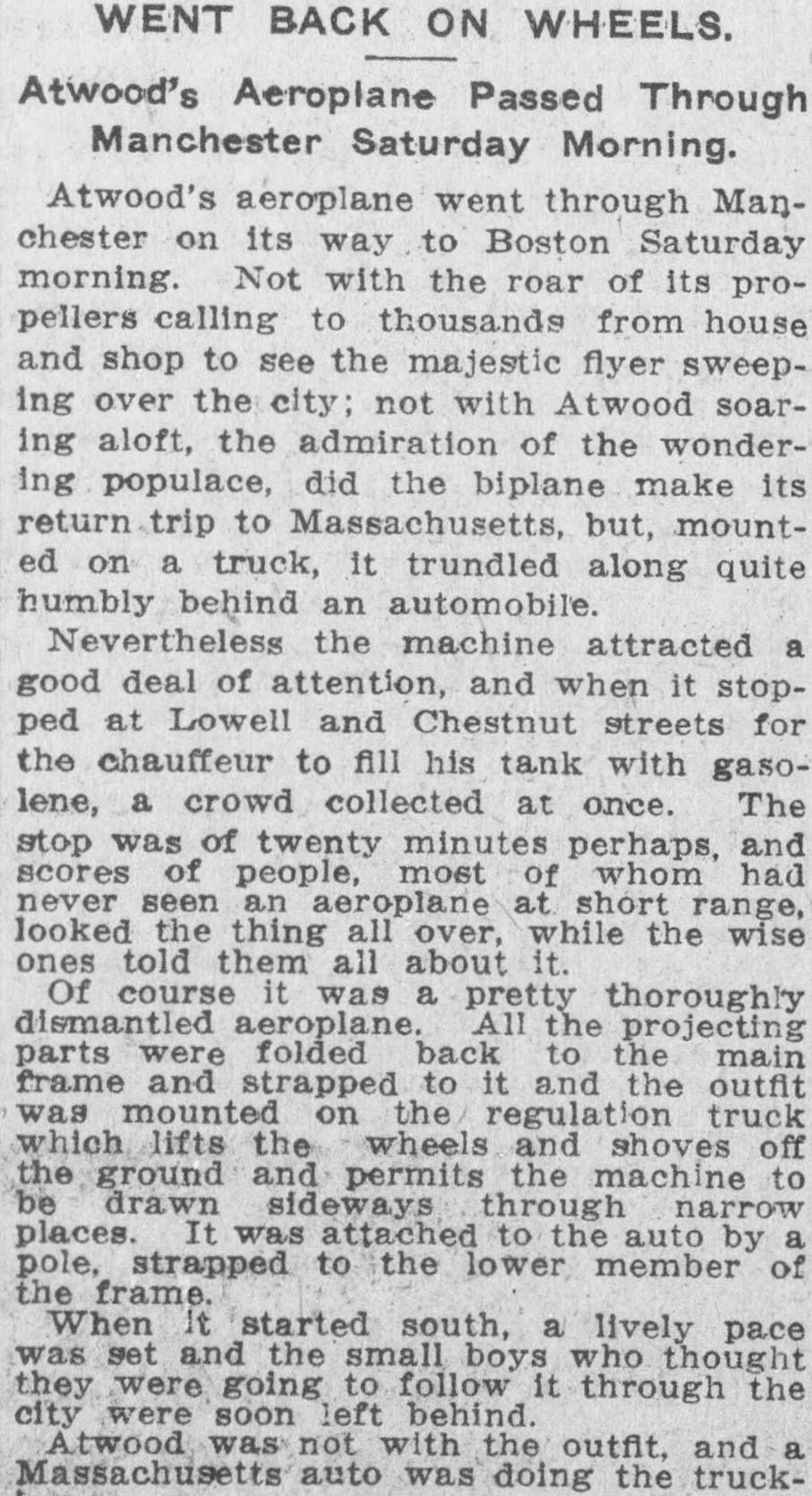
“Went Back on Wheels”: Atwood’s biplane passes through Manchester on a truck. New Hampshire Farmer and Weekly Union, Manchester, New Hampshire, June 28, 1911, page 12. Library of Congress, Chronicling America. Click the clipping to read it full size.
Sources
- New Hampshire Farmer and Weekly Union (Manchester, N.H.), June 21, 1911, page 5 (“Birdman Atwood Flew Over City,” with the Nashua and Concord specials, the mayor’s message, Toye’s account and the Union photographs).
- New Hampshire Farmer and Weekly Union, June 21, 1911, page 11 (the Tilton, Laconia and Pittsfield flight on June 20, and Draper’s camera).
- New Hampshire Farmer and Weekly Union, June 28, 1911, page 10 (Atwood on the “cold feet” of amateur passengers and their cameras).
- New Hampshire Farmer and Weekly Union, June 28, 1911, page 12 (“Went Back on Wheels”).
- Daily Kennebec Journal (Augusta, Me.), June 20, 1911, page 3 (“A Remarkable Flight”).
- Newspaper images from the Library of Congress, Chronicling America. Published 1911, public domain.
- Merrimack River at Manchester, N.H., Detroit Publishing Co., between 1900 and 1920, Library of Congress, no known restrictions on publication.
- Cover: “Atwood rising,” Harry N. Atwood’s biplane lifting off a beach about 1911 (not the New Hampshire flight), Bain News Service glass negative (cropped). Library of Congress Prints and Photographs Division, 2014689493. No known restrictions on publication.