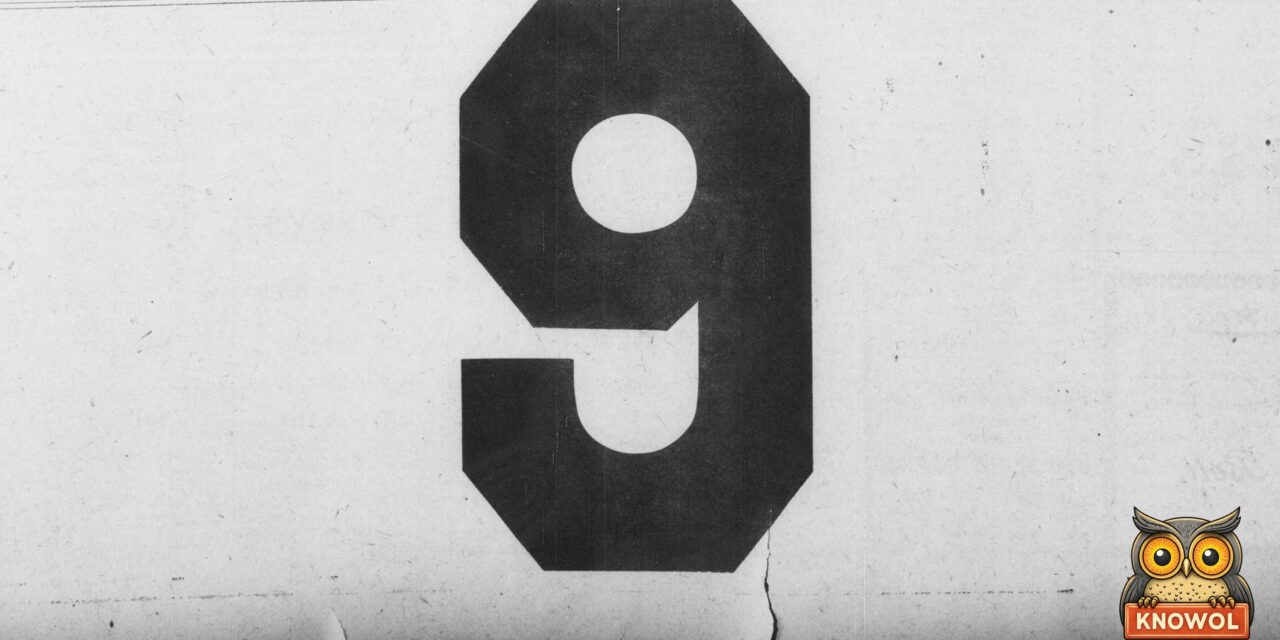
In the last week of October 1905, readers of the Americus Times-Recorder in Americus, Georgia kept opening their paper to the same strange sight. Across the bottom of the front page sat a huge black figure 9, almost a quarter of the page tall. There was no store name under it, no price and no picture, and for days the paper didn’t say one word about it.

The bottom of the front page, Americus Times-Recorder, Americus, Georgia, October 31, 1905. Library of Congress, Chronicling America. Click the clipping to read it full size.
Just a 9
The 9 first showed up on Friday, October 27, all by itself. Nothing else on the page explained it. The next morning it was back, and this time a line of type sat on each side of it, both saying “Watch for Ad.” It ran the same way in Sunday’s paper, and since there was no Monday paper, it greeted readers again on Tuesday, October 31.
Halloween came and went with the 9 still sitting there. Later the paper described the stir it caused. For several days, it said, the figure “has mystified thousands of readers, and one could hear on every hand, ‘What does it mean?'”
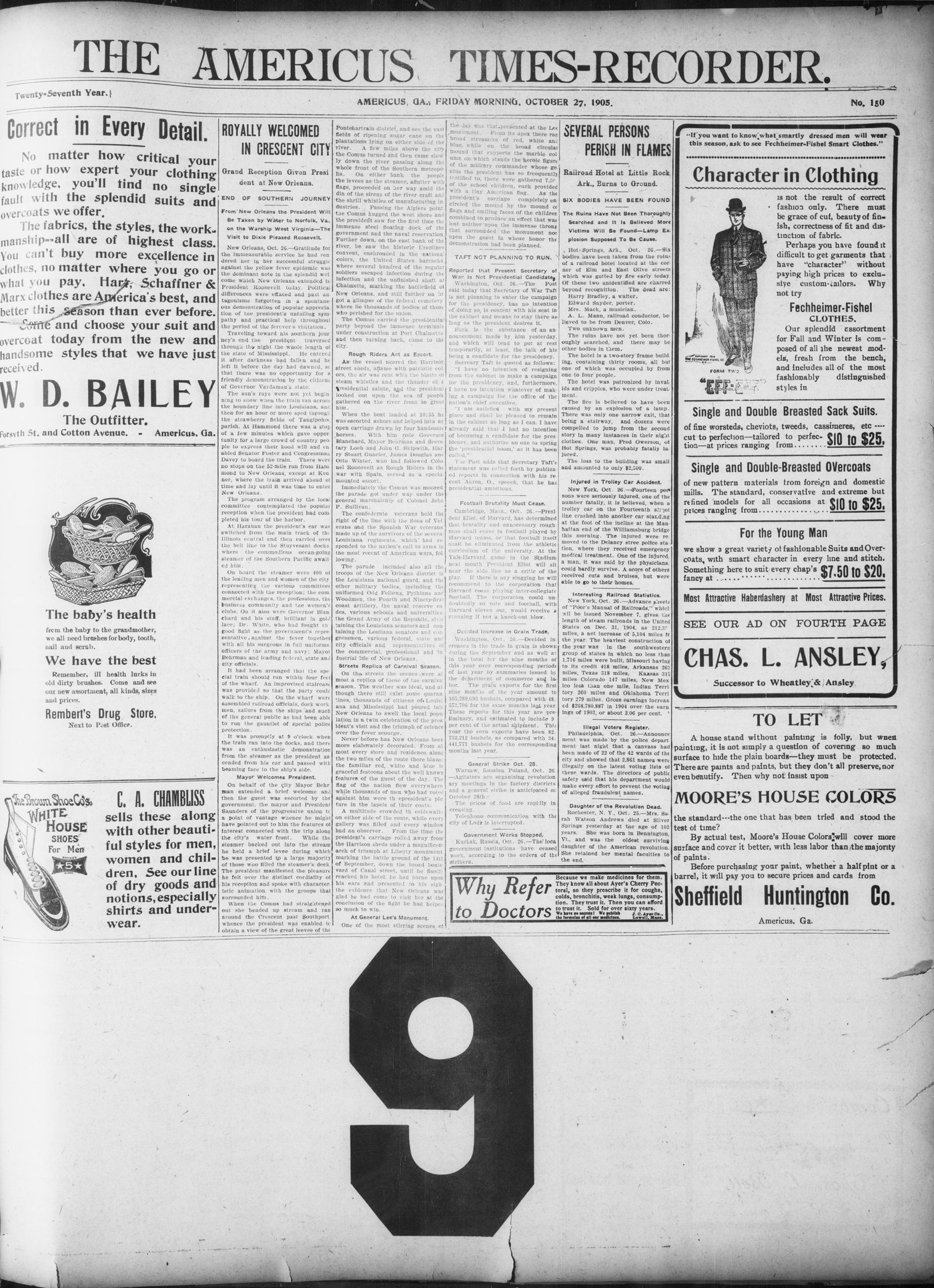
The whole front page on Friday, October 27, 1905, with the first 9 all alone across the bottom. Americus Times-Recorder. Library of Congress, Chronicling America. Click the clipping to read it full size.
The mystery fully solved
On Wednesday, November 1, the 9 was gone. In its place ran a big ad that shouted “GREAT NINE-CENT SALE!” It promised “A Mammoth $15,000 Stock of New and Seasonable Goods to be Slaughtered IN NINE DAYS,” belonging to M. Williams, of 207 Forsyth Street. The sale would begin at 8:30 in the morning on Friday, November 3.
Inside, on page 4, the paper let its readers in on the secret under the headline “The ‘Mystery’ Fully Solved.” The big ad “tells the tale of the great 9-cent sale,” it said, and the sale “continues nine days of genuine bargain selling.” Then came the hook. “One novel feature of this sale is the plan of giving every ninth customer a present free, it matters not if the purchase is ten cents or ten dollars.” The presents would be things like “clothing, shoes, caps, hosiery, suspenders, handkerchiefs, etc.”
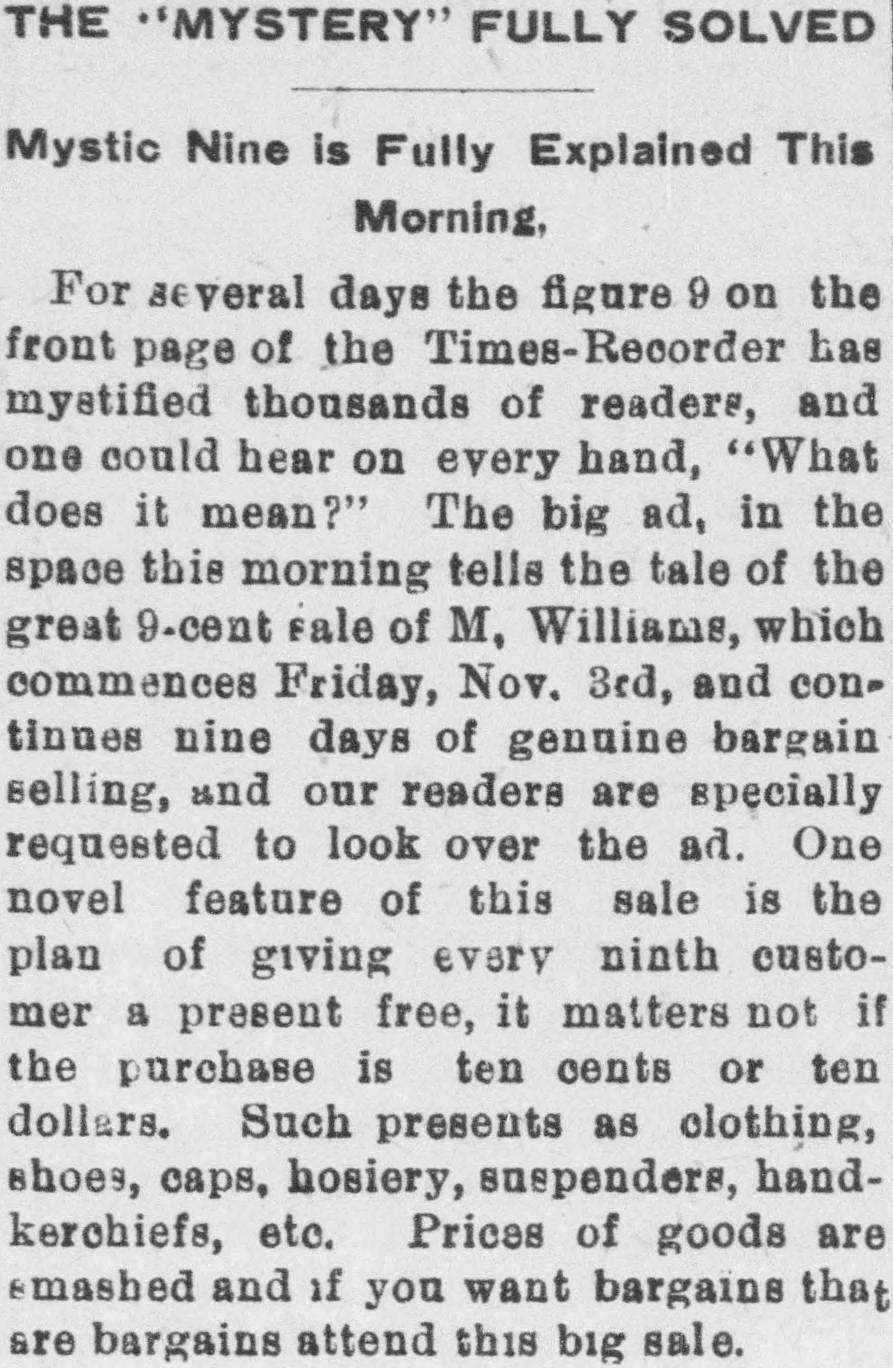
“The ‘Mystery’ Fully Solved,” Americus Times-Recorder, November 1, 1905, page 4. Library of Congress, Chronicling America. Click the clipping to read it full size.
Prices that end in 9
The ad itself reads like a walk through a dry goods store. Skirts worth $2 were $1.19. Blankets worth $2 were $1.49, and the store said, “These goods are winter necessities and as our stock is too large we are going to cut the price and cut hard.” Felt hats, regularly $1.50, were 99 cents, and men’s and boys’ 35-cent caps were 19 cents. Trunks ran from $1.89 to $7.49, and telescopes, light travel cases made of two halves that slid together, went for 39 to 89 cents. A man could buy a fancy cheviot suit, a regular $8.50 value, for $6.49.
Most of the prices in the ad end in 9, and that seems to be where the “nine-cent” name came from. Ladies’ hats were offered “at prices competitors cannot touch.” The ad still didn’t have room for everything, so it simply said, “For want of space cant price all of stock. Come and see them.”
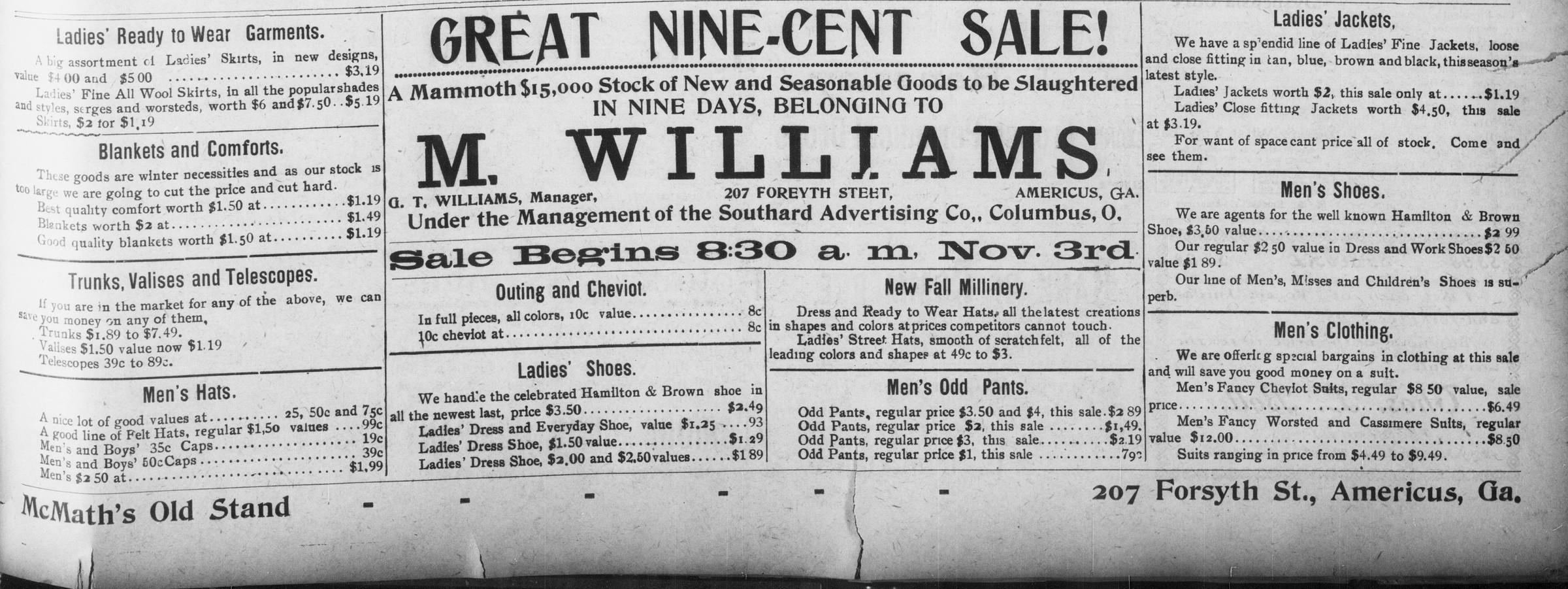
“Great Nine-Cent Sale!” across the bottom of the front page, Americus Times-Recorder, November 1, 1905. Library of Congress, Chronicling America. Click the picture to see it full size.
A store on Forsyth Street
So who was M. Williams? The ad gave a few clues. The store stood at “McMath’s Old Stand,” 207 Forsyth Street, and a G. T. Williams was its manager. Back in January 1905, T. B. Westbrook had put a notice in the same paper: “I take pleasure in stating to my friends that I am now with M. Williams, on Forsyth street.” He’d be glad to see them “when in the market for dry goods and notions.” Notions were the small things every household needed, like thread, buttons, needles and pins.
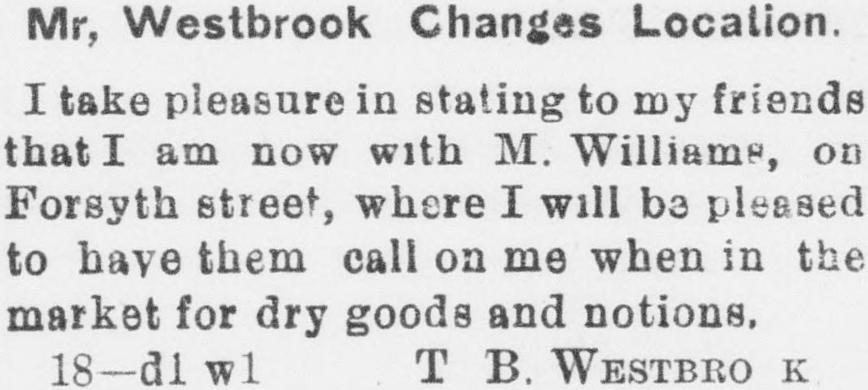
“Mr. Westbrook Changes Location,” Americus Times-Recorder, January 19, 1905, page 3. Library of Congress, Chronicling America. Click the clipping to read it full size.
There was one more line in the ad, set in big type under the store’s name. The sale was “Under the Management of the Southard Advertising Co., Columbus, O.” That was an outfit from Columbus, Ohio, more than 500 miles away. So the mystery 9 may not have been a hometown idea at all, and the Times-Recorder never said who dreamed it up.
Nine days
The big ad kept running across the bottom of the front page through at least November 9. After that the trail goes quiet. The Times-Recorder never reported how big the crowds were, how many presents went out or who walked home with a free pair of suspenders for being the ninth customer through the door.
What’s left is the trick itself. For four issues in a row, one number, a lot of ink and a lot of white space had people all over Americus, by the paper’s account, asking the same question. Then a store on Forsyth Street answered it with skirts, blankets and 19-cent caps.
Sources
- Americus Times-Recorder (Americus, Georgia), January 19, 1905, page 3 (“Mr. Westbrook Changes Location”), October 25, 1905, page 1 and October 26, 1905, page 1 (no 9 yet), October 27, 1905, page 1 (the first 9), October 28, 1905, page 1, October 29, 1905, page 1 and October 31, 1905, page 1 (the 9 with “Watch for Ad.”), November 1, 1905, page 1 (“Great Nine-Cent Sale!”), November 1, 1905, page 4 (“The ‘Mystery’ Fully Solved”) and November 9, 1905, page 1 (the ad still running).
- All newspaper images: Library of Congress, Chronicling America. Published 1905, public domain.
- Cover: the first 9, bottom of the front page, Americus Times-Recorder, Americus, Georgia, October 27, 1905. Library of Congress, Chronicling America. Published 1905, public domain.