At 1 o’clock one morning in the fall of 1905, five Philadelphia millionaires reached Denver on their way home from Nevada’s gold camps. That night they left on the Burlington in a private car, carrying “specimens of the ore taken from the track” of a Nevada railroad. The rocks were going home “to astonish the acquaintances of the Philadelphia millionaires.” On November 3, 1905, The Goldfield News of Goldfield, Nevada, reprinted the Denver News story about them under the headline “Gold and Silver for Ballast.”
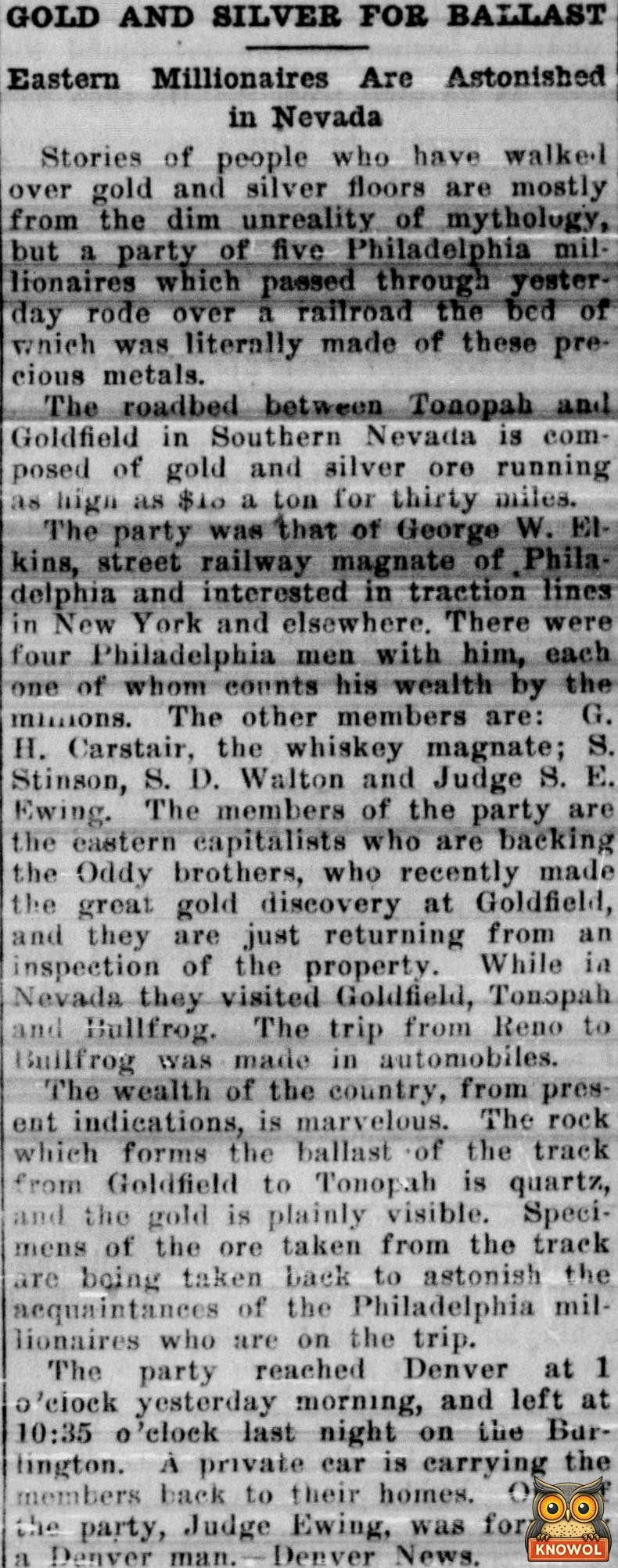
“Gold and Silver for Ballast,” reprinted from the Denver News in The Goldfield News, Goldfield, Nevada, November 3, 1905, page 3. Library of Congress, Chronicling America. Click the clipping to read it full size.
Gold under the ties
“Stories of people who have walked over gold and silver floors are mostly from the dim unreality of mythology,” the story began, but these men “rode over a railroad the bed of which was literally made of these precious metals.” Ballast is the crushed rock packed around the wooden ties to hold a track steady. On the thirty miles between Tonopah and Goldfield, the paper said, the roadbed “is composed of gold and silver ore.” It even gave a price per ton, but that figure is too worn on the page to read for sure. “The rock which forms the ballast of the track from Goldfield to Tonopah is quartz,” it added, “and the gold is plainly visible.”
Five men from Philadelphia
The leader was George W. Elkins, “street railway magnate of Philadelphia and interested in traction lines in New York and elsewhere.” With him came “G. H. Carstair, the whiskey magnate,” S. Stinson, S. D. Walton and Judge S. E. Ewing. They were the eastern money behind “the Oddy brothers,” just back from inspecting the property, and they had gone from Reno to Bullfrog by automobile.
Nevada papers spelled the name Oddie. Two weeks earlier, The Goldfield News had listed the new directors of the Denver Bullfrog mining company: T. L. Oddie and C. M. Oddie of Tonopah, with John H. Carstairs, D. B. Stinson and John W. Brock, all of Philadelphia. T. L. was Tasker Oddie, a state senator who later became governor of Nevada and a United States senator. The Denver paper’s “G. H. Carstair” was most likely John H. Carstairs.
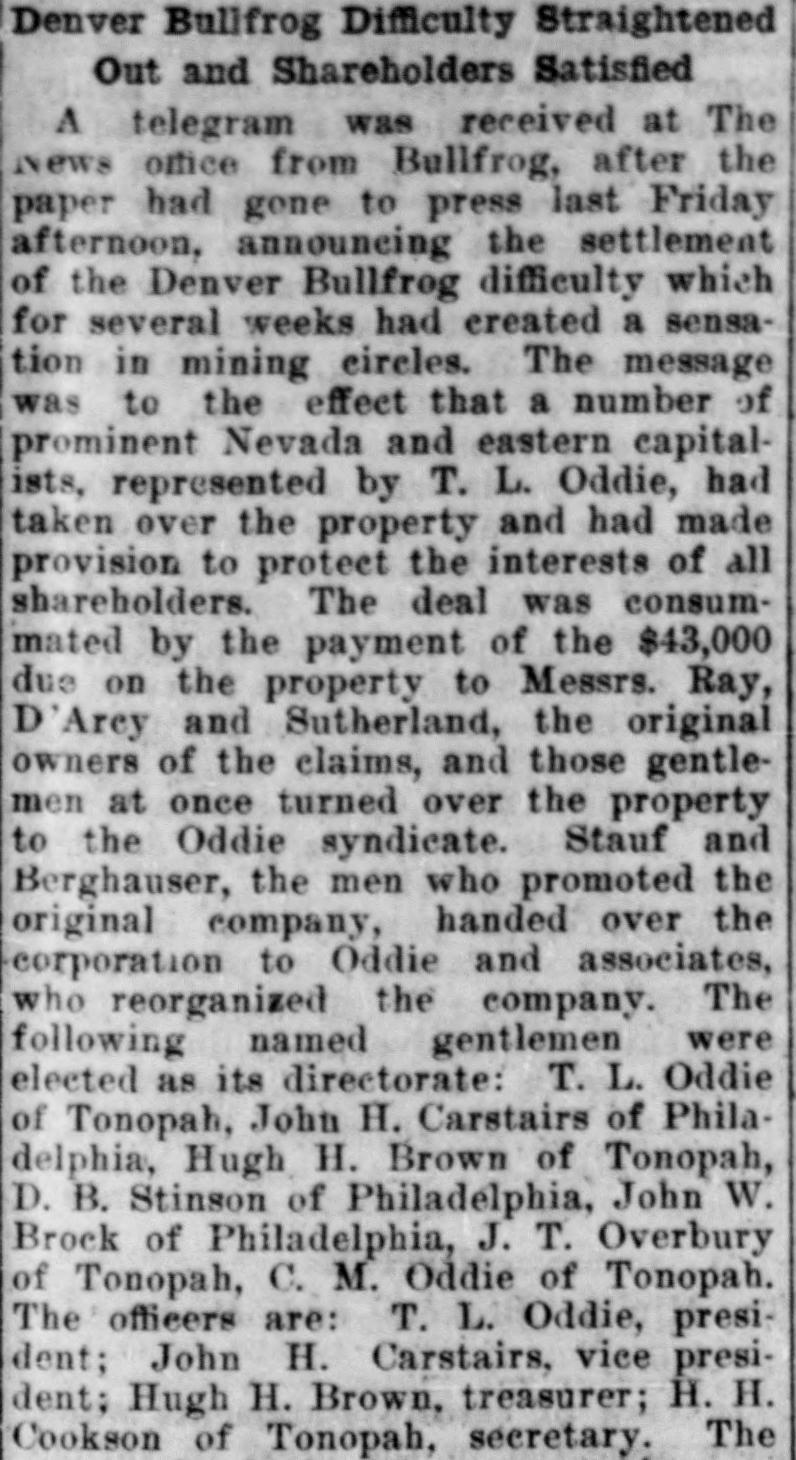
The Oddies and their Philadelphia partners take over the Denver Bullfrog company. The Goldfield News, Goldfield, Nevada, October 20, 1905, page 9. Library of Congress, Chronicling America. Click the clipping to read it full size.
A brand new railroad
The railroad was a Philadelphia project too. It belonged to the Tonopah Mining Company, which kept its business office in Philadelphia, and in 1905 the company widened its narrow-gauge line to standard gauge and stretched it south to Goldfield. That January, a Winnemucca paper had named Brock as president of the Tonopah Railroad Company.
The first train had reached Goldfield on September 12, 1905. It “pulled into the Goldfield depot at 12:43 o’clock Tuesday morning,” The Goldfield News reported, and at least 300 people met it with “cheers, the ringing of bells, tooting of tin horns and the banging of metal on tin cans.” The train was christened with champagne. It had come straight through from the Southern Pacific’s pier at Oakland, with a Pullman sleeper named Zerbino.
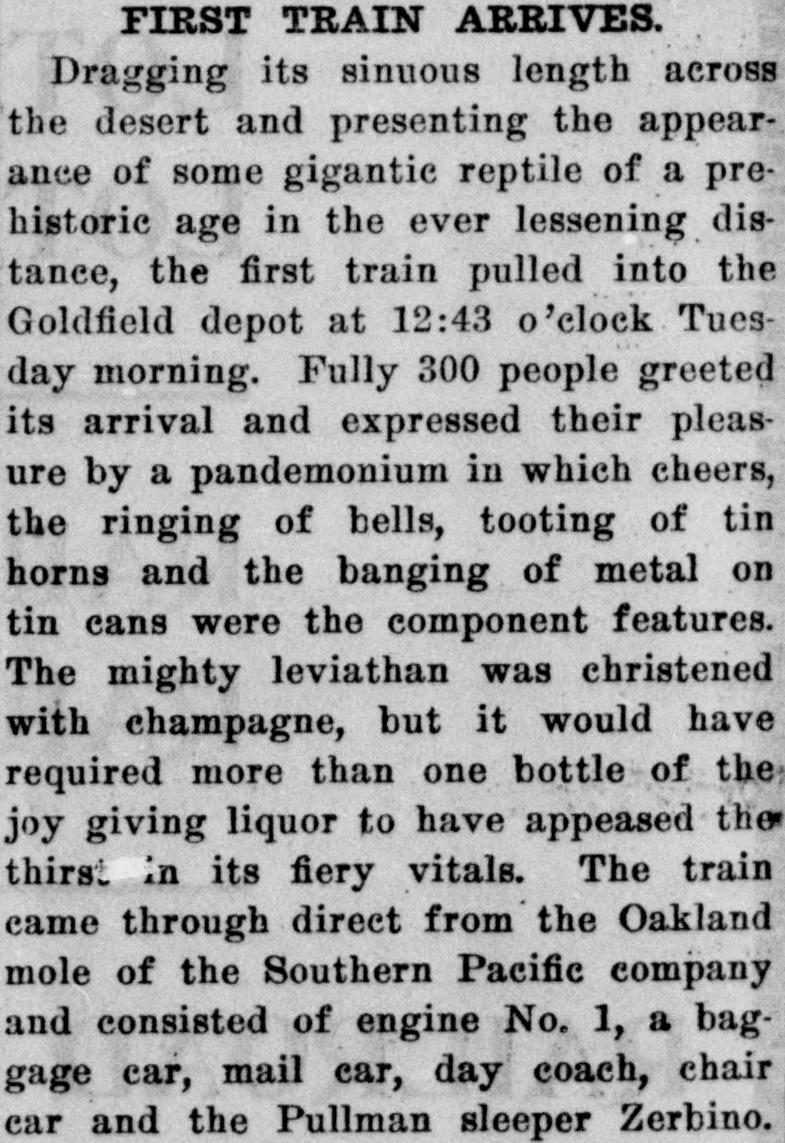
“First Train Arrives.” The Goldfield News, Goldfield, Nevada, September 15, 1905, page 11. Library of Congress, Chronicling America. Click the clipping to read it full size.
Conductor Sam Parker called the track “one of the very best I have ever ridden over,” except for the two miles nearest Goldfield, which had “not yet been thoroughly ballasted.” He joked that the crew “did not break ‘Scotty’s’ record.” That was Walter Scott, the Death Valley miner, whose hired Santa Fe special had raced from Los Angeles to Chicago that July in a record 44 hours and 54 minutes.
Too poor to ship
Ore only paid if it was worth more than its freight and smelting bills. In the same November 3 issue, C. D. Taylor of the Red Top and Jumbo mining companies complained that the Tonopah railroad charged “three-fourths as much for a haul of 90 miles as the Southern Pacific does for a haul of 800 miles.” His company had “large bodies of low-grade ore blocked out,” he said, but no way to make it pay until it had a mill of its own. Rock with some gold in it but not enough to pay its freight was just the kind that could end up under a railroad track.
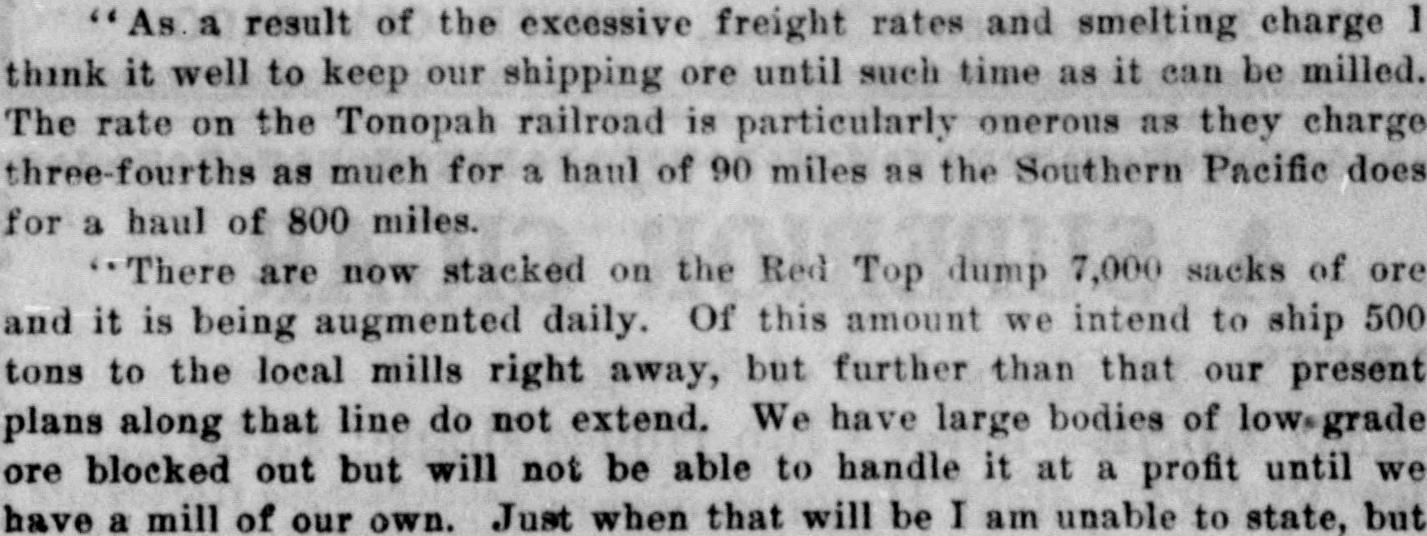
C. D. Taylor on freight rates and low-grade ore. The Goldfield News, Goldfield, Nevada, November 3, 1905, page 1. Library of Congress, Chronicling America. Click the picture to see it full size.
The rich ore got very different treatment. That day’s front-page banner read “Foot of Ore in Kendall Averages $119,000,” and the paper said the Kendall mine’s high grade was “being stored in the big vault in the Nixon block,” a “huge steel treasure chest.” The paper that told it all cost 10 cents.
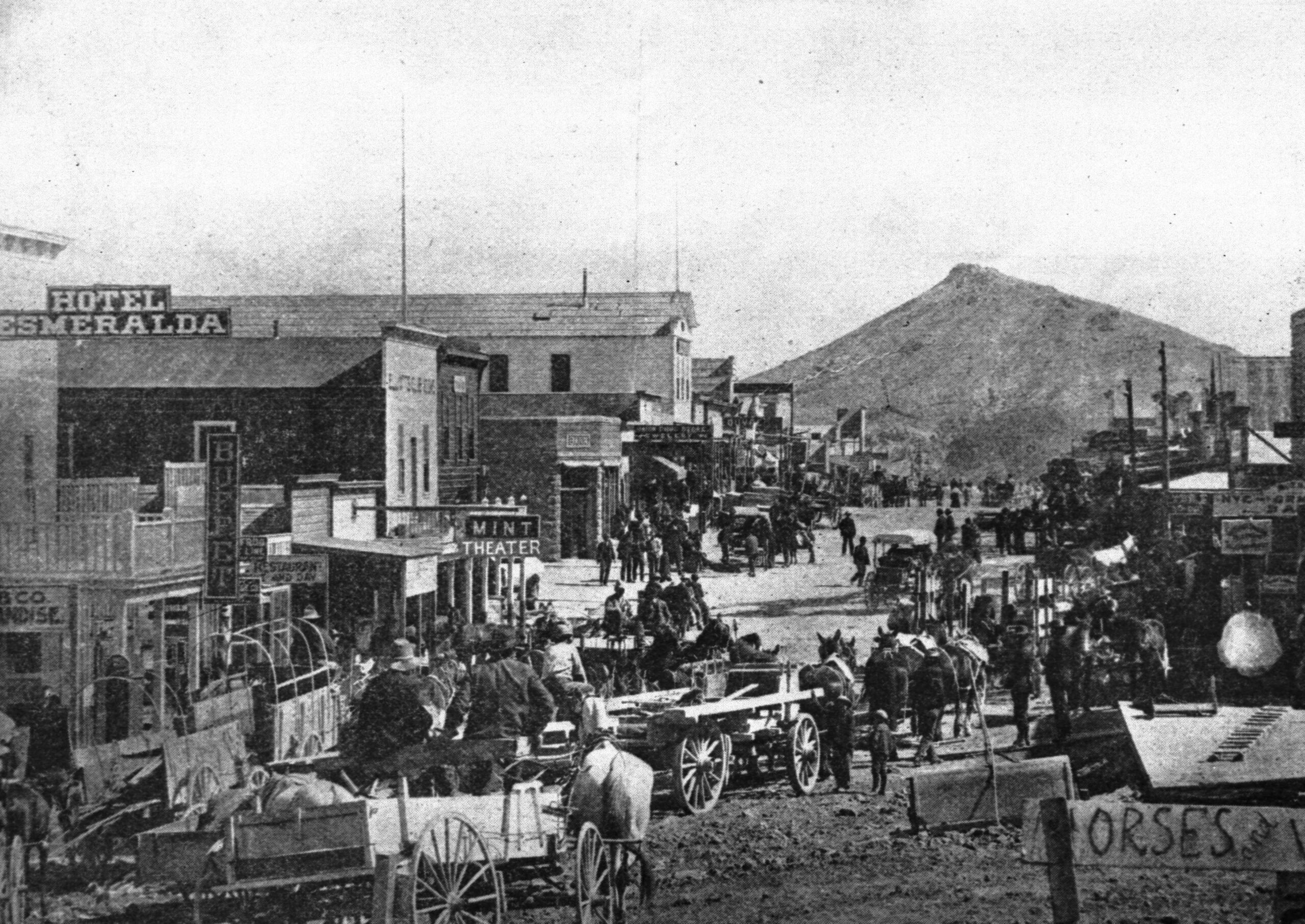
Main Street in Goldfield, Nevada, about 1905, with the Hotel Esmeralda and the Mint Theater at left and freight wagons crowding the dirt street. California Historical Society Collection, USC Digital Library, via Wikimedia Commons. Public domain. Click the picture to see it full size.
The rocks went east
The paper never said what the millionaires’ friends back home made of their rocks, and no Nevada paper we could find followed up on the gold and silver roadbed. The Tonopah and Goldfield Railroad ran until it was abandoned in 1947. The story it left behind says a lot about Goldfield in 1905: a camp where a foot of ore could assay at $119,000 a ton, where a 90-mile freight bill could eat a mine’s profit, and where even the rock under the trains was worth carrying home to show off.
Sources
- The Goldfield News (Goldfield, Nevada), November 3, 1905, page 3 (“Gold and Silver for Ballast,” reprinted from the Denver News), November 3, 1905, page 1 (“Foot of Ore in Kendall Averages $119,000” and “Taylor Talks on Red Top Affairs”), October 20, 1905, page 9 (“Denver Bullfrog Difficulty Straightened Out”) and September 15, 1905, page 11 (“First Train Arrives”).
- The Daily Silver State (Winnemucca, Nevada), January 25, 1905, page 1 (“Examining Tonopah Mines,” John W. Brock of the Tonopah Railroad Company).
- Evening Times-Republican (Marshalltown, Iowa), July 11, 1905, page 1 (the Scott special’s record run to Chicago).
- All newspaper images: Library of Congress, Chronicling America. Published 1905, public domain.
- Tonopah Mining Company Records, 1901-1941, MS-00752, Special Collections and Archives, University of Nevada, Las Vegas: finding aid (the company’s Philadelphia office, its railroad’s 1905 extension to Goldfield, and the line’s abandonment in 1947).
- National Governors Association, Gov. Tasker Lowndes Oddie (state senator, governor of Nevada, United States senator).
- Photograph: “Busy main street in Goldfield, Nevada, ca.1905,” California Historical Society Collection, USC Digital Library (CHS-2851), Wikimedia Commons. Public domain.
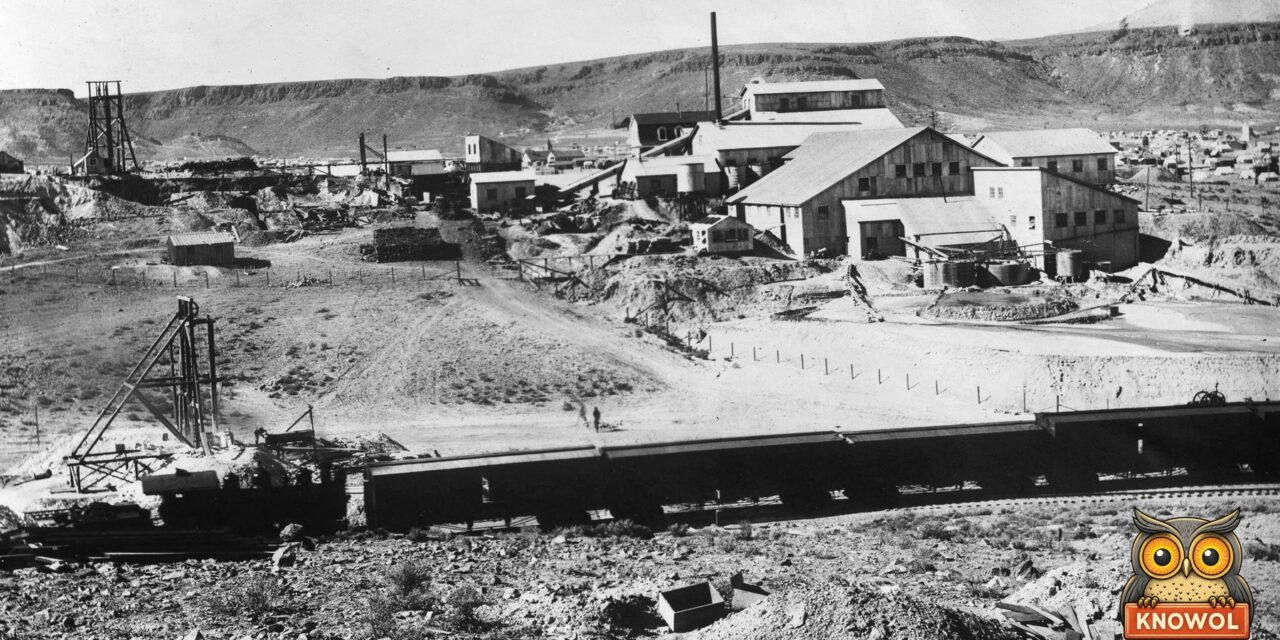
- Cover: “A train in front of a combination mine, Goldfield, Nevada, ca.1905,” photograph by C. C. Pierce, California Historical Society Collection, USC Digital Library (CHS-5430), Wikimedia Commons. Public domain.