On Halloween 1933, the Imperial Valley Press in El Centro, California ran a short editorial under the headline “Goblins Will Get You.” It opened with three words its readers needed explained: “Trick or treat.” Today the phrase feels as old as the jack-o’-lantern, but in 1933 it was new enough that a newspaper had to translate it.
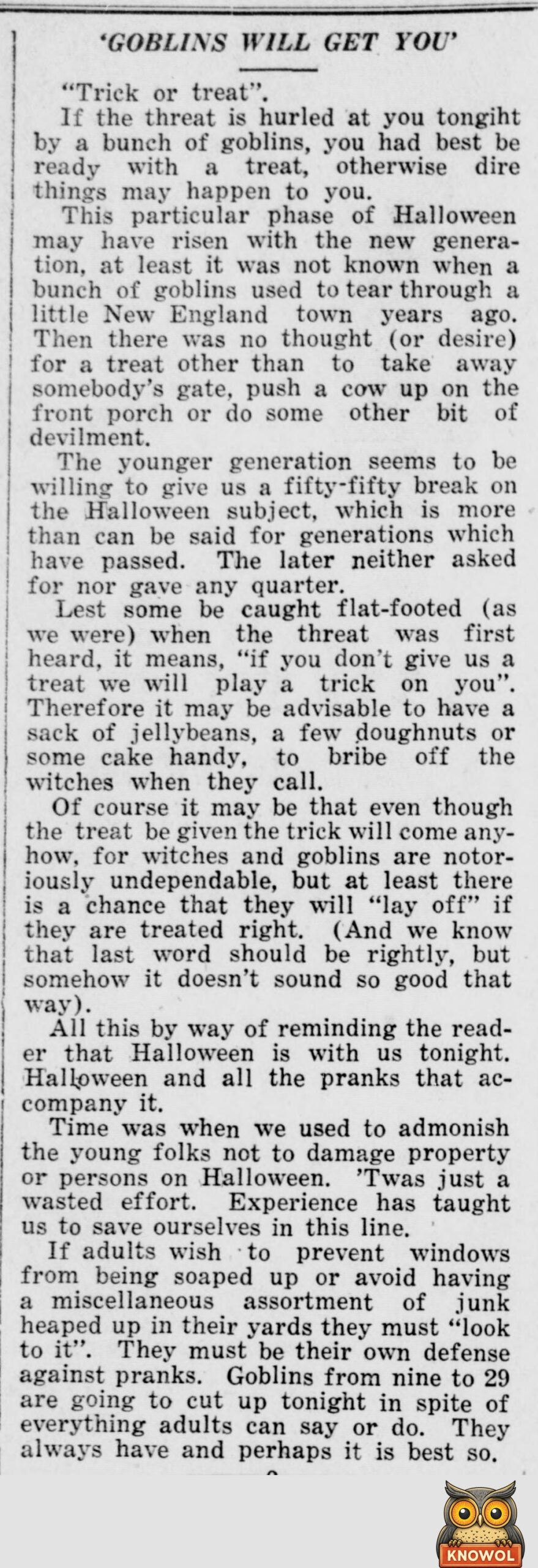
The Imperial Valley Press explains “trick or treat” on Halloween, October 31, 1933. Library of Congress, Chronicling America. Click the clipping to read it full size.
“Caught flat-footed (as we were)”
The writer admitted the newsroom hadn’t known the phrase either. “Lest some be caught flat-footed (as we were) when the threat was first heard,” the editorial said, “it means, ‘if you don’t give us a treat we will play a trick on you’.” The advice that followed was practical: “Therefore it may be advisable to have a sack of jellybeans, a few doughnuts or some cake handy, to bribe off the witches when they call.” There was no guarantee it would work. The trick might come anyway, the paper warned, “for witches and goblins are notoriously undependable.”
Doughnuts were the Halloween treat
Look at that shopping list again. The only candy on it was a sack of jellybeans. In the 1920s and 1930s, the food everybody expected on Halloween was doughnuts and cider, the way we expect candy now. “Doughnuts and cider are the traditional Hallowe’en refreshments,” the Brownsville Herald in Brownsville, Texas told party planners in 1932. A 1931 column in the Washington Daily News put it even more plainly: “No Hallowe’en frolic is complete without doughnuts and cider, so it behooves the hostess to get out her fat kettle and start to work.”
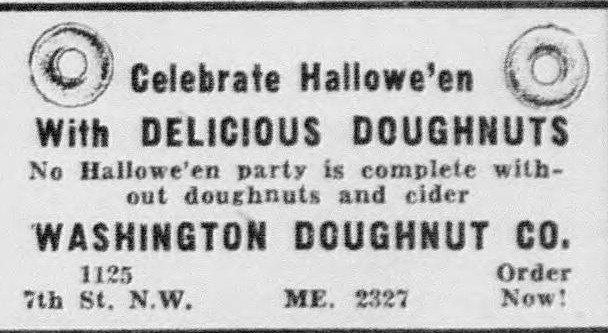
A Halloween ad for the Washington Doughnut Co., Washington Daily News, October 27, 1938. Click the clipping to read it full size.
Bakeries cashed in. In Browning, Montana, the Browning Bakery told readers in October 1940 to “watch for our big special on Halloween Doughnuts next week,” then asked, “Oh boy are they good?” Doughnuts were part of the party games, too. A 1925 Halloween party guide in the Milwaukee Leader in Milwaukee, Wisconsin said to “hang a doughnut on a string in a doorway and let a guest try to eat it without touching it with his hands.”
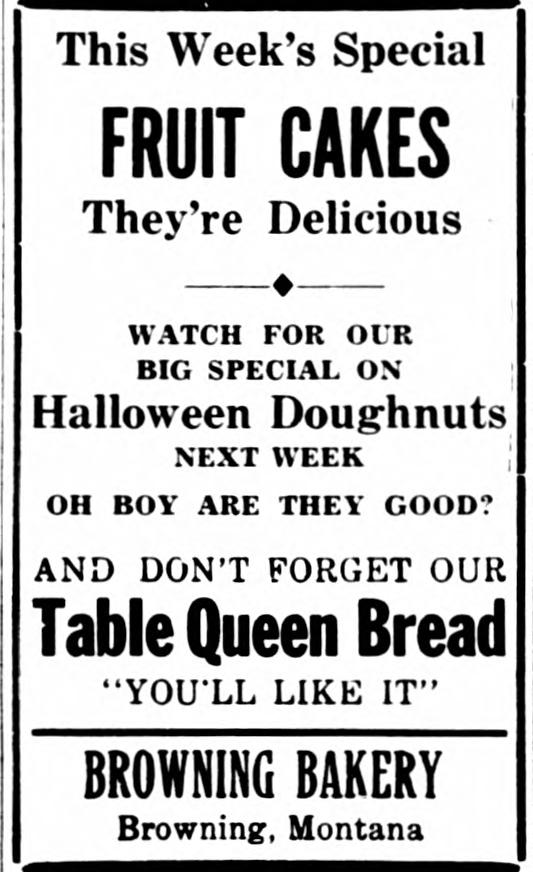
Browning Bakery ad, Glacier County Chief, Browning, Montana, October 18, 1940. Click the clipping to read it full size.
A better deal than the old Halloween
The writer had grown up in “a little New England town,” where Halloween meant mischief with no bargain attached. Back then, the editorial said, “there was no thought (or desire) for a treat other than to take away somebody’s gate, push a cow up on the front porch or do some other bit of devilment.” To a grownup who remembered those nights, the new custom looked like progress. “The younger generation seems to be willing to give us a fifty-fifty break on the Halloween subject,” the writer said, “which is more than can be said for generations which have passed.”
Thirty-five trick-or-treaters on Wensley Avenue
The same issue shows the custom already at work in El Centro. On page 2, a society note reported that sisters Marilyn and Suzanne Perkins had given a Halloween costume party the night before at their family’s home on Wensley Avenue. “All sorts of Halloween games were featured,” it said, “but the most enjoyed was ‘trick or treat’, when the whole group of 35 youngsters called at various houses in the neighborhood.”
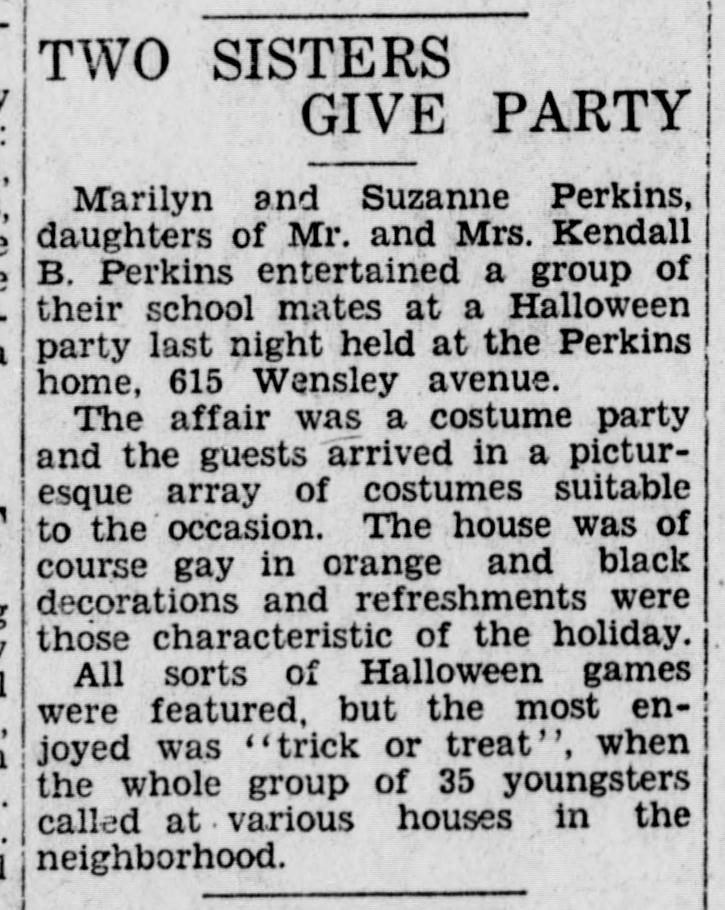
“Two Sisters Give Party,” Imperial Valley Press, October 31, 1933, page 2. Click the clipping to read it full size.
Where the phrase came from
“Trick or treat” didn’t start in California. It came down from Canada. Word historian Barry Popik has collected the earliest printed uses he could find, and the oldest are Canadian. The Sault Daily Star in Sault Ste. Marie, Ontario, described gangs calling out “tricks or treats” on Halloween 1917, and Alberta papers used the phrase through the 1920s, including a much-quoted 1927 report from the small town of Blackie. The first American paper on his list is the Bay City Daily Times in Michigan, in 1928, followed by the Oregonian in Portland in 1932.
The earliest California example on that list is a Los Angeles Times story from October 30, 1938. The Imperial Valley Press printed the phrase five years before that, and it had to explain what it meant.
By 1939, everyone knew it
Six years later, nobody needed it explained. On October 28, 1939, the Tacoma Times in Tacoma, Washington reported that pranksters were already soaping windows and ringing doorbells to make threats, and it compared their “trick or treat” demands to the methods of old Chicago racketeers. The city’s garbage department told residents to protect their garbage cans until Halloween was over.
In Juneau, Alaska, Chief of Police Dan Ralston reminded the town’s young people that Halloween was the next night, not that one. “Those attempting to celebrate in hallowe’en ‘tricks or treats’ style tonight will be dealt with summarily by the police,” the Daily Alaska Empire reported on October 30, 1939. Even on Halloween itself, the paper added, the streets would be patrolled “to guard against vandalism in the guise of fun.”
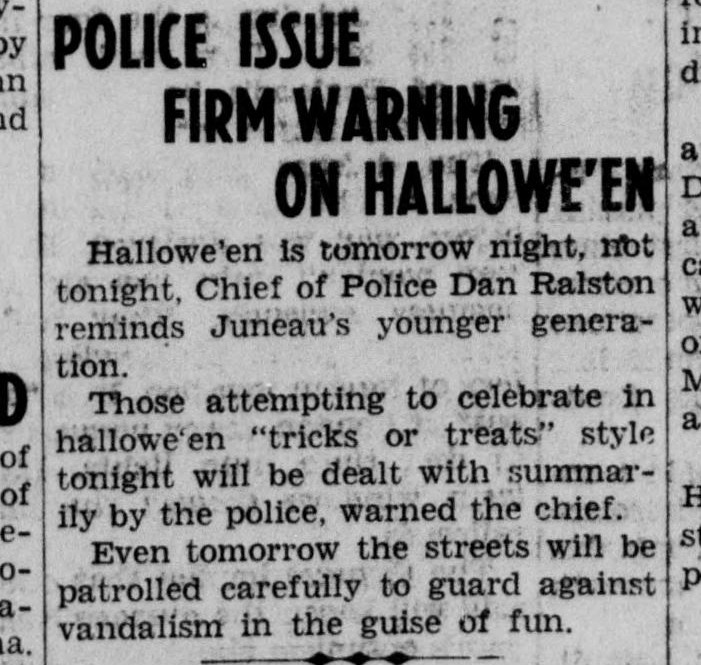
“Police Issue Firm Warning on Hallowe’en,” Daily Alaska Empire, Juneau, October 30, 1939. Click the clipping to read it full size.
In Harlem, Montana, the Harlem News reported a quiet Halloween and thought the town’s children had come up with something brand new. “Some of the younger pranksters had a happy thought and invented a new stunt of ‘tricks or treats,'” the paper said, “which brought them lots of fun and many treats from householders they visited.” The editor also thanked them for leaving the weather station alone, since pranksters had wrecked it without meaning to the year before.
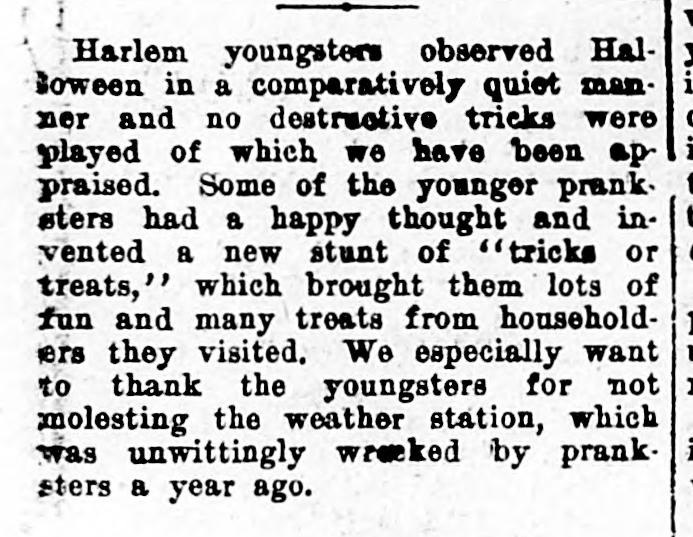
The Harlem News, Harlem, Montana, November 3, 1939. Click the clipping to read it full size.
From the editorial page to the police log
In El Centro, the phrase that needed explaining in 1933 had reached the police log by 1940. The Imperial Valley Press printed the department’s Halloween night log on November 1, 1940. At 12:06 a.m. it recorded “Eleven boys, brought to station during the course of the evening on complaints ranging from hurling mud balls to invading root beer stand demanding ‘trick or treat’, released to go home on promise of good behavior.”
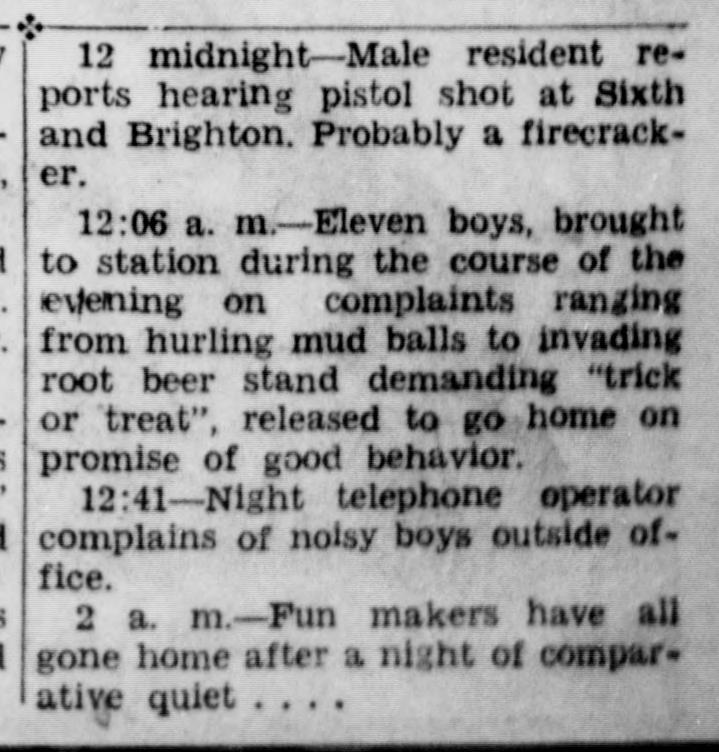
El Centro’s Halloween police log, Imperial Valley Press, November 1, 1940. Click the clipping to read it full size.
The 1933 editorial had already made peace with nights like that one. “Goblins from nine to 29 are going to cut up tonight in spite of everything adults can say or do,” it said. “They always have and perhaps it is best so.”
Sources
- Imperial Valley Press (El Centro, Calif.), October 31, 1933, page 4, October 31, 1933, page 2 and November 1, 1940, page 1.
- The Tacoma Times (Tacoma, Wash.), October 28, 1939, page 15.
- The Daily Alaska Empire (Juneau, Alaska), October 30, 1939, page 2.
- The Harlem News (Harlem, Mont.), November 3, 1939, page 4.
- Brownsville Herald (Brownsville, Tex.), October 28, 1932, page 5.
- The Washington Daily News (Washington, D.C.), October 13, 1931, page 17 and October 27, 1938, page 40.
- Glacier County Chief (Browning, Mont.), October 18, 1940, page 4.
- The Milwaukee Leader (Milwaukee, Wis.), October 31, 1925, page 13.
- All newspaper images: Library of Congress, Chronicling America. No known copyright restrictions.
- Barry Popik, “Trick or Treat,” The Big Apple, for the early Canadian and American citations.
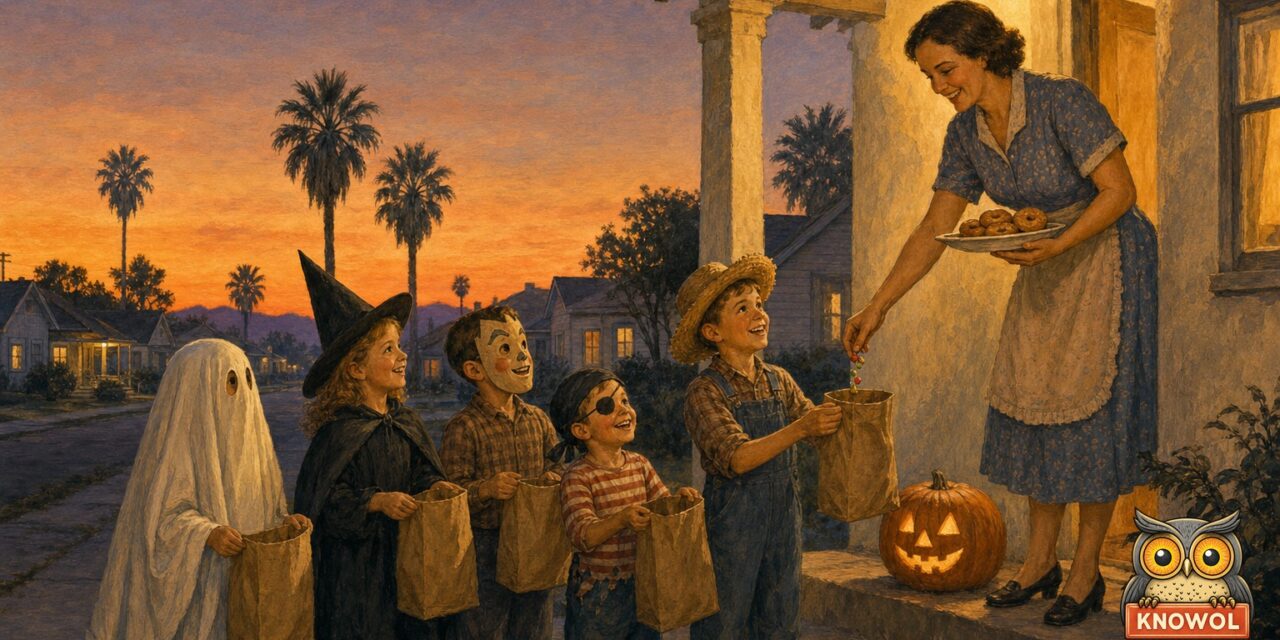
- Cover: an illustration made for KNOWOL with AI (OpenAI GPT Image 2), not a historical photograph. The jellybeans and doughnuts come from the 1933 editorial.