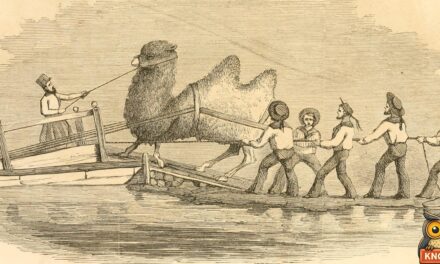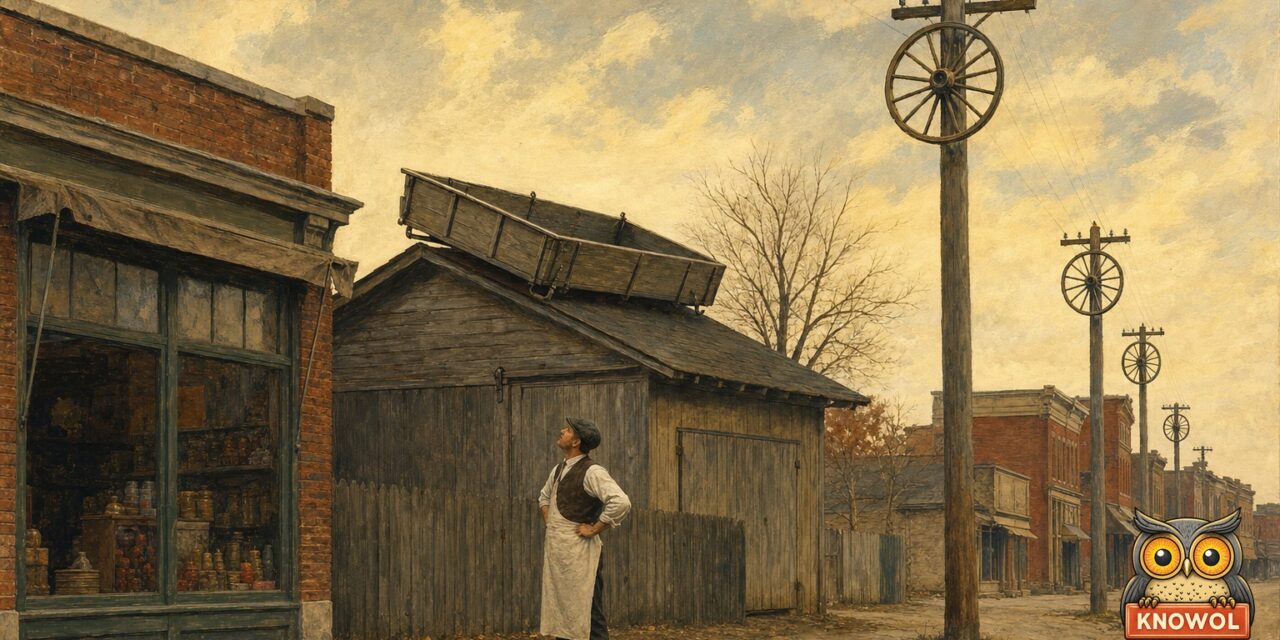
On the morning after Halloween in 1907, Charles Speck went out to hitch up his wagon. Speck ran a grocery at Thirteenth and Tennessee streets in Paducah, Kentucky, and he had his early marketing to do. He “found no wagon to hitch to,” the Paducah Evening Sun reported that day. “After a careful search he found the bed on top of the stable and the wheels hanging on several nearby telephone poles.”
Speck wasn’t the only one looking for his things that morning. Newspapers all over the country printed reports like this on November 1, after their towns woke up and went looking for their gates. They show what Halloween pranks really were before trick-or-treating: a lot of heavy lifting in the dark.
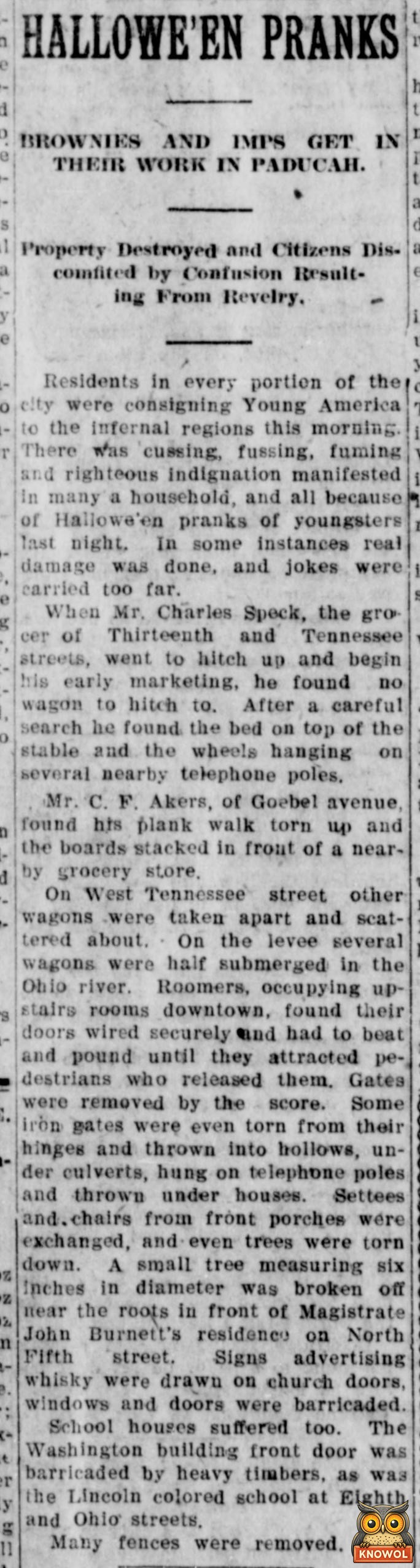
“Hallowe’en Pranks,” the Paducah Evening Sun, Paducah, Kentucky, November 1, 1907. Library of Congress, Chronicling America. Click the clipping to read it full size.
“Cussing, fussing, fuming”
“Residents in every portion of the city were consigning Young America to the infernal regions this morning,” the Evening Sun began. “There was cussing, fussing, fuming and righteous indignation manifested in many a household, and all because of Hallowe’en pranks of youngsters last night.”
The list went on from there. A man on Goebel Avenue found his plank walk torn up and the boards stacked in front of a grocery store. On West Tennessee Street, wagons were taken apart and scattered around. “On the levee several wagons were half submerged in the Ohio river.” People renting upstairs rooms downtown “found their doors wired securely and had to beat and pound until they attracted pedestrians who released them.”
“Gates were removed by the score,” the paper said. Some iron gates were “torn from their hinges and thrown into hollows, under culverts, hung on telephone poles and thrown under houses.” Porch settees and chairs were swapped from house to house. Somebody drew whisky ads on church doors, and two school buildings had their front doors barricaded with heavy timbers. The report ended with one more line: “Many fences were removed.”
Buggies on the roofs
Twenty years earlier, the boys of Hope, a small town in Dakota Territory, did their work up high. “Monday night was Halloween, and a number of mad pranks were played by the boys around town,” the Hope Pioneer reported on November 4, 1887. “Over the door of the bank was placed an old hotel sign, in front of the Hope House door was placed an old threshing machine, a wagon loaded with straw, a binder and a hay rake.”
A buggy owned by Wood Brothers ended up “on top of the Beidler & Robinson lumber shed.” A seeder and a sulky plow went on top of a pile of lumber, and another man’s buggy “was found on top of Frank Hill’s hay stack.” The paper never said how the boys got a buggy onto a lumber shed. It was just glad nothing was broken: “No malicious mischief was perpetrated that we have learned of.”
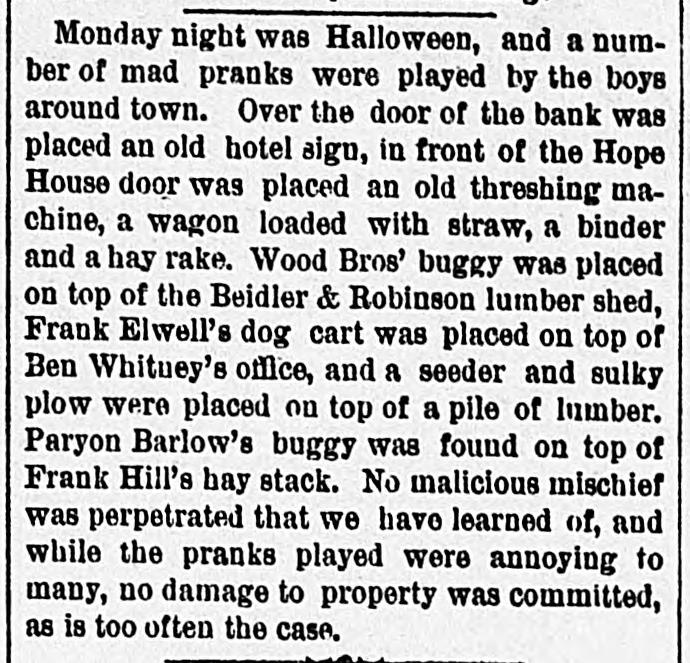
The Hope Pioneer, Hope, Dakota Territory, November 4, 1887. Click the clipping to read it full size.
“If you wake up this morning”
By 1913, the Pine Bluff Daily Graphic in Pine Bluff, Arkansas knew exactly what its readers would find on November 1, and it opened its front-page story with a checklist: “If you wake up this morning and find your fence gateless, the wheels of your buggy or automobile missing, your favorite flower pot turned upside down, a porch chair hanging to a telephone wire in the front of your home or your front door off the hinges, scratch your head and recall that last night was Hallowe’en.”
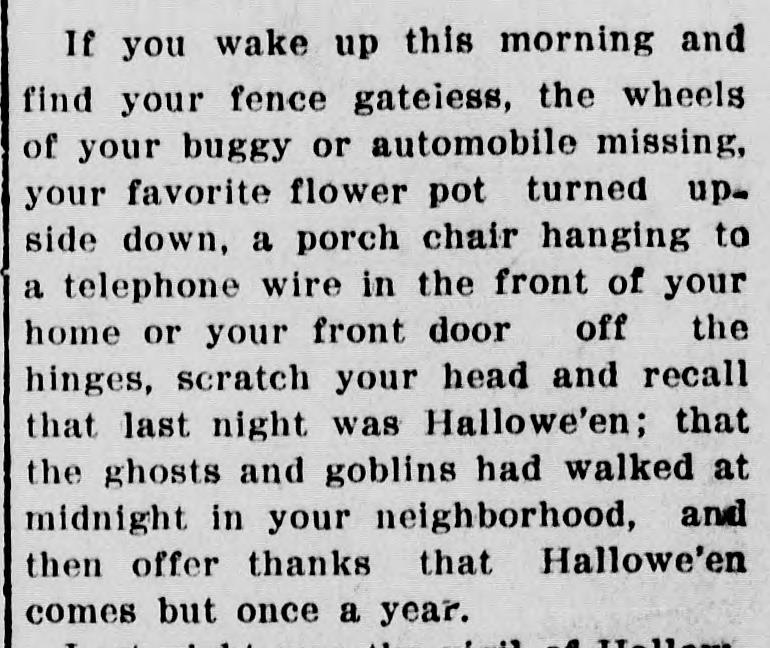
Pine Bluff Daily Graphic, Pine Bluff, Arkansas, November 1, 1913, page 1. Click the clipping to read it full size.
The next year, in Cimarron, New Mexico, Halloween fell on a Saturday. The Cimarron News reported that “those who arose early Sunday morning found a few outhouses upset, wagons and buggies placed against doors, windows decorated, sign boards obliterated and a few other pranks performed.” By Cimarron’s standards that was a quiet night. The paper said the pranks “were not very numerous and not particularly costly to the owners of the property fooled with.”
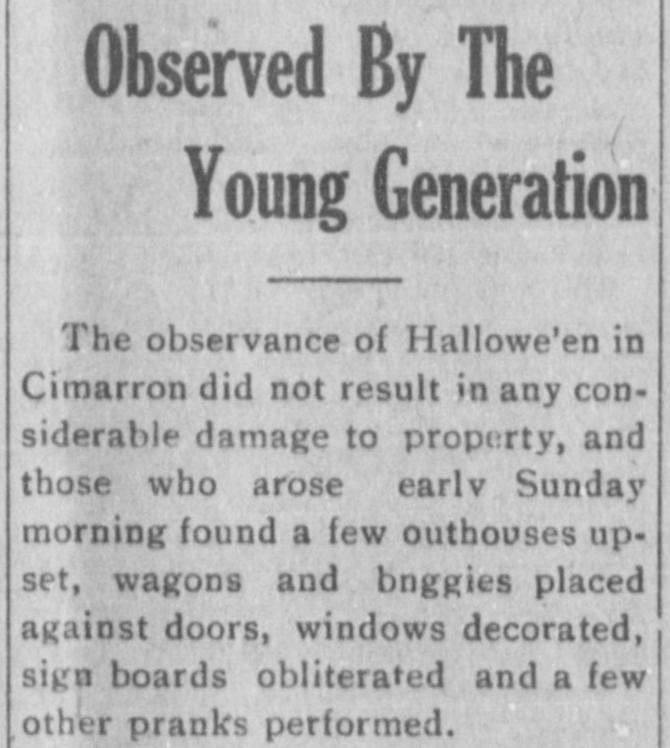
The Cimarron News and Cimarron Citizen, Cimarron, New Mexico, November 5, 1914. Click the clipping to read it full size.
“In spite of the officers”
Some towns tried to fight back. In 1922, Covington, Tennessee hired six extra policemen for Halloween night and put a watchman at every school. It didn’t work. “A group of youths managed to put a part of their program over here and there in spite of the officers,” the Covington Leader reported. A concrete fence was nearly torn down, flower gardens were “invaded and plundered,” and a set of wooden front steps was lifted and turned over. Street crossings “were raised from the ground and dragged into nearby ditches.”
Three of them were arrested, and “each offender was lodged in the calaboose until morning.” The schools, at least, came through fine. Each watchman “reported that no trouble was encountered.”
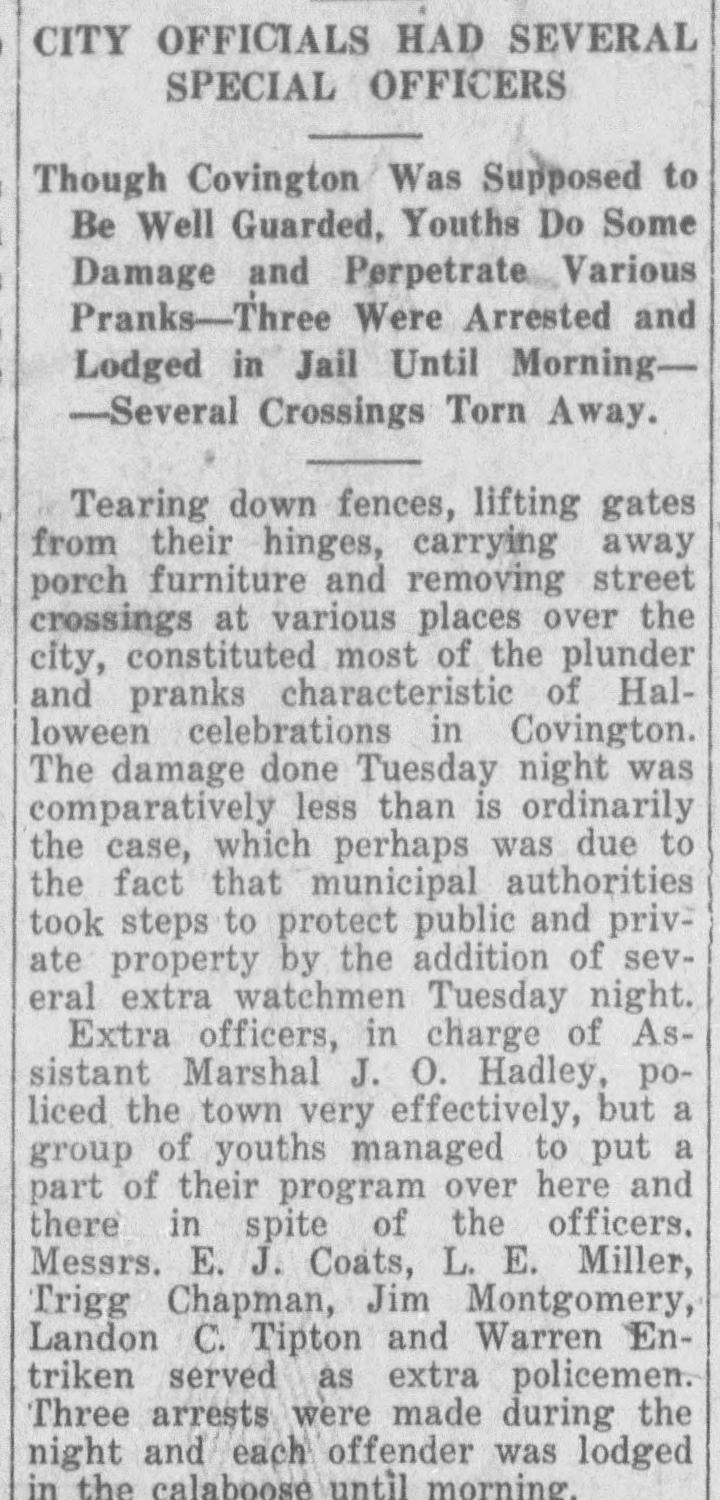
The Covington Leader, Covington, Tennessee, November 2, 1922, page 1. Click the clipping to read it full size.
The paper ended its story with a quote from another editor, and it sums up how a lot of grownups felt by then. “The so-called celebration of Halloween has reached a point where it is genuinely dreaded,” it said. “Let the young people have their fun, but teach them that there is no fun in destructiveness.”
Then came “trick or treat”
Eleven years later, a newspaper in El Centro, California, had to explain a new Halloween phrase to its readers: “trick or treat.” The writer had grown up in “a little New England town,” where Halloween meant pranks just like these, with “no thought (or desire) for a treat other than to take away somebody’s gate, push a cow up on the front porch or do some other bit of devilment.”
To someone who remembered those nights, the new custom looked like a bargain. Hand out a treat, and maybe your gate stays where it is. “The younger generation seems to be willing to give us a fifty-fifty break on the Halloween subject,” the 1933 editorial said, “which is more than can be said for generations which have passed.”
Sources
- The Paducah Evening Sun (Paducah, Ky.), November 1, 1907, page 3.
- The Hope Pioneer (Hope, Dak.), November 4, 1887, page 1.
- Pine Bluff Daily Graphic (Pine Bluff, Ark.), November 1, 1913, page 1.
- The Cimarron News and Cimarron Citizen (Cimarron, N.M.), November 5, 1914, page 5.
- The Covington Leader (Covington, Tenn.), November 2, 1922, page 1.
- Imperial Valley Press (El Centro, Calif.), October 31, 1933, page 4.
- All newspaper images: Library of Congress, Chronicling America. No known copyright restrictions.
- Cover: an illustration made for KNOWOL with AI (OpenAI GPT Image 2), not a historical photograph. It shows what the Paducah Evening Sun reported: Charles Speck’s wagon bed on top of his stable and its wheels hanging on the telephone poles.