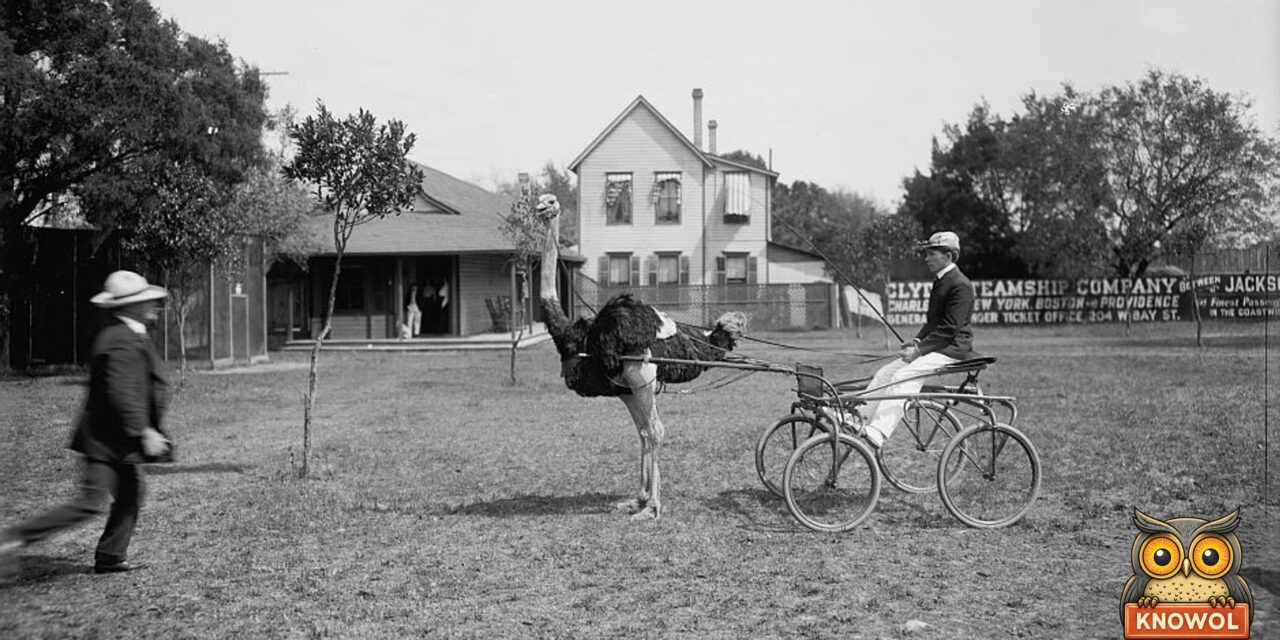
One April morning, two girls hopped on a streetcar in Jacksonville, Florida, and rode out toward the edge of the city. They were going to the Ostrich Farm. One of them wrote about the trip for the Jacksonville Times-Union. She never gave her own name, only her friend’s, Rosalie. The Pensacola Journal printed her story again on June 20, 1905, under the headline “A Visit to the Ostrich Farm.” The girls got off early and walked the last part, past honeysuckle, pear trees and the St. Johns River.
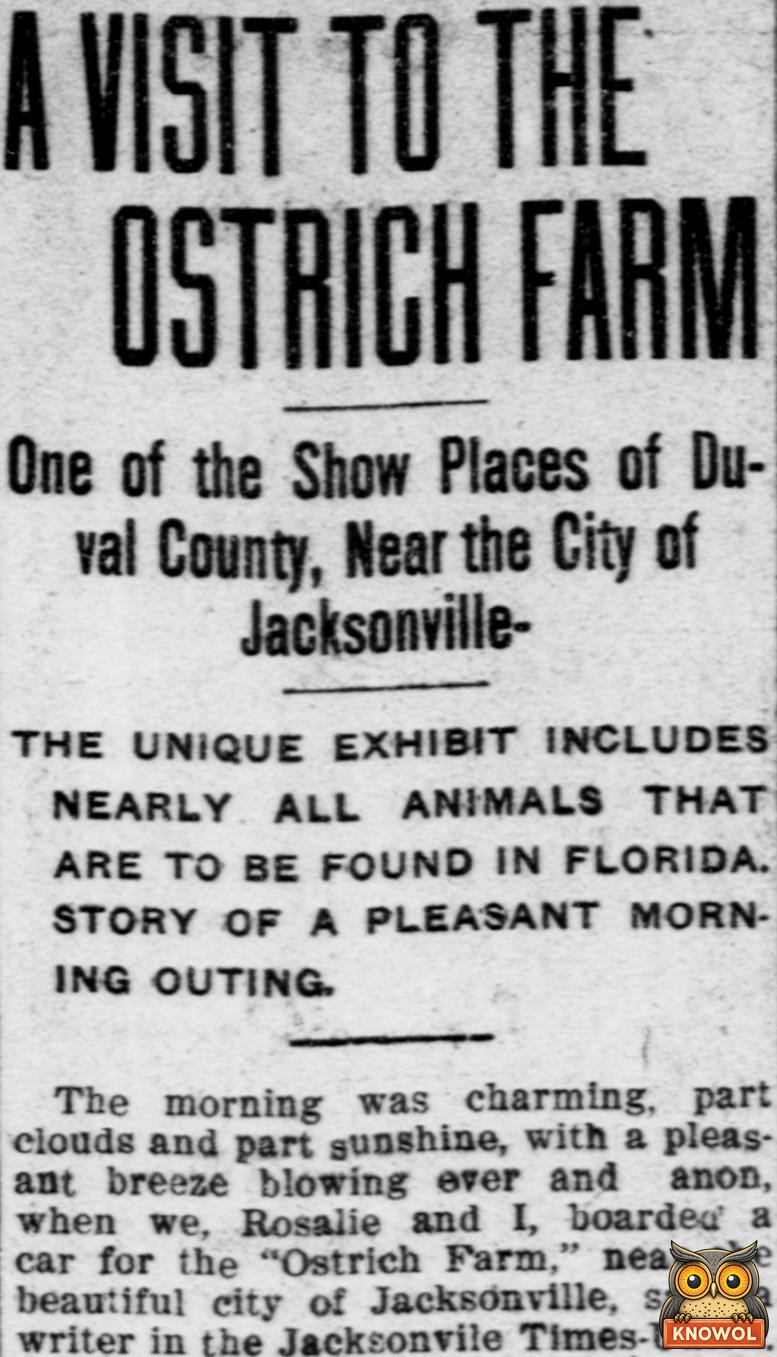
“A Visit to the Ostrich Farm.” The Pensacola Journal, Pensacola, Florida, June 20, 1905, page 2, reprinted from the Jacksonville Times-Union. Library of Congress, Chronicling America. Click the clipping to read it full size.
Seventy-five birds and a pavilion
At the farm they paid to get in. “We entered a room, paid our fee, skipped across the green grass and seated ourselves in the pavilion to watch the ostriches,” she wrote. A pavilion is a roofed shelter with open sides. In the pen in front of them stood about 75 ostriches. Some were gray and some were black. The black ones were the males, and the gray ones were the females.
That summer the East Oregonian, a paper in Pendleton, Oregon, counted about nine ostrich farms in the whole country. All but one or two, it said, made their money by showing the birds to visitors.
The Jacksonville birds had come from California. In the fall of 1898, the Arizona Republican reported, a man named A. Y. Pearson bought 30 ostriches from Mr. Cawston, a California ostrich farmer, and started the Florida Ostrich Farm with them.
A bird in harness
“We saw one fine fellow, in harness, the only ostrich in America that has been taught to draw a buggy; another one bore upon his feathery back the body of a man.” In plain words, one ostrich pulled a cart and another one carried a rider. “It was a queer sight to see a bird driven instead of a horse,” she wrote.
The farm had plenty of other animals, too. The girls watched six or eight sea lions swim in their clear pool and slide out to lie in the sun. There were alligators, of course, and monkeys she called “mischievous.” There was even a wildcat caught in the wilds of Florida.
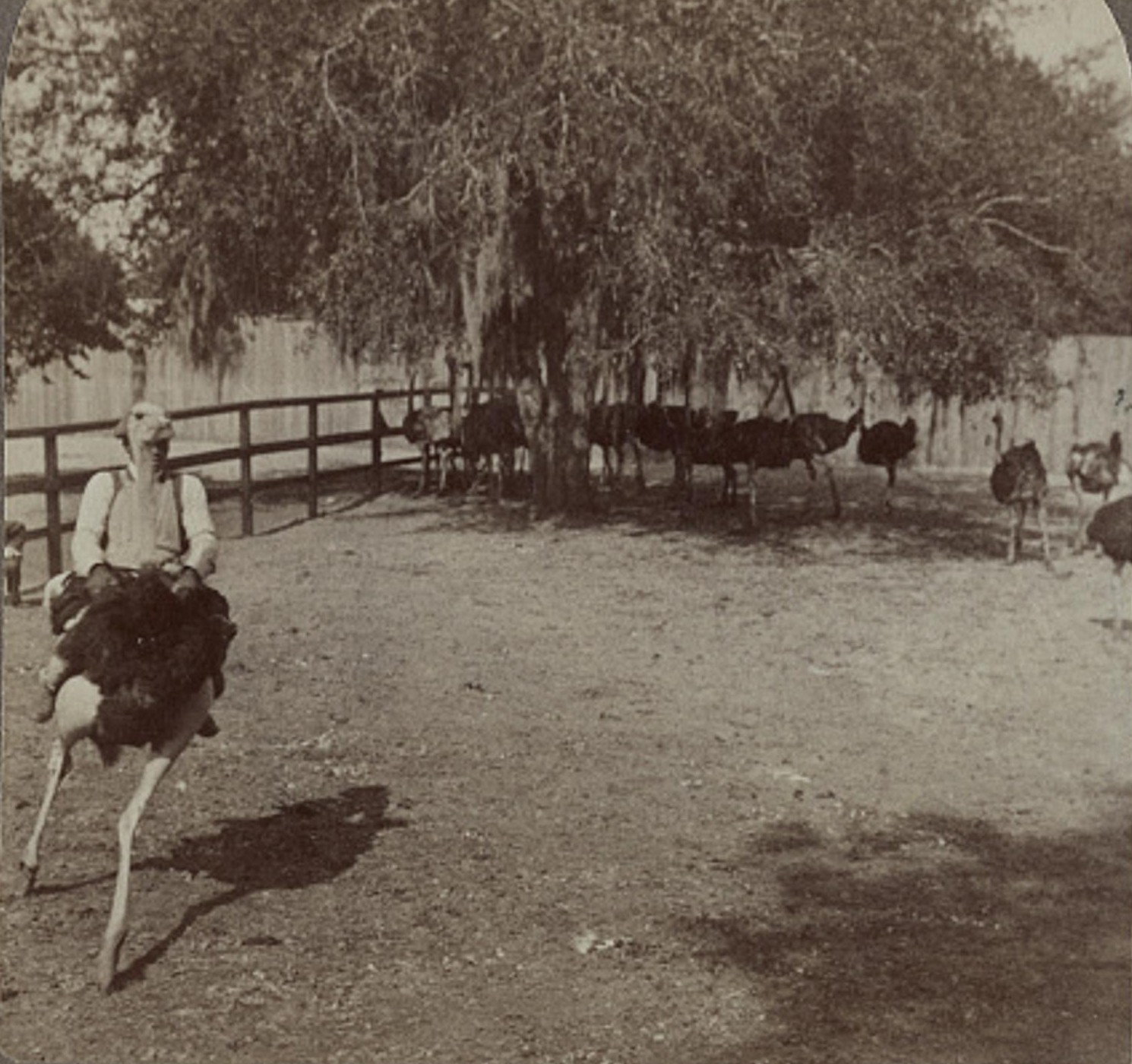
A man rides a running ostrich at an ostrich farm in Jacksonville, Florida, while other ostriches rest in the shade. The photographers called it “The fleetest of bipeds.” A biped is an animal that walks on two legs, and fleetest means fastest. Stereograph by Underwood & Underwood, 1905. Library of Congress, Prints and Photographs Division. Click the picture to see it full size.
How you drive an ostrich
By June 1905 the farm had 17 of its birds up north at Dreamland, a big amusement park at Coney Island in New York. A man named W. W. Ford was in charge of them. Two had been “broken,” or trained, the New-York Tribune said on June 25, one for riding and one for driving.
To drive an ostrich, the Tribune explained, the farm used “a halter, without bit, the reins snapping into a ring on each side of the beak.” A bit is the metal bar that goes in a horse’s mouth. An ostrich didn’t get one. It pulled a light four-wheeled racing wagon with rubber tires full of air, like a bicycle’s.
The star was an ostrich named Jacksonville, the same as his hometown. He had trotted a mile in 2 minutes and 12 seconds at a race track in Philadelphia, racing against a horse. Each of his running steps covered fifteen feet. That’s about as long as a car.
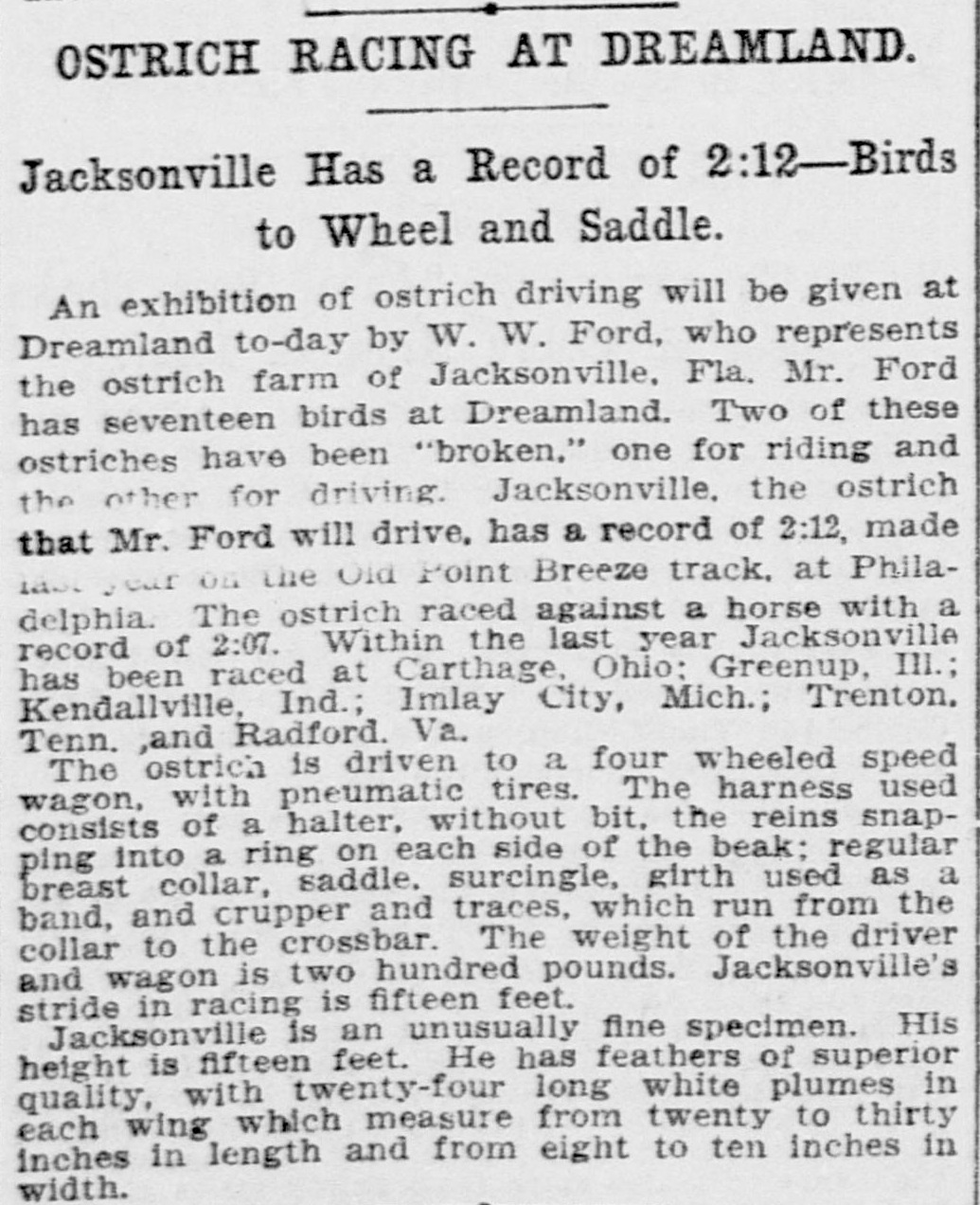
“Ostrich Racing at Dreamland.” New-York Tribune, New York, New York, June 25, 1905, page 5. Library of Congress, Chronicling America. Click the picture to see it full size.
The egg that fed twelve people
The funniest moment came at Dreamland, too. One Wednesday, while the birds were being moved, an ostrich named Marie Dressler laid a five-pound egg right on the boardwalk. She was named after Marie Dressler, a funny actress of the day. The egg rolled away and cracked before anyone could catch it. A cracked egg could never hatch, so Mr. Ford invited his friends to lunch. The real Marie Dressler was invited as guest of honor, but she couldn’t come.
“Luncheon for twelve, the principal dish being one hard-boiled egg,” the New York World reported. The Birmingham Age-Herald in Alabama printed the story again on July 2, 1905. The shell was an eighth of an inch thick, so the egg had to boil for two whole hours. It came to the table sitting in a block of ice with a hollow scooped out, “and a small hatchet was used to crack it.” The guests said it tasted a little richer than a hen’s egg. Eggs like it were worth $300 a dozen, the World said, so nobody was eating them for breakfast.
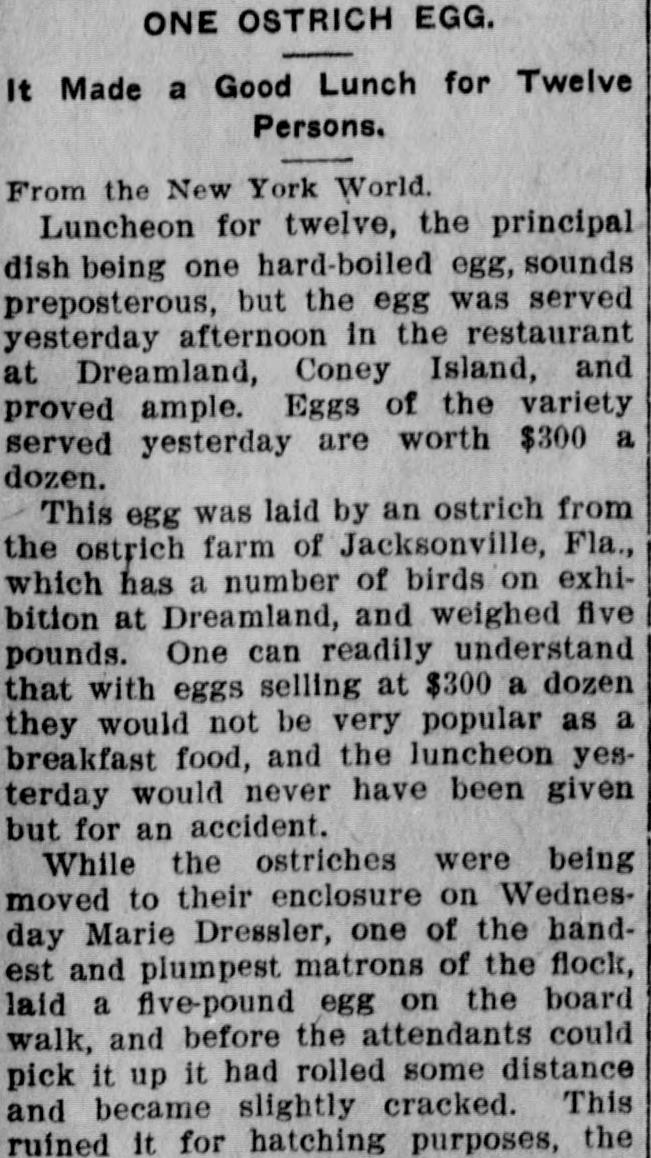
“One Ostrich Egg. It Made a Good Lunch for Twelve Persons.” The Birmingham Age-Herald, Birmingham, Alabama, July 2, 1905, page 19, from the New York World. Library of Congress, Chronicling America. Click the picture to see it full size.
After lunch Mr. Ford hitched a big male ostrich named Jim Jeffries to a racing wagon. The bird was named after the heavyweight boxing champion. It didn’t go well. The track was new to him, and “the crowds of women and children lining the railings frightened him so that he balked and dodged.” He did run nicely for half a lap, though, with giant steps 12 feet long.
What a feather was worth
The real money was in feathers. In 1905 ladies wore big, fluffy ostrich plumes on their hats. The East Oregonian said each grown ostrich could be counted on for “some $30 worth of crude ostrich feathers each year.” Crude means raw, before the feathers were cleaned and curled. Getting them ready for a hat shop doubled the price. Jacksonville, the racing bird, had 24 long white plumes in each wing, and the longest were 30 inches, about as long as a baseball bat.
By the numbers
- About 75 birds stood in the pen on the girls’ visit.
- 2 minutes and 12 seconds was the ostrich Jacksonville’s best mile.
- 5 pounds was the weight of Marie Dressler’s egg, and it boiled for 2 hours.
- $30 was one ostrich’s raw feathers for a whole year.
A piece of eggshell
Back in Jacksonville, the morning slipped away. Then, she wrote, “as girls will get hungry,” they started home. As they took one last look at the sea lions, a kind young man walked up and talked with them about nature. When they left, he “presented us with a piece of eggshell as a souvenir of the occasion.” They never even learned his name. “Never will we forget that April morning at the Ostrich Farm,” she wrote.
Sources
- The Pensacola Journal (Pensacola, Florida): June 20, 1905, page 2 (“A Visit to the Ostrich Farm,” reprinted from the Jacksonville Times-Union).
- New-York Tribune (New York, New York): June 25, 1905, page 5 (“Ostrich Racing at Dreamland”).
- The Birmingham Age-Herald (Birmingham, Alabama): July 2, 1905, page 19 (“One Ostrich Egg,” from the New York World).
- East Oregonian (Pendleton, Oregon): July 13, 1905, page 3 (ostrich farms and feathers).
- Arizona Republican (Phoenix, Arizona): February 27, 1905, page 3 (how the Florida Ostrich Farm began).
- All newspaper images: Library of Congress, Chronicling America. Published 1905, public domain.
- Photograph: “The fleetest of bipeds,” ostrich farm, Jacksonville, Florida, stereograph, Underwood & Underwood, 1905, Library of Congress, no known restrictions.
- Cover: “Oliver W., the famous trotting ostrich,” Florida Ostrich Farm, Jacksonville, Detroit Publishing Co., about 1903, Library of Congress, no known restrictions.