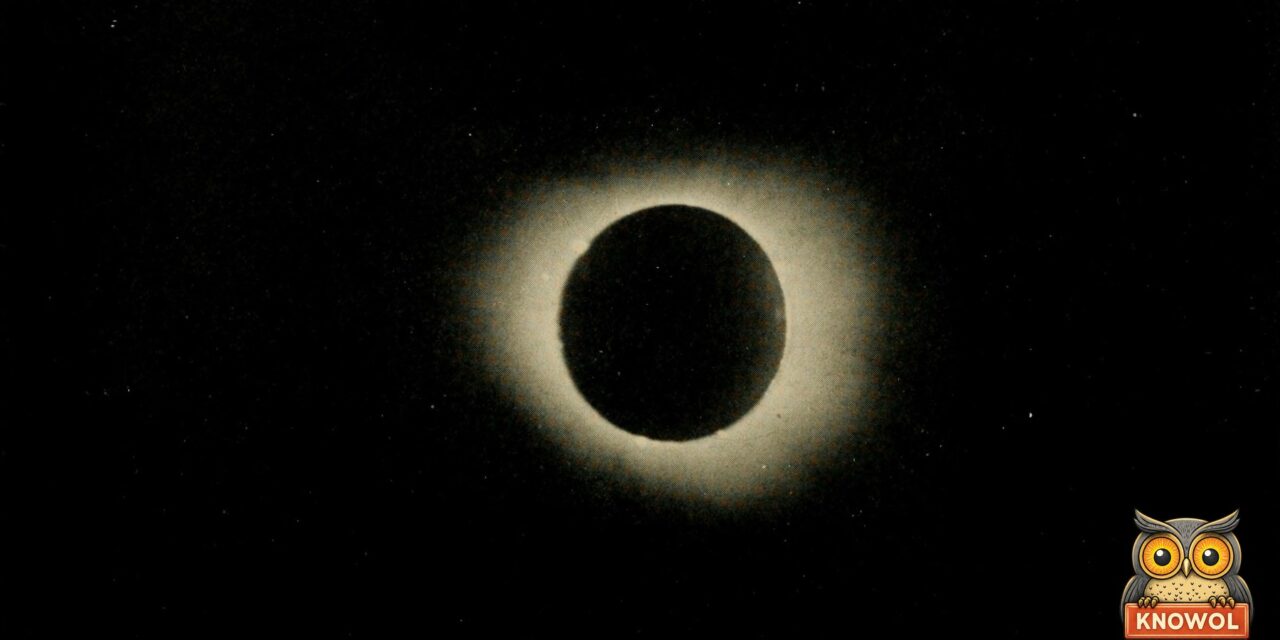
At about 4 o’clock on Saturday afternoon, June 8, 1918, the sun went out over Hood River, Oregon. Stars showed up in the daytime sky. Night birds came out to hunt gnats. Then a rooster crowed, and “the call was taken up and sent back and forth over the valley” by every other rooster around. The Hood River Glacier, the town’s weekly paper, put it in big type the next Thursday: “Total Eclipse Was Very Impressive.”
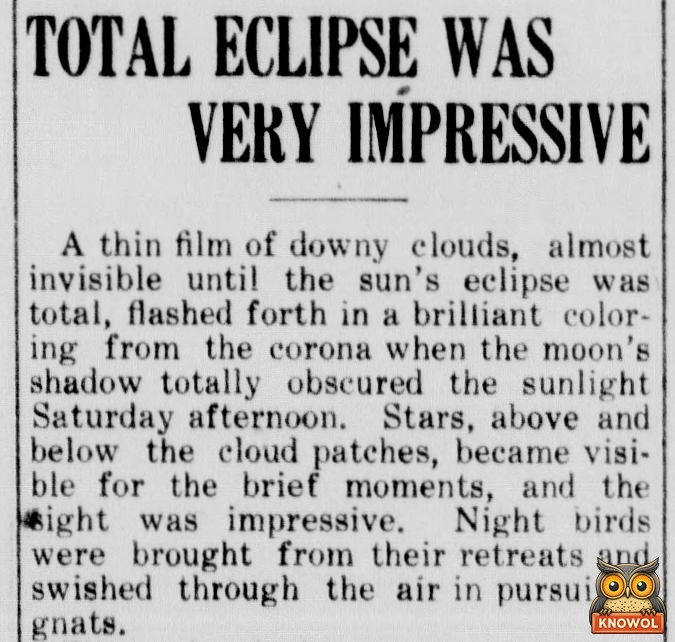
“Total Eclipse Was Very Impressive.” The Hood River Glacier, Hood River, Oregon, June 13, 1918, page 1. Library of Congress, Chronicling America. Click the clipping to read it full size.
How the moon blots out the sun
A total eclipse happens when the moon passes exactly between the sun and the Earth. The sun is about 400 times wider than the moon. It’s also about 400 times farther away. So from the ground, they look almost the same size, and the moon can cover the sun like a lid.
The moon’s dark shadow only covers a narrow strip of the Earth at a time. On June 8, 1918, that strip raced from the coast of Washington all the way to Florida. No other total eclipse crossed the whole country from ocean to ocean until 2017.
When the sun is covered, its corona shows. The corona is the sun’s glowing outer layer, and it’s too faint to see on a normal day. At Hood River, a thin film of clouds caught its light and “flashed forth in a brilliant coloring.”
Getting ready
Two days before, the Glacier told readers what to expect. “Many will go to the high points around the valley,” it said. Some families planned to drive east “in case clouds obscure the heavens here.” Others planned to cross the Columbia River to Glenwood and Trout Lake, Washington, closer to the middle of the shadow’s path.
The paper said the moon would start to cross the sun “at about 3 o’clock, present daylight saving time.” Daylight saving time was brand new. The country had started it that spring for the first time, to save fuel during World War I. Total darkness, “lasting about a minute,” would come “at just about 4 o’clock.”
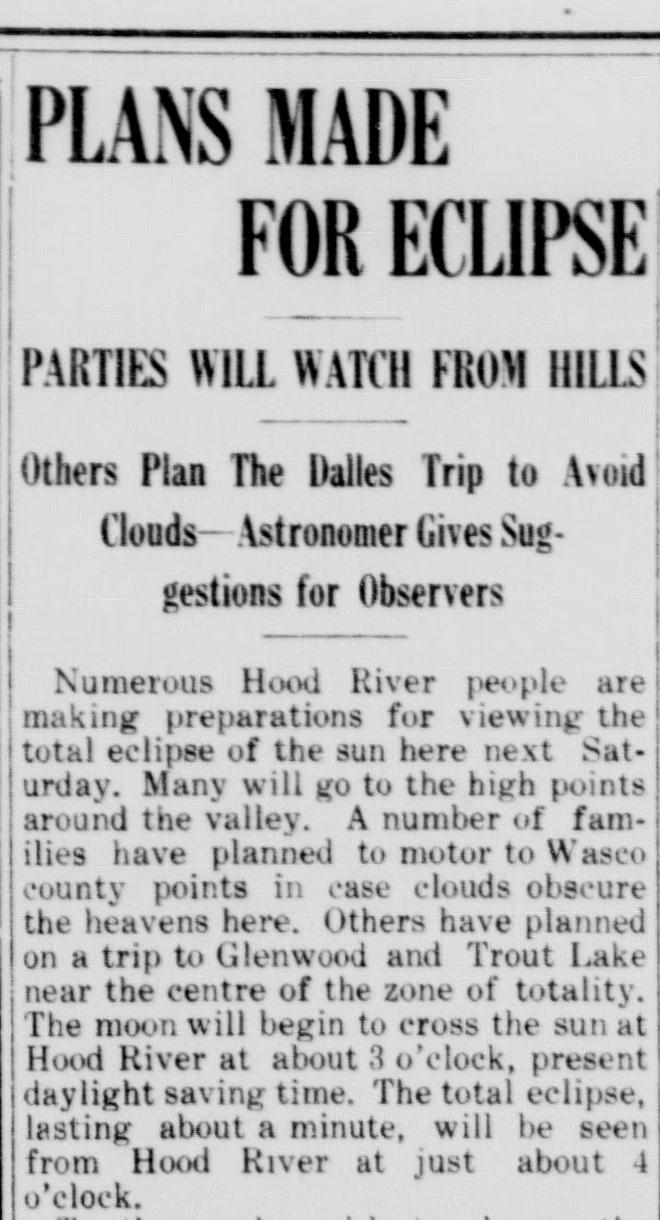
“Plans Made for Eclipse.” The Hood River Glacier, Hood River, Oregon, June 6, 1918, page 1. Library of Congress, Chronicling America. Click the clipping to read it full size.
Most people watched through smoked glass. That was a piece of window glass held over a candle flame until soot turned it dark. More than 50 visitors came up from Portland for the show.
When the lights went out
The animals were fooled. Chickens went to roost as if it were evening. Night birds “swished through the air in pursuit of gnats.”
A road crew watched a yellowhammer, a kind of woodpecker, get caught away from its nest in the sudden dark. The bird couldn’t see well, the men said. It “went dashing madly through the tree tops, coming in frequent contact with the boughs.” Boughs are branches.
Highway workers on the Ruthton hill had been getting ready for days. As the sun shrank to “a tiny crescent,” they fired “a series of mighty blasts” that echoed up and down the Columbia River Gorge.
The scientist who watched moths
Leroy Childs studied the codling moth. Its caterpillar is the worm that ends up inside apples, so in an apple town like Hood River, it was a big enemy. Childs had learned that the female moth starts laying eggs at twilight.
So he skipped the sky. He built “a screened-in cage around a small fruit tree in his backyard” and waited with magnifying glasses, cameras and notepads. When the eclipse made a fake twilight, the moths got to work right away, “beginning their deposit of eggs.” When the sun came back, they stopped. At real nightfall, they started again.
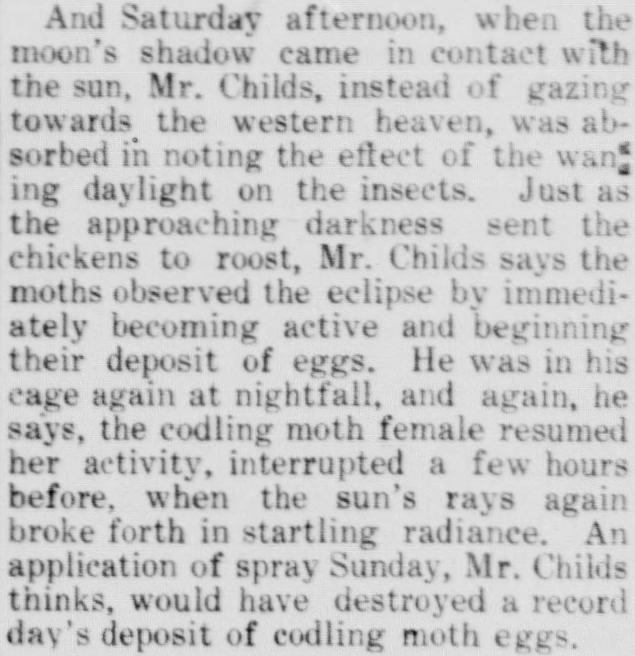
Leroy Childs and the moths. The Hood River Glacier, Hood River, Oregon, June 13, 1918, page 1. Library of Congress, Chronicling America. Click the clipping to read it full size.
The moths were using light as their clock, and the moon had moved the hands. Childs figured a spray of bug killer that Sunday would have wiped out “a record day’s deposit of codling moth eggs.”
A clever trick and a ruined roll of film
At the Staten place in Frankton, a Native American man running a crew of strawberry pickers turned down a piece of smoked glass. “Come here,” he said, and pointed toward an irrigation ditch. In the still water lay “a perfect reflection of the moon-curtained sun.” The paper said smoked glass “lost favor” in that spot after that.
Joe D. Thomison took a whole series of eclipse photos. On Sunday morning his older daughter, Becky Ann, found “the peculiar roll of paper” on the living room table and opened it. Light ruins film before it’s developed, so the pictures were lost. The Glacier said her parents took steps “to impress on Becky Ann’s memory” that kids should leave strange packages alone.
People watching from the north end of the county saw the best sight of all. Mount Adams, near the middle of the shadow, sat “in ghost-like shadow.” Mount Hood, outside it, still glowed in “the rays of the afternoon sun.”
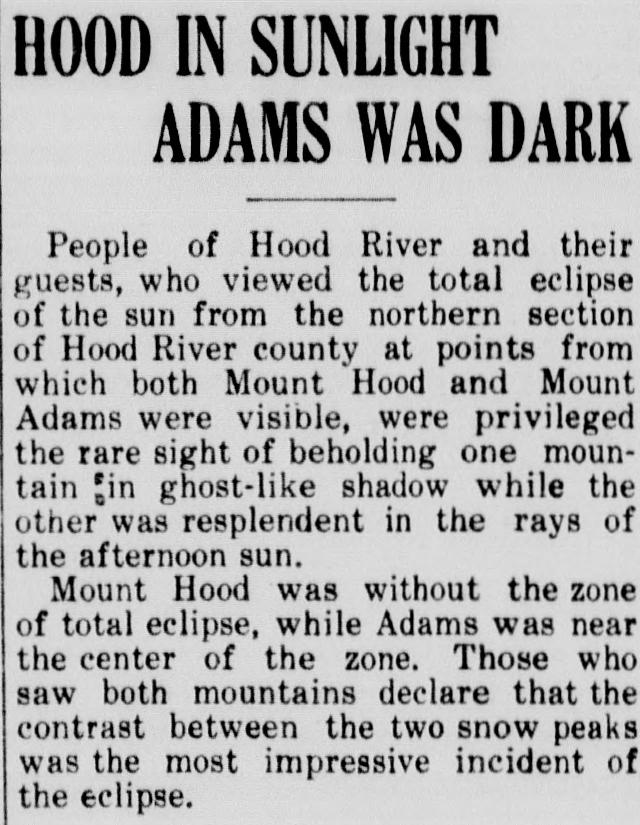
“Hood in Sunlight, Adams Was Dark.” The Hood River Glacier, Hood River, Oregon, June 20, 1918, page 3. Library of Congress, Chronicling America. Click the clipping to read it full size.
Meanwhile, nearby
- Pendleton, Oregon: Right at the darkest moment, an iceman delivering ice held out his hand to a crowd of watchers. Someone gave him a smoked glass. “No, no!” he said. “I want a dime for that ice.”
- Cottonwood, Idaho: The chickens “went to bed” and had to get up an hour later, “looking sort of down in the mouth.”
Watch the next one the safe way
Smoked glass and ditch water were not safe. NASA says even the darkest sunglasses can’t protect your eyes from the sun. Real eclipse glasses are thousands of times darker.
There’s a safe trick, though, and the trees in Athena, Oregon, showed it in 1918. Under the trees, the paper said, there were “countless little half moon formations.” Each tiny gap between leaves works like a pinhole, and it lays a little picture of the sun on the ground. To make your own, punch a small hole in an index card. Stand with the sun behind you and let the light fall on a sheet of paper. During an eclipse, you’ll see a tiny sun with a bite taken out of it.
Sources
- The Hood River Glacier (Hood River, Oregon): June 6, 1918, page 1 (“Plans Made for Eclipse”), June 13, 1918, page 1 (“Total Eclipse Was Very Impressive”; the strawberry crew; Becky Ann; Leroy Childs) and June 20, 1918, page 2 (the yellowhammer) and page 3 (“Hood in Sunlight, Adams Was Dark”).
- East Oregonian (Pendleton, Oregon): June 10, 1918, page 3 (the iceman).
- Cottonwood Chronicle (Cottonwood, Idaho): June 14, 1918, page 1 (“Old Sol Duly Eclipsed”).
- The Athena Press (Athena, Oregon): June 14, 1918, page 3 (half moons under the trees).
- All newspaper images: Library of Congress, Chronicling America. Published 1918, public domain.
- Eye safety: NASA, Eclipse Safety.
- Cover: “Total Solar Eclipse of June 8, 1918,” photograph by the Smithsonian eclipse expedition, from L. B. Aldrich, “The Smithsonian Eclipse Expedition of June 8, 1918,” Smithsonian Miscellaneous Collections (1919), Wikimedia Commons, public domain.