At 9 o’clock on the night of March 14, 1905, the floor of the Auditorium in Grand Junction, Colorado, filled with skaters in masks. A band played. Manager Boyer tried to line everybody up for the grand march, the big parade that opened the night. It wasn’t easy. The Daily Sentinel said “it was in for a good time, and it did not propose to be held down by conventionalities,” which is an old way of saying nobody felt like following the rules.
Out in front rolled a Spanish dancing girl and what looked like a navy admiral in a summer uniform. When the masks came off, they turned out to be Miss Juanita Goodwin and Leo Kersburg. Grand Junction was in the middle of a roller skating craze.
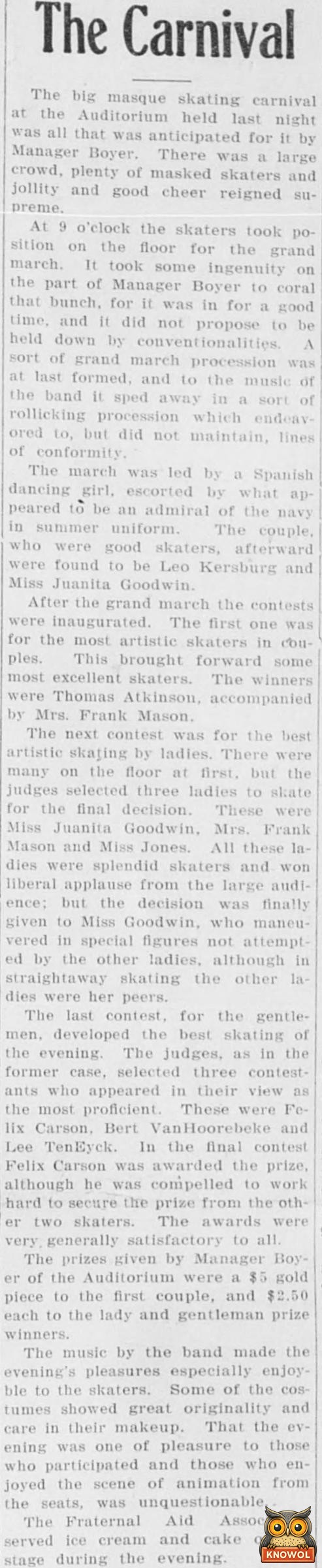
“The Carnival.” The Daily Sentinel, Grand Junction, Colorado, March 15, 1905, page 1. Library of Congress, Chronicling America. Click the clipping to read it full size.
Two rinks open at once
It started in January. The Auditorium usually held a dance in the middle of the week, but the Sentinel said the one on January 11 would probably be the last of the season “on account of the roller skating.” Manager Boyer had ordered skates. The Turners, the club at Turner hall, got a shipment of skates for a rink of their own. Both rinks opened in mid-January.
Skating at Turner hall cost 40 cents, skates included, and it cost 15 cents just to sit and watch. People came anyway. A few days after opening night, the Sentinel counted “a hundred people” on the Auditorium floor every hour and more than 200 watching. “The roller skating craze has certainly revived,” the paper said.
Why “revived”?
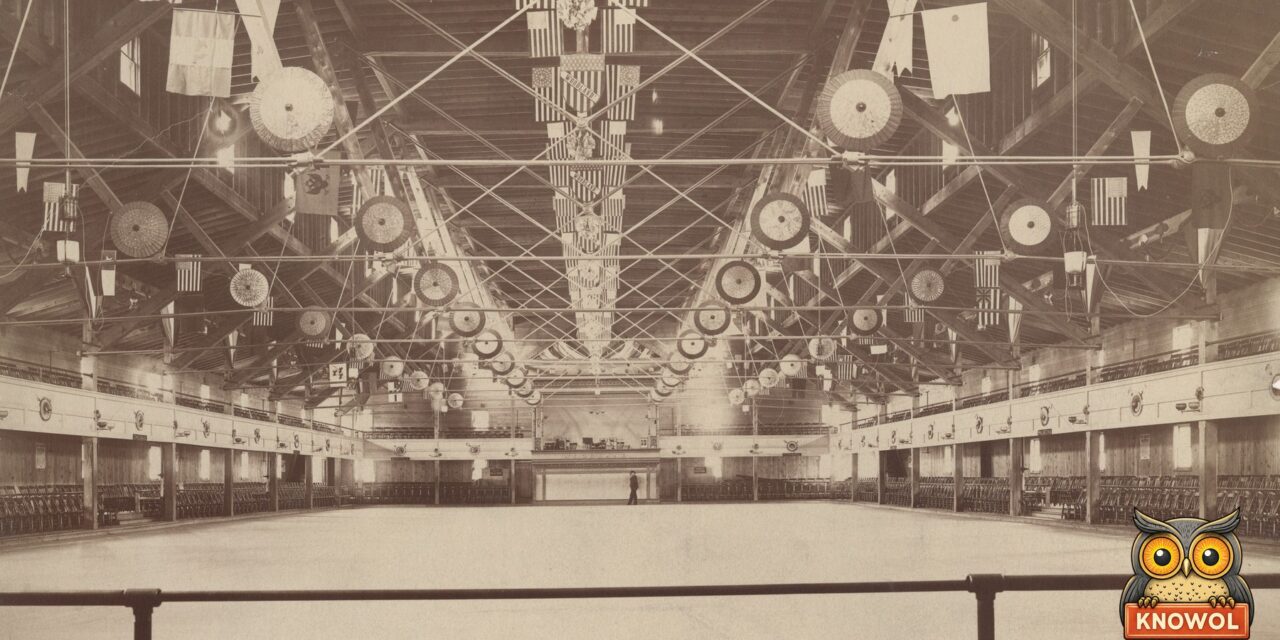
Because America had gone skate-crazy once before, in the 1880s. Cities built giant, barn-like rinks. One of them, the Woodland Rink in Cleveland, Ohio, hung its ceiling with flags and round paper decorations over a floor so big that one man standing on it looks tiny.
Then the fad crashed. In 1886 a story printed as far away as Louisiana said “The ‘craze’ is over.” Frank Hall, who ran a rink and a skate factory in Philadelphia, had sold 100,000 pairs of skates one year and none the next. Skate wheels back then were made of boxwood, a hard wood. Skate makers wanted so much of it that its price jumped from $26 a ton to $40.
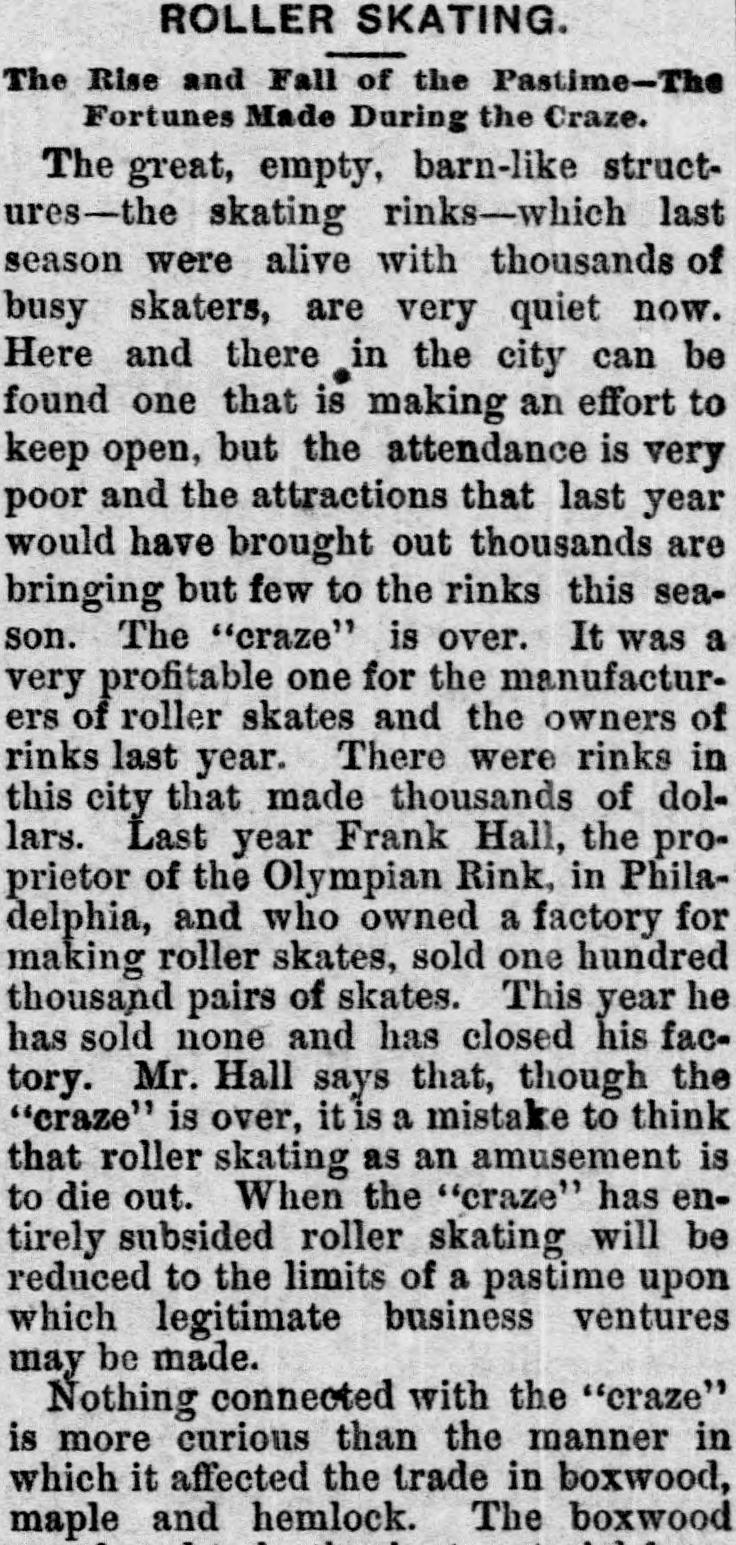
The first craze ends. The Bossier Banner, Bellevue, Louisiana, March 4, 1886, page 1. Library of Congress, Chronicling America. Click the clipping to read it full size.
Rules of the rink
The new skates of 1905 often had ball bearings, tiny steel balls that let the wheels spin smoothly. Turner hall told people to “Try the Richardson ball bearing skates.” By then the price had come down, too: 10 cents to get in and 15 cents to rent the skates.
The rinks had rules, too. At Turner hall, Saturday mornings were for children only, 10 cents with skates. And on couples’ night at the Auditorium, “No skates will be rented to any gentleman unless accompanied by a lady.”
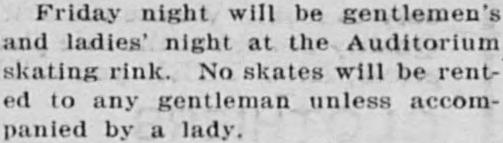
Couples’ night. The Daily Sentinel, Grand Junction, Colorado, February 16, 1905, page 4. Library of Congress, Chronicling America. Click the clipping to read it full size.
Not everyone loved the craze. On Sunday, February 26, the Rev. C. W. G. Lyon of St. Matthew’s church spoke out against opening the two rinks on Sunday. He thought they should stay “closed all day Sunday.” Two weeks later Manager Boyer announced that the Auditorium rink would close every Sunday from then on.
Masks and prizes
The big carnival had prizes for the most graceful couple and the best “fancy” skaters, who did tricks and figures. “No rapid skating will be permitted,” the notice warned. Contestants had to wear costumes that would “completely mask the face,” so nobody could complain the judges picked their friends.
Thomas Atkinson and Mrs. Frank Mason won for couples. Juanita Goodwin, the dancing girl from the parade, won for ladies because she did special figures the others didn’t try. Felix Carson won for gentlemen, but he had to work hard for it. The prizes were a $5 gold coin for the best couple and $2.50 for each of the others. All evening, the Fraternal Aid Association served ice cream and cake on the stage.
A race on election night
Manager Boyer’s next idea was even stranger. Grand Junction voted for its city leaders on Tuesday, April 4, so he planned a roller skating “election race” for that night, from 9 to 9:30. The day of the race, the Sentinel said every skater “should have his own placard,” a sign naming the candidate he was skating for. Election returns would be posted at the rink during the evening as they came in.
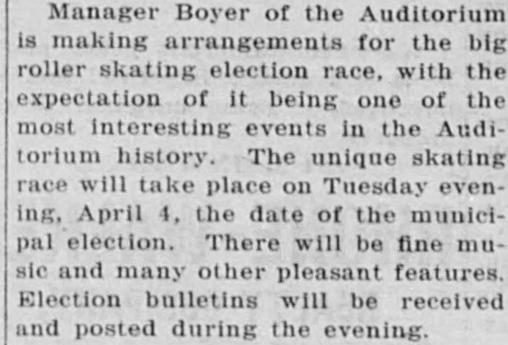
Planning the election race. The Daily Sentinel, Grand Junction, Colorado, March 22, 1905, page 4. Library of Congress, Chronicling America. Click the clipping to read it full size.
Spring ends the fun
In late March the Sentinel still saw “no abatement,” or slowing down, in the craze. By late April the paper decided the craze had “somewhat abated,” probably because of “the approaching warm weather.”
It didn’t stay gone. That fall Turner hall opened its roller rink again, bragging that it was the biggest in the city at 70 by 84 feet. Admission was 25 cents, skates included. Children could skate on Wednesday and Saturday afternoons for a dime.
Sources
- The Daily Sentinel, Grand Junction, Colorado (Library of Congress, Chronicling America): January 12, 1905, page 4; January 13, 1905, page 4; January 17, 1905, page 4; January 20, 1905, page 4; February 16, 1905, page 4; February 17, 1905, page 4; February 27, 1905, page 1 (carnival notice); February 27, 1905, page 4 (Sunday protest); March 13, 1905, page 4; March 15, 1905, page 1 (“The Carnival”); March 22, 1905, page 4; March 23, 1905, page 4; April 4, 1905, page 4; April 28, 1905, page 4; October 28, 1905, page 4.
- “Roller Skating: The Rise and Fall of the Pastime,” The Bossier Banner, Bellevue, Louisiana, March 4, 1886, page 1. Library of Congress, Chronicling America.
- Cover: Woodland Rink, Cleveland, Ohio, 1885, via the Digital Public Library of America and Wikimedia Commons. Public domain.