On the night of October 7, 1908, a picture show in Columbia, Missouri, stopped for a short break between films. A college student pulled out a slip of paper and began to call the roll, just like a teacher. On his list were the University of Missouri students who came to that show all the time. Each member of this “class” answered when his name was called.
The rest of the crowd loved it and clapped. Then the next song began, and the roll call was over. The University Missourian, Columbia’s college newspaper, put the story on its front page the next day.
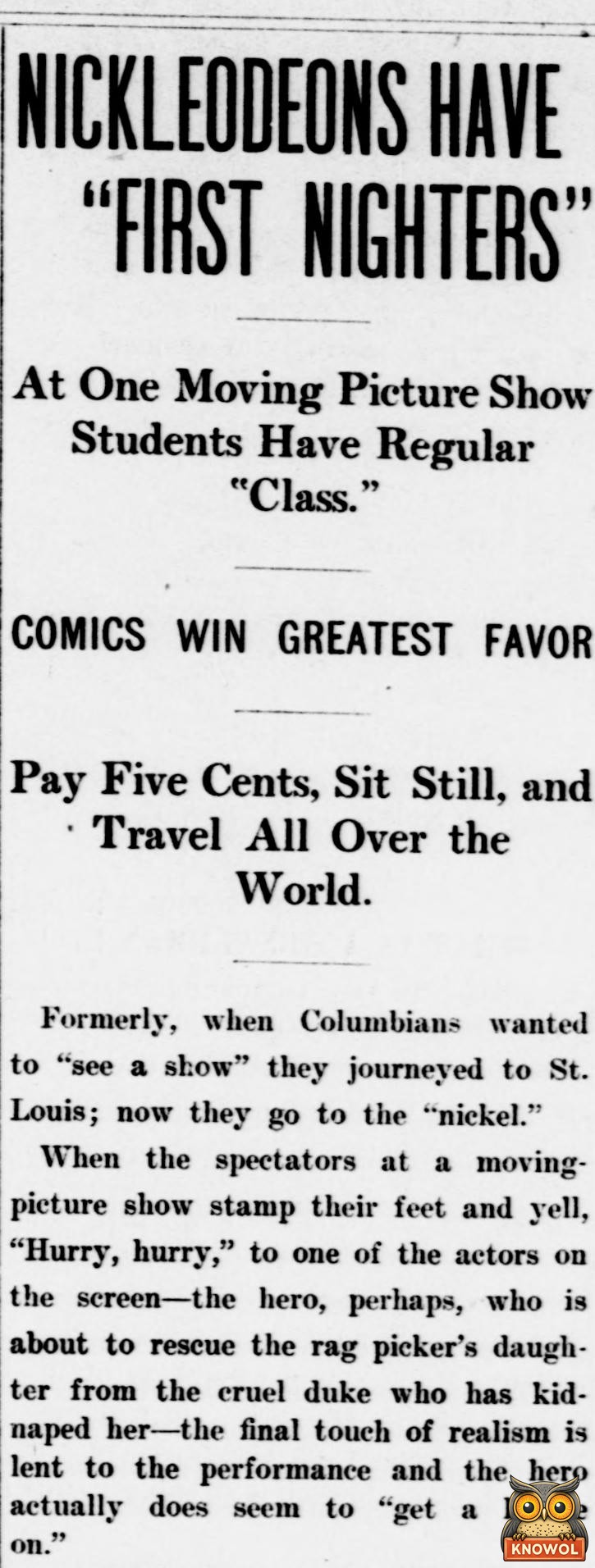
“Nickleodeons Have ‘First Nighters.'” The University Missourian, Columbia, Missouri, October 8, 1908, page 1. Library of Congress, Chronicling America. Click the clipping to read it full size.
What was a nickelodeon?
A nickelodeon was a small movie theater where a ticket cost a nickel, five cents. The name mixes “nickel” with “odeon,” an old Greek word for a theater. Movies were still new, and these little theaters were popping up all over America. People in Columbia just called theirs the “nickel.”
Before the nickel came to town, the paper said, “when Columbians wanted to ‘see a show’ they journeyed to St. Louis.” That was a trip of more than 100 miles. Now a show was right down the street. Each one lasted about 30 minutes, so you could see two in one evening.
The movies were silent, with no voices at all. The paper had heard of a new gadget, a kind of phonograph, that could speak the words for the actors. “To this dizzy height,” it joked, “Columbia has not attained.” Real talking movies were still about 20 years away.
Chases, comics and two giant tears
The audience didn’t sit quietly. When the hero raced to save a girl from a cruel duke, people stamped their feet and yelled “Hurry, hurry” at the screen. Almost every show had a chase. A crowd runs around a corner and knocks over a baby carriage, and the nurse joins the chase. The mob hits a ladder, a painter crashes down, and he joins too. At the end, they often tumble down a hill into a creek.
“Columbia audiences like the comics,” a theater man said. He could tell by the way they clapped. The show changed three times a week, and some fans came every time. Other films showed real life, like a car race or a public nursery, where babies got a bath, were weighed by a doctor, ate, played and went to bed. “It’s the cutest picture I ever saw,” one woman said.
Between films came an illustrated song. A singer sang while pictures were shown on the screen. At one show the song was about “Blue Eyes,” and the screen showed a huge face with painted blue eyes. When the singer reached “Tears are falling from two blue eyes,” the picture changed and two giant tears appeared. One man couldn’t take it and hurried out.
Sometimes the words of the chorus were flashed on the screen so everyone could sing along. One hit that people whistled on the street was “Take Your Girl to the Ball Game.” The paper got the name a little wrong. It was almost surely “Take Me Out to the Ball Game,” a brand-new song in 1908.
Five cents versus thirty
One theater, the Elite, put an ad in the paper with the day’s films. On October 19 the list was “Wouldn’t It Tire You,” “Tale of a Hat,” “O! What Lungs” and “Breaking Into Society.” The ad also promised, “We Cater to Ladies and Children.”
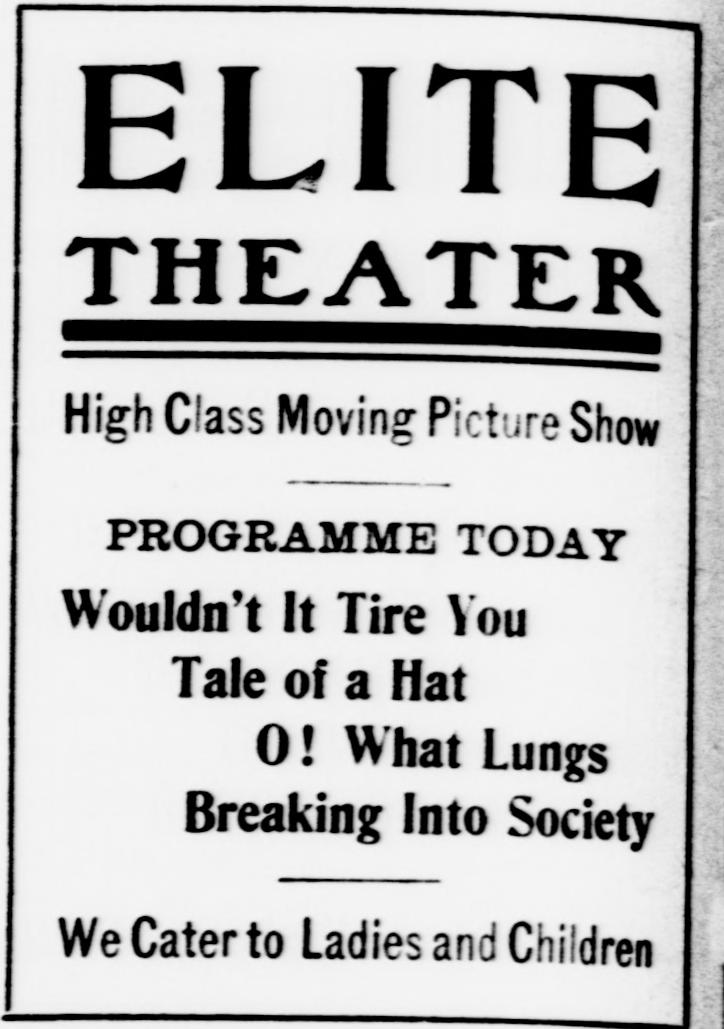
The Elite Theater’s films for October 19. The University Missourian, Columbia, Missouri, October 19, 1908, page 4. Library of Congress, Chronicling America. Click the clipping to read it full size.
The same page shows why the nickel was such a deal. A company of live actors was putting on shows all week at the Columbia Theatre, and seats cost 10, 20 or 30 cents. At the movies, a nickel got you in.
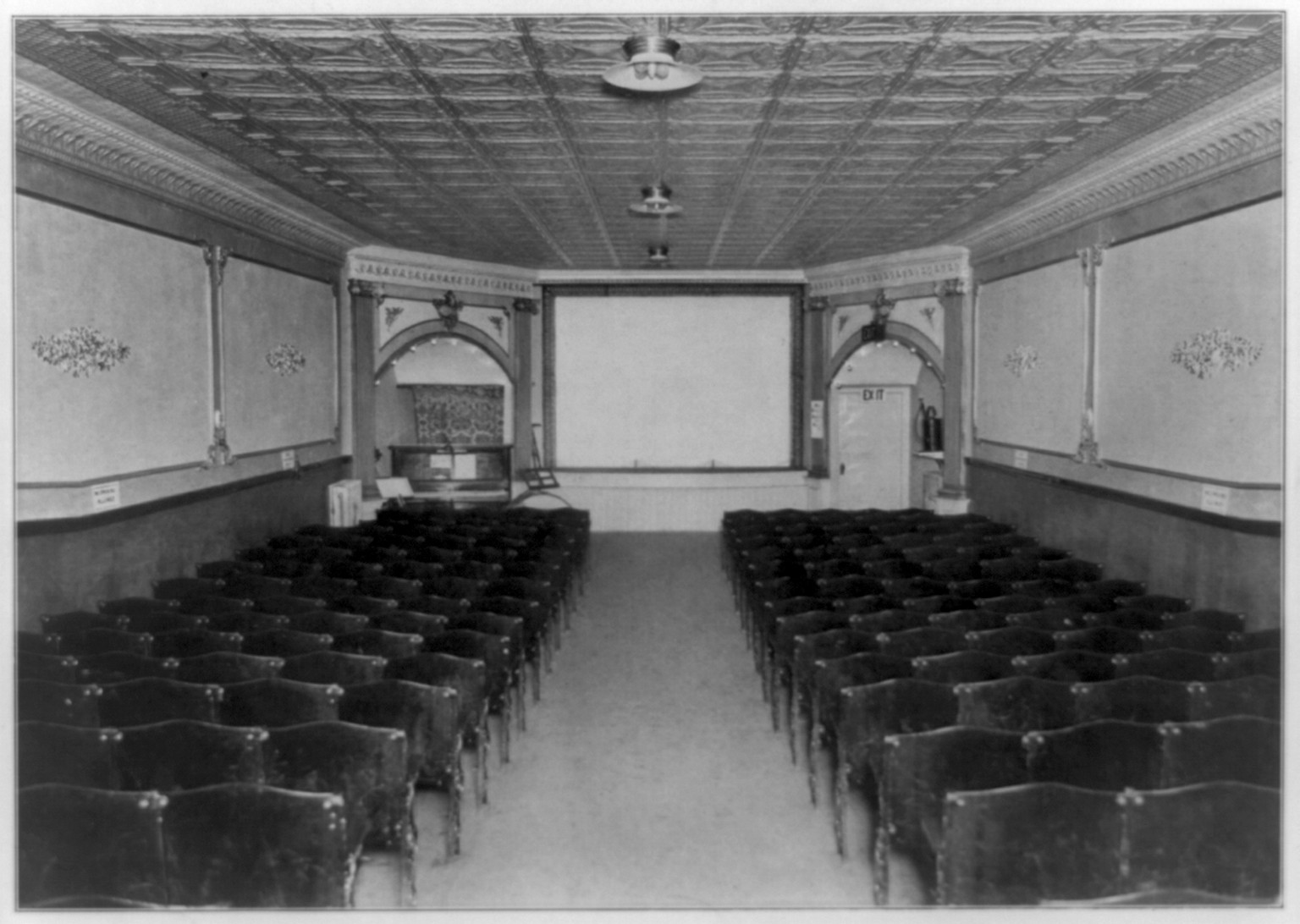
Inside a picture show: the Normal Theatre on Halsted Street in Chicago, around 1909. Rows of seats face the screen, with a piano to the left and an exit door to the right. Decorators’ Supply Co., Library of Congress. Click the picture to see it full size.
The “nickelodeon course”
The movies kept growing. In February 1909 the Missourian reported that two nickel shows weren’t enough, so a third had just opened. Another theater was coming to Walnut Street, but tickets there would cost ten cents. Crowds came every night, the paper said.
The students had a new joke, too. Some said they were taking “a nickelodeon course” and earned credit for every night they went.
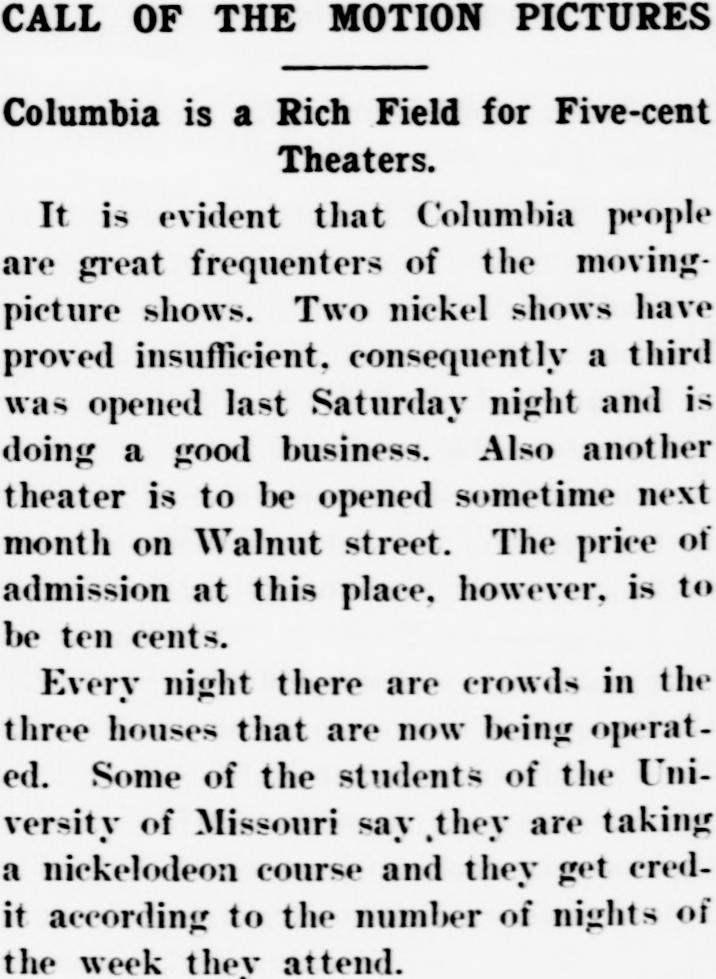
A third nickel show opens. The University Missourian, Columbia, Missouri, February 25, 1909, page 1. Library of Congress, Chronicling America. Click the clipping to read it full size.
Nickel shows across America
Big cities had hundreds of them. In May 1908 a newspaper in Coeur d’Alene, Idaho, printed a New York column that said 400,000 people went to that city’s “nickelodeons” and other picture theaters every day. A group of women at a New York hotel called picture shows “a menace to the youth of our city” and wanted them shut down. The writer said trying to get rid of them would never work. The nickelodeon, he said, had become “the playhouse of the poor.”
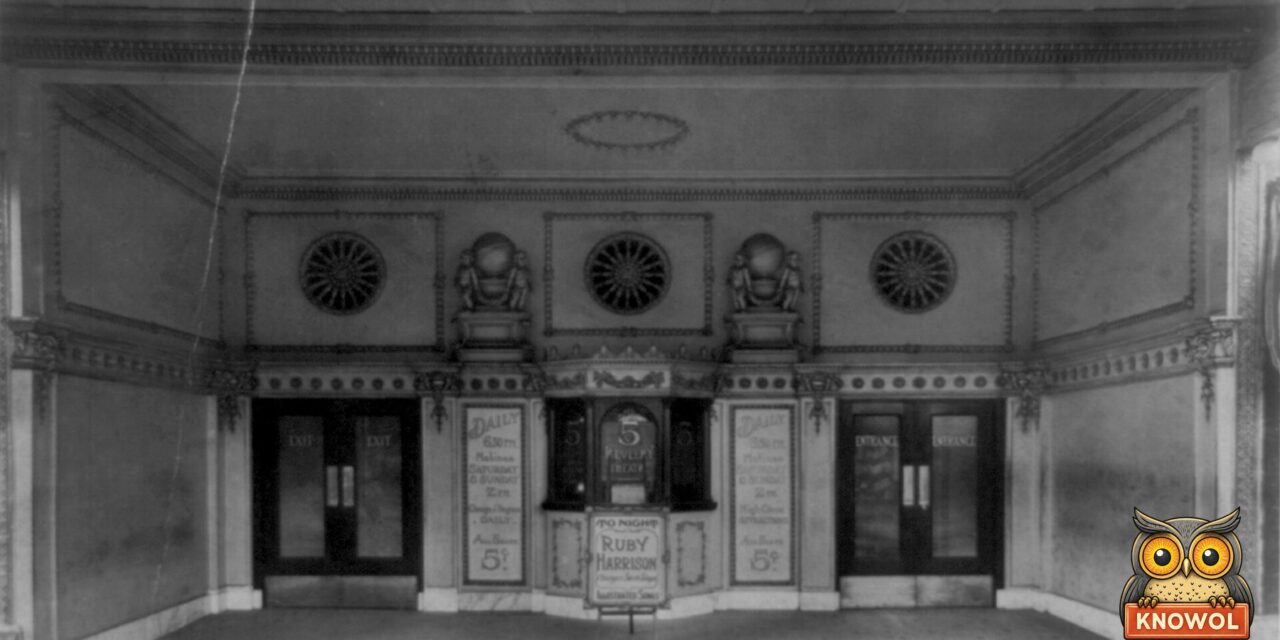
Nickel theaters wanted to look fancy from the sidewalk. A photograph from around 1909, probably in Chicago, shows the doorway of the Revelry Theatre. A ticket booth in the middle has a big “5” in its window, with an EXIT door on one side and an ENTRANCE door on the other. Signs on both sides say “All Seats 5¢,” and another promises “Illustrated Songs” that night.
Sources
- The University Missourian, Columbia, Missouri (Library of Congress, Chronicling America): “Nickleodeons Have ‘First Nighters,'” October 8, 1908, page 1; October 14, 1908, page 3 (Elite Theater ad); October 19, 1908, page 4 (Elite Theater and Columbia Theatre ads); “Call of the Motion Pictures,” February 25, 1909, page 1.
- “News, Views and Gossip,” Coeur d’Alene Evening Press, Coeur d’Alene, Idaho, May 9, 1908, page 2. Library of Congress, Chronicling America.
- Normal Theatre, Chicago, interior and Revelry Theatre entrance, photographs about 1909, Decorators’ Supply Co. Library of Congress Prints and Photographs Division.