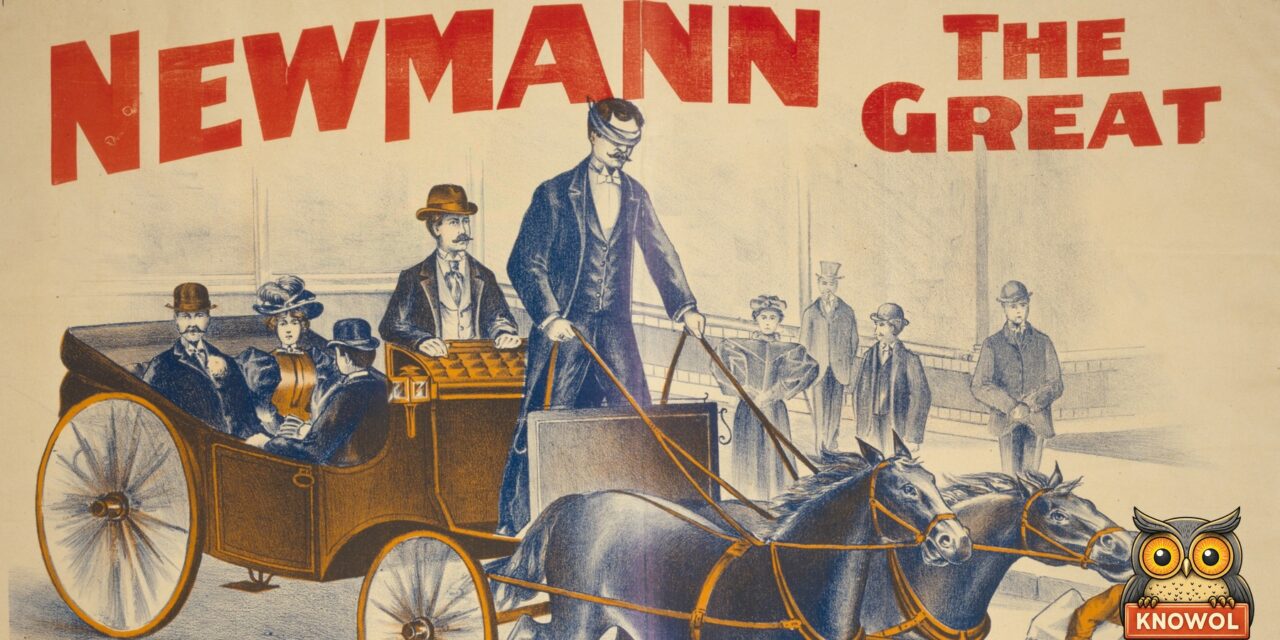
On Friday afternoon, July 30, 1909, a stranger in a blindfold took the reins of a carriage in Dawson, Georgia. His name was Professor Fayssoux. He called himself a hypnotist and a “telepathist,” which meant he said he could read other people’s thoughts. He was about to prove it, for free, right out in the street.
The test was simple to say and hard to do. Four local men had hidden a post office key somewhere in town. Fayssoux would have to find the key, unlock the right post office box, pull out one letter and hand it to the person it was written to. He didn’t know where the key was, which box held the letter, or whose name was on it.
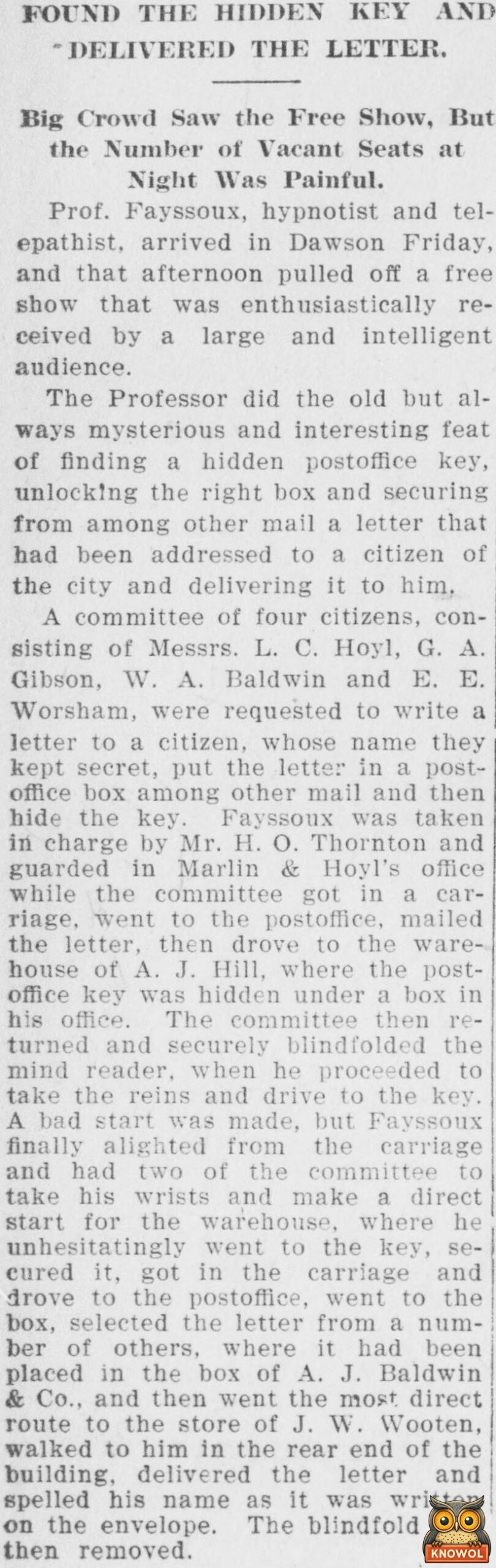
“Found the Hidden Key and Delivered the Letter.” The Dawson News, Dawson, Georgia, August 4, 1909, page 6. Library of Congress, Chronicling America. Click the clipping to read it full size.
The hunt
The four men were the committee, townspeople picked to make sure there was no cheating: L. C. Hoyl, G. A. Gibson, W. A. Baldwin and E. E. Worsham. They wrote a letter to a citizen and kept his name secret. Meanwhile H. O. Thornton guarded Fayssoux inside an office so he couldn’t watch.
The committee rode to the post office in a carriage and mailed the letter. Then they drove to A. J. Hill’s warehouse and hid the key under a box in his office. They came back, tied the blindfold on tight, and let Fayssoux drive.
It didn’t go well at first. “A bad start was made,” The Dawson News admitted. So Fayssoux climbed down from the carriage and “had two of the committee to take his wrists.” With a man holding each arm, he headed straight for the warehouse and went right to the key.
After that it was quick. He drove to the post office and found the letter in the box of A. J. Baldwin & Co. Then he went to the store of J. W. Wooten, walked to the back of the building, handed Mr. Wooten the letter and spelled his name the way it was written on the envelope. Only then did the blindfold come off.
How the trick really worked
Those two men holding his wrists were the secret. Performers called it mind reading. People who exposed it called it muscle reading.
Here’s how it works. When you think hard about a hiding place, your body leans toward it a tiny bit. Your arm tugs, stiffens or relaxes without your knowing it. A performer holding your wrist feels those little pushes and follows them like a trail. You lead him, and you never know you did it.
In 1902 the Evening Bulletin of Honolulu printed a long explanation under the headline “Mind Reading Trick Is Successfully Exposed.” The blindfold drive, it said, “is not an evidence of telepathy. All it requires is a little nerve, quick wit, some practice, and anyone can accomplish it.” The driver could usually peek. Even with a handkerchief over his eyes, “he can always see under it,” which is why so many drivers were “seen to lean far back while driving.” At the end of the ride, the driver “has to take the hand of the sensitive to locate the object through muscle reading.” The sensitive was the helper whose thoughts were being “read.” The paper even told readers to try it at home: hold a friend’s hand, keep your arm a little stiff, and “you can fairly feel him lead you towards it when he concentrates his whole attention on the place.”
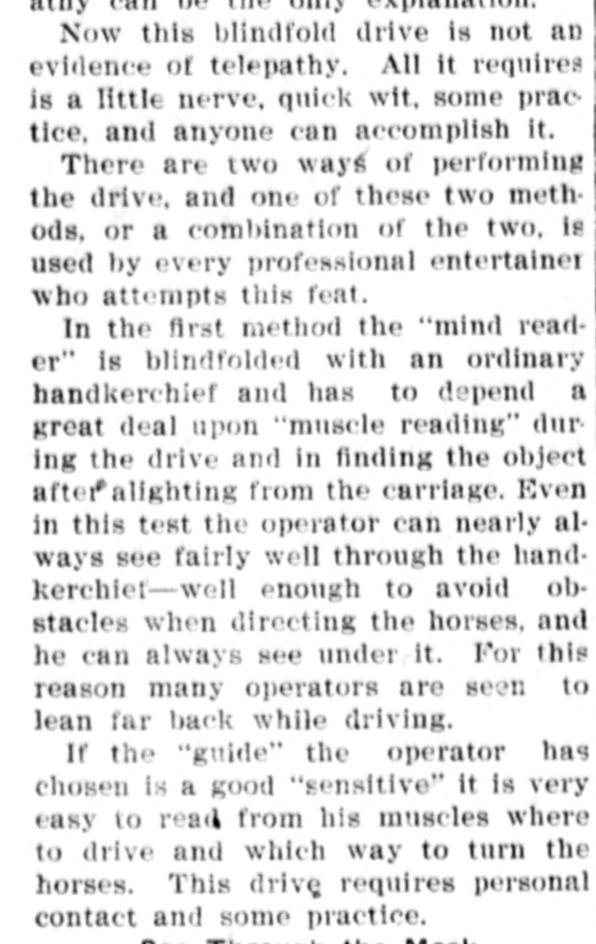
How the blindfold drive was done. Evening Bulletin, Honolulu, Hawaii, August 1902, page 12. Library of Congress, Chronicling America. Click the clipping to read it full size.
The same show, town after town
Traveling mind readers did this stunt all over the country, and local papers loved to print the names of the men who hid the prize.
In Red Lodge, Montana, in April 1902, the driver was a woman: Mrs. Moxie, the wife of a stage hypnotist. Her committee hid Joe Hardin’s gold watch, and they stopped at the depot (the train station) “as a bluff” to fool her. She stopped at the depot, too. Then she searched the cigar case at the post office news stand for about ten minutes, with no luck. She went back out, “led two of the members thereof into the store,” and found the watch in a cigar box at the bottom of the case. Like Fayssoux, she needed the people who knew right beside her.
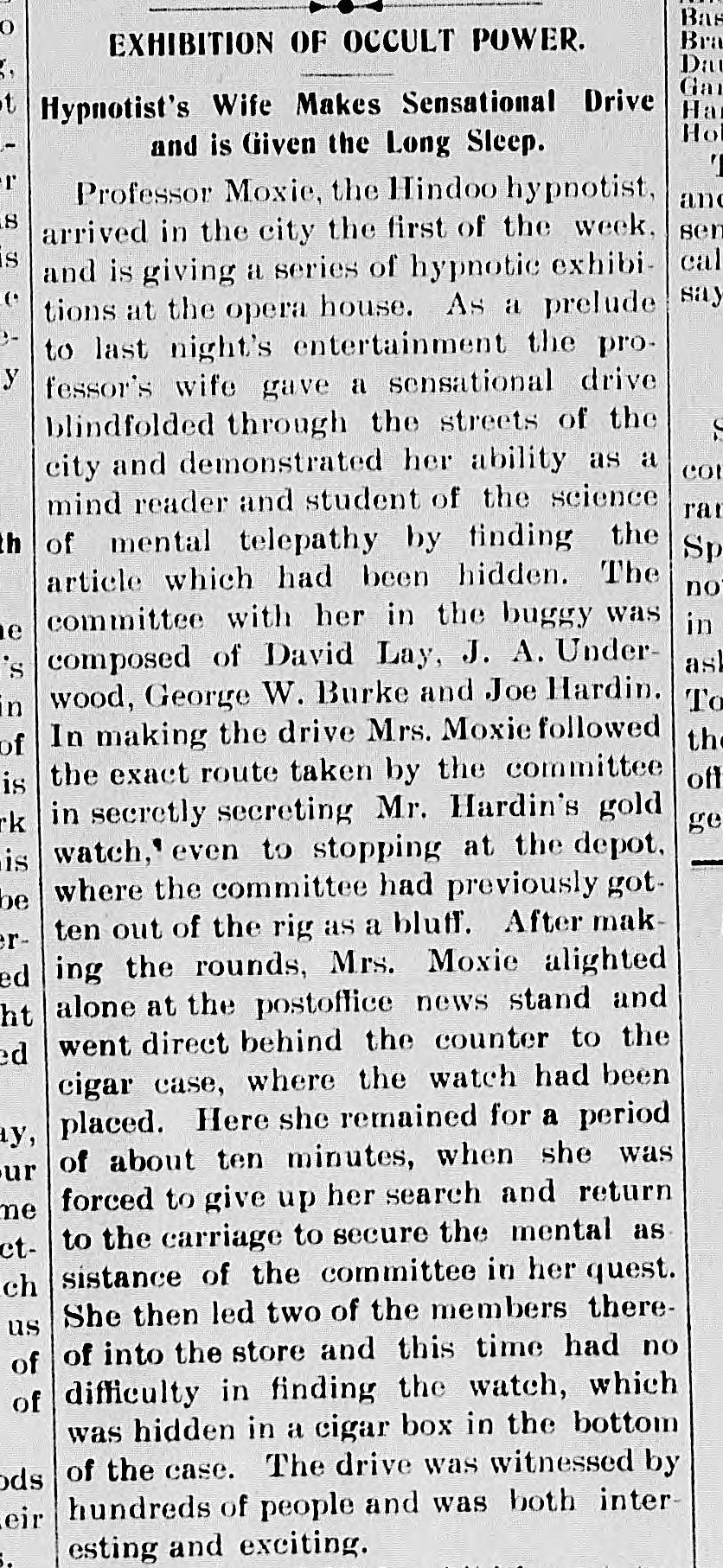
“Hypnotist’s Wife Makes Sensational Drive.” Red Lodge Picket, Red Lodge, Montana, April 4, 1902, page 1. Library of Congress, Chronicling America. Click the clipping to read it full size.
Fayssoux took the same act to Columbus, Mississippi, that September. The paper promised he would “drive a span of fiery horses” (a pair of horses) through town. This time the prize was a slip of paper with a post office box combination, hidden under a bridge in front of President Whitfield’s home on College Street. Fayssoux “went straight to the bridge ripped off a plank, found the paper” and opened the box.
The stunt was old by then. Around 1898 a magician called Newmann the Great put it on his poster: Newmann standing blindfolded in a carriage, driving two galloping horses, with his committee riding behind him.
The sleeper in the window
Fayssoux had a second trick to sell tickets. At his first night show in Dawson, he hypnotized a young man from Eufaula, Alabama, and had him moved to the show window of a store called the Bee Hive. There he lay until Saturday night, “in an apparently lifeless condition in full view of every passerby.” Hundreds came to look. In Columbus, his sleeper lay in the City Furniture Company’s window for 48 hours.
Other hypnotists used the same two tricks. When a showman named Galvani came to Maysville, Kentucky, in November 1909, his ad promised a man asleep in a store window and a “daring drive blindfolded.” Tickets cost 10, 20 or 30 cents.
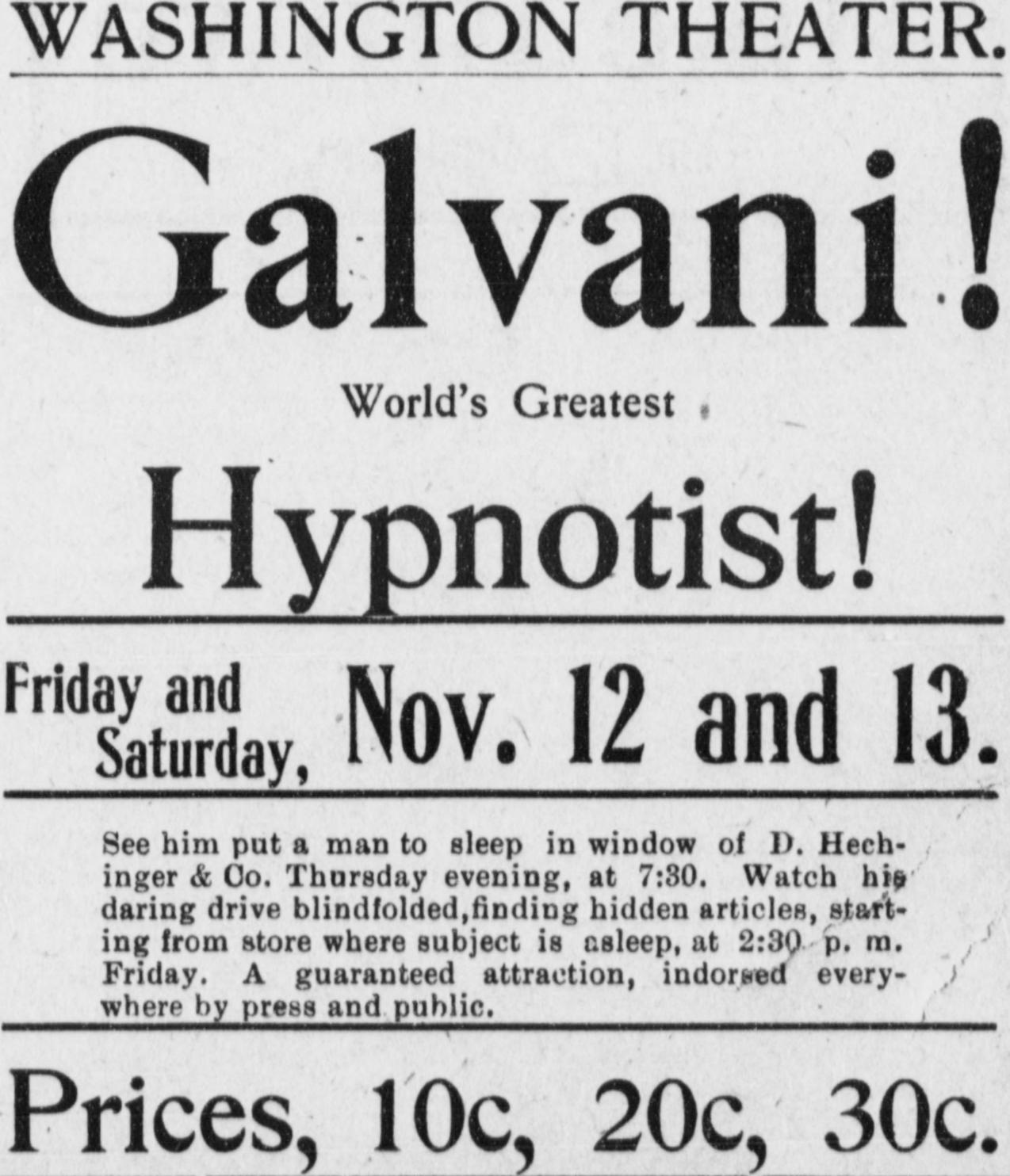
Galvani’s ad: a man asleep in a store window, a blindfolded drive, and seats for 10, 20 and 30 cents. Daily Public Ledger, Maysville, Kentucky, November 12, 1909, page 2. Library of Congress, Chronicling America. Click the picture to see it full size.
An act that wasn’t on the bill
In Dawson the street show was a hit, but the paid shows were not. The night crowd was “nothing like as large as it was in the afternoon, when the entertainment was free.” The paper’s headline put it plainly: “the Number of Vacant Seats at Night Was Painful.”
Then Saturday night got stranger. The sleeper in the Bee Hive window was Ralph Odum, and his father, Wm. Odum, wanted him home in Eufaula. He came on the 9:30 train “with the intention of having the hypnotist arrested for kidnapping.” Police Chief Paschal walked Fayssoux to a lawyer’s house, and it was settled there. Fayssoux paid for the father’s trip and a week of Ralph’s salary. That sounds like the young man in the window was being paid to be part of the show. Fayssoux said Ralph had told him he was 22 and that his father was willing.
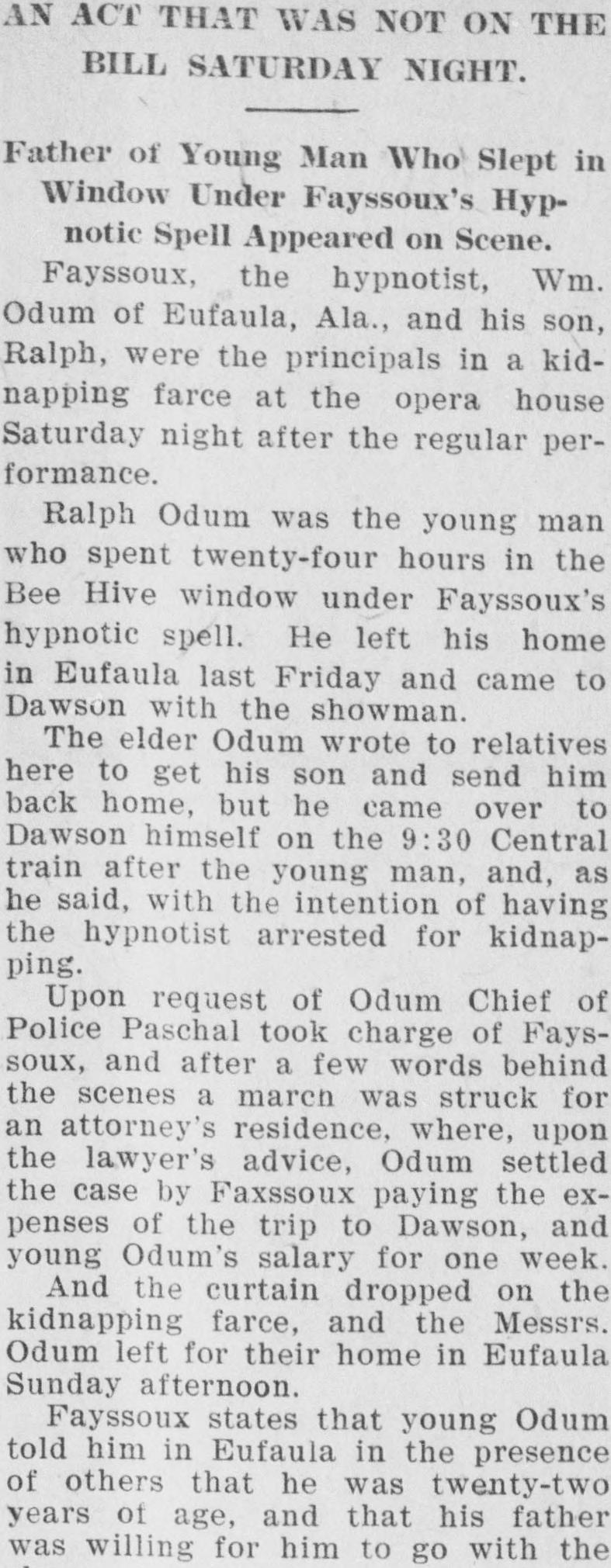
“An Act That Was Not on the Bill Saturday Night.” The Dawson News, Dawson, Georgia, August 4, 1909, page 3. Library of Congress, Chronicling America. Click the clipping to read it full size.
The News called it a “kidnapping farce” (a farce is a silly comedy). Father and son went home to Eufaula on Sunday afternoon. Fayssoux stayed for more shows through Tuesday night. The paper didn’t say whether anyone ever figured out how he found the key.
Sources
- The Dawson News (Dawson, Georgia): August 4, 1909, page 6 (“Found the Hidden Key and Delivered the Letter”) and August 4, 1909, page 3 (“An Act That Was Not on the Bill Saturday Night”).
- The Columbus Commercial (Columbus, Mississippi): September 16, 1909, page 1 and September 23, 1909, page 4.
- Red Lodge Picket (Red Lodge, Montana): April 4, 1902, page 1.
- Evening Bulletin (Honolulu, Hawaii): August 1902, page 12, “Mind Reading Trick Is Successfully Exposed,” an explanation the paper credited to a magazine called Suggestion.
- Daily Public Ledger (Maysville, Kentucky): November 12, 1909, page 2 (Galvani’s ad).
- All newspaper images: Library of Congress, Chronicling America. Published 1902 to 1909, public domain.
- Cover: “Newmann the Great: Making his famous blindfold drive,” color lithograph poster, Riverside Printing Company, Milwaukee, about 1898, Magic poster collection, Library of Congress, no known restrictions on publication.