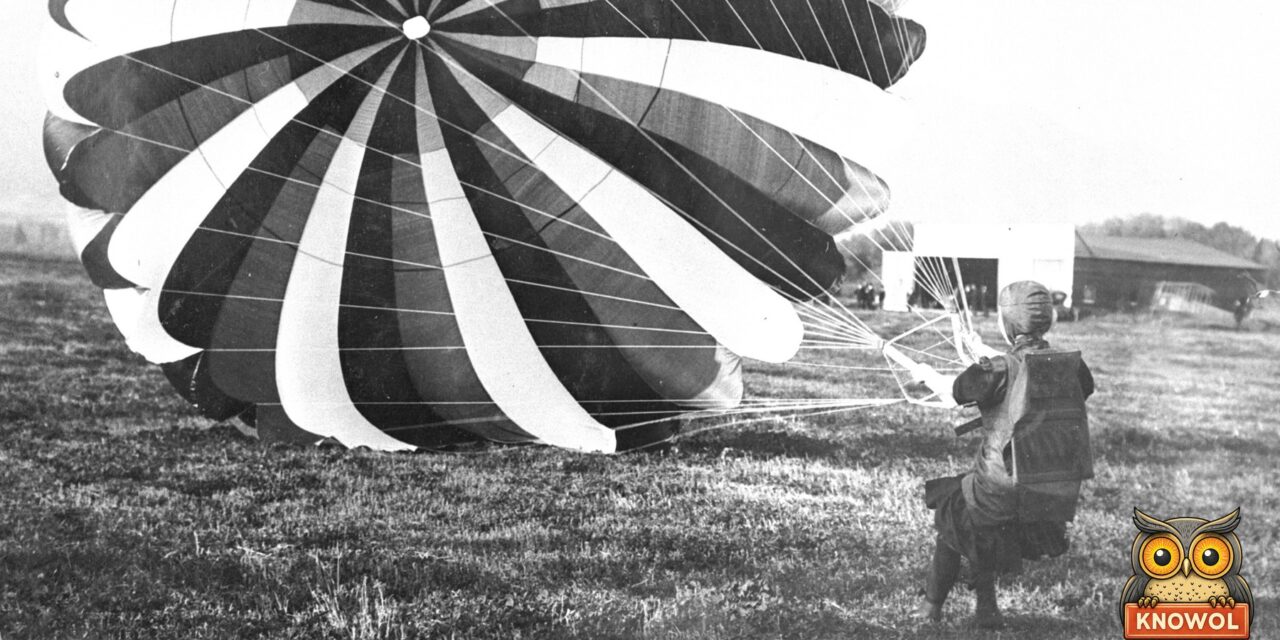
On Friday afternoon, September 3, 1909, a girl hung under a parachute high above Waterville, Maine. The wind pushed her toward Western Avenue. She came down right in the middle of the telephone and telegraph wires.
Men who were working there brought ladders and climbed up to get her. She came out of it with “no serious injuries.” Her name was Miss Tiny Broadwick, and that week she was a star attraction at the Central Maine Fair.
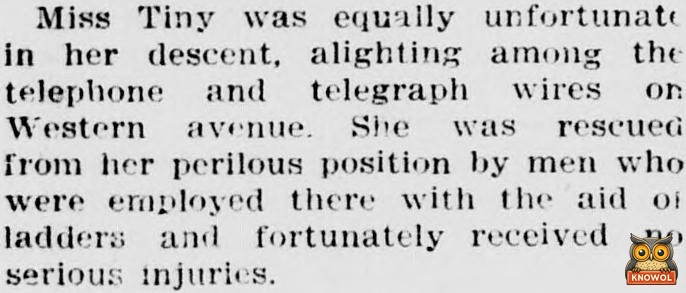
“Miss Tiny … alighting among the telephone and telegraph wires on Western avenue.” Daily Kennebec Journal, Augusta, Maine, September 4, 1909, page 12. Library of Congress, Chronicling America. Click the clipping to read it full size.
A balloon made in Waterville
Tiny’s family did balloon shows. The fair’s ads called them “Famous French Aeronauts.” An aeronaut is a person who flies in a balloon. The ads promised a “triple parachute drop by Miss Tiny.” That meant three parachutes on one ride. High in the sky she would cut loose from the first one, then the second, and ride the third one down.
The Broadwicks made their own balloons. The week before the fair, they rented rooms over the Dickinson Harness store in Waterville and made a new one. It took 1,600 yards of cloth “direct from the Lockwood mill in this city.” That’s about nine-tenths of a mile of cloth.
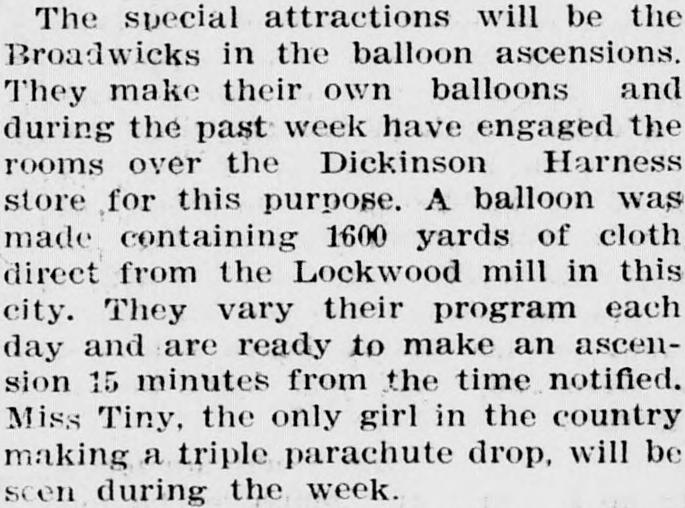
The Broadwicks made their balloon in Waterville with cloth from a Waterville mill. Daily Kennebec Journal, Augusta, Maine, August 30, 1909, page 3. Library of Congress, Chronicling America. Click the clipping to read it full size.
What the ride felt like
Balloons like this had no gas inside. A fire on the ground filled them with hot air, and hot air rises. The best report of a ride came from a reporter who tried it himself.
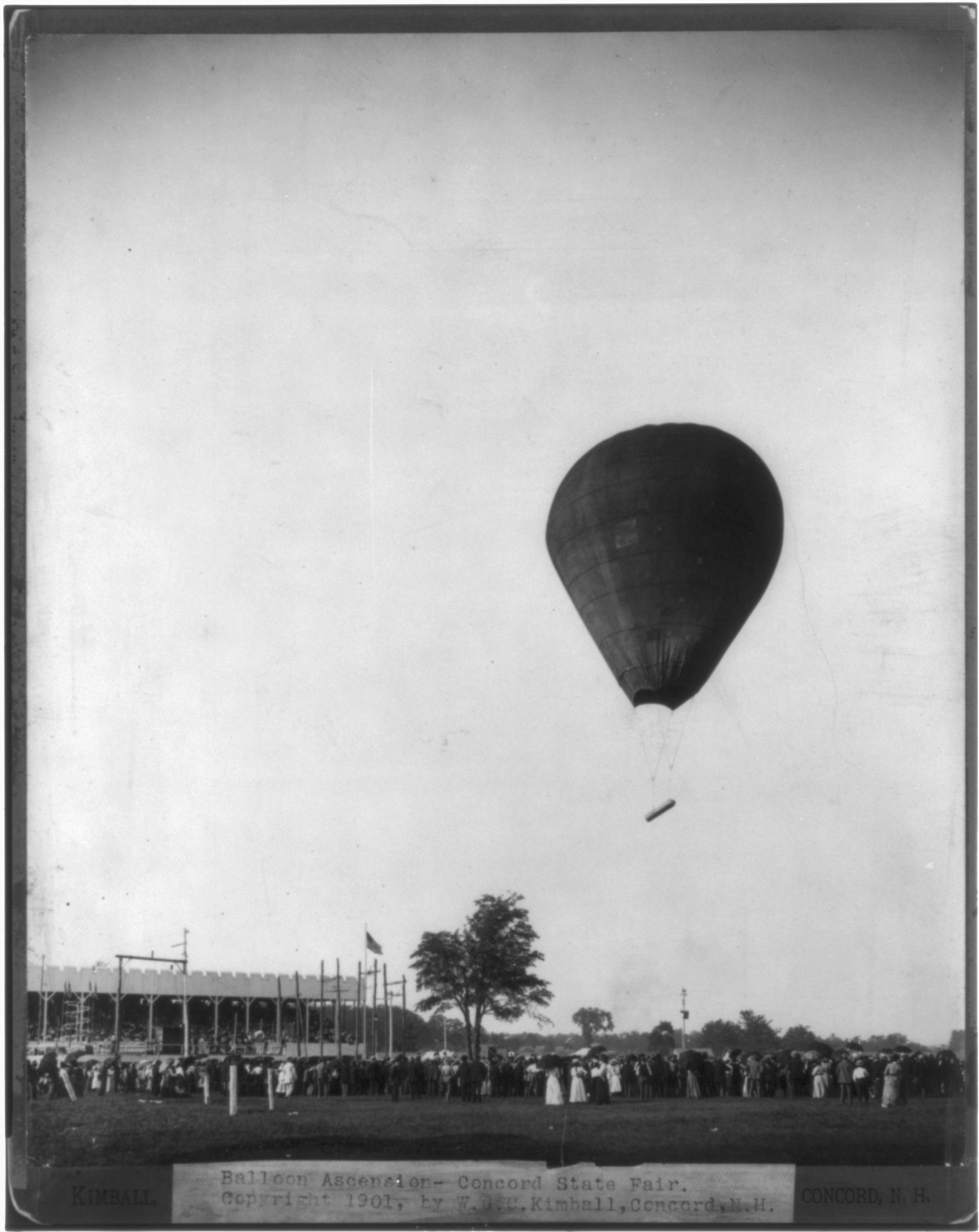
A hot-air balloon goes up over the crowd at the state fair in Concord, New Hampshire, in 1901. Photo by W. G. C. Kimball. Library of Congress. Click the picture to see it full size.
In the fall of 1907, the Broadwick balloon show came to the fair in Augusta, Georgia. Mr. Broadwick was supposed to go up. Instead, a few minutes before the start, a young reporter named William B. Seabrook “peeled off his coat and vest, took a seat on the trapeze” and went up in his place. Even the other reporters at The Augusta Chronicle didn’t know.
“At four o’clock the fires were lighted,” Seabrook wrote, and soon “the blasts of hot air filled the bags.” He wore a life preserver in case he came down in the canal or the river. His seat was a trapeze bar “no bigger than a broom-stick.”
Going up didn’t feel like moving at all. The people below just kept shrinking. “The race track looked like somebody’s small back yard,” he wrote, and the main fair building looked like “a hen-house.”
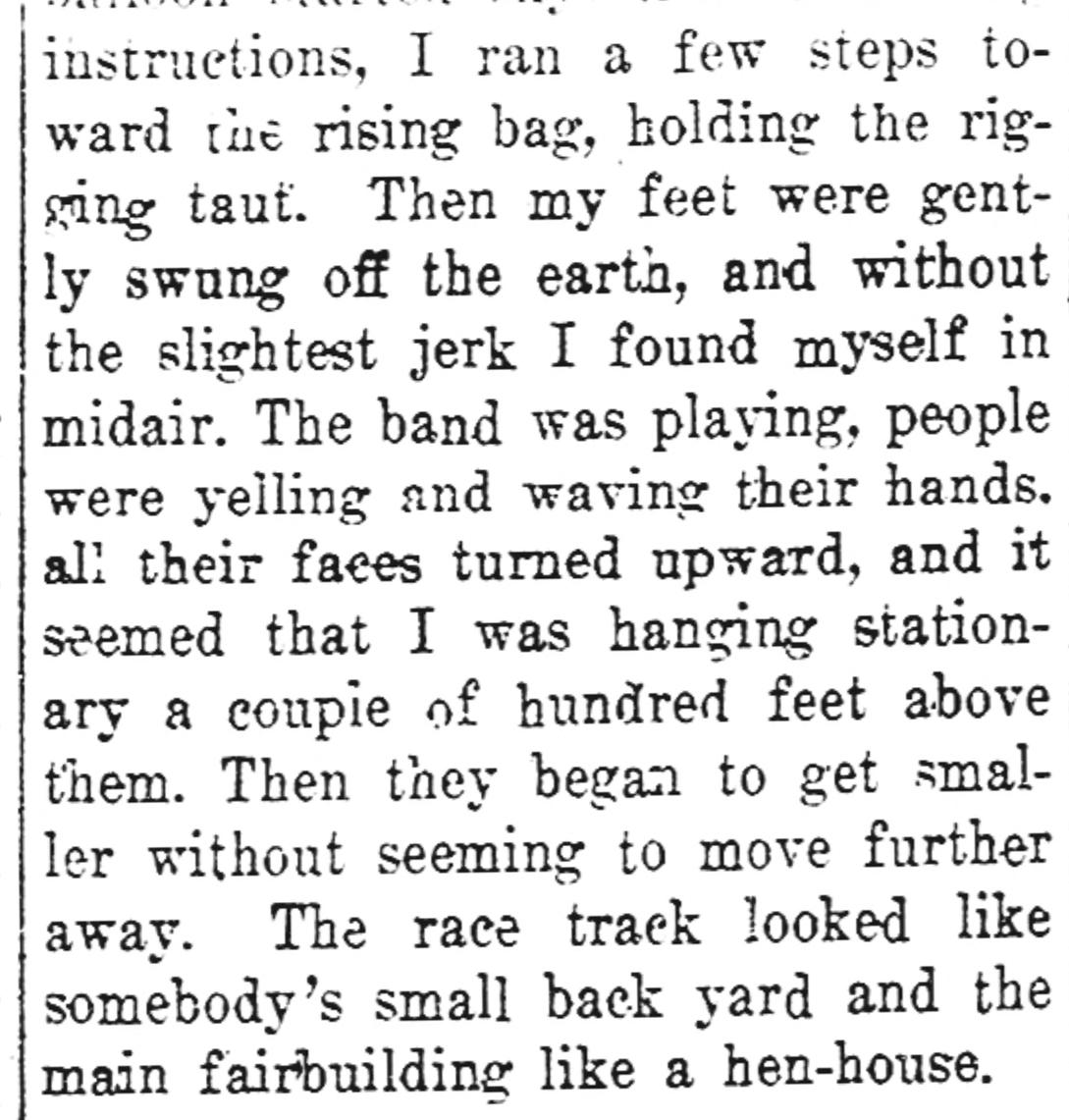
A reporter’s first balloon ride, at the fair in Augusta, Georgia. The Augusta Chronicle story was reprinted in The Herald and News, Newberry, South Carolina, November 12, 1907, page 3. Library of Congress, Chronicling America. Click the clipping to read it full size.
When Broadwick gave his signal, it was time to cut loose. Seabrook had been told his parachute would “drop three hundred feet like a bullet before opening.” He wrote that “the bottom seemed to drop out of everything.” Then the parachute “flared wide” and caught the air. He steered away from a clump of pine trees. Then the Augusta canal seemed to rush up at him. He ended up in the mud of a swamp field.
Back at the fairground, Broadwick held out “a grimy paw” to shake. Seabrook had gone “two-thirds of a mile high.” Then, with a grin, Broadwick told him he had used the parachute that falls 500 feet before it opens, not the 300-foot one.
Three tries in four days
The Waterville fair ran from Tuesday, August 31, to Friday, September 3. Tiny was billed to go up every afternoon.
On Tuesday the wind was too strong. The crew filled the balloon just before 6 o’clock. Then the manager “decided not to risk the chances of injuring the little girl” and kept her on the ground.
On Wednesday it worked. The balloon rose with “little Tiny Bradwick, the girl aeronaut, sitting in the basket.” (The paper spelled her name two ways that week.) She let go of one parachute and then the next. She landed in a field just north of the park. She told a reporter the balloon had gone up “over 2000 feet.” Then, because she was “very fond of horses,” she stayed to watch two or three horse races. The paper said she was 18 but looked “at least five years younger.”
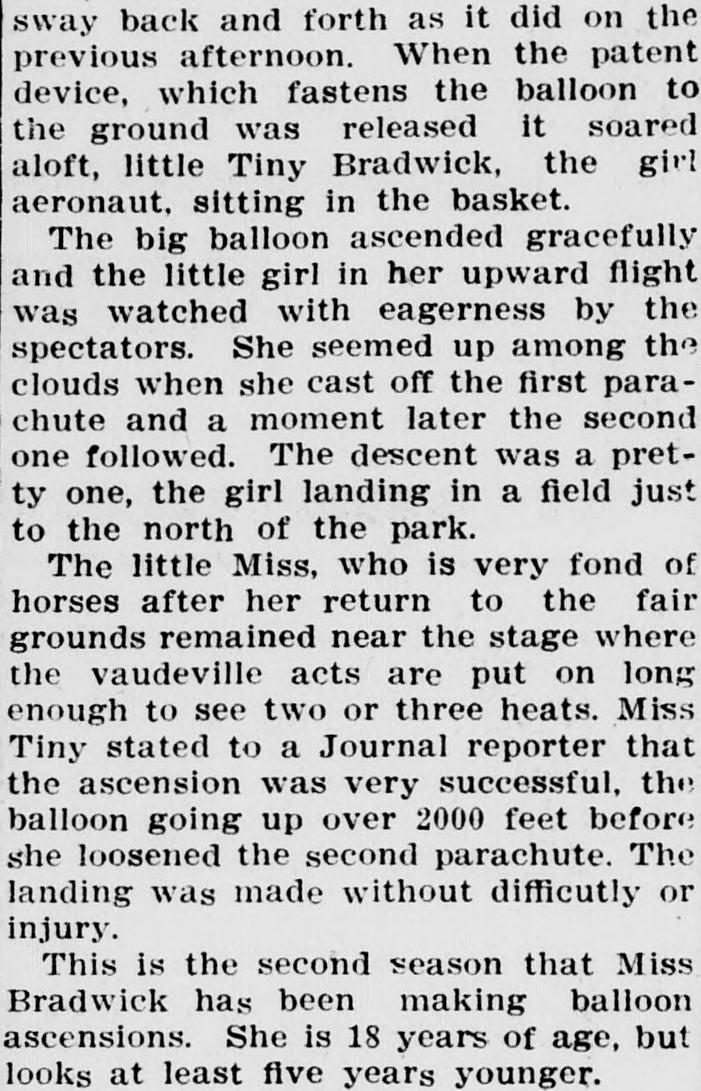
Wednesday’s ride: “little Tiny Bradwick, the girl aeronaut.” Daily Kennebec Journal, Augusta, Maine, September 2, 1909, page 10. Library of Congress, Chronicling America. Click the clipping to read it full size.
On Thursday the wind blew hard again, so she waited until nearly sundown. This time she did the whole triple act. The balloon “floated gracefully over the grandstand,” and the whole crowd stood up to watch. She looked like “a tiny speck” up there. She cut loose from the first and second parachutes and rode the third one down. The wind carried her southeast toward the Messalonskee Stream, but she landed safely “some distance from the water.”
Friday was a double ascension. A balloon man named John Depree went up with her, and each had a parachute. Depree drifted east into an orchard. He swerved to miss an apple tree, landed hard and broke a small bone in his ankle. Tiny drifted the other way, toward Western Avenue and those wires.
What it cost
Watching Tiny was part of the price of a fair ticket. It cost 50 cents to get into the park, or $2.00 for a ticket good for five visits. That also got you horse races, art and flower shows, and “Nelson’s Guideless Wonder,” a horse that would run “a fast mile each afternoon going without driver.”

The fair’s ad: the Broadwicks, a horse with no driver, and 50 cents to get in. Daily Kennebec Journal, Augusta, Maine, August 28, 1909, page 3. Library of Congress, Chronicling America. Click the clipping to read it full size.
After Waterville
Tiny kept jumping. In February 1910, an ad for a traveling show in Ocala, Florida, promised “Prof. Broadwick and his 16 year old daughter.” This ad spelled her name “Tiney.” So was she 16 or 18? The papers didn’t agree.
In June 1913, near Los Angeles, California, she tried something new. She jumped from an airplane more than 1,000 feet up. She was testing a new parachute from the aviator Glenn Martin, which the paper called an aerial “lifeboat.” The San Francisco Call reported that “for the first time in the history of aviation a woman has made a descent from a rapidly moving aeroplane to the earth in perfect safety.” She landed in a grain field near the Griffith Park aviation field. Four years earlier, she had been the girl in the wires on Western Avenue.
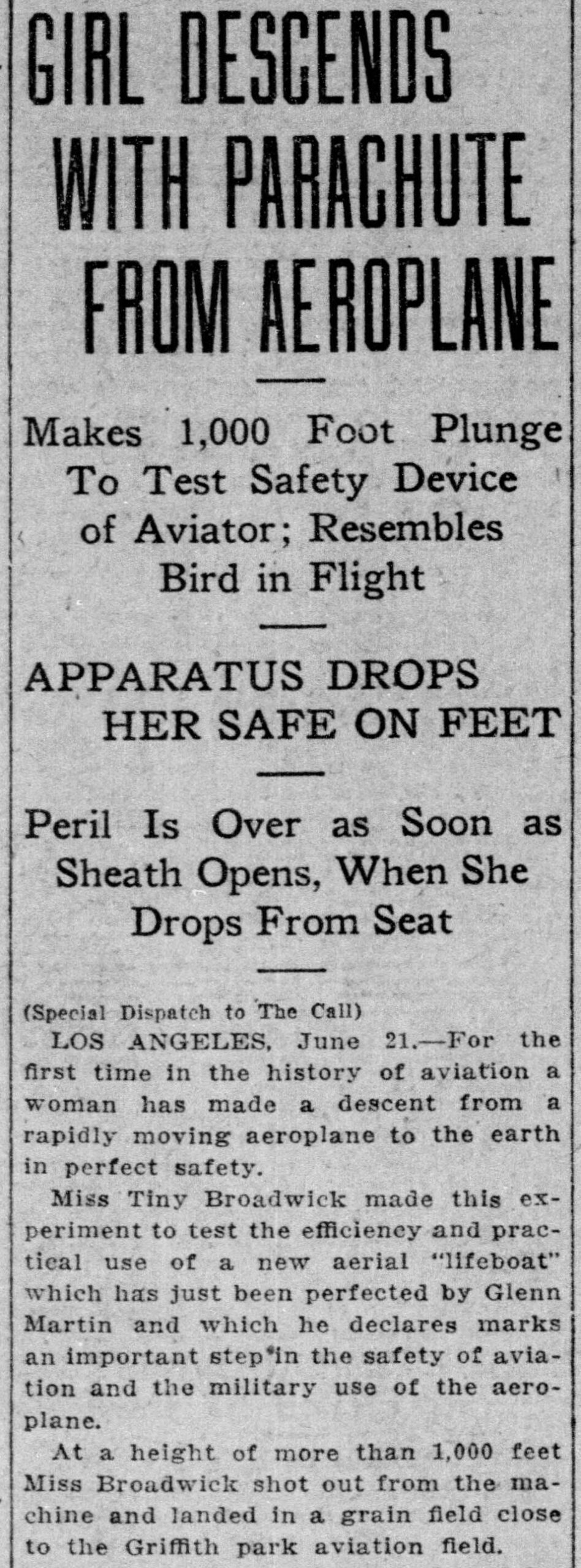
“Girl Descends With Parachute From Aeroplane.” The San Francisco Call, San Francisco, California, June 22, 1913, page 17. Library of Congress, Chronicling America. Click the clipping to read it full size.
Sources
- Daily Kennebec Journal (Augusta, Maine), reports on the Central Maine Fair in Waterville: August 18, 1909, page 3 (ad), August 28, 1909, page 3 (ad), August 30, 1909, page 3, September 1, 1909, page 10, September 2, 1909, page 10, September 3, 1909, page 1 and September 4, 1909, page 12.
- The Herald and News (Newberry, South Carolina): November 12, 1907, page 3, W. B. Seabrook’s “Up in a Balloon,” reprinted from The Augusta Chronicle.
- The Ocala Evening Star (Ocala, Florida): February 25, 1910, page 1 (show ad).
- The San Francisco Call (San Francisco, California): June 22, 1913, page 17.
- All newspaper images: Library of Congress, Chronicling America. Published 1907 to 1913, public domain.
- “Balloon Ascension, Concord State Fair, Concord, N.H.,” photograph by W. G. C. Kimball, about 1901, Library of Congress, no known restrictions on publication.
- Cover: “Tiny Broadwick with open chute,” about 1913 to 1922, General Negative Collection, State Archives of North Carolina, no known copyright restrictions; via Wikimedia Commons.