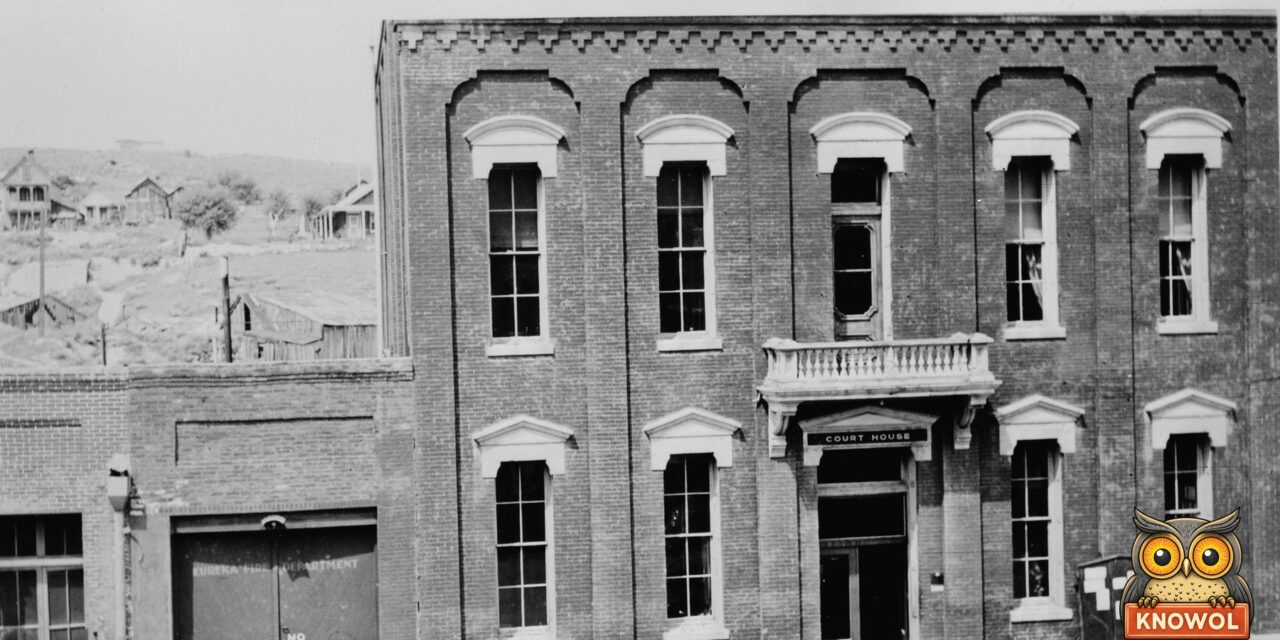
On Saturday evening, July 1, 1922, a sedan parked on Main Street in Eureka, Nevada, right in front of the courthouse. A long wire ran from the top of the courthouse flag pole to the top of the Eureka Theatre building, about 80 feet up. Inside the car was a radio. Just about everybody in town came out to hear it.
The Eureka Sentinel said there was a big crowd, with “every one from near and far turning out for a demonstration of this new wonder of the age.” Nobody knew yet if radio would even work out here, in a mining town in the mountains of central Nevada.
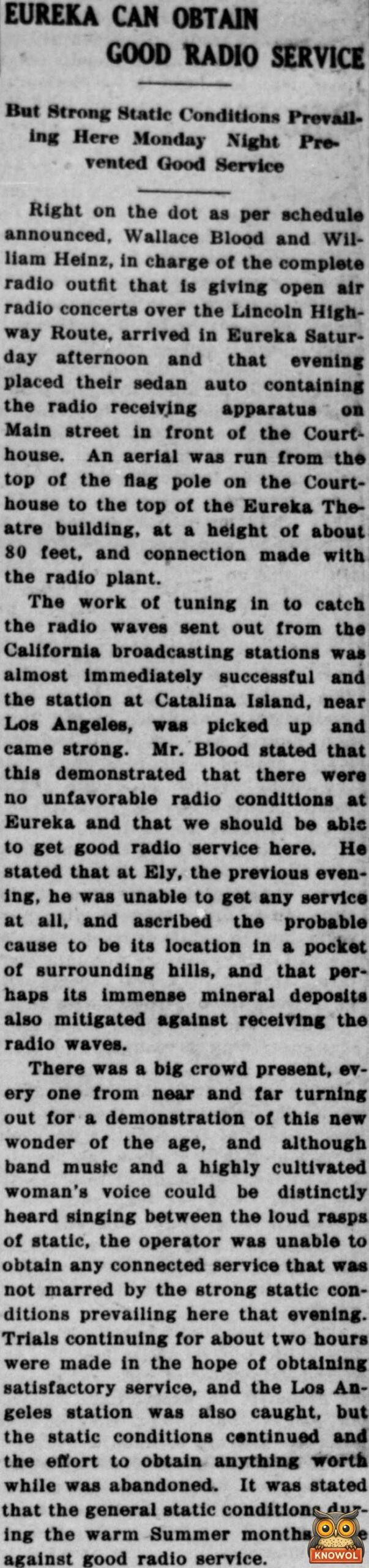
“Eureka Can Obtain Good Radio Service.” The Eureka Sentinel, Eureka, Nevada, July 8, 1922, page 1. Library of Congress, Chronicling America. Click the clipping to read it full size.
A radio show on wheels
Radio stations that played music for anyone to hear were brand new in 1922, so that summer a radio went on the road. Two cars drove the Lincoln Highway all the way from Detroit to San Francisco, on what the papers called “America’s first cross-country radio tour.”
Detroit business groups and the Lincoln Highway Association paid for the trip, to show the country that Detroit made radios as well as cars. Wallace Blood and William Heinz ran the show. Eddie Rickenbacker, the World War I flying hero, officially sent them off on their 2,800-mile run. The plan was to stop in town after town, set up, and play whatever music came through the air.
How the radio car worked
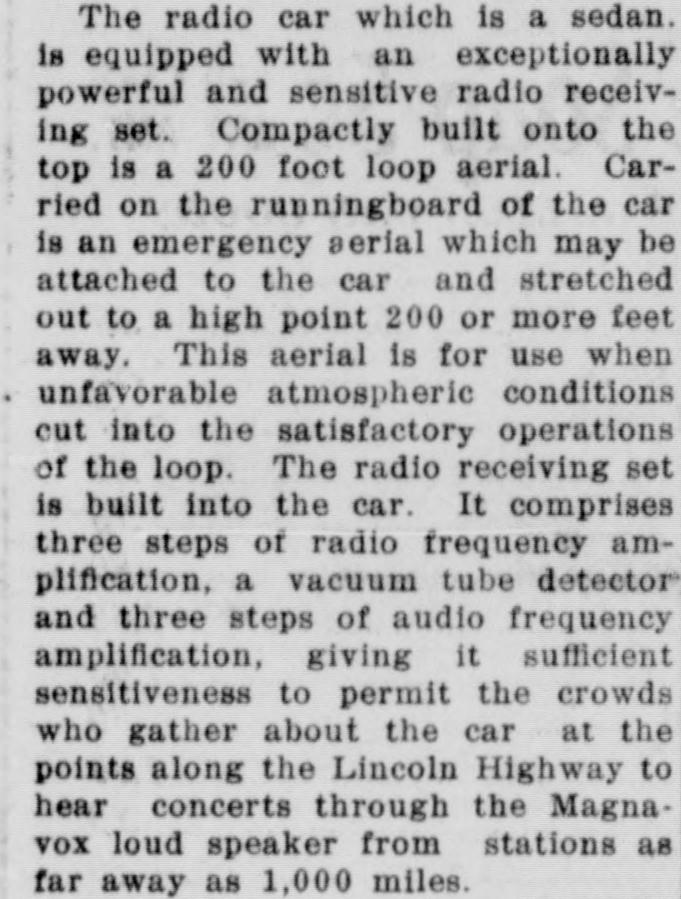
How the radio car worked. The Standard, Fallon, Nevada, June 21, 1922, page 1. Library of Congress, Chronicling America. Click the clipping to read it full size.
The radio was built right into the car. On the roof sat a loop aerial, a frame of wire that catches radio waves. Today we’d call it an antenna. Within 75 miles of a station, the Carson City Daily Appeal said, the roof aerial was enough.
Farther out, the men strung a long wire up high, from a flag pole, a tree or the top of a building. A spare aerial rode on the running board, the wide step along the side of old cars, and it could stretch out 200 feet or more.
The set held seven vacuum tubes, glass bulbs that made weak radio signals strong enough to hear. Tiny chips do that job in a phone today. The sound came out of a Magnavox loud speaker, so a whole crowd could listen at once, and the papers promised music from stations up to 1,000 miles away.
Saturday night in Eureka
A week before, the Sentinel said the concert might be held at the new Richmond baseball grounds, “or on the big slag dumps adjoining if a more elevated position is desired.” Slag is the rocky waste left over when ore is melted down for its metal, and Eureka had hills of it. In the end, the car simply parked on Main Street.
At first, things went great. The men tuned in, and a station on Catalina Island, near Los Angeles, “was picked up and came strong.” Wallace Blood was pleased, because the night before in Ely he hadn’t picked up anything at all. He blamed Ely’s spot in a pocket of hills, and maybe all the metal ore in the ground. Eureka, he said, could get good radio.
But the static was strong that night. Static is the crackle and buzz that electricity in the air puts into a radio. The crowd heard band music and a woman singing, but only in bits, “between the loud rasps of static.” The men kept at it for about two hours and even caught a Los Angeles station before they gave up. Summer, they explained, was hard on radio.
A thousand people in a town of fifty
Other stops went better. In Carson City, Blood told the Appeal about one Sunday afternoon in Fort Bridger, Wyoming. The place had “a population of about fifty, but over a thousand people” came in from the country around it.
Blood wasn’t sure he could catch a concert that time of day. He strung a short aerial between a tree and a telegraph post, and out came a special Sunday concert from Salt Lake City.
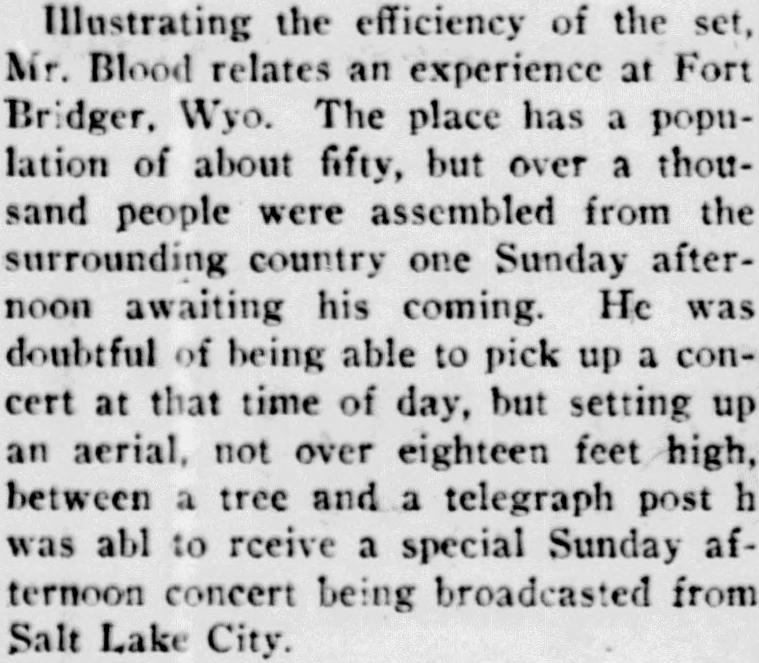
The Fort Bridger story. Carson City Daily Appeal, Carson City, Nevada, July 6, 1922, page 1. Library of Congress, Chronicling America. Click the clipping to read it full size.
“Buzz! Burr! Spit!”
Carson City wasn’t so lucky. On July 6 the aerial went up between the flag poles at the Memorial building and the courthouse. Static again. Faint music came in from a far-off newspaper’s station, and then nothing but a loud buzzing. Blood called it off, and the cars headed on toward Lake Tahoe and California.
The next day the Appeal printed a letter from someone in that crowd, written in joke spelling, the way a country character talked in the funny papers. The writer called Blood “Radio Ralph” and said the crowd stood there two hours, shifting from one foot to the other, and then onto somebody else’s foot. In the letter’s words, “all we herd wuz buzz! burr! spit! NIX! blooy!”
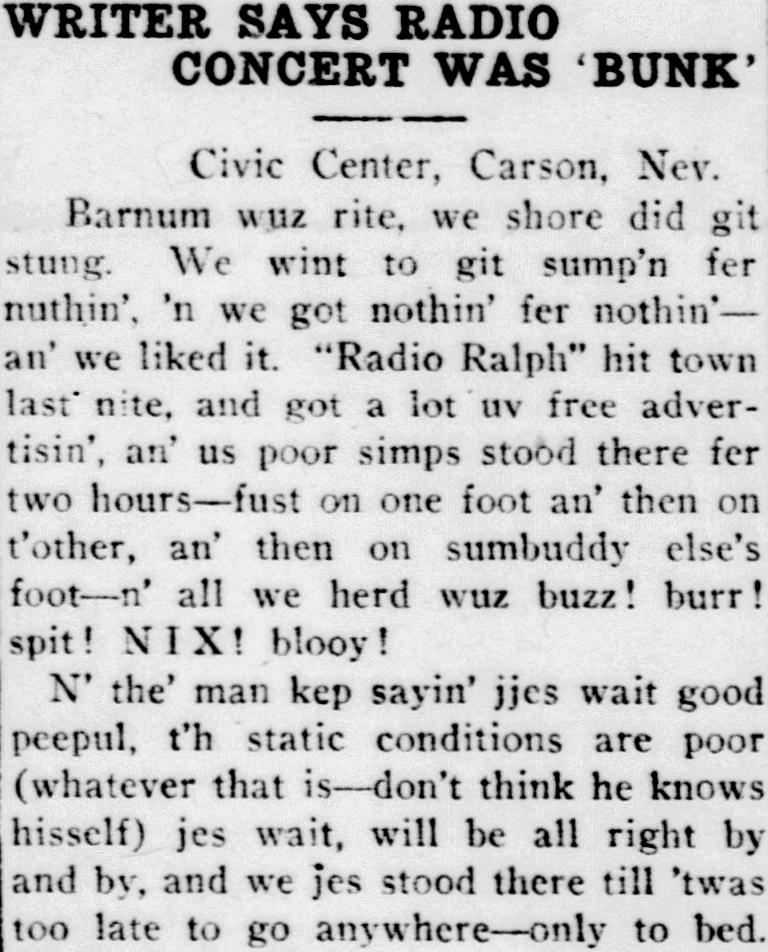
A grumpy listener’s letter. Carson City Daily Appeal, Carson City, Nevada, July 7, 1922, page 1. Library of Congress, Chronicling America. Click the clipping to read it full size.
Eureka stayed hopeful
Eureka’s paper didn’t sound let down at all. The Sentinel came out on Saturdays, and its next issue, on July 8, ran the headline “Eureka Can Obtain Good Radio Service.”
The crowd on Main Street never heard a whole song. But they did hear band music and a woman’s voice, sent through the air from California to a car parked in front of their courthouse. In 1922, in a town like Eureka, that was big news.
Sources
- The Eureka Sentinel, Eureka, Nevada: June 24, 1922, page 1 (concert plans); July 8, 1922, page 1 (“Eureka Can Obtain Good Radio Service”). Library of Congress, Chronicling America.
- The Standard, Fallon, Nevada: June 21, 1922, page 1 (“Radio Tour Over Lincoln Highway”). Library of Congress, Chronicling America.
- Carson City Daily Appeal, Carson City, Nevada: July 6, 1922, page 1 (seven tubes, Fort Bridger); July 7, 1922, page 1 (“Static Electricity Prevents Concert” and the letter). Library of Congress, Chronicling America.
- Cover: Eureka County Courthouse, Main Street, Eureka, Nevada, photographed around 1940 by Worth Bailey for the Historic American Buildings Survey. Library of Congress, Prints and Photographs Division.