On the night of July 11, 1912, a crowd in downtown Portland, Oregon, watched two men ride their horses through the door of the Elks’ club. They didn’t stop at the lobby. Sheriff “Til” Taylor and a wheat grower named George Peringer “rode their horses into the elevator at the Elks’ club and were hoisted to the third floor,” the East Oregonian reported. Upstairs, they rode right into the reception room.
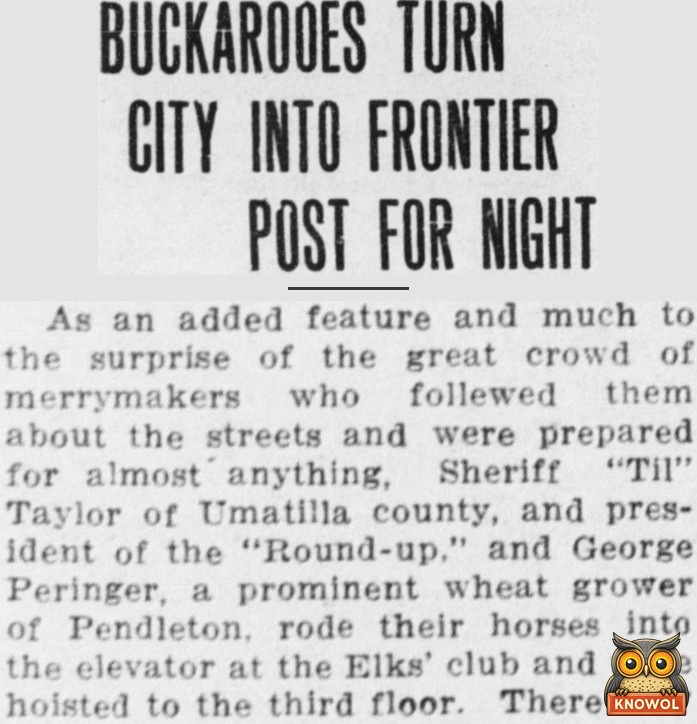
“Buckarooes Turn City Into Frontier Post for Night.” East Oregonian, Pendleton, Oregon, July 13, 1912, page 2. Library of Congress, Chronicling America. Click the clipping to read it full size.
The riders came from Pendleton, Oregon, a ranch and wheat town about 200 miles east of Portland. They were members of the Elks, a big club for men with branches, called lodges, in towns all over the country. That week thousands of Elks had come to Portland, Oregon, for their national meeting. Many of the visitors came from back East. Pendleton decided to show them the real West.
A surprise on a train
Pendleton had a rodeo called the Round-Up, held every September. Its riders and its band came to Portland too. The lodge sent its men on a special train of 11 passenger cars. Right behind it rolled “13 palace stock cars, bringing 280 spotted mustangs,” a Portland paper said. A stock car is a railroad car for animals, and a mustang is a tough western horse.
The horses were unloaded out of sight at the Portland Country Club, “so that none would know what the round-up town was going to do.” The Pendleton boys also packed 39 mules and a burro, a big load of saddles, and four famous bucking horses. One of them, Long Tom, had never been ridden “clean.” That meant nobody had stayed on him with one hand on the reins and the other hand free.
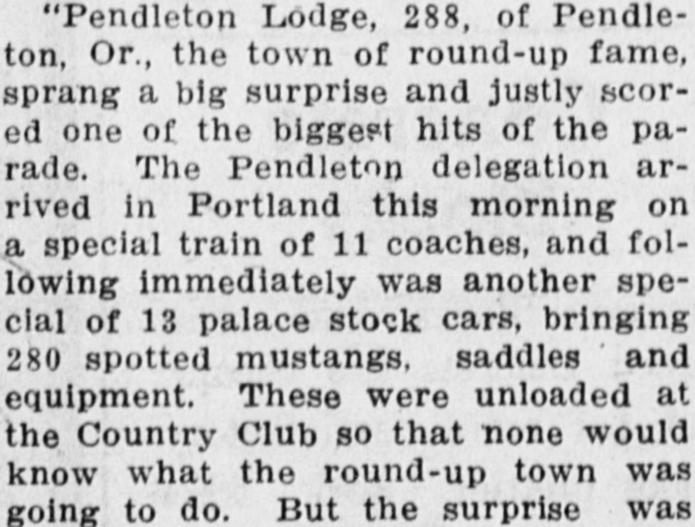
A Portland paper’s report, reprinted in the East Oregonian, Pendleton, Oregon, July 12, 1912, page 8. Library of Congress, Chronicling America. Click the clipping to read it full size.
The parade
The big Elks parade was on Thursday, July 11. Pendleton got a whole section of it to itself. First came the Round-Up Band, 25 players on horseback. Then came cowboys swinging ropes, and old stagecoaches driven by gray-bearded pioneers. Other Pendleton Elks dressed up as Indians in paint and feathers, a costume most people today would call disrespectful. Men from the Umatilla Indian Reservation near Pendleton came along to help with the face paint and headdresses.
The crowd went wild. The Round-Up’s motto was “Let ‘er buck,” a rodeo cry that means “turn the bucking horse loose.” The Eastern visitors had never heard it. “The Round-up slogan, ‘Let ‘er buck’ was new to them and they caught it up and shouted it madly in every section of the city,” the East Oregonian said.
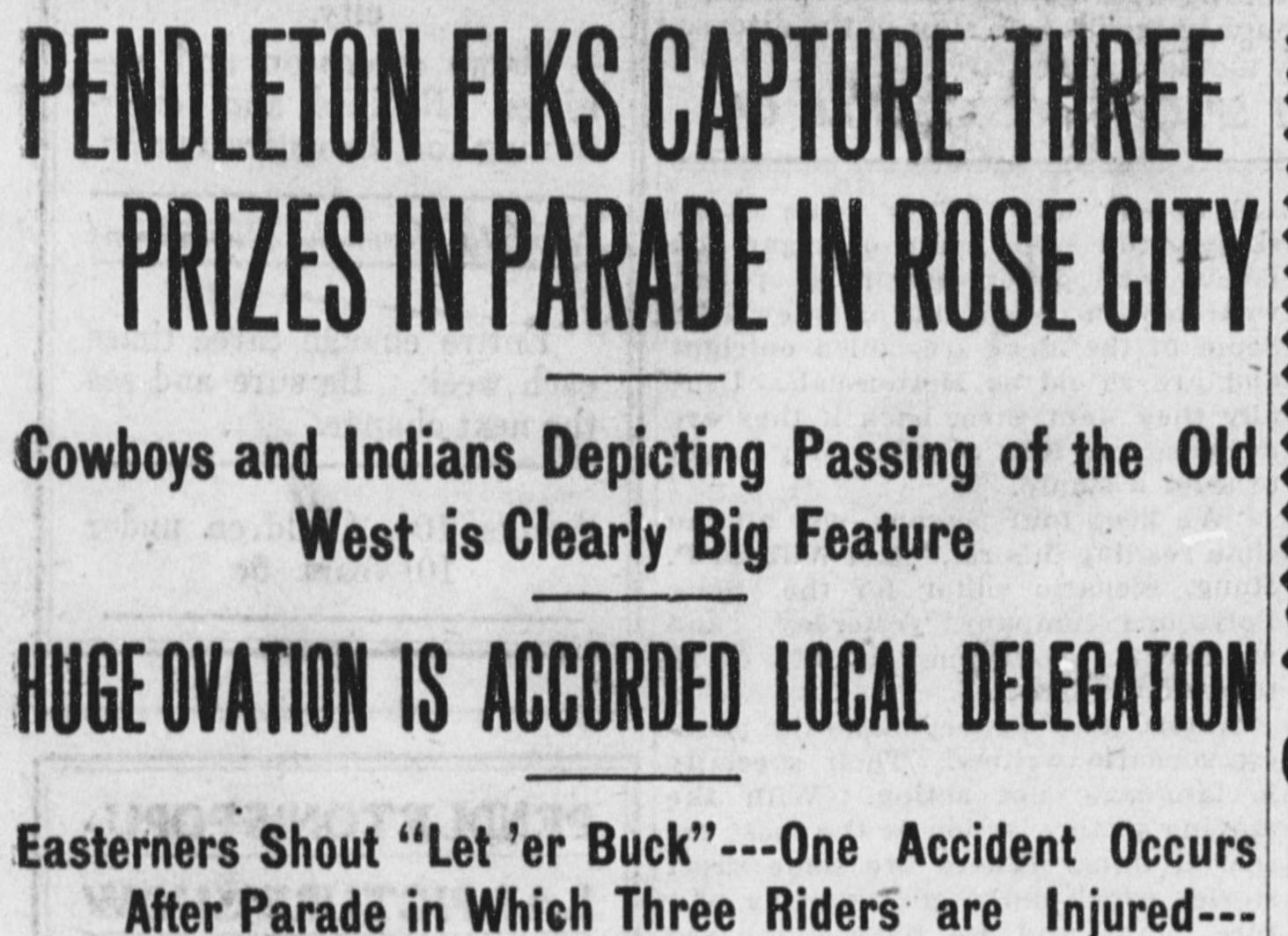
“Pendleton Elks Capture Three Prizes in Parade in Rose City.” East Oregonian, Pendleton, Oregon, July 12, 1912, page 1. Library of Congress, Chronicling America. Click the clipping to read it full size.
The judges liked it too. Pendleton won $600 in prize money: $300 for the “most unique costumes,” $200 for the third best band, and $100 for the third best look in line.
Horses in the hotels
After the parade, the Pendleton riders didn’t go to bed. They rode through downtown with their band, stopping to serenade each hotel. Then they rode inside.
At the Imperial Hotel, five riders, including the sheriff and his brother “Jinks” Taylor, went “down the steps into the bar room,” where the horses were given a “drink” at the bar. At the Multnomah Hotel, the horses “cantered into the big lobby as though it were nothing new for them.” At the Portland Hotel they walked down the stairs into the grill, a kind of restaurant. A cantering horse moves at an easy run, so picture that on a marble floor.
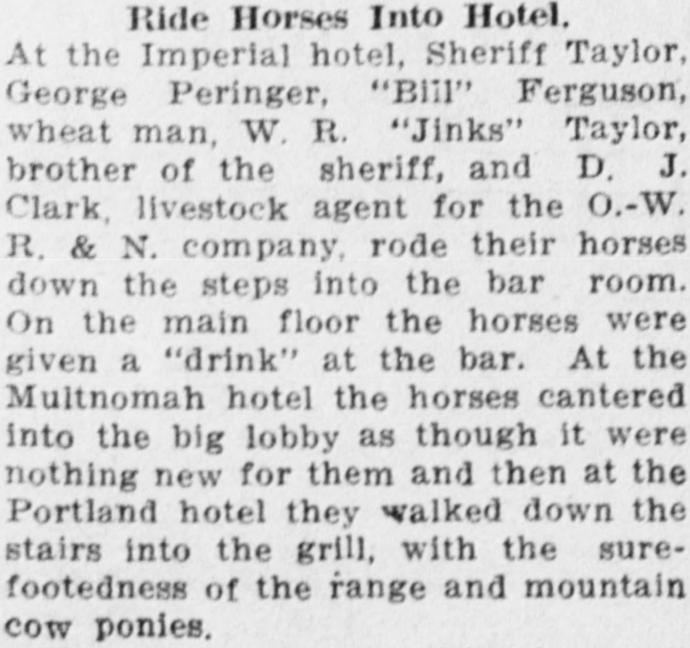
East Oregonian, Pendleton, Oregon, July 13, 1912, page 2, quoting the Portland Journal. Library of Congress, Chronicling America. Click the clipping to read it full size.
The story went all the way to Hawaii. “Ride Their Cayuses Into Hotel Parlors,” said the Honolulu Star-Bulletin. A cayuse is a small western horse. The paper said the riders did all the stunts of a Western cow town “with the exception of ‘shootin’ up.’ Guns were kept in holsters.” In other words, it was wild, but nobody got shot at.
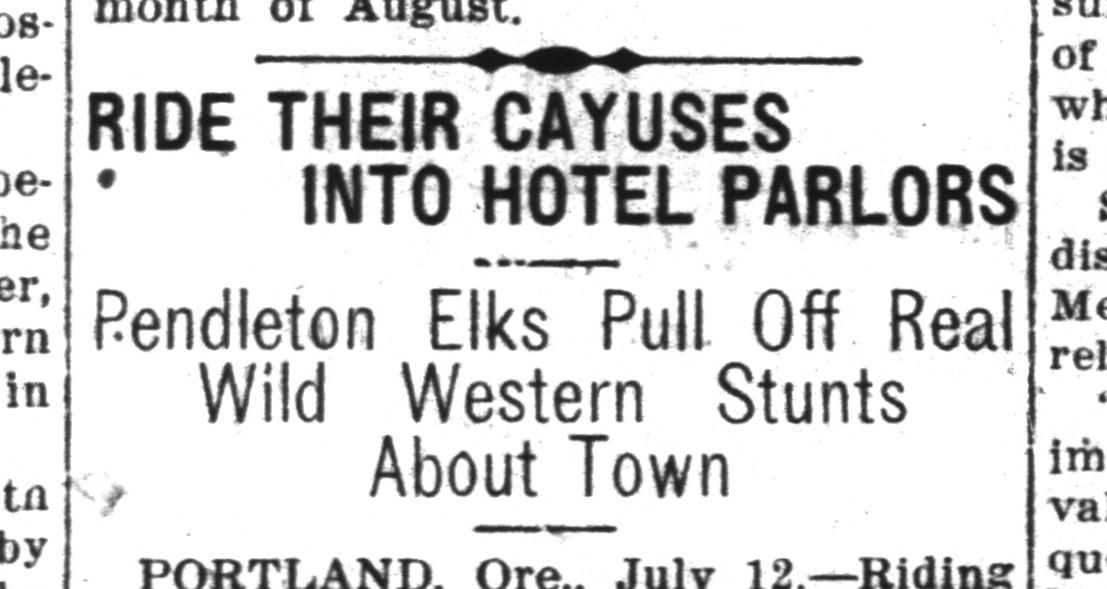
Honolulu Star-Bulletin, Honolulu, Hawaii, August 3, 1912, page 3. Library of Congress, Chronicling America. Click the clipping to read it full size.
Prizes for the tallest and the fattest
The Elks gave out some funny prizes that week. Five men won $25 each for being the tallest Elk, the shortest, the fattest, the leanest, and the oldest. The oldest was F. X. Matthieu of Portland.
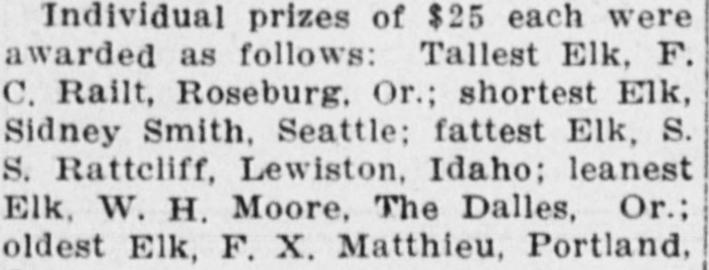
East Oregonian, Pendleton, Oregon, July 12, 1912, page 1. Library of Congress, Chronicling America. Click the clipping to read it full size.
Next stop, New York?
Portland loved the cowboys so much that some Elks wanted to send them to the next national meeting, in Rochester, New York, in 1913. “Those fellows would make the eyes of the east stick out a foot,” one man told the Sunday Journal. But the Portland trip had cost Pendleton’s lodge between $6,000 and $7,000. A trip to Rochester would cost “at least $20,000.”
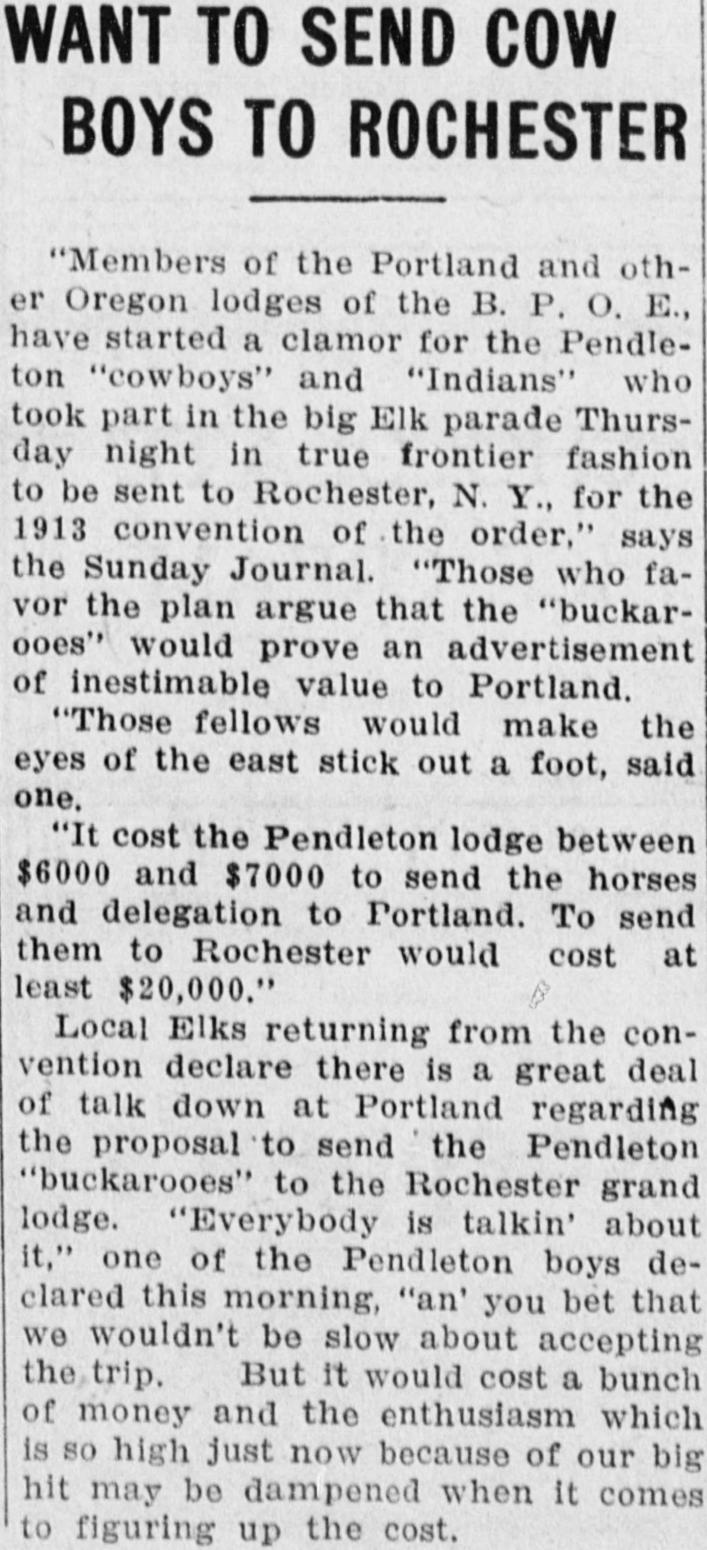
“Want to Send Cow Boys to Rochester.” East Oregonian, Pendleton, Oregon, July 15, 1912, page 1. Library of Congress, Chronicling America. Click the clipping to read it full size.
Back home, the riders were thrilled. “Everybody is talkin’ about it,” one of them said, “an’ you bet that we wouldn’t be slow about accepting the trip.” Then he added the catch. All that excitement might fade “when it comes to figuring up the cost.” In December the lodge named a committee to see if it could pay for the trip.
The money question seems to have won. We found no report that the horses ever went East. In June 1913 the East Oregonian said Pendleton’s lodge was sending one man, R. Alexander, to Rochester by train. He went without a single horse.
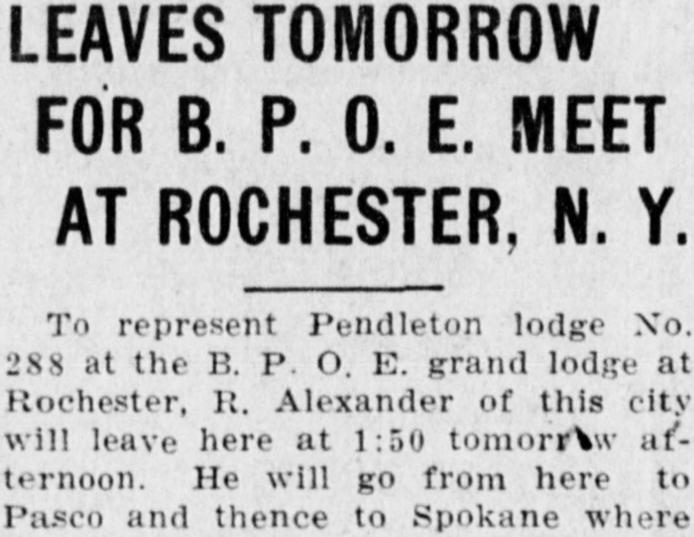
East Oregonian, Pendleton, Oregon, June 27, 1913, page 1. Library of Congress, Chronicling America. Click the clipping to read it full size.
Still bucking
Pendleton’s big night still paid off. A Portland paper said the town “scored one of the biggest hits of the parade.” The East Oregonian bragged that the Round-Up got advertising of “incalculable value,” which means too big to count. The Pendleton Round-Up still runs every September, it still has a mounted band, and its fans still shout “Let ‘er buck.” Another lodge from that same parade, from Aberdeen, Washington, had its own surprise: five real elk.
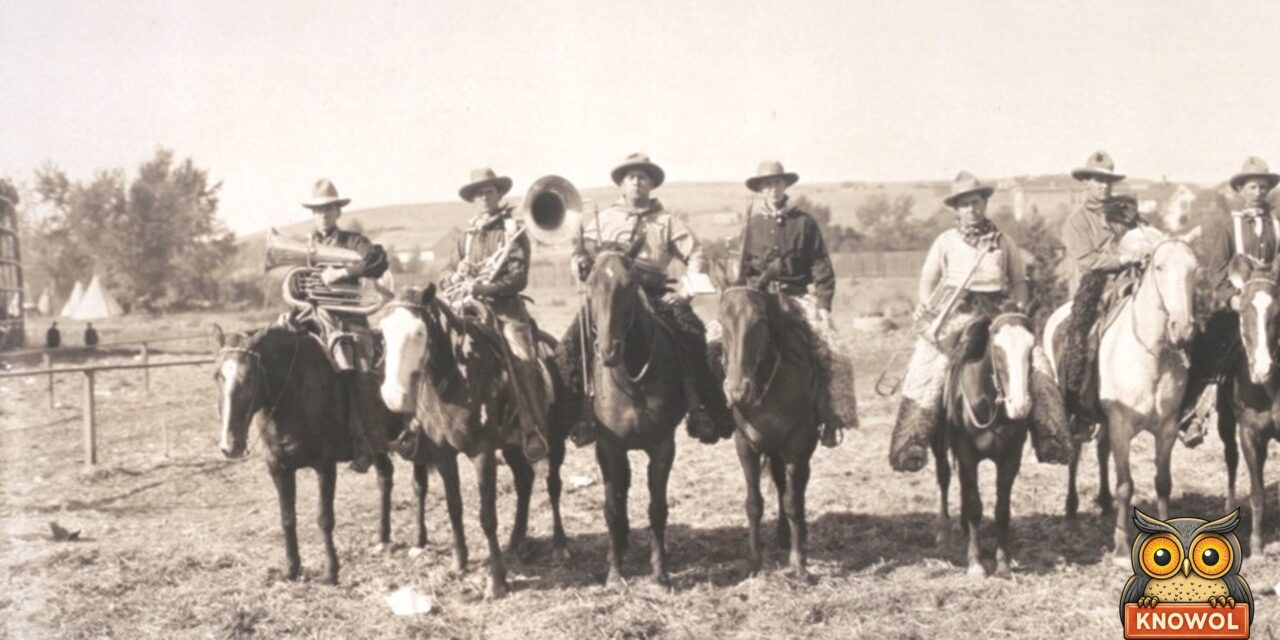
The picture at the top shows Pendleton’s Round-Up Band on horseback in 1911, the year before its big ride through Portland. Below is the Round-Up’s first day that same year.

First Day, Pendleton “Round Up,” 1911. Photo by Marcell of Portland. Library of Congress Prints and Photographs. Click the picture to see it full size.
Sources
- East Oregonian (Pendleton, Oregon): July 9, 1912, page 6 (“Let ‘er Buck” slogan); July 12, 1912, page 1 (“Pendleton Elks Capture Three Prizes in Parade in Rose City”); July 12, 1912, page 8 (the special trains); July 13, 1912, page 2 (“Buckarooes Turn City Into Frontier Post for Night”); July 15, 1912, page 1 (“Want to Send Cow Boys to Rochester”); December 27, 1912, page 1 (“Elks May Send Wild West Delegation to Rochester Meeting”); June 27, 1913, page 1 (“Leaves Tomorrow for B. P. O. E. Meet at Rochester, N. Y.”).
- Honolulu Star-Bulletin (Honolulu, Hawaii): August 3, 1912, page 3 (“Ride Their Cayuses Into Hotel Parlors”).
- Marcell, “First Day, Pendleton ‘Round Up’, 1911,” Library of Congress, no known restrictions on publication.
- All newspaper images: Library of Congress, Chronicling America. Published 1912 and 1913.
- Cover: Marcell, “‘The Round-Up Band’, Pendleton, Ore., 1911,” Library of Congress, no known restrictions on publication. It shows the band in Pendleton in 1911, not the 1912 Portland parade.