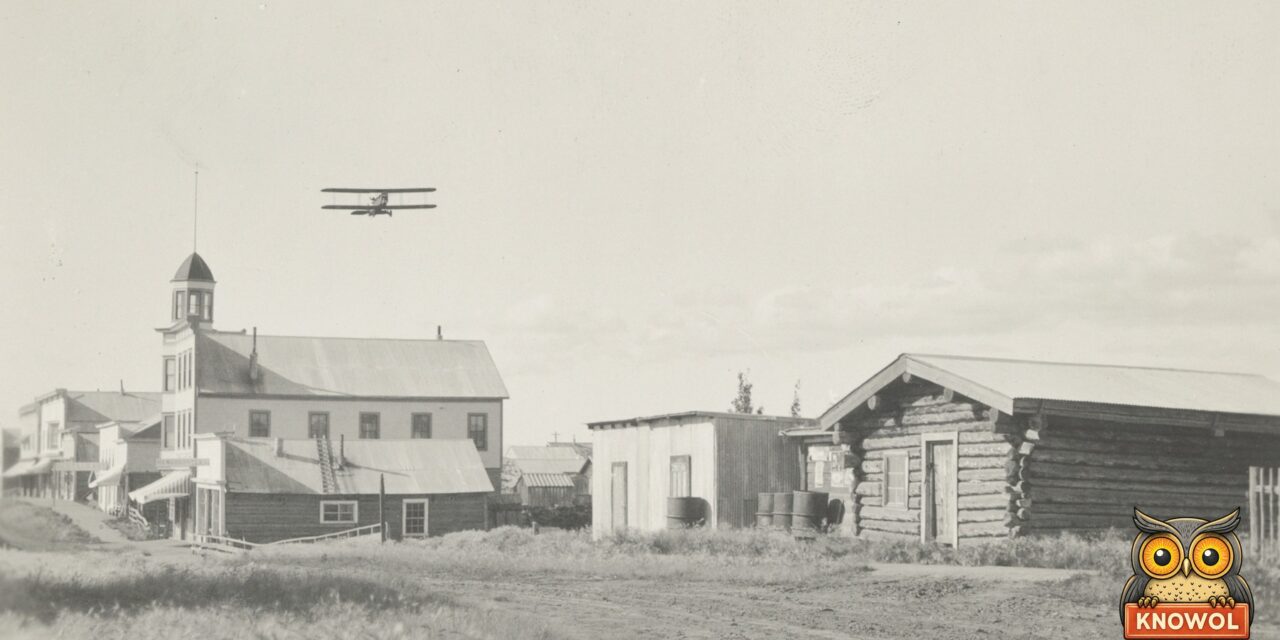
In the winter of 1929, some boys in a small village on Alaska’s Bering Sea coast looked up and saw something coming over the flat, open land. It had long, stiff wings. It made a roar. It was bigger than any bird they knew. The boys ran into the village “crying at the top of their voices about the ‘big eagle.'” It was an airplane, the first one anybody in that village had ever seen.
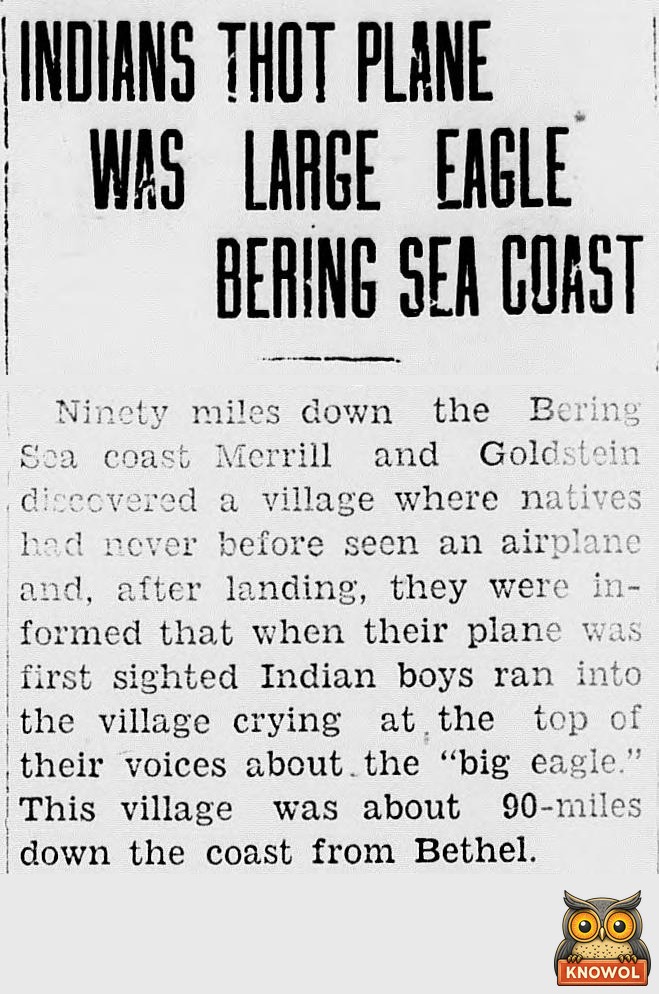
“Indians Thot Plane Was Large Eagle, Bering Sea Coast.” Seward Daily Gateway, Seward, Alaska, February 8, 1929, page 7 (the headline and the paragraph about the village, two parts of one story joined). Library of Congress, Chronicling America. Click the clipping to read it full size.
The pilot and the fur buyer
The pilot was Russell Merrill of Anchorage, Alaska. He flew for the Anchorage Air Transport company, and a Juneau paper, the Alaska Fisherman, said he “has been kept busy all winter.” On January 31, 1929, it said, “he left Anchorage with fur buyer Goldstein of Juneau for Bethel on the Kuskokwim River.”
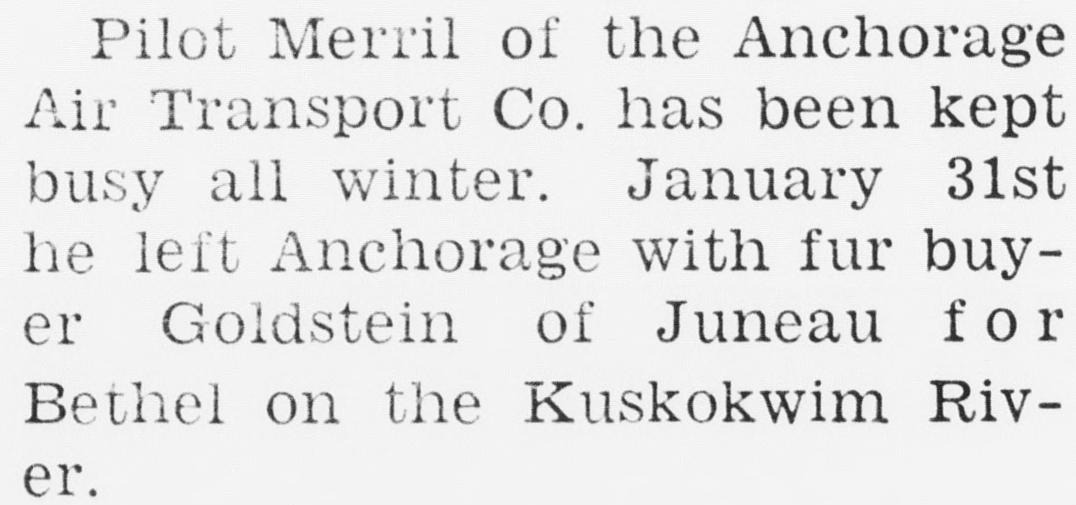
“January 31st he left Anchorage with fur buyer Goldstein of Juneau.” The Alaska Fisherman, Juneau, Alaska, February 15, 1929, page 15. Library of Congress, Chronicling America. Click the clipping to read it full size.
The fur buyer was Marion Goldstein. The papers called him Mickey. A fur buyer went out to trading posts and villages to buy animal skins from trappers. Then he shipped the furs south, where they were made into coats, collars and hats.
Bethel, Alaska, sits on the Kuskokwim River in western Alaska, far from any road or railroad. Getting there in winter used to mean a long trip behind a team of sled dogs. Merrill and Goldstein had already tried the faster way. In January 1928, the Daily Alaska Empire of Juneau said Goldstein flew from Anchorage to Bethel “making the trip in four and one-half hours.” The usual way, by dog team, took “about 30 days.”
A cloud of volcano gas
The flight west crosses big, snowy mountains. Over Mount Spurr, a volcano west of Anchorage, the plane was “approximately 10,000 feet” up. That’s almost two miles high. There, the paper said, it “passed thru a volcanic strata of gas and sulphur making breathing difficult.” Strata means layers. They had flown into a layer of volcano gas.
Merrill said that if they had stayed in it for more than half an hour, “the efficiency of the motor would have been problematical.” In plain words, the engine might have stopped working right. They got through it.
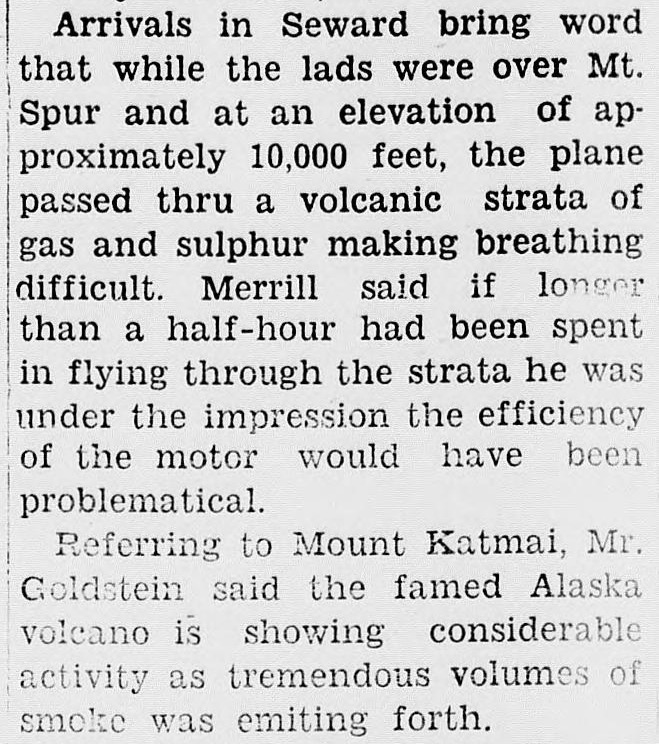
Over Mount Spurr at about 10,000 feet, the plane flew through volcano gas. Seward Daily Gateway, Seward, Alaska, February 8, 1929, page 7. Library of Congress, Chronicling America. Click the clipping to read it full size.
Goldstein brought news about another volcano, too. Mount Katmai, “the famed Alaska volcano,” was “showing considerable activity,” he said, with “tremendous volumes of smoke” coming out of it.
The big eagle
Then came the part the papers put in the headline. “Ninety miles down the Bering Sea coast Merrill and Goldstein discovered a village where natives had never before seen an airplane.” They landed. After that, the people told them what had happened when the plane first showed up in the sky. The boys saw it first. They ran into the village “crying at the top of their voices about the ‘big eagle.'”
Picture it from the ground. A dark shape with wide, straight wings sails in over the tundra by the sea. It is bigger than any bird. It is louder than any bird. The biggest flying thing those boys knew was an eagle, so that’s what they called it. They had the right idea. An airplane is a machine built to do what a bird does.
The paper called them “Indian boys.” The people who live along that part of the Bering Sea coast are Yup’ik, Alaska Native people whose families have lived there for a very long time. The paper did not print the name of the village or the names of the boys.
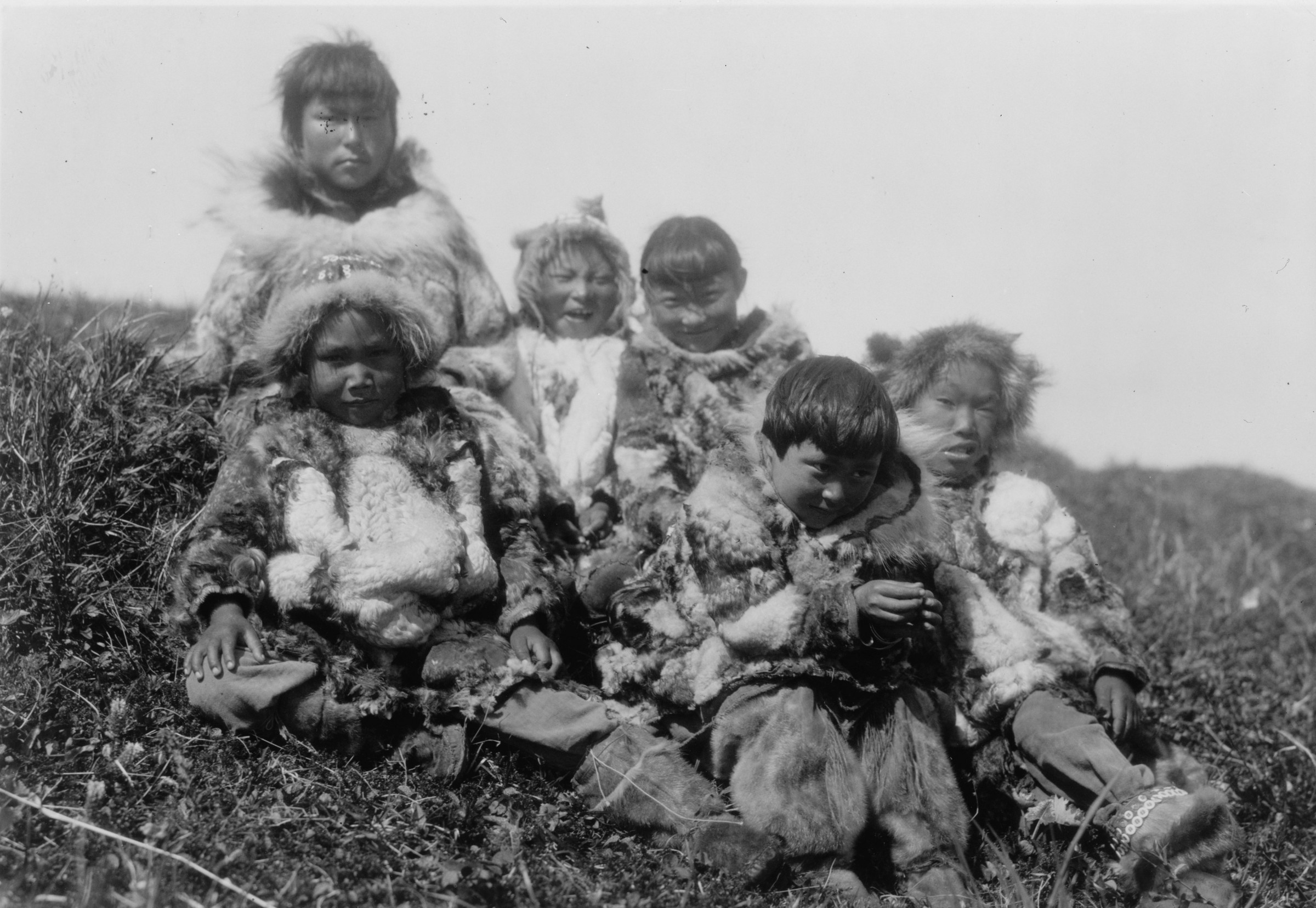
Children on Nunivak Island, off the same Bering Sea coast, photographed by Edward S. Curtis (copyright 1929). They are not the boys in this story; no picture of those boys is known. Edward S. Curtis Collection, Library of Congress. Click the picture to see it full size.
No snow for the dogs
Goldstein had planned to go on without the plane. From Bethel he wanted to travel by dog team to Nushagak, a trading place on Bristol Bay, to the south. But he “found the entire region barren of snow.” A dog team pulls a sled, and a sled needs snow. With bare ground, the dogs couldn’t go. So he canceled that trip and flew back to Anchorage with Merrill.
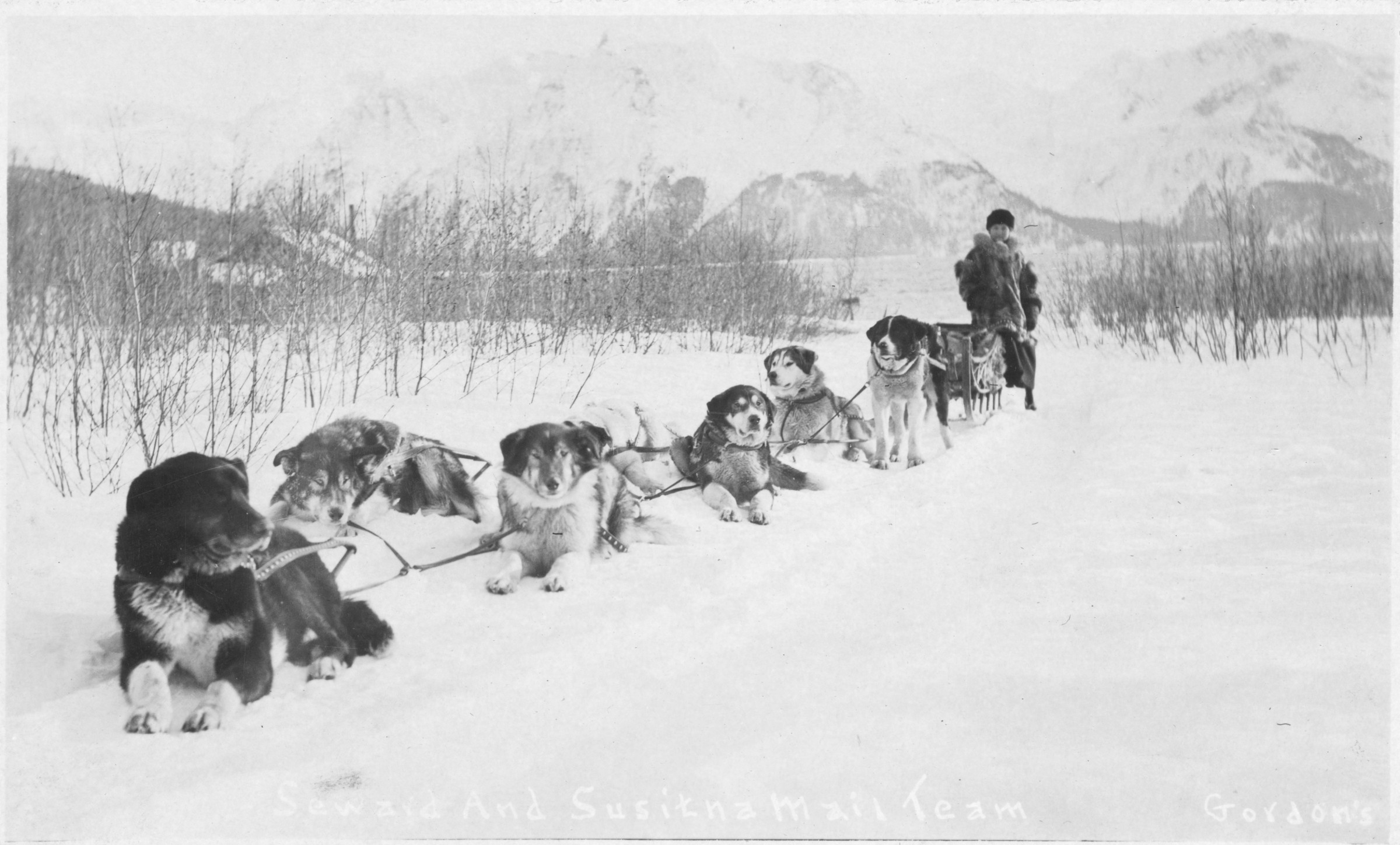
The “Seward and Susitna Mail Team,” photo by Gordon, sometime between about 1900 and 1930. Teams like this one were the usual way to cross Alaska in winter before airplanes. Frank and Frances Carpenter Collection, Library of Congress. Click the picture to see it full size.
A month or an afternoon
The paper saved its favorite fact for the end. Going by dog team, “Ordinarily it would have required at least 30 days but via the plane he made the entire trip in four and one-half hours.” Thirty days is a whole month on the trail, sleeping out in the cold. Four and a half hours is less than one school day.
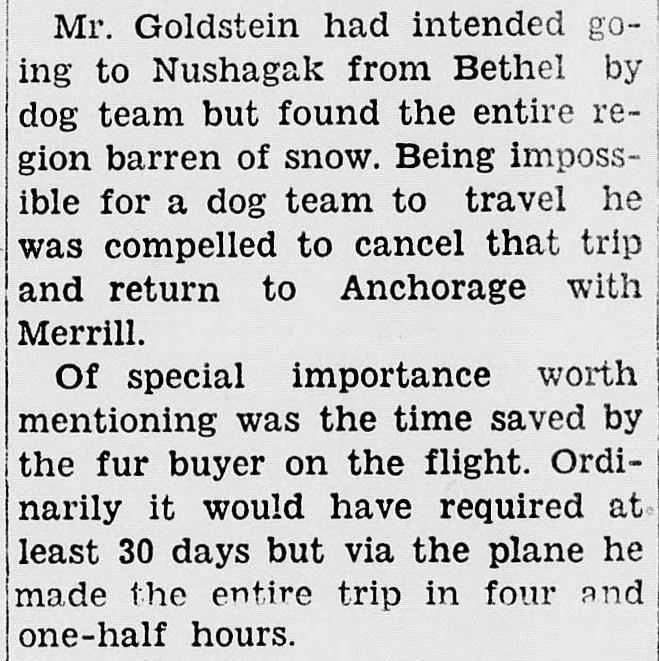
“At least 30 days” by dog team, “four and one-half hours” by plane. Seward Daily Gateway, Seward, Alaska, February 8, 1929, page 7. Library of Congress, Chronicling America. Click the clipping to read it full size.
The news reached Seward, Alaska, with travelers, and the Seward Daily Gateway printed it on February 8. On February 19, Goldstein’s hometown paper in Juneau, Alaska, the Daily Alaska Empire, printed the same story under the headline “Marion Goldstein’s Plane Mistaken for Eagle by Indians.” The Juneau copy ended with “four and one-half days” instead of hours. One of the two papers made a slip, and the 1928 flight time of four and a half hours from Anchorage to Bethel points to the hours.
What a plane could carry
Fur buyers liked airplanes for another reason. A plane could carry the furs out, too. In March 1928, Merrill flew the first plane to land at Seward’s new flying field. It “brought furs valued at $100,000 from Bethel,” the Juneau paper said. The load “included 400 red fox and 100 white fox.” On a second landing that day, the plane skidded into two automobiles. Nobody was hurt.
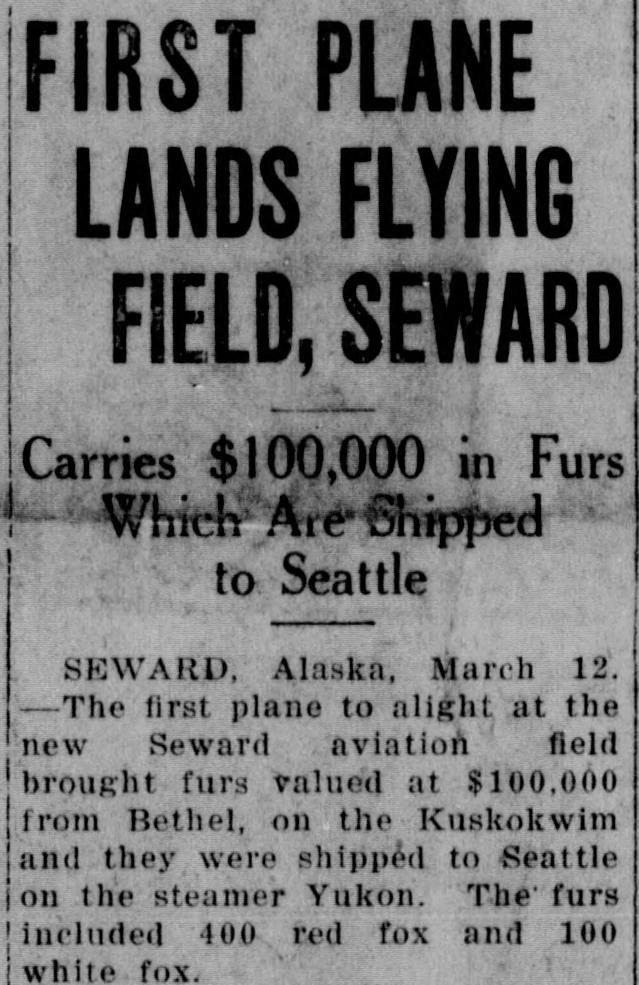
“First Plane Lands Flying Field, Seward. Carries $100,000 in Furs.” Daily Alaska Empire, Juneau, Alaska, March 12, 1928, page 1. Library of Congress, Chronicling America. Click the clipping to read it full size.
By the numbers
- 10,000 feet: about how high the plane was over Mount Spurr
- 90 miles: how far down the coast from Bethel the village was
- 30 days: “at least” that long by dog team
- 4 1/2 hours: the same trip by plane
- 500: fox skins in one plane load out of Bethel in 1928
The picture at the top of this story is a postcard of a biplane flying over Tanana, Alaska, on August 27, 1920. It is not Merrill’s plane, and Tanana is a river town far from the Bering Sea. But it shows what those boys saw: wings in the sky over a quiet Alaska village. They had never seen anything like it, so they ran to tell everybody. Merrill and Goldstein heard about it when they landed, and that is how the big eagle got into the newspaper.
Sources
- Seward Daily Gateway (Seward, Alaska): February 8, 1929, page 7 (“Indians Thot Plane Was Large Eagle, Bering Sea Coast”).
- The Daily Alaska Empire (Juneau, Alaska): February 19, 1929, page 8 (“Marion Goldstein’s Plane Mistaken for Eagle by Indians,” the same story, credited to the Seward Gateway).
- The Alaska Fisherman (Juneau, Alaska): February 15, 1929, page 15 (“Cook Inlet Notes”: Merrill left Anchorage January 31 with Goldstein for Bethel).
- The Daily Alaska Empire (Juneau, Alaska): January 26, 1928, page 8 (“Fur Buyers Fly to Kuskokwim”: four and one-half hours by plane, about 30 days by dog team).
- The Daily Alaska Empire (Juneau, Alaska): March 12, 1928, page 1 (“First Plane Lands Flying Field, Seward”).
- Cover photo: Shade, “Aeroplane, Tanana, Alaska, Aug. 27, 1920”, real photo postcard, copyright 1920. Library of Congress Prints and Photographs. Published in the United States in 1920, public domain.
- Edward S. Curtis, “Nunivak children”, copyright 1929, published in The North American Indian, volume 20. Library of Congress Prints and Photographs. No known restrictions on publication.
- Gordon, “Seward and Susitna mail team”, between about 1900 and 1930. Frank and Frances Carpenter Collection, Library of Congress Prints and Photographs. No known restrictions on publication.
- All newspaper images: Library of Congress, Chronicling America. Published 1928 and 1929.