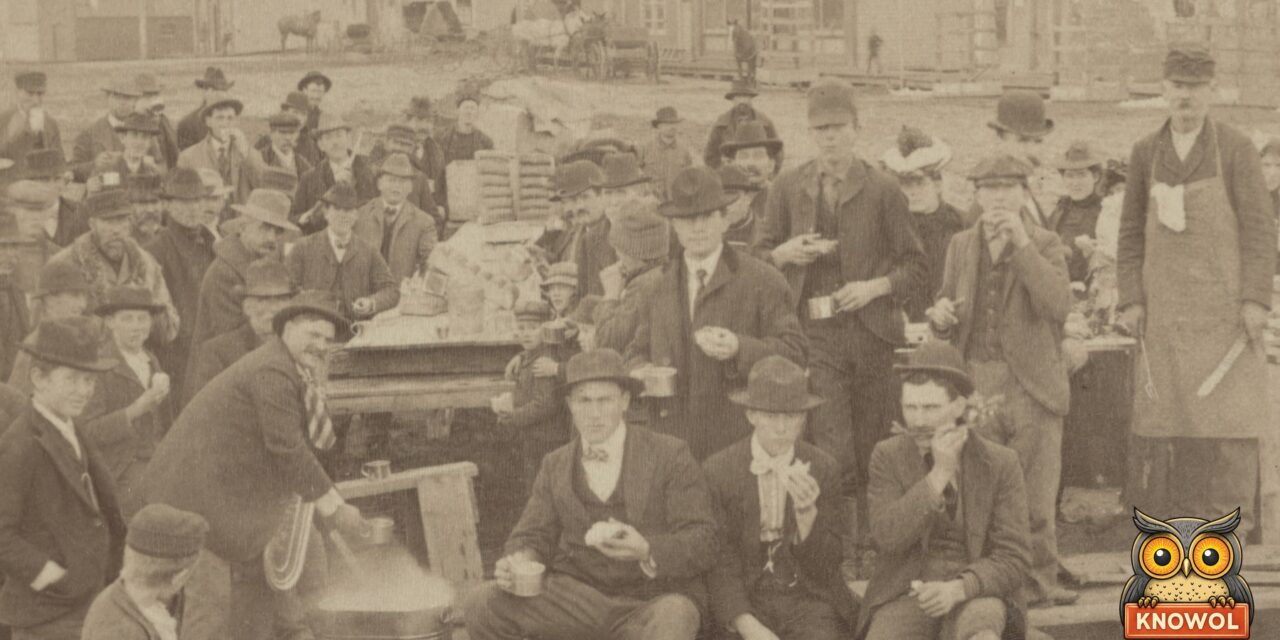
On Thursday, September 7, 1905, the farm town of Loveland, Colorado, set the table for company. A lot of company. The people running the town’s big day expected “fully 10,000 strangers to care for,” the Greeley Tribune reported that day. Every one of them would be fed for free. And the folks who lived in Loveland had one job at dinnertime. They were “always requested to ‘hold back and give the guests a chance.'”

“Loveland Ready: Will Entertain 10,000 Visitors at Great Festival Day.” The Greeley Tribune, Greeley, Colorado, September 7, 1905, page 8. Library of Congress, Chronicling America. Click the clipping to read it full size.
The party was Loveland’s free corn roast. The Tribune called it “that most unique of Colorado festival days.” It added, “Perhaps that is what makes the hospitality of the town so famed.” Hospitality is a big word for a simple idea: being good to your guests.
A deal with a railroad man
The corn roast started with a deal. Back in 1895, a man named F. W. Angier worked for the Union Pacific Railway in Denver. He was a traveling passenger agent, and his job was to fill the railroad’s trains with riders. He went to Loveland, about 50 miles north, with an idea. The town agreed to “furnish the provisions if Mr. Angier would furnish the people.” Provisions means food.
Both sides kept their promise. About 800 people rode the train up from Denver. Farmers and their wives gave “the best ears of corn in their fields.” A trench about fifty feet long had been dug and filled with red-hot coals. An hour before the train pulled in, “some 3,000 ears of corn” went onto the coals, still wrapped in their husks. The cooks had also made “about 1,500 nice bologna sandwiches” from Loveland flour and homemade sausage. There was creamery butter, coffee, lemonade and milk. “The corn was done to a turn,” a local paper said.
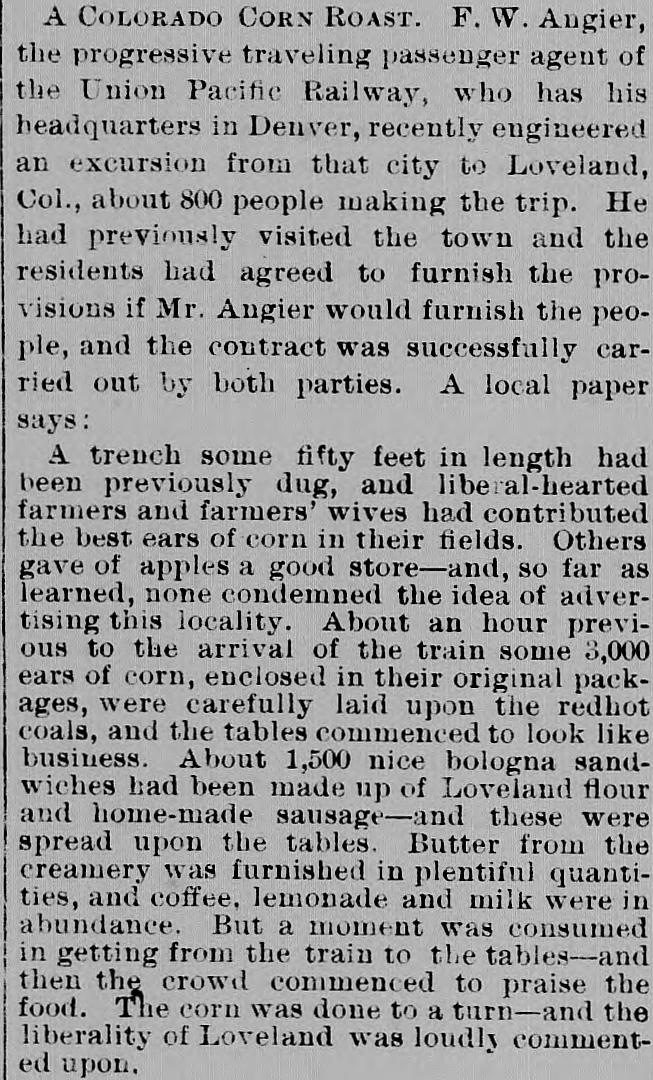
“A Colorado Corn Roast.” The Republican Journal, Belfast, Maine, October 10, 1895, page 5. Library of Congress, Chronicling America. Click the clipping to read it full size.
That story ran far away, in a newspaper in Belfast, Maine. Angier had grown up there. Two years later, the same paper bragged that Loveland’s corn roast “was the idea of a Belfast boy, F. W. Angier.”
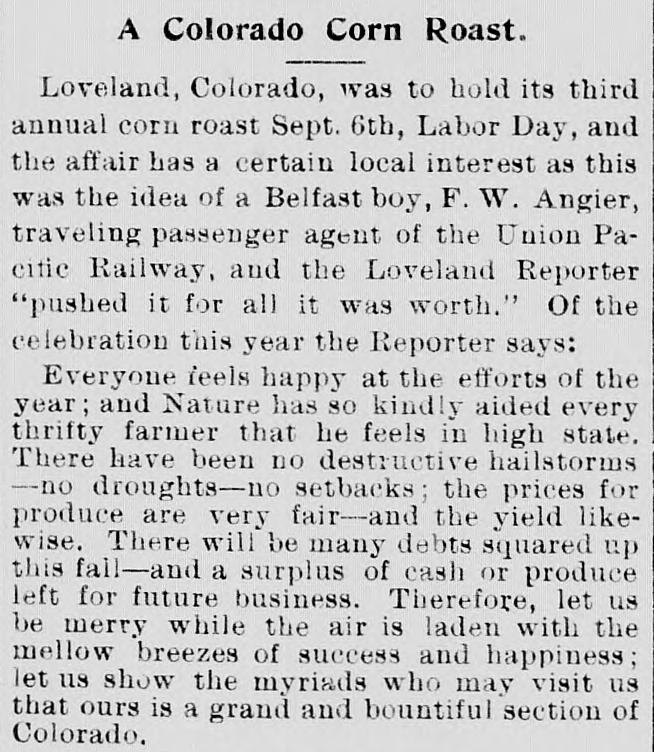
“A Colorado Corn Roast.” The Republican Journal, Belfast, Maine, September 9, 1897, page 5. Library of Congress, Chronicling America. Click the clipping to read it full size.
How to roast corn for a crowd
Nobody owned a stove big enough for this. So Loveland used the ground. A writer for Breeder’s Gazette, a farm magazine, explained how it worked in 1901. First the town dug a giant trench. Then it was packed with “dry wood, cordwood, railroad ties, fenceposts or poles” and set on fire. “For a whole day the trench represents a miniature inferno,” he wrote. In other words, it was a long, low bonfire in a ditch.
When the wood burned down to glowing coals, workers threw a thin layer of damp dirt on top. That kept the corn from burning. Then came “cartloads and cartloads of roasting ears,” laid down “with not a single husk removed.” More dirt went over the top. The husks worked like wrappers, so the corn steamed inside them. Soon steam rose from the ground “like vapor from some hidden geyser.”
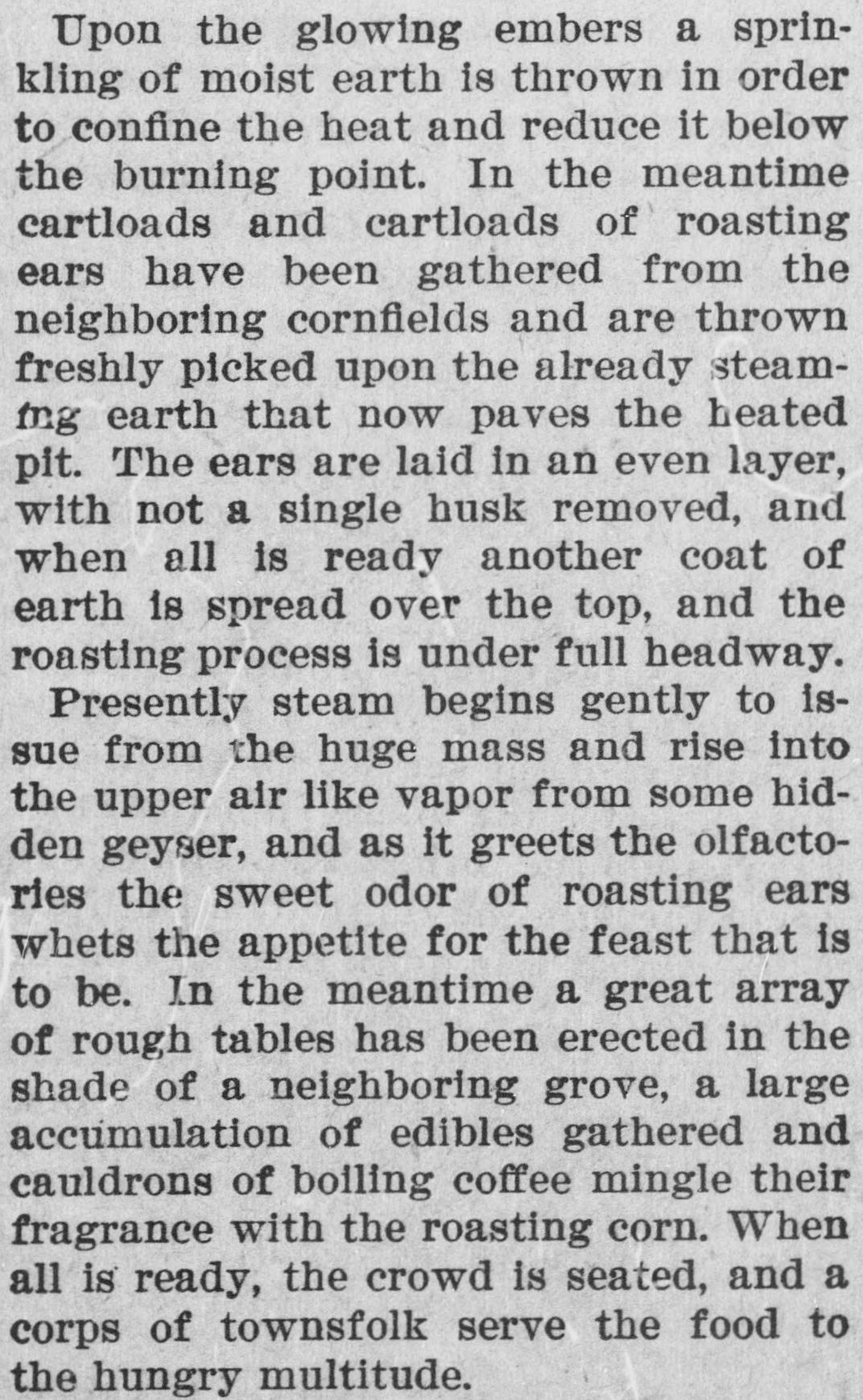
How the corn was roasted, from a Breeder’s Gazette writer’s story “The Farm Festival: How Loveland, Colo., Entices People to Town.” The Telegraph-Courier, Kenosha, Wisconsin, November 14, 1901, page 2. Library of Congress, Chronicling America. Click the clipping to read it full size.
Meanwhile, rough tables went up in the shade of a grove of trees. “Cauldrons of boiling coffee” sat nearby. When it was time to eat, the guests sat down, and “a corps of townsfolk serve the food to the hungry multitude.” A corps is a team. The hosts did the serving.
Corn that grew just for the party
Here is the funny part. Loveland wasn’t really corn country. “Corn isn’t really a product of the country in which Loveland is situated,” the Greeley Tribune admitted. So, the paper said, “two or three get together each year and see to it that enough corn is planted to take care of the crowds.” A Texas paper said farmers around Loveland grew patches of sweet corn “solely to furnish the main dish for the annual feast.”
The crowds kept growing. In 1903, two extra trains came in “loaded to the guards,” meaning packed full. The town “was literally full of carriages.” A Denver paper guessed the crowd at 5,000 people. “Corn by the wagon loads was roasted,” it said, along with sandwiches, coffee, apples and watermelons. “Fully 2,000 people were served to a free dinner and still there was corn to spare.”
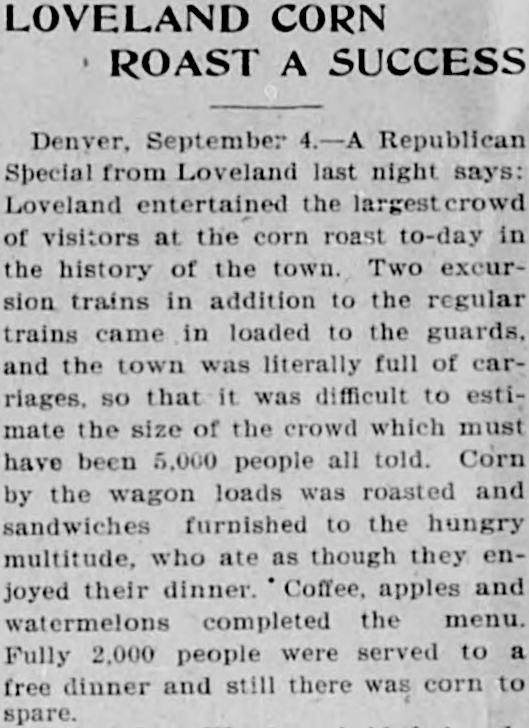
“Loveland Corn Roast a Success.” The Elk Mountain Pilot, Crested Butte, Colorado, September 8, 1903, page 2. Library of Congress, Chronicling America. Click the clipping to read it full size.
The 1905 show
By 1905, the corn roast was the start of three big days. The Tribune said the committee had planned for “double the usual attendance.” Lining up thousands of people for “a square meal,” it said, “is no easy task.”
There was plenty to watch after dinner. “Forty-five of the best horses in the state are entered” in the races. There would be “three balloon ascensions,” which means hot-air balloons going up, and “a bucking and broncho busting contest.” The strangest act was a racehorse named College Maid, “the guideless wonder.” She was a pacer, a racehorse that usually pulls a driver around the track in a light two-wheeled cart. College Maid would “pace a half mile without a driver.” Nobody would be holding the reins.
The photo at the top of this story shows a free town feast like Loveland’s. It is a Thanksgiving barbecue in Moscow, Washington, in 1904, with tin cups, a steaming kettle and a cook in a long apron.
What it cost
The dinner cost nothing. Getting there cost a little. A train left Greeley at 8 in the morning and came back from Loveland at 7:30 at night, for a “round trip rate of $1.” The dollar paid for the ride. The corn was on Loveland.
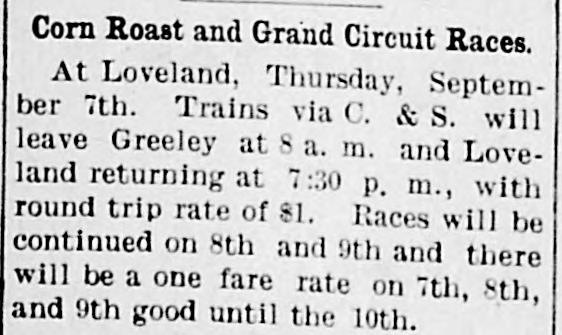
“Corn Roast and Grand Circuit Races.” The Greeley Tribune, Greeley, Colorado, September 7, 1905, page 2. Library of Congress, Chronicling America. Click the clipping to read it full size.
When the corn ran out
Loveland’s farmers had a different crop on their minds. Around 1901, the town got a big new factory that turned sugar beets into sugar. Railroad cars full of beets soon lined the tracks.
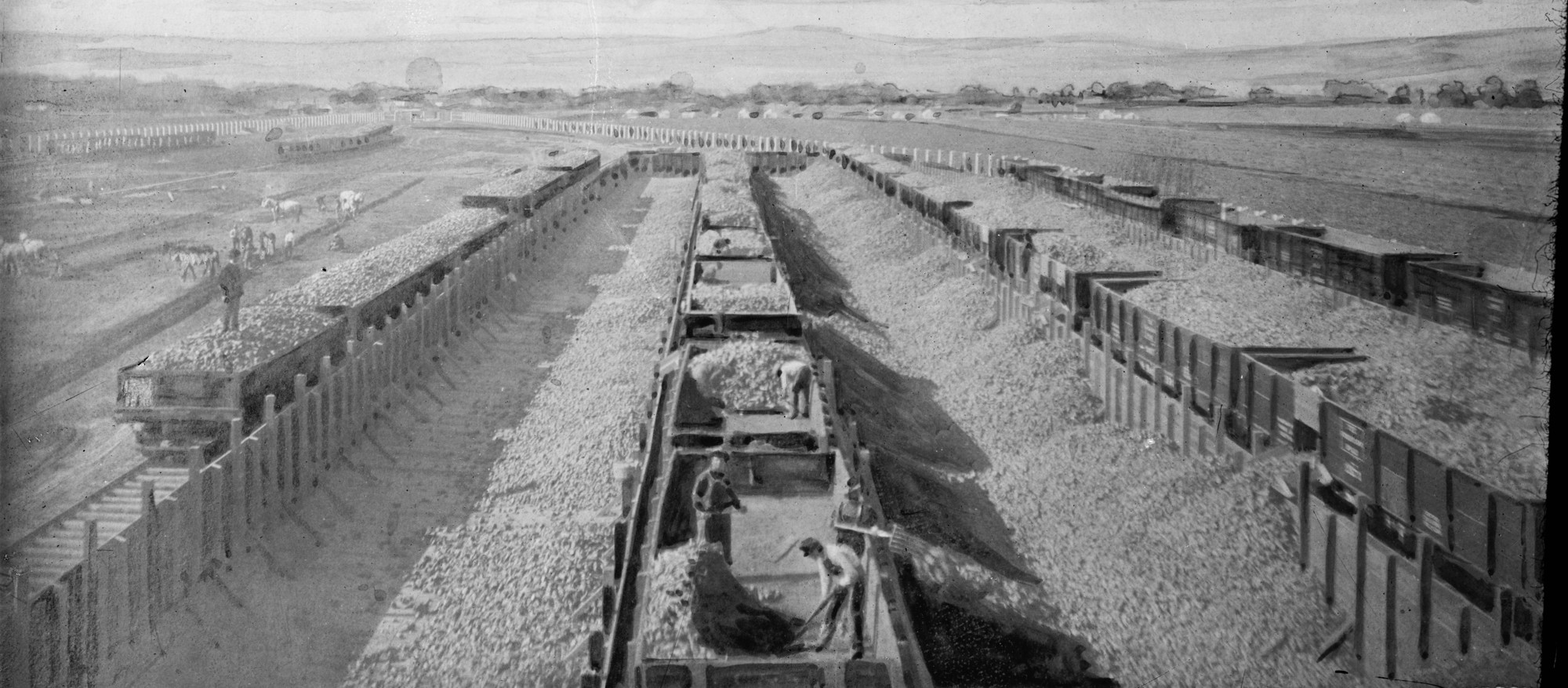
Railroad cars loaded with sugar beets at Loveland, Colorado. The Library of Congress says the photo was possibly taken in fall 1901, the first season of Loveland’s new sugar factory. Bain News Service, Library of Congress. Click the picture to see it full size.
In the end, the corn ran short. In 1926, a history of Colorado farming looked back on “the Corn Roast which once made Loveland famous.” It said the party “could not be kept up because roasting ears were scarce in a locality where corn is a minor crop.” Loveland had grown famous for a food it barely grew.

Alvin T. Steinel, History of Agriculture in Colorado, 1926, page 469. Internet Archive, public domain. Click the clipping to read it full size.
But for years, a whole town planted corn it didn’t need, dug a ditch, burned fence posts in it all day, and fed every stranger who stepped off the train. Then the people of Loveland stood back and waited their turn.
Sources
- “Loveland Ready,” The Greeley Tribune (Greeley, Colorado), September 7, 1905, page 8, and the train notice “Corn Roast and Grand Circuit Races,” same issue, page 2. Library of Congress, Chronicling America.
- The Republican Journal (Belfast, Maine): “A Colorado Corn Roast,” October 10, 1895, page 5; “A Colorado Corn Roast,” September 9, 1897, page 5. Library of Congress, Chronicling America.
- “The Farm Festival: How Loveland, Colo., Entices People to Town,” from Breeder’s Gazette, in The Telegraph-Courier (Kenosha, Wisconsin), November 14, 1901, page 2. Library of Congress, Chronicling America.
- “Free Feasts,” San Antonio Daily Light (San Antonio, Texas), December 4, 1897, page 5. Library of Congress, Chronicling America.
- “Loveland Corn Roast a Success,” The Elk Mountain Pilot (Crested Butte, Colorado), September 8, 1903, page 2. Library of Congress, Chronicling America.
- Alvin T. Steinel, History of Agriculture in Colorado (1926), page 469. Internet Archive.
- Photos: “Thanksgiving barbecue, Moscow, Wash.” (the cover; stereograph, copyright 1904 by B. W. Kilburn); “Unloading sugar beets from railroad cars, Loveland, Colorado” (Bain News Service, 1901). Library of Congress Prints and Photographs Division. No known restrictions on publication.