At noon on Friday, December 14, 1917, a special train pulled into Ottawa, Illinois. Out stepped forty-two young sailors from the Great Lakes Naval Training Station, north of Chicago. They brought a band, a drill squad and an officer in charge. A committee of Ottawa’s leading citizens was waiting at the station to meet them. By the Free Trader-Journal’s account, the visit “turned Ottawa into a gala city in honor of the visitors.”
The sailors had come to play music and to sell something small: a stamp that cost a quarter. But the town had been told to expect one more guest, and he was the most famous bandleader in America.
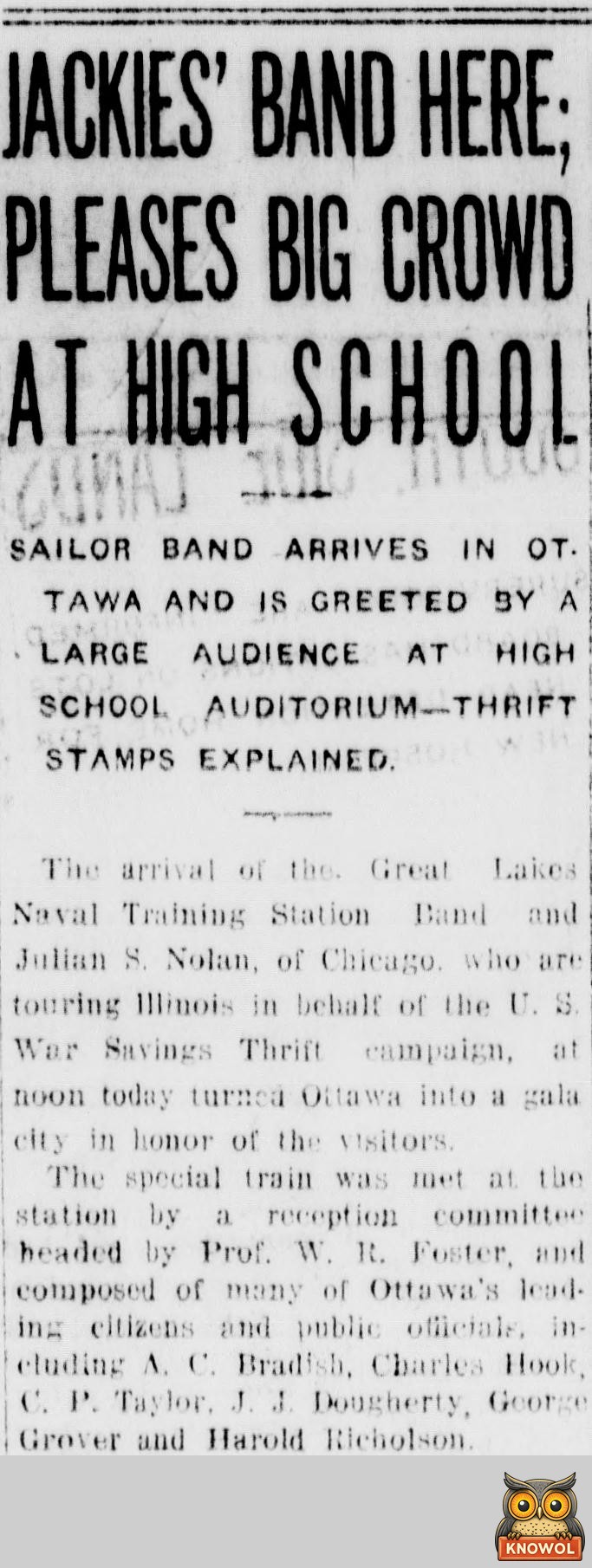
“Jackies’ Band Here; Pleases Big Crowd at High School.” The Free Trader-Journal, Ottawa, Illinois, December 14, 1917, page 1. Library of Congress, Chronicling America. Click the clipping to read it full size.
The man who was supposed to come
Three days earlier, the paper’s front page was full of excitement. With the band, it said, “will be none other than Lieut. John Phillip Sousa, patriotic to the core and America’s beloved bandmaster and composer.” The paper spelled his first name with two l’s. It added that “Assurances that John Phillip will accompany his boys” had been given to the people running the stamp campaign.
That was big news. John Philip Sousa wrote marches that every brass band in the country played, like “The Stars and Stripes Forever.” In 1917, after the United States entered World War I, he joined the Navy and trained the bands at Great Lakes. A visit from Sousa would be like a visit from a movie star.
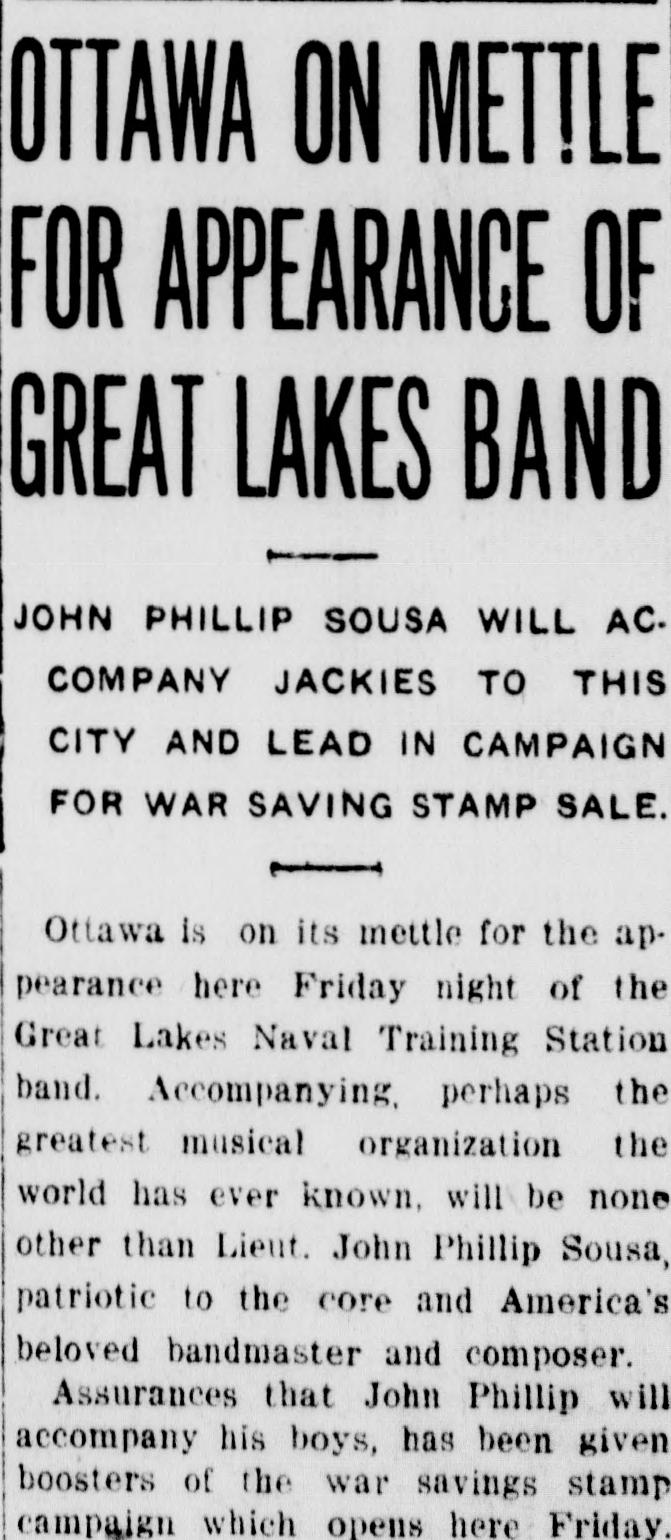
“Ottawa on Mettle for Appearance of Great Lakes Band.” The Free Trader-Journal, Ottawa, Illinois, December 11, 1917, page 1. Library of Congress, Chronicling America. Click the clipping to read it full size.
Forty-two Jackies
On Friday, the paper told who was on the train. Sailors were called “Jackies” back then, and “There were in all forty-two Jackies in the party.” Besides the band, there was a drill squad, a team that marched in perfect step. The officer in charge was Chief Yeoman Austin O’Malley. A yeoman did the Navy’s office work, and before he joined up that spring, O’Malley had been an editor at the Chicago Tribune. Granville English played the piano.
And the bandleader? “Harry Rachig was the band leader,” the paper said. It didn’t mention Sousa at all. The famous man wasn’t with them.
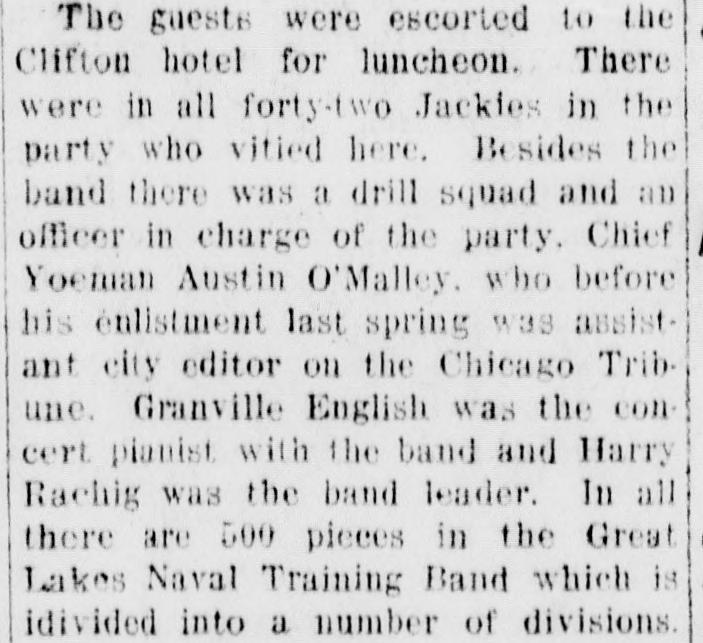
Who came to Ottawa: forty-two Jackies, a drill squad, a pianist and bandleader Harry Rachig. The Free Trader-Journal, Ottawa, Illinois, December 14, 1917, page 1. Library of Congress, Chronicling America. Click the clipping to read it full size.
The whole Great Lakes band had 500 players, so it was split into smaller groups that traveled on their own. This group had been on the road since the first of October. The night before Ottawa, it played in Aurora. That evening, it would play in Streator.
A birthday at the Clifton Hotel
First came lunch. The town took the sailors to the Clifton Hotel, and the sailors gave a show in return. Between courses, they played violin, piano and vocal solos and sang as a quartet. One sailor did a comedy act that, the paper said, “alone was worth the price of admission.” The reporter decided they were “not only a very live bunch, but a very talented one.”
Then came “One happy stunt.” One of the sailors, named Grimes, was turning 22. At lunch, he was handed a wrist watch for his birthday. Then, as part of the gag, came a pretend “sentence”: he “should be shot at sunrise.” Grimes didn’t miss a beat. The paper said his answer “came right off the bat”: “Can’t be there; I don’t get up that early.”
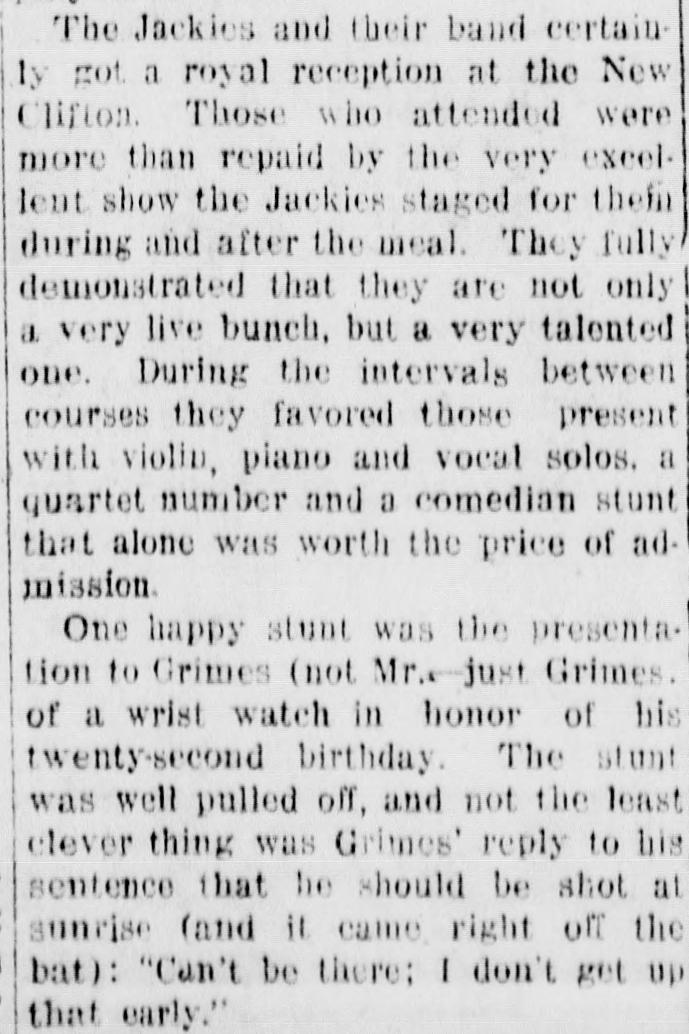
Lunch at the New Clifton, and Grimes’s twenty-second birthday. The Free Trader-Journal, Ottawa, Illinois, December 14, 1917, page 1. Library of Congress, Chronicling America. Click the clipping to read it full size.
1,500 voices
After lunch, the high school cadets and the school band marched the sailors to the township high school. The auditorium “was filled beyond its official capacity and cheers rang out from 1,500 voices.” When the band began the national anthem, every member of the drill team, the six singers and the cadets stood still with a hand raised in salute.
The paper printed the whole program. There was “Semper Fideles,” one of Sousa’s own marches. There were two trombone tunes the paper spelled “Lassie Trombone” and “Salle Trombone.” Pieces like that were made for laughs, with the trombones sliding up and down like a giggle. There was “Over There,” the big new war song of 1917, and “America, Here’s My Boy.” The band finished with the “Marseilles,” as the paper spelled the “Marseillaise,” the national song of France, America’s friend in the war.
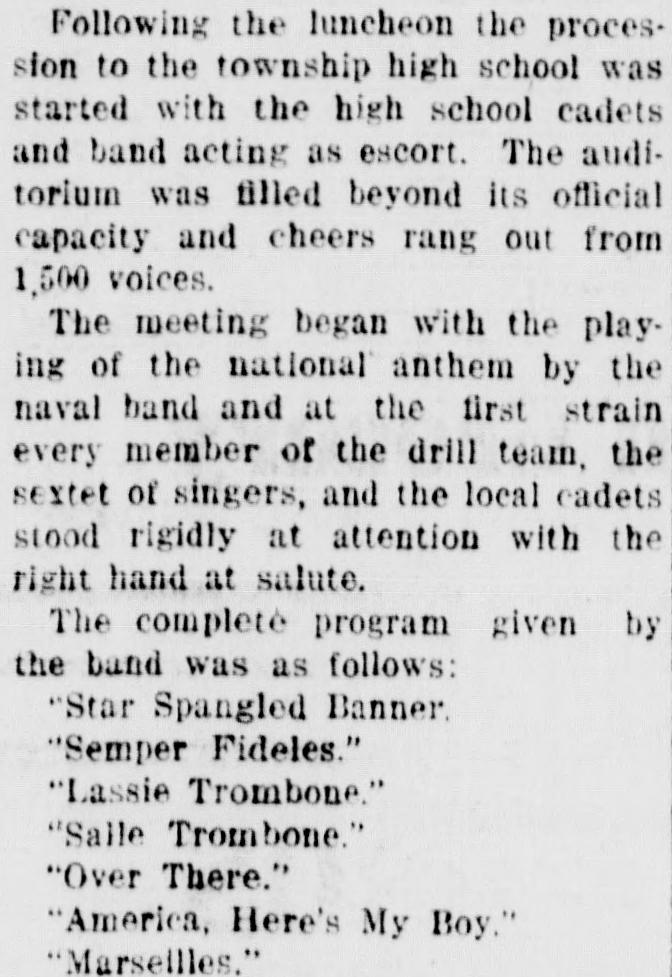
The packed auditorium and the band’s program. The Free Trader-Journal, Ottawa, Illinois, December 14, 1917, page 5. Library of Congress, Chronicling America. Click the clipping to read it full size.
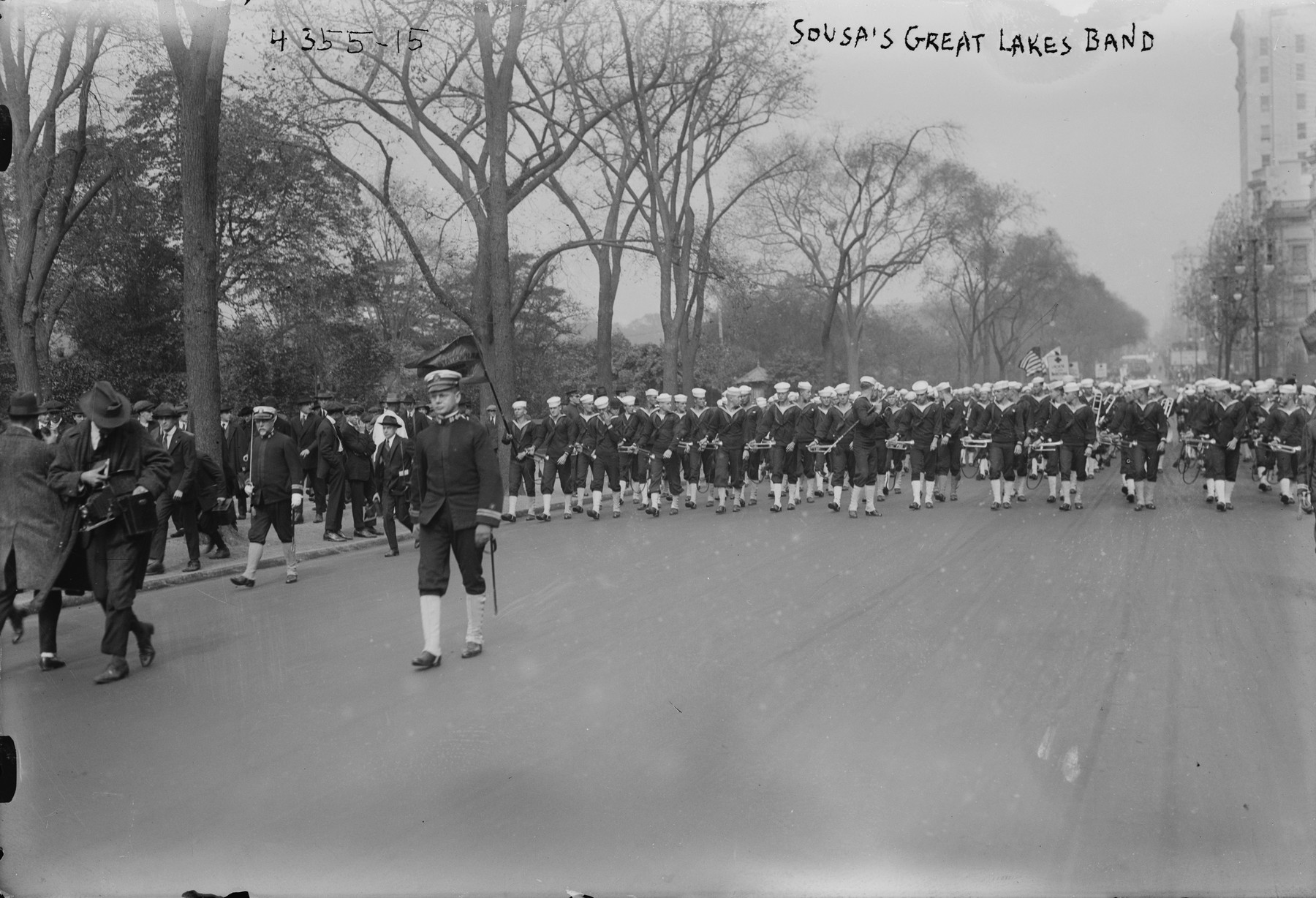
“Sousa’s Great Lakes Band” marching down a city street, about 1918. Bain News Service, Library of Congress. Click the picture to see it full size.
What a quarter could do
Then the guest speaker stood up. He was Julian S. Nolan, a Chicago businessman who was touring Illinois with the band for free. His job was to explain War Savings Stamps, a brand-new way to lend the government money to pay for the war. Nolan said the stamps were for everybody, and most of all for school children and families without much money.
Here’s how it worked. “A Thrift Stamp costs twenty-five cents,” he said. With your first stamp, the post office gave you a card with 16 spaces. Sixteen quarters make $4. When the card was full, you added 12 cents and traded it for a War Savings Stamp. A certificate held 20 of those. Fill it before January 1, 1918, and it cost $82.40. On January 1, 1923, the paper said, “the government will pay the owner $100.” So a kid who saved quarters for the war would get back more than they put in, five years later.
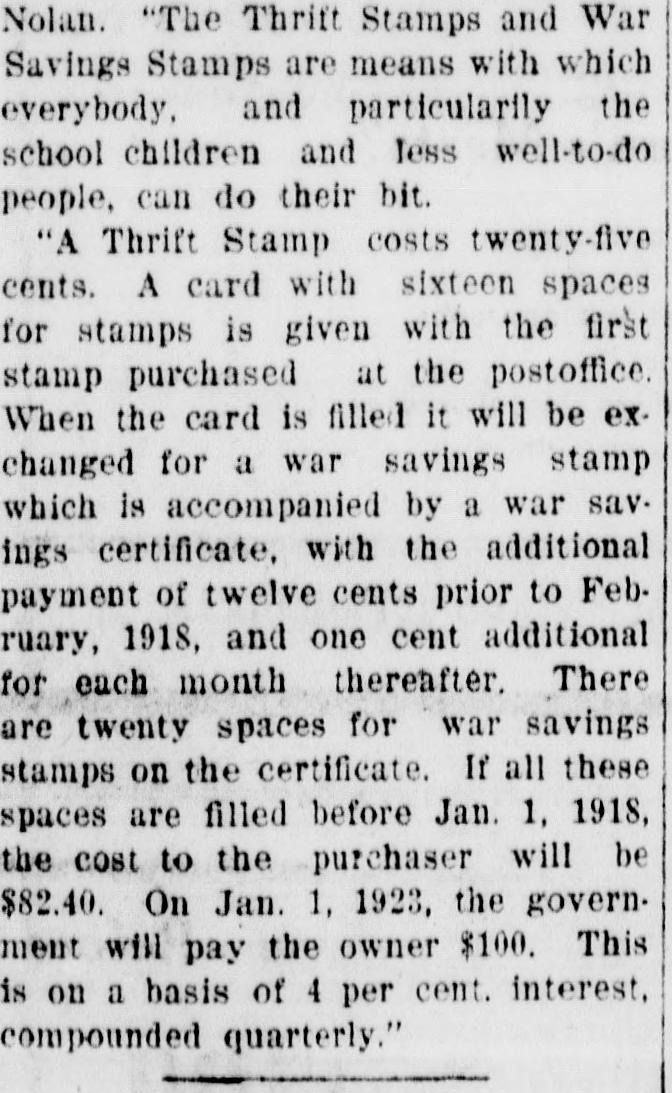
“A Thrift Stamp costs twenty-five cents.” The Free Trader-Journal, Ottawa, Illinois, December 14, 1917, page 5. Library of Congress, Chronicling America. Click the clipping to read it full size.
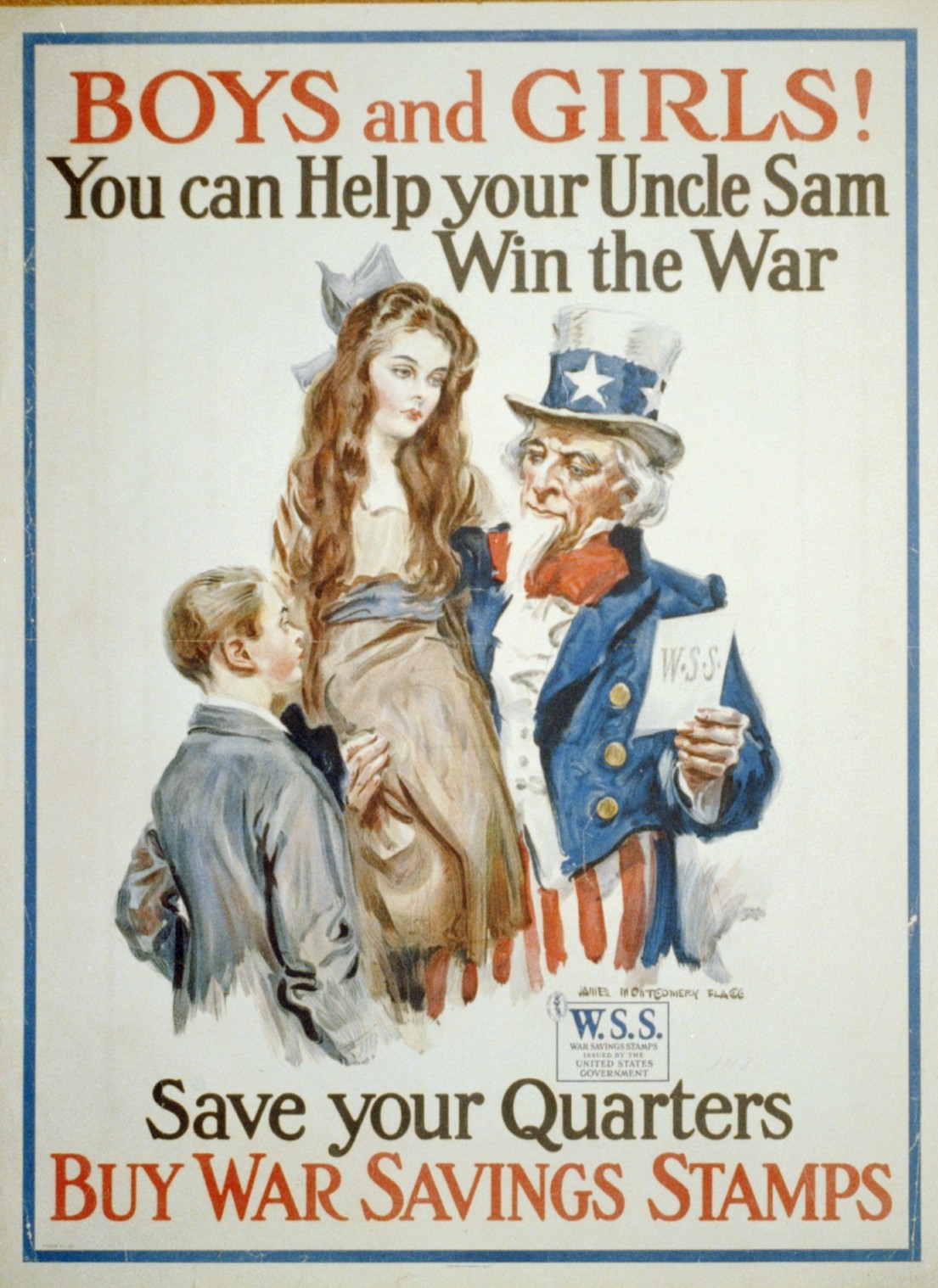
“Boys and Girls! You can Help your Uncle Sam Win the War. Save your Quarters. Buy War Savings Stamps.” Poster by James Montgomery Flagg, 1917. Library of Congress. Click the picture to see it full size.
Three days earlier, in Rock Island
Ottawa wasn’t the only town the sailors won over. On Tuesday night, December 11, the Great Lakes band played and Mr. Nolan spoke at the Augustana College gym in Rock Island, Illinois, for “an audience of 3,000.” The Rock Island Argus said the music ranged “from the classical to the jazz and ragtime type.” Right at the start, the sailors gave their famous “whistle-yell” for Rock Island and Augustana. The college boys cheered back, copying the sailors’ own “stuff” as best they could. The visitors thought that was very funny.
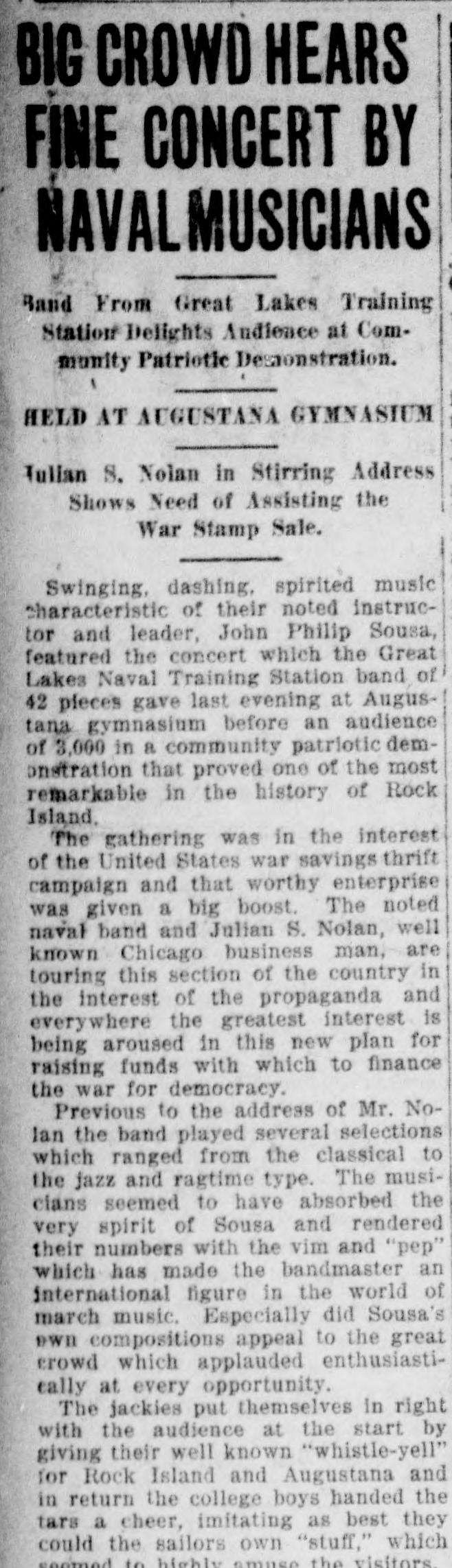
“Big Crowd Hears Fine Concert by Naval Musicians.” The Rock Island Argus, Rock Island, Illinois, December 12, 1917, page 4. Library of Congress, Chronicling America. Click the clipping to read it full size.
Also in town that weekend
Page five of the same Ottawa paper shows what else people could do that weekend. The Crescent Theatre promised a new Charlie Chaplin comedy, “The Adventurer,” for Saturday, “First Time Ever Shown in Ottawa.” On Sunday, Alice Brady starred in “Betsy Ross,” with admission at 5 and 10 cents.
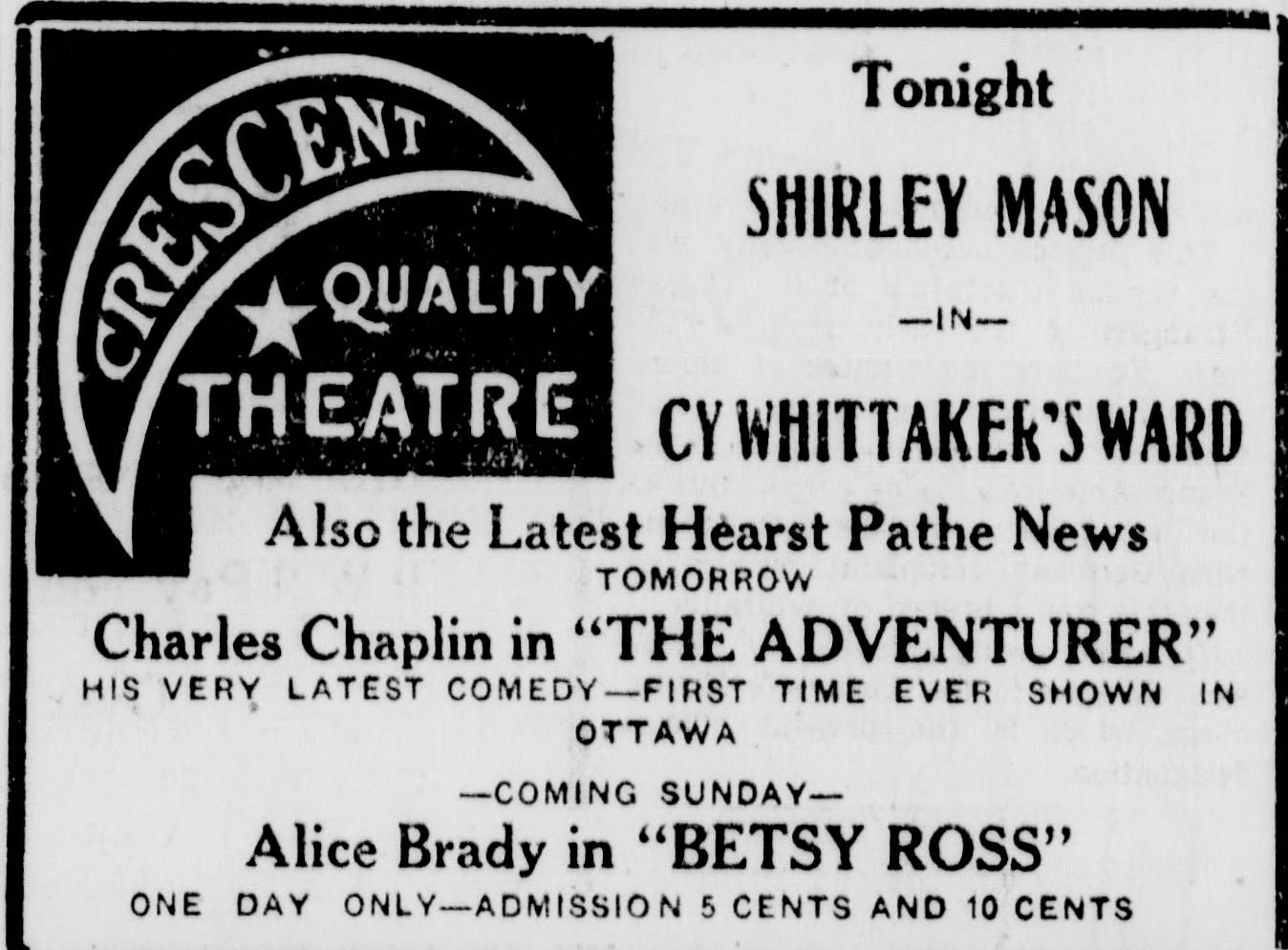
The Crescent Theatre’s ad, with Charlie Chaplin in “The Adventurer.” The Free Trader-Journal, Ottawa, Illinois, December 14, 1917, page 5. Library of Congress, Chronicling America. Click the clipping to read it full size.
About the cover
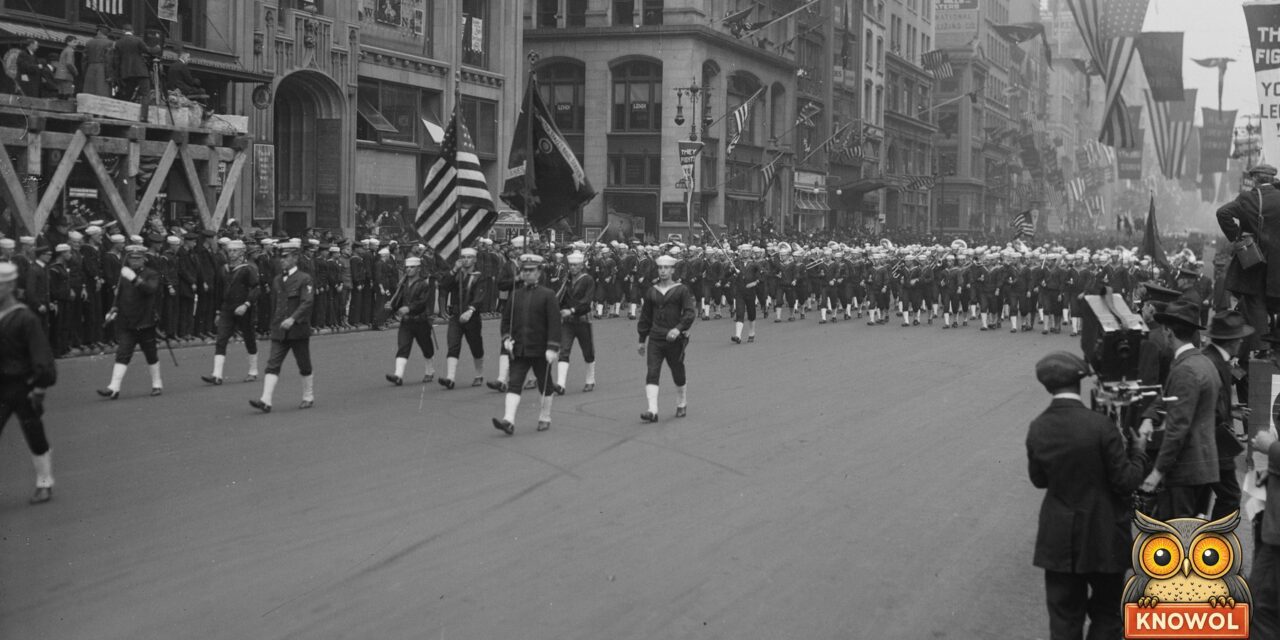
The photo at the top of this story shows sailors of the Great Lakes band marching with their flags in a big city parade, with men filming from the curb. The Bain News Service took it between about 1915 and 1920 and did not write down the city. It isn’t Ottawa, but it’s the same Navy band.
Ottawa never did get its famous bandleader that Friday. It got forty-two sailors instead, and they were enough. They played to a packed school, taught kids what a quarter could do, and gave the town one great line to remember. Grimes, the sailor who turned 22 over lunch, said it best: “Can’t be there; I don’t get up that early.”
Sources
- The Free Trader-Journal (Ottawa, Illinois): “Jackies’ Band Here; Pleases Big Crowd at High School,” December 14, 1917, page 1 and its continuation on page 5 (also the Crescent Theatre ad); “Ottawa on Mettle for Appearance of Great Lakes Band,” December 11, 1917, page 1. Library of Congress, Chronicling America.
- “Big Crowd Hears Fine Concert by Naval Musicians,” The Rock Island Argus (Rock Island, Illinois), December 12, 1917, page 4. Library of Congress, Chronicling America.
- Pictures: “Great Lakes band” (the cover; Bain News Service, between about 1915 and 1920) and “Sousa’s Great Lakes Band” (Bain News Service, about 1918), George Grantham Bain Collection, no known restrictions on publication; “Boys and girls! You can help your Uncle Sam win the war, save your quarters, buy War Savings Stamps” (James Montgomery Flagg, 1917), World War I posters, no known restrictions on publication. Library of Congress Prints and Photographs Division.