Judge David Cross stood up after dinner in the town hall of New Boston, New Hampshire, on Thursday, June 13, 1907. He was 89 years old, and the hall was full of people who had come home for the town’s Old Folks’ Day. The judge had something to tell them. He had stood in this exact spot before, long before the town hall was built.
More than 60 years earlier, a school building had stood right there. In 1843 and 1844, its teacher was a young man named David Cross. The New Hampshire Farmer and Weekly Union, a paper from Manchester, said his talk was “in a happy vein of reminiscences,” which means happy old memories told out loud.
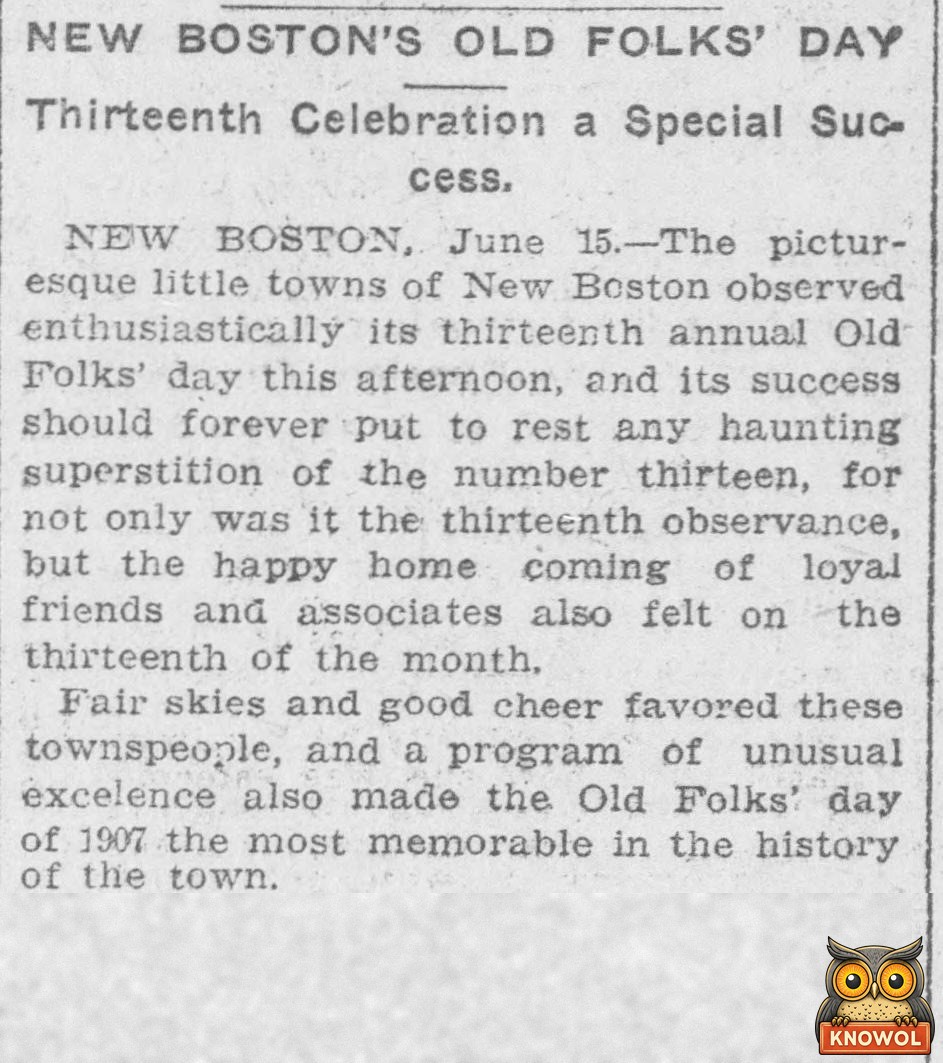
“New Boston’s Old Folks’ Day.” New Hampshire Farmer and Weekly Union, Manchester, New Hampshire, June 19, 1907, page 9. Library of Congress, Chronicling America. Click the clipping to read it full size.
Old Folks’ Day in New Boston
New Boston was a small farm town in the hills west of Manchester, and it had been holding an Old Folks’ Day since 1894. It was a homecoming: people who had grown up in New Boston and moved away came back for one day.
In 1907, the paper said, “the morning trains and automobiles together with the carriages” brought “a happy throng to the town hall.” At the door, each visitor got a boutonniere of lilies of the valley, a little bunch of flowers to pin on a coat. At noon, the women of New Boston served dinner downstairs on tables “loaded with an abundance of good things.”
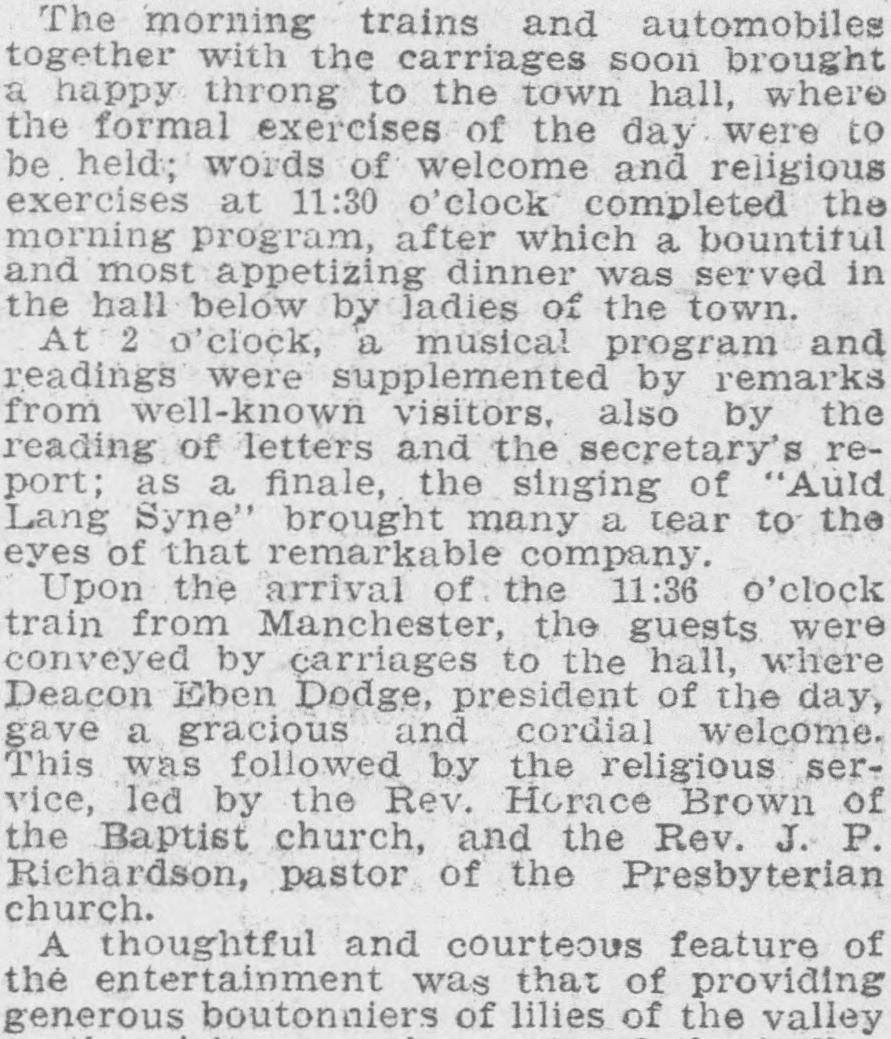
How the guests got to New Boston, and the lilies of the valley at the door. New Hampshire Farmer and Weekly Union, Manchester, New Hampshire, June 19, 1907, page 9. Library of Congress, Chronicling America. Click the clipping to read it full size.
Thirteen on the Thirteenth
New Boston’s 1907 Old Folks’ Day was its thirteenth, and it fell on the thirteenth day of the month. Some people think 13 is an unlucky number, but the paper said the day’s success “should forever put to rest any haunting superstition of the number thirteen.”
The town even hung the number over the stage. Of three laurel wreaths, the one on the left said 1894, when the celebrations began, and the one on the right said 1907. The circle in the middle held the number 13.
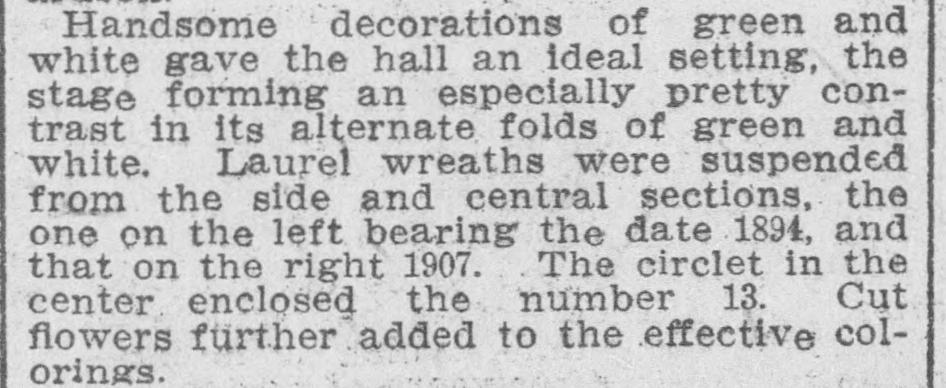
The wreaths over the stage: 1894, 1907 and 13. New Hampshire Farmer and Weekly Union, Manchester, New Hampshire, June 19, 1907, page 9. Library of Congress, Chronicling America. Click the clipping to read it full size.
Judge Cross Remembers His New Boston School
Deacon Eben Dodge, the president of the day, introduced Judge Cross. The judge started with a name. “It was in the fall of 1843 and 1844 that I taught here and James A. V. Smith was then one of my pupils,” he said. “I am very proud to have taught such a man.”
Here is the best part: James A. V. Smith was there too. The paper lists “J. A. V. Smith” of Manchester among the speakers that day, so the old teacher and his old pupil were in the same hall again, more than 60 years after their school days together.
Then he told them how big his school had been. “In 1844 I had seventy-five pupils in my school, and none were under 14 years of age.” Picture a teacher in his twenties with 75 students in one room, every one of them 14 or older.
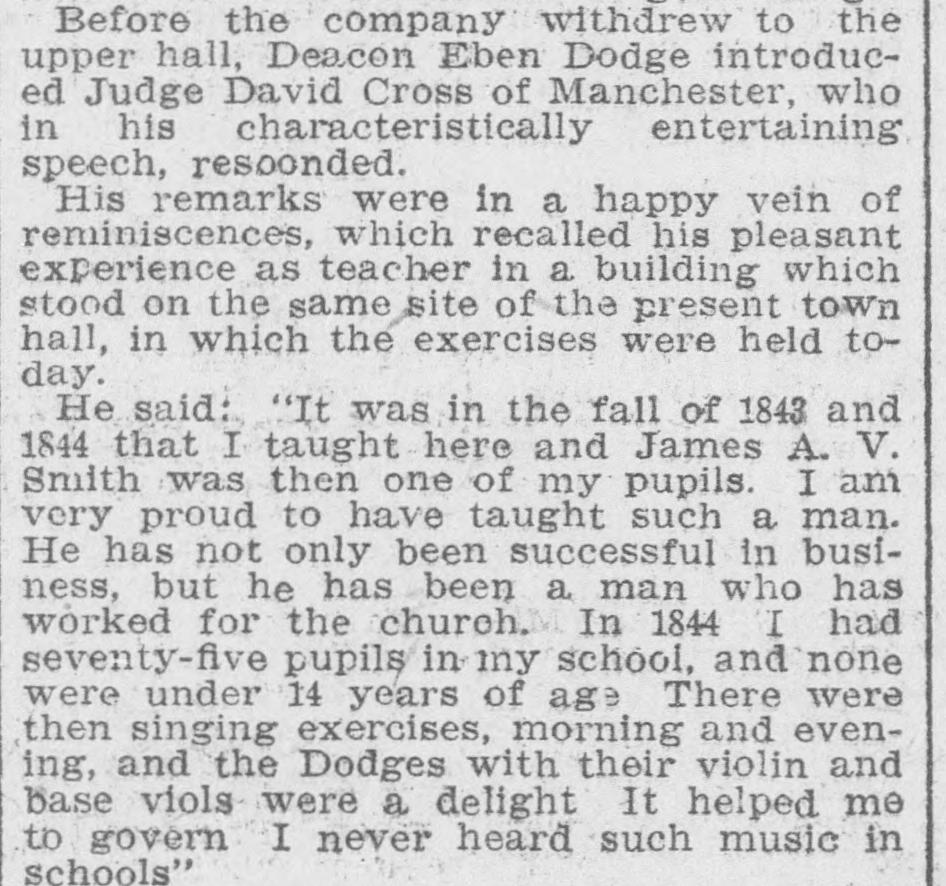
Judge Cross remembers his school. New Hampshire Farmer and Weekly Union, Manchester, New Hampshire, June 19, 1907, page 9. Library of Congress, Chronicling America. Click the clipping to read it full size.
How Music Kept the New Boston School in Line
So how did one young teacher keep order? Judge Cross said the answer was music. There were “singing exercises, morning and evening,” he said, and a family named Dodge played for them. The Dodges “with their violin and base viols were a delight,” the paper printed. A bass viol (the paper spelled it “base”) was a big, deep-voiced stringed instrument, a lot like a cello.
The music did more than sound nice. “It helped me to govern,” the judge said. To govern a school meant to keep it in order. Then he paid the Dodges his best compliment: “I never heard such music in schools.”
The Long Walk Home From a Wedding in New Boston
In 1843, one of New Boston’s young women got married, and David Cross was the best man. On the way home, he and the bridesmaid rode in a “two wheeled shay.” A shay, or chaise, was a light carriage with two wheels, pulled by one horse.
The shay broke down, and the paper said the two of them “suddenly found themselves stranded in the highways.” So they walked the rest of the way. The paper called it “a most peculiar procession coming from a wedding.” It did not print the bridesmaid’s name. It also did not say what happened to the horse.
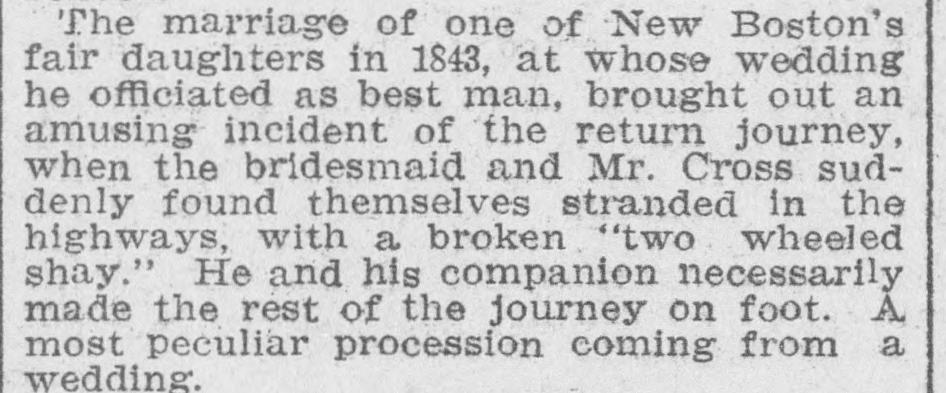
The broken shay. New Hampshire Farmer and Weekly Union, Manchester, New Hampshire, June 19, 1907, page 9. Library of Congress, Chronicling America. Click the clipping to read it full size.
“I Bring to You Cheer”
The report of the judge’s talk at New Boston ends with warm words about his old pupils. “Not one of these boys and girls have become a recreant; all have done well.” A recreant is someone who gives up or goes bad. Then came a little advice: “I have tried in my life to look on the sunny side.” And a goodbye: “I bring to you cheer, I bring to you a grateful heart.”
After that, everyone went upstairs for the afternoon program. A chorus of twenty voices sang, and four women, Miss Eva Shedd, Miss Ethel Leach, Miss Edith Allen and Miss Ruth Todd, put on a piece called “Old Maids’ Tea Party.” Last of all, the whole hall sang “Auld Lang Syne,” the old Scottish song about old friends. The paper said it “brought many a tear to the eyes of that remarkable company.”
By the Numbers: New Boston, June 13, 1907
- 13: New Boston’s thirteenth Old Folks’ Day, held on the thirteenth of June.
- 89: Judge Cross’s age that day. He turned 90 three weeks later.
- 63: years since his last term as New Boston’s teacher, in 1844.
- 75: pupils in his school that year, none under 14.
- 20: voices in the chorus.
- 1: broken two-wheeled shay, in 1843.
The New Boston Teacher Who Never Grew Old
David Cross was born on July 5, 1817, in Weare, the town just north of New Boston. A history of Weare printed in 1888 says he paid his way through school partly by teaching, and it lists “two at New Boston” among his school terms. He finished Dartmouth College in 1841, and in January 1845 he opened a law office in Manchester, and from 1856 to 1874 he was the county’s judge of probate, the judge who handles wills.
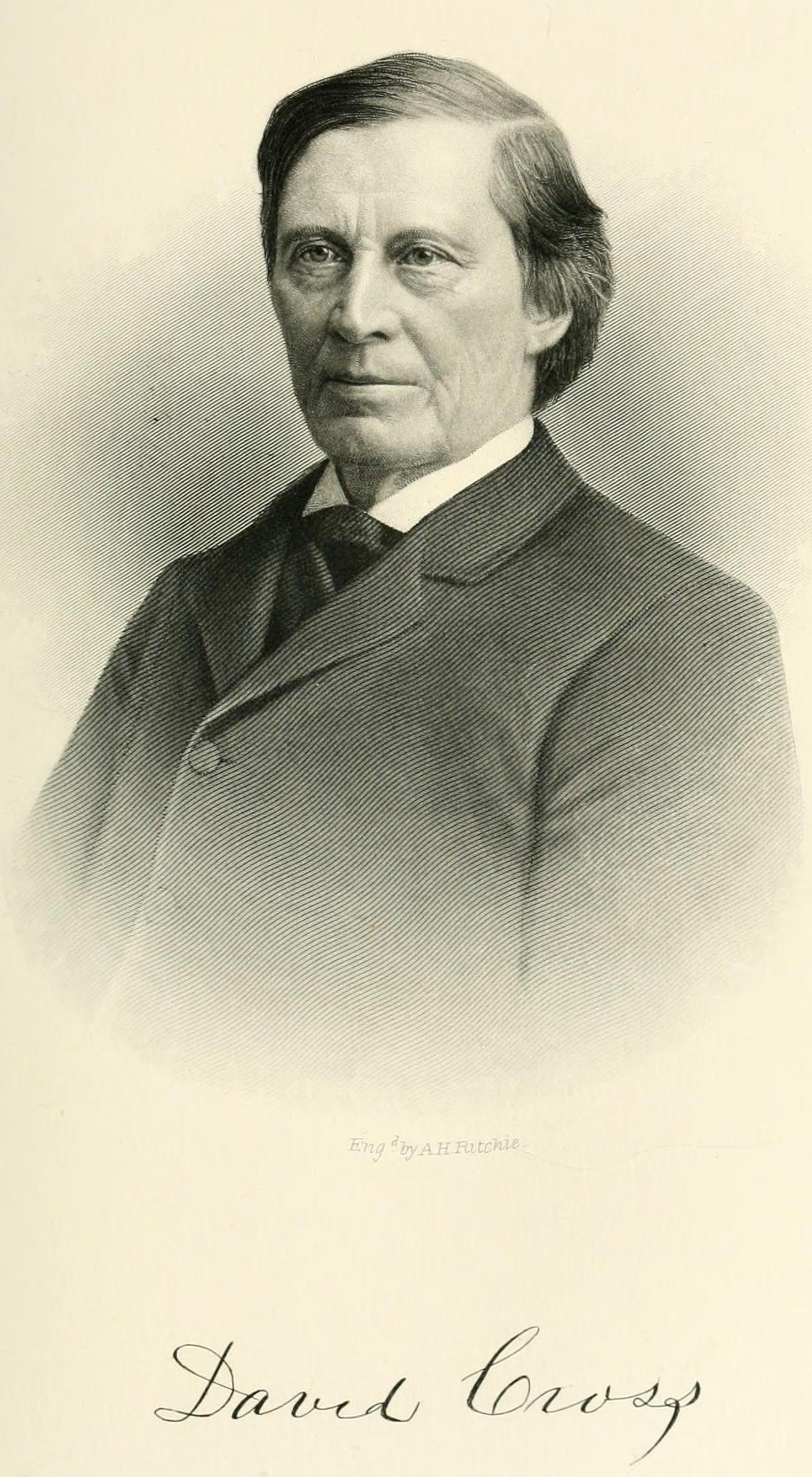
David Cross, engraved by A. H. Ritchie, with his signature. From The History of Weare, New Hampshire, 1735-1888, by William Little (1888). Internet Archive. Click the picture to see it full size.
He had seen a lot change. When he first went off to Dartmouth, a Manchester paper later wrote, “there was not a mile of railroad in New Hampshire, the trip being made by stagecoach.” On Old Folks’ Day in 1907, his friends came to New Boston by train and by automobile.
Three weeks after that day, he turned 90. A group of “250 old residents” gave him “a silver loving cup,” a big cup with handles that people gave as an honor. Judge Cross lived to be 97. When he was gone, the Manchester paper summed him up in one line: “He lived for more than 97 years and never grew old.”
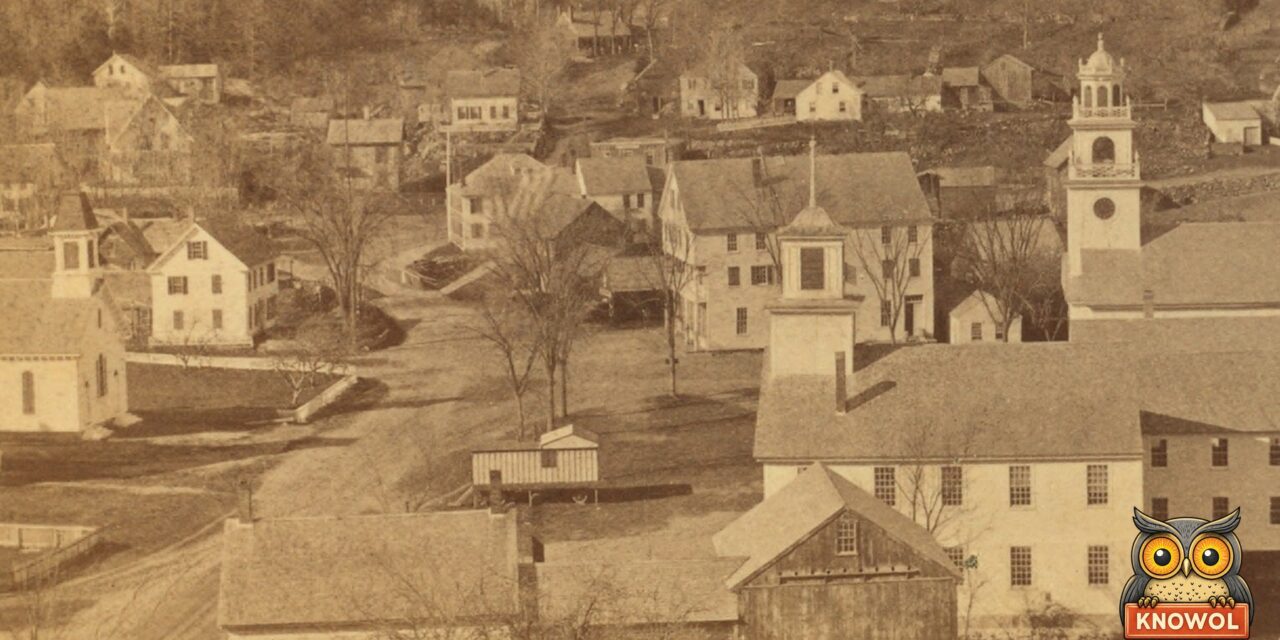
The building where he taught in New Boston was long gone by 1907, and the town hall stood in its place. But for one June afternoon, the old teacher was back where he had started, with one of his pupils in the room and a hall full of people who knew what it means to come home. The picture at the top of this page shows New Boston about 1875, some 30 years after he taught there, from a stereograph by S. A. Putnam (a card with two photos that look 3D through a viewer).
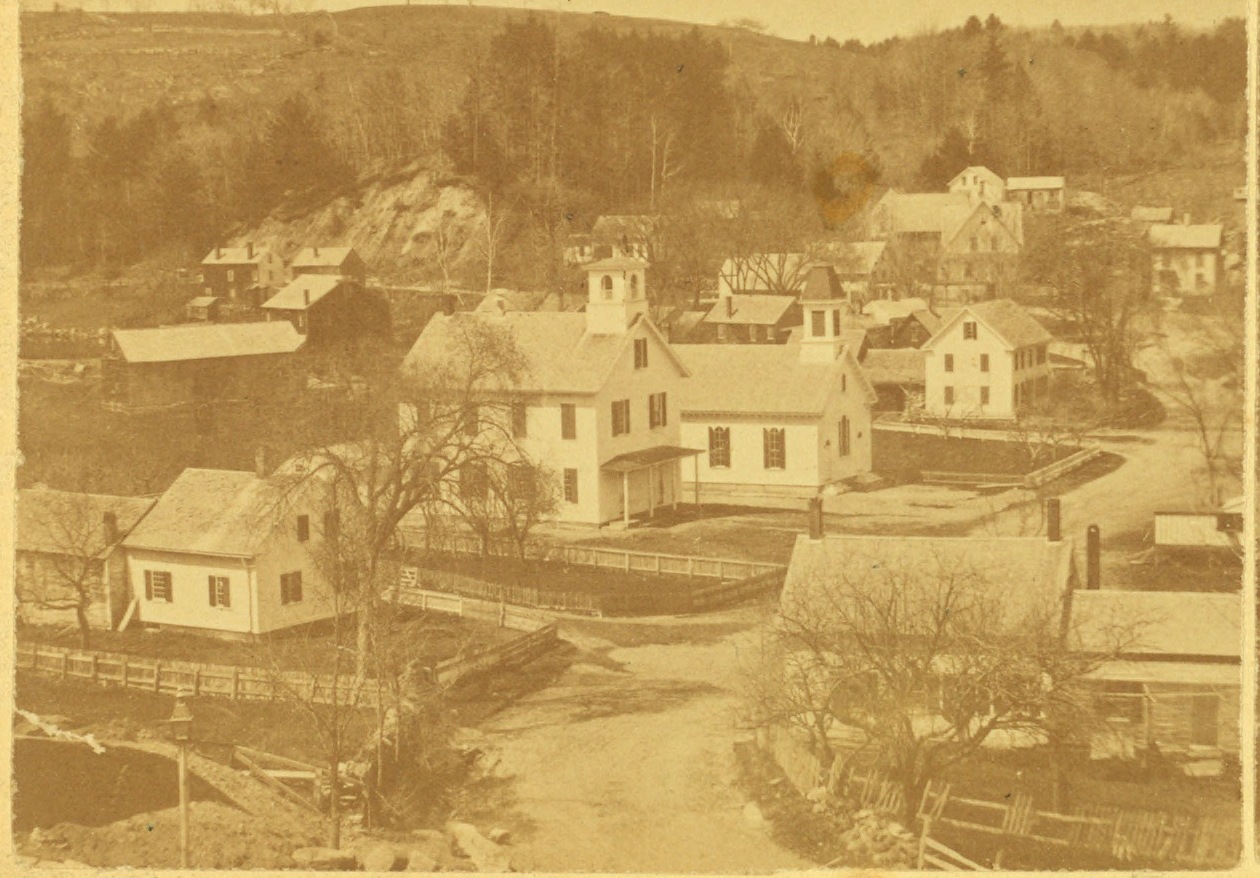
Another view of New Boston village, from a stereograph card of about 1865 to 1880 (one half of the card, cropped). Robert N. Dennis Collection of Stereoscopic Views, New York Public Library, via Wikimedia Commons. Click the picture to see it full size.
Sources
- “New Boston’s Old Folks’ Day,” New Hampshire Farmer and Weekly Union (Manchester, New Hampshire), June 19, 1907, page 9. Library of Congress, Chronicling America.
- “Death of Judge Cross Last Thursday Night,” The Mirror and Farmer (Manchester, New Hampshire), October 8, 1914, page 5: his age, the stagecoach line, the loving cup on his 90th birthday and “never grew old.” Library of Congress, Chronicling America.
- William Little, The History of Weare, New Hampshire, 1735-1888 (Lowell, Massachusetts: S. W. Huse and Company, 1888; David Cross sat on the town’s publishing committee): David Cross’s birth date, his school terms at New Boston, his law office and his years as judge of probate (pages 396 and 454-455), and his engraved portrait. Internet Archive.
- Cover: “New Boston Village, N.H.,” stereograph by S. A. Putnam, about 1875, and another New Boston village stereograph, Robert N. Dennis Collection of Stereoscopic Views, New York Public Library, via Wikimedia Commons. Public domain.
- The newspaper pages, the book and the photographs were all published or made before 1931 and are in the public domain in the United States.