In the summer of 1865, a small company in Benson, Vermont, had something new to sell to the farms around it. It was a pump that lived at the bottom of the well, down under the water, where winter could not reach it. The company was Dorsey Sweet & Co., and on July 19, 1865, its ad ran in the Middlebury Register, the weekly paper in Middlebury, Vermont.
The ad’s headline, in big black letters, named Reynolds’ Ohio Pump. Under that it said “SOMETING NEW.” The printer dropped the H, but the idea was real. It came from Dayton, Ohio, by way of a New York science paper called Scientific American.
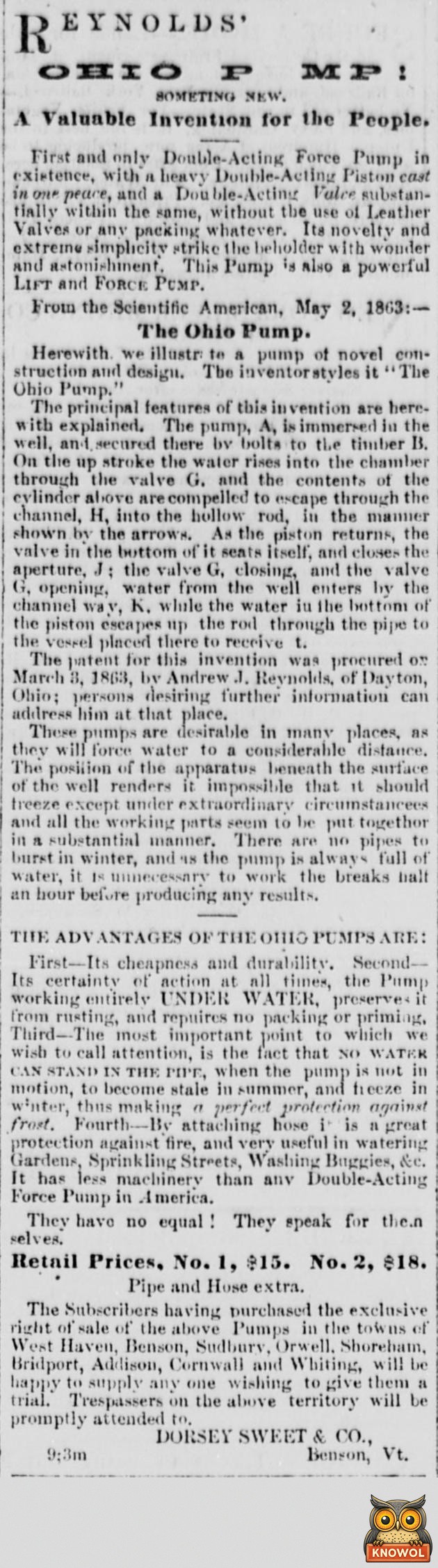
Reynolds’ Ohio Pump, Dorsey Sweet & Co.’s ad in The Middlebury Register, Middlebury, Vermont, July 19, 1865, page 4. Library of Congress, Chronicling America. Click the clipping to read it full size.
The Trouble With a Pump in a Vermont Winter
On a farm near Benson, Vermont, in 1865, water did not come from a faucet. It came up out of a well, one pull of the handle at a time. The animals needed it and the kitchen needed it, and the pump stood outside all winter long.
An ordinary pump kept water standing in its pipe above the ground. In a hard frost that water could freeze and split the pipe. Many pumps also had leather valves, little flaps that let water go up but not back down. When the leather dried out, the pump lost its grip on the water. You had to pour some water in the top to wet it, which was called priming, and then pump and pump until water finally came.
The Scientific American put it best. With the new pump, it said, “There are no pipes to burst in winter,” and “it is unnecessary to work the brakes half an hour before producing any results.” Brakes was an old word for a pump handle. Half an hour of pumping for nothing is a long time on a cold morning.
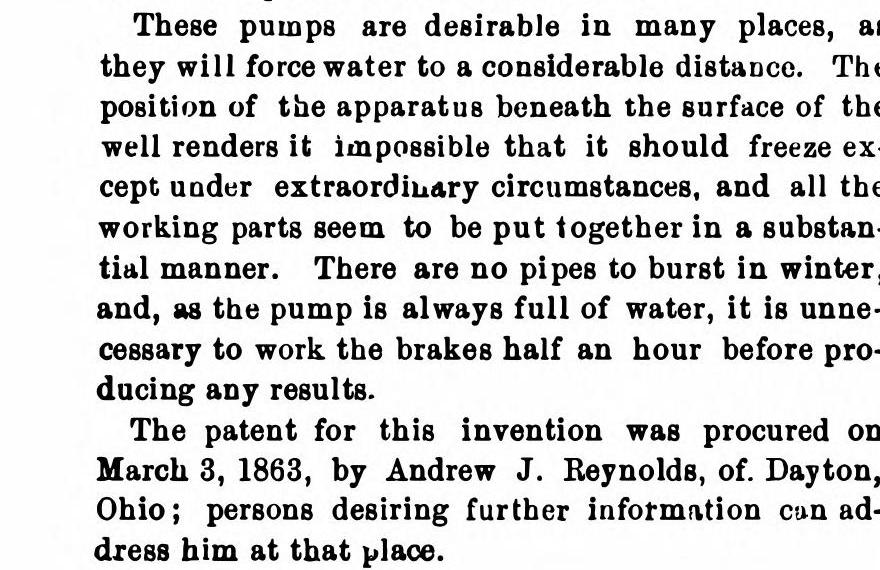
“There are no pipes to burst in winter.” Scientific American, New York, May 2, 1863, page 1. Internet Archive, public domain. Click the clipping to read it full size.
How the Ohio Pump Hid Under the Water
The pump that Dorsey Sweet sold in Benson, Vermont, was invented by Andrew J. Reynolds of Dayton, Ohio. He got a patent for it, No. 37,826, on March 3, 1863. Two months later, Scientific American put his pump on its front page with a big drawing.
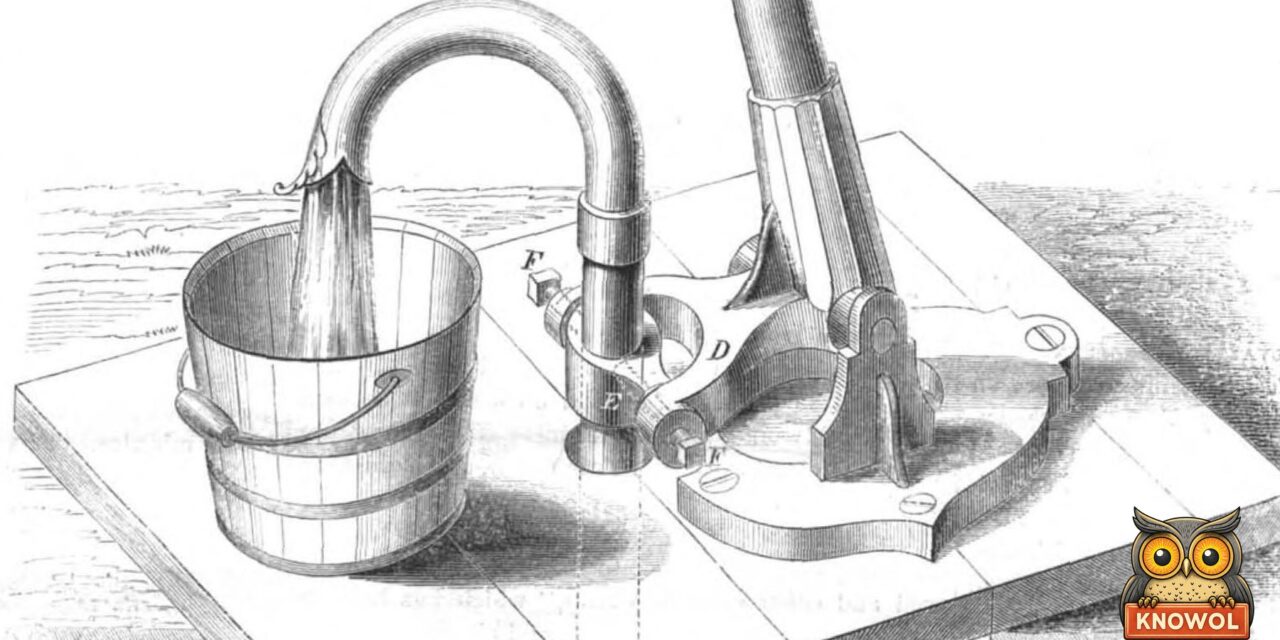
The picture at the top of this page is part of that Scientific American drawing: the wooden platform over the well, the iron handle, and a curved spout pouring into a wooden bucket. Below the platform, the full drawing cuts the well open like an X-ray. Reynolds’ own patent drawing does the same thing. Down at the bottom, bolted to a timber and sitting in the water, is the pump itself. Its piston rod is a hollow pipe, so the water rides up through the rod and out the spout.
The most important part was what happened when you let go of the handle. In his patent, Reynolds wrote that the pump “is self-emptying to the water-level, and is therefore non-freezing.” The water in the pipe simply drained back down into the well. Nothing was left up top to freeze. And since the pump sat in the water all the time, it never needed priming.
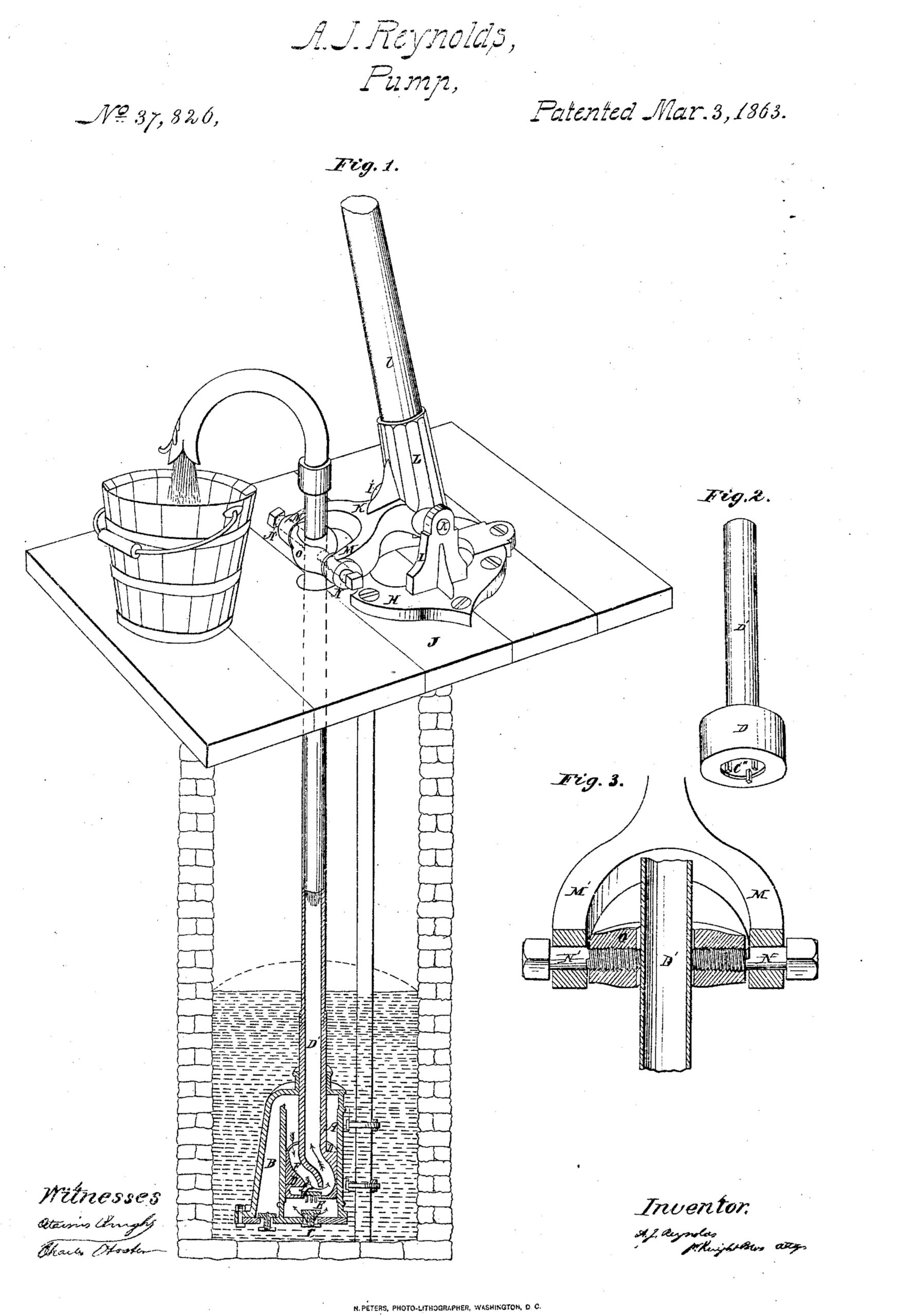
Andrew J. Reynolds’ patent drawing, “Pump,” No. 37,826, patented March 3, 1863. The dashed lines in the well are the water. The pump sits at the bottom, under it. U.S. Patent Office, via Google Patents. Click the picture to see it full size.
What the Benson Ad Promised
Dorsey Sweet & Co. of Benson copied the Scientific American story right into its ad, and then added its own list of reasons to buy. The pump was working “entirely UNDER WATER,” the ad said, which kept it “from rusting.”
The best reason came third. “NO WATER CAN STAND IN THE PIPE,” the ad said, so the water could not “become stale in summer, and freeze in winter.” The ad called that “a perfect protection against frost.”
The pump was a force pump, which means it could push water up and out with some power, not just lift it to the spout. Hook a hose to it, the ad said, and it was “a great protection against fire.” It was also good for watering gardens, sprinkling streets and washing buggies.
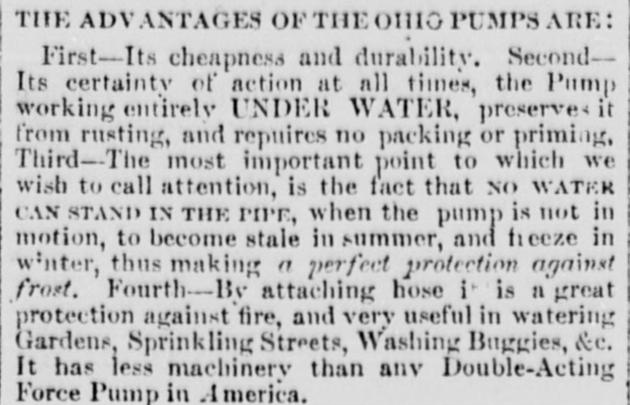
“The Advantages of the Ohio Pumps Are.” The Middlebury Register, Middlebury, Vermont, July 19, 1865, page 4. Library of Congress, Chronicling America. Click the clipping to read it full size.
What the Pump Cost in 1865
The Benson ad printed its prices in big type: “Retail Prices, No. 1, $15. No. 2, $18.” The pipe and the hose cost extra. For a sense of size, Scientific American’s own front page that spring said a copy cost six cents and a whole year cost $3. So the smaller pump cost as much as five years of the magazine that made it famous.
Nine Towns Around Benson, Vermont, and No Trespassers
The last part of the Benson ad shows how inventions were sold in the 1860s. An inventor with a patent could sell the right to sell his invention, one piece of the map at a time. A dealer bought a few towns, and nobody else was supposed to sell the product there.
Dorsey Sweet & Co. said it had “purchased the exclusive right of sale” in nine Vermont towns: West Haven, Benson, Sudbury, Orwell, Shoreham, Bridport, Addison, Cornwall and Whiting. That is a row of farm towns south and west of Middlebury, toward Lake Champlain.
Then came a line that sounds like a sign on a fence. “Trespassers on the above territory will be promptly attended to.” In plain words, any other pump seller who came into those nine towns would hear from Dorsey Sweet & Co. The ad does not say how.
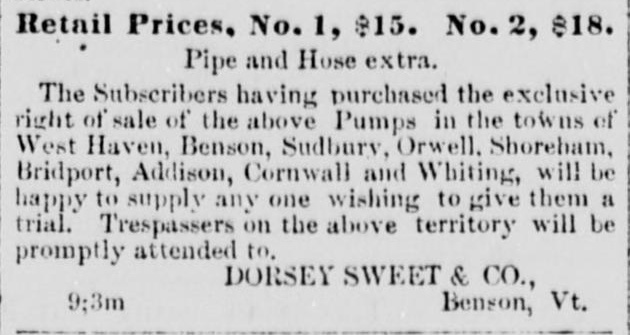
The prices and the nine towns, signed “Dorsey Sweet & Co., Benson, Vt.” The Middlebury Register, Middlebury, Vermont, July 19, 1865, page 4. Library of Congress, Chronicling America. Click the clipping to read it full size.
The Printer’s Slips in the Benson Ad
The ad has a few funny mistakes, and they are worth a look. In 1865 a printer set every word by hand, one metal letter at a time, picked out of a wooden case. Small slips were easy to make and hard to catch.
So the ad says “SOMETING NEW.” It says the piston was “cast in one peace,” when it meant one piece. It spells valve “Valce.” And where Scientific American wrote “brakes,” the ad wrote “breaks.” The pump itself, at least, was all in one piece.
Why the Underwater Pump Still Makes Sense
The newspaper does not tell us how many Ohio Pumps Dorsey Sweet & Co. sold around Benson, Vermont, and we could not find more about the company. What we do have is the idea, and it was a good one. Keep the working parts below the cold, and let the pipe drain itself when no one is using it.
That same idea is still at work on farms today. A frost-free yard hydrant, the tall metal faucet you see by many barns, shuts off its water deep underground and lets the pipe above it drain. Andrew Reynolds of Dayton, Ohio, would have understood it at a glance. In 1865, a farmer near Benson could get that kind of winter peace of mind for $15, pipe and hose extra.
Sources
- Reynolds’ Ohio Pump ad by Dorsey Sweet & Co., Benson, Vt., The Middlebury Register (Middlebury, Vermont), July 19, 1865, page 4. Library of Congress, Chronicling America.
- “The Ohio Pump” and “Reynold’s Patent Pump,” Scientific American, Vol. 8, No. 18, May 2, 1863, page 1. Internet Archive.
- Andrew J. Reynolds, of Dayton, Ohio, “Improvement in Pumps,” U.S. Patent No. 37,826, March 3, 1863. Google Patents.
- The newspaper and magazine pages were printed before 1931 and are in the public domain.