One Monday in 1891, the schooner Mildred V. Lee came home to Gloucester, Massachusetts, from the fishing banks. Her crew had been out after halibut. They also brought in one fish that nobody on the wharf could name.
The Gloucester Times took its measure. The fish was “nearly oval in shape, with a very short tail.” It was three and a half feet long and two and a half feet wide, and it weighed 112 pounds. “When taken from the water it was of a bright red color,” the paper said. A line ran along each side of its back like a scar, “as if he had been cut and stitches taken in the wound.”
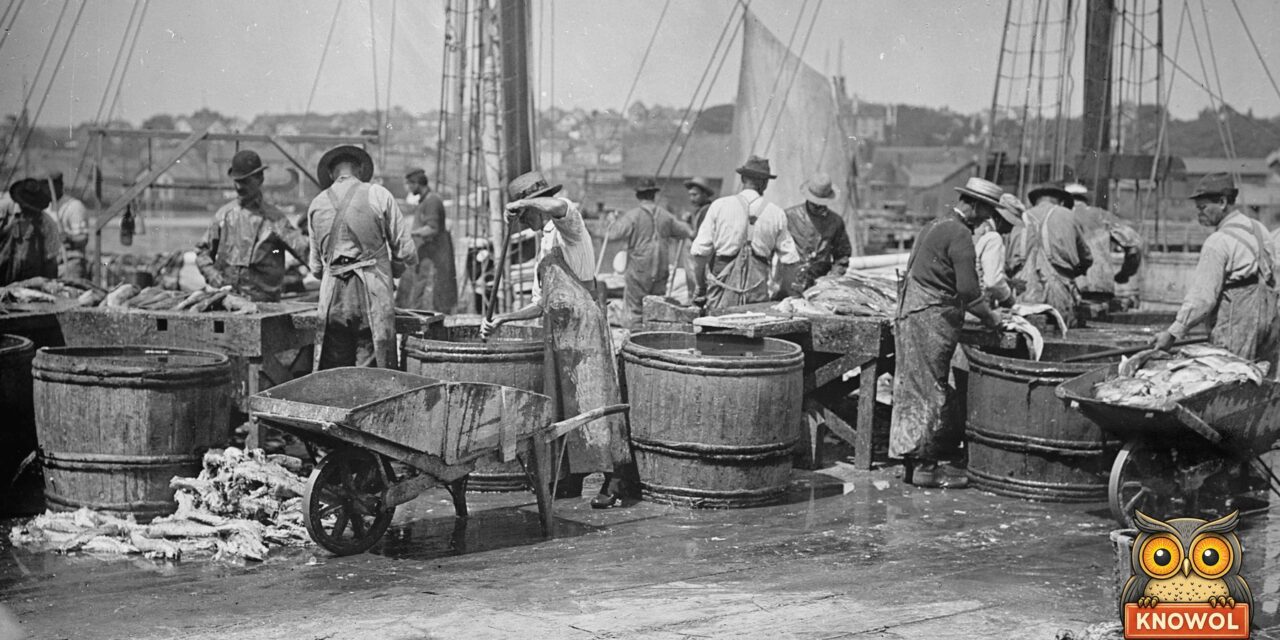
Gloucester was a fishing town, and its men knew their fish. The photograph at the top of this page shows them on a wharf about 1905, handling a cargo from the fishing banks. But in 1891 the Times had to admit that “nothing like it has ever been landed here before.” The paper even looked in the books of the United States Fish Commission, the government office that studied fish. The red fish was not in them.
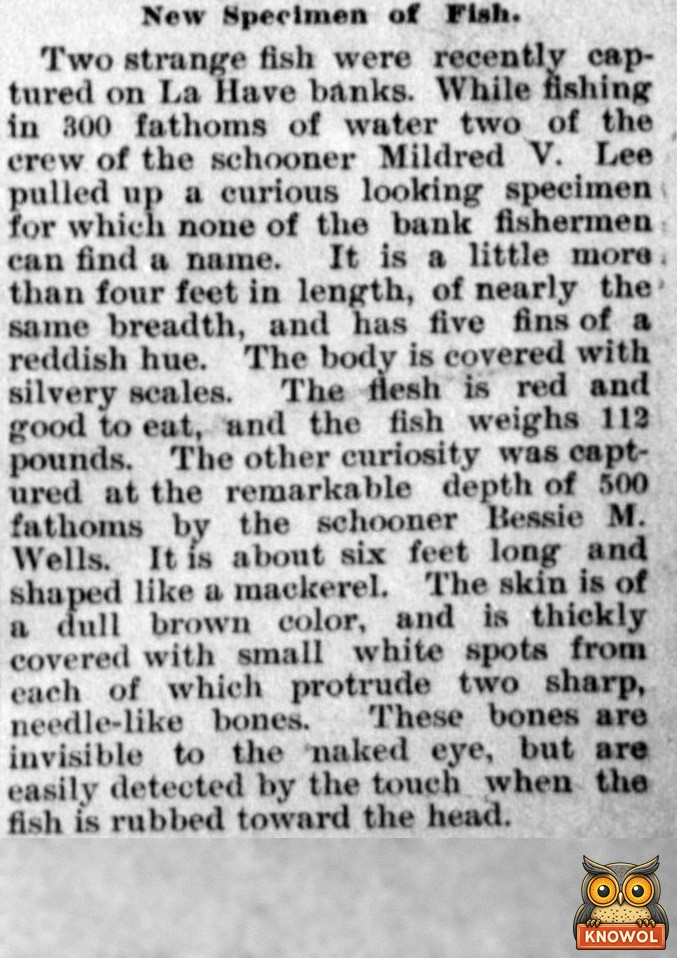
“New Specimen of Fish.” Audubon County Republican, Audubon, Iowa, December 31, 1891, page 1. Library of Congress, Chronicling America. Click the clipping to read it full size.
A third of a mile down
The Mildred V. Lee, the Gloucester schooner, hooked her strange fish south of Nova Scotia, on the La Have fishing grounds. It came up on a halibut trawl, a very long line with many baited hooks laid along the sea bottom. This one lay about 280 fathoms down. A fathom is six feet, so that is 1,680 feet, about a third of a mile.
A second Gloucester schooner, the Bessie M. Wells, went deeper still. Her crew pulled up a different stranger from “the remarkable depth of 500 fathoms,” more than half a mile. This fish was about six feet long, dull brown, and “shaped like a mackerel.” Out of its skin poked sharp, “needle-like bones.” A hand could feel them “when the fish is rubbed toward the head.”
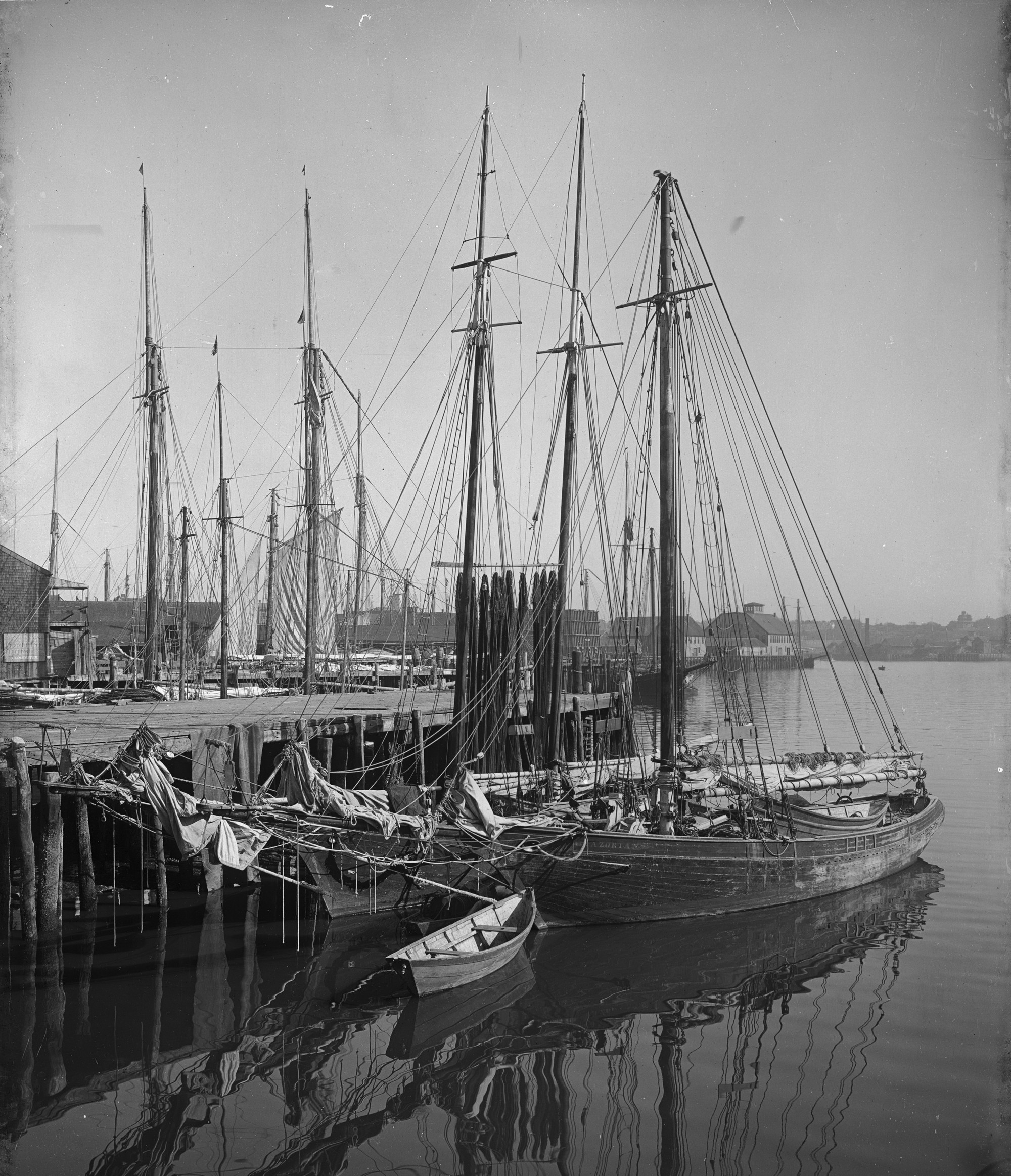
Fishing vessels along the wharves at Gloucester, Massachusetts, in a 1905 photograph, about fourteen years after the strange fish came in. Detroit Publishing Co., Library of Congress. Click the picture to see it full size.
The news reaches Audubon, Iowa
The story of Gloucester’s two strange fish traveled a long way from salt water. On December 31, 1891, it ran on the front page of the Audubon County Republican in Audubon, Iowa, more than a thousand miles from the Gloucester wharves. The headline was “New Specimen of Fish.” The item said that “none of the bank fishermen can find a name” for the red one.
The fish had also grown a little on the trip. In Gloucester it was three and a half feet long. In Iowa it was “a little more than four feet in length.”
By February 5, 1892, the Gloucester Times report had reached Honolulu, Hawaii. The Pacific Commercial Advertiser gave it a headline of its own: “A Sewed Fish.” Readers in Iowa and Hawaii had no way to know it, but by then the mystery was already solved.
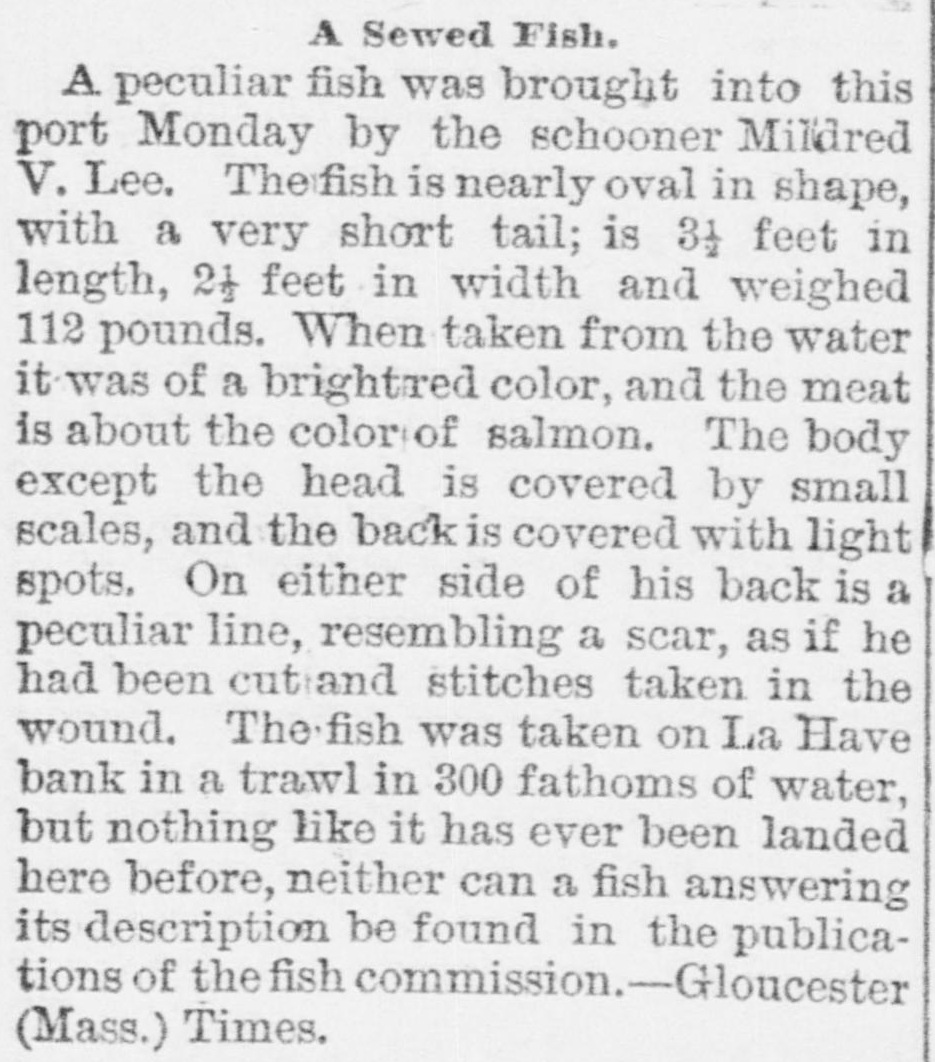
“A Sewed Fish,” from the Gloucester (Mass.) Times. The Pacific Commercial Advertiser, Honolulu, February 5, 1892, page 6. Library of Congress, Chronicling America. Click the clipping to read it full size.
Captain Lee sends the fish to Washington
The red fish from Gloucester was caught by Capt. William T. Lee, and he knew just who should see it. For years, Lee had been one of the crew on a halibut schooner under Capt. J. W. Collins. Collins now worked for the Fish Commission in Washington, D.C. He was getting its exhibit ready for the World’s Columbian Exposition, the world’s fair set for Chicago, Illinois, in 1893. So Lee sent the fish to his old skipper.
On November 5, 1891, the outdoor weekly Forest and Stream told the news: “Two most interesting fishes were received at the exhibit not long ago.” It gave both of them names. The red one was an opah, also called a moonfish. It was “the first specimen ever recorded as having been taken in American waters.” The brown one was an escolar, a cousin of the mackerel known from the Mediterranean Sea.
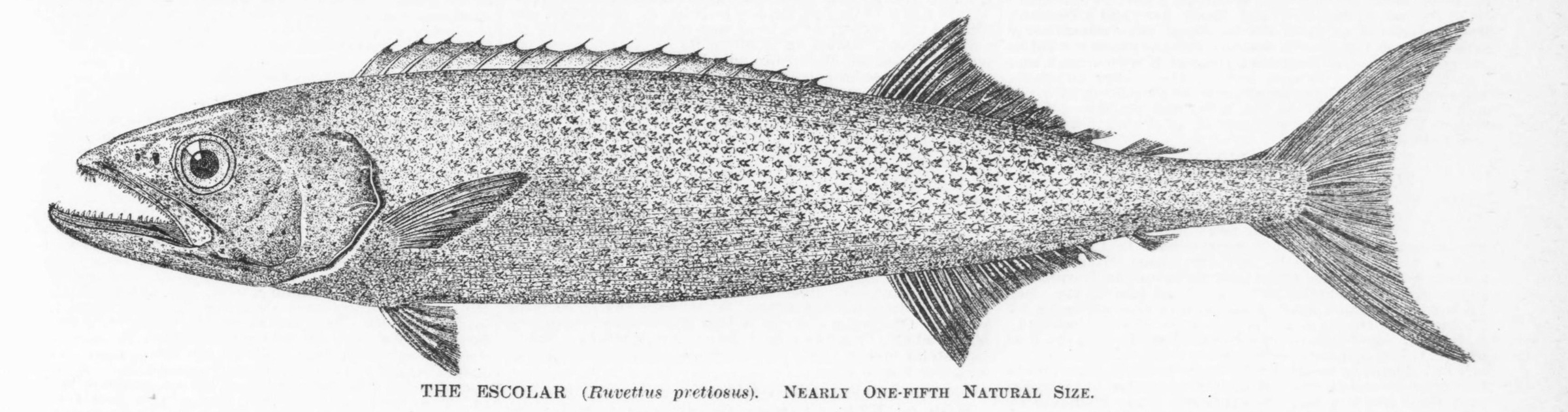
The escolar, the second strange fish, as pictured in Forest and Stream, December 17, 1891, page 431. Internet Archive, public domain. Click the picture to see it full size.
The magazine noticed one more thing about the opah. It had red fins, silvery white sides, and a blue back with white spots. Its “general coloration,” the writer said, “is that of the national emblem.” Gloucester had caught a red, white and blue fish.
So the name was in print eight weeks before Audubon read that nobody could find one. That same Audubon front page had a report headed “Iowa and the Fair,” about Iowa’s own plans for Chicago. No reader could have guessed that the fish with no name was going too.
How a Gloucester fish got to the Chicago fair
A real fish from Gloucester would never keep until 1893, so the Fish Commission showed copies. A man named Sherman F. Denton made a mold of each fish and then a cast from the mold. Casts made of plaster kept breaking on the road. Denton used “a certain glue compound” instead. “The secret of this compound is known only to himself,” Forest and Stream said. By that November about 125 casts were ready.
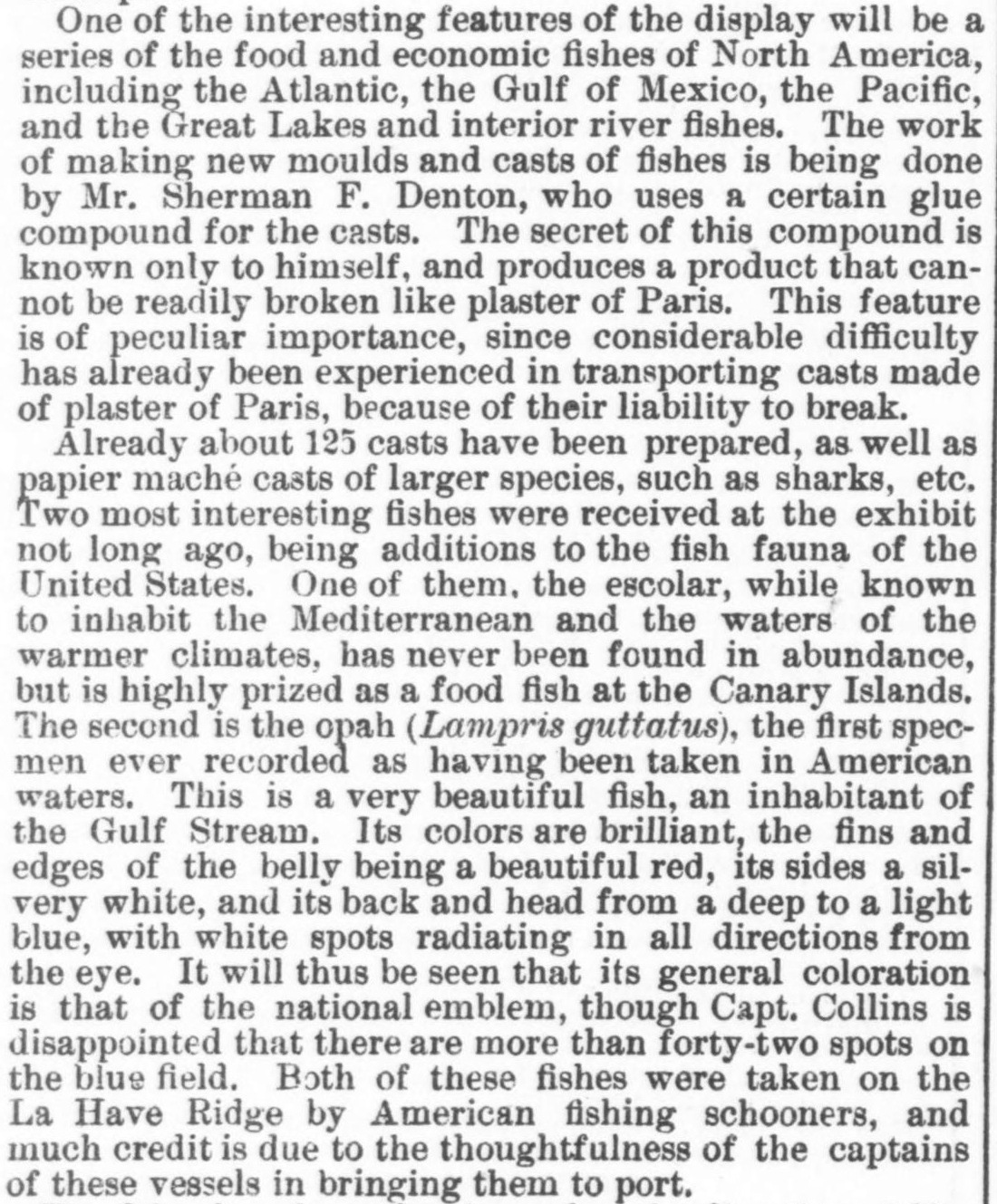
The secret glue, the 125 casts and the “two most interesting fishes.” Forest and Stream, New York, November 5, 1891. Internet Archive, public domain. Click the clipping to read it full size.
The opah got a cast of its own. In 1893 a writer in Forest and Stream called it “a magnificent flexible cast” that was “colored true to nature.” It “looked almost exactly like the living fish,” he wrote, “and it is now in Chicago.”
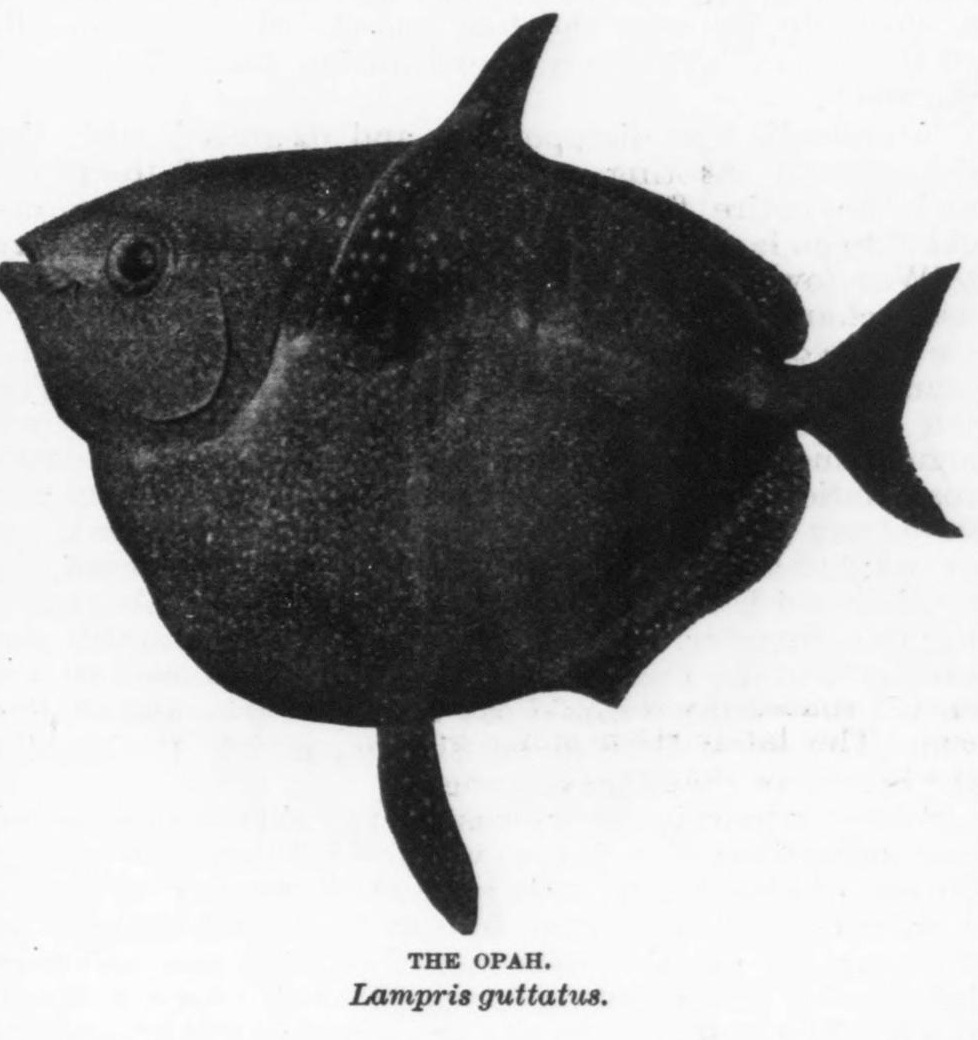
A photograph of the cast made from Captain Lee’s opah, taken before it left Washington for the fair. Forest and Stream, October 7, 1893, page 293. Internet Archive, public domain. Click the picture to see it full size.
Thanks to two captains
The Chicago fair closed in the fall of 1893. Afterward the Fish Commission’s report on its exhibit thanked two fishing captains by name, and Gloucester’s Captain Lee came first:
“Acknowledgments are due to Capt. William T. Lee, of Gloucester, Mass., and Capt. William M. Ellis, for specimens of rare and curious fishes obtained by them on La Have Bank.”
Captain Collins said it more warmly in a letter to Forest and Stream that October. “The ‘aid to science’ which has been given by the New England fishermen is worthy of all praise,” he wrote.
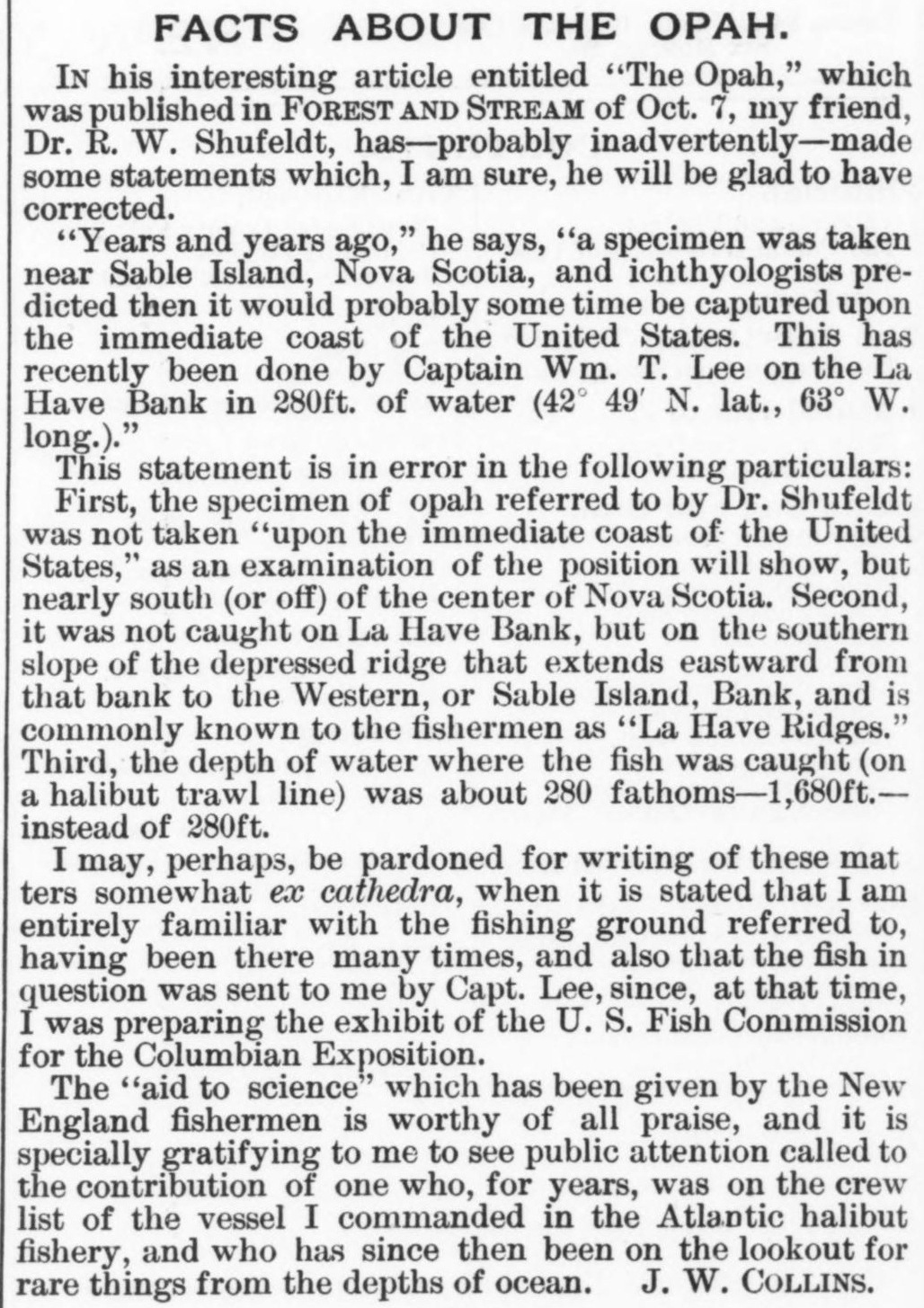
“Facts About the Opah,” Capt. J. W. Collins’s letter. Forest and Stream, New York, October 21, 1893. Internet Archive, public domain. Click the clipping to read it full size.
The opah had one more secret
The red fish that puzzled Gloucester in 1891 kept one more secret for a very long time. In 2015, government scientists at NOAA Fisheries reported that the opah is the first fish known to be fully warm-blooded. It moves warm blood through its whole body, “much like mammals and birds.”
In Honolulu, where readers once puzzled over “A Sewed Fish,” the opah is no stranger now. Hawaii’s fishing boats landed 460,000 pounds of it in 2021.
The fish with no name ended up with a name, a painted twin at the world’s fair, and a line in the government’s books. It got there because one Gloucester fisherman was, as his old skipper put it, “on the lookout for rare things from the depths of ocean.”
Sources
- Audubon County Republican (Audubon, Iowa): December 31, 1891, page 1 (“New Specimen of Fish,” and “Iowa and the Fair” on the same page).
- The Pacific Commercial Advertiser (Honolulu, Hawaii): February 5, 1892, page 6 (“A Sewed Fish,” from the Gloucester Times).
- Forest and Stream (New York): November 5, 1891 (the fish casts and the two fishes), December 17, 1891, pages 430 and 431 (“World’s Fair Fishes,” with the drawings), October 7, 1893, page 293 (“The Opah,” by Dr. R. W. Shufeldt, with the photograph of the cast), and October 21, 1893 (“Facts About the Opah,” by J. W. Collins). All at the Internet Archive.
- Tarleton H. Bean, Report of the Representative of the United States Fish Commission at the World’s Columbian Exposition (Washington, 1896), page 194, at the Internet Archive.
- NOAA Fisheries: Warm Blood Makes Opah an Agile Predator (May 12, 2015) and its opah species page (Hawaii landings for 2021).
- Photo: “Along the wharves, Gloucester, Mass.,” Detroit Publishing Co., 1905, Library of Congress, no known restrictions on publication.
- Newspaper images: Library of Congress, Chronicling America. Published 1891 and 1892. Forest and Stream pictures: published 1891 and 1893, public domain.
- Cover: “Handling a cargo from the fishing banks, Gloucester, Mass.,” Detroit Publishing Co., about 1905, Library of Congress, no known restrictions on publication. It was taken about fourteen years after the strange fish came in.