On September 18, 1878, a traveler from Wheeling, West Virginia, sat down in a hotel high in the Rocky Mountains and wrote a letter home. He was in Silverton, Colorado, a young silver-mining camp. He sent the letter to his hometown paper, the Wheeling Daily Intelligencer, and signed it with three letters: H. C. G.
The paper printed it nine days later. It reads like a note from a friend far away. “Do you wonder where this place is?” he began. Then he told his readers to look on the map, in San Juan County, “the famous San Juan mining country.”
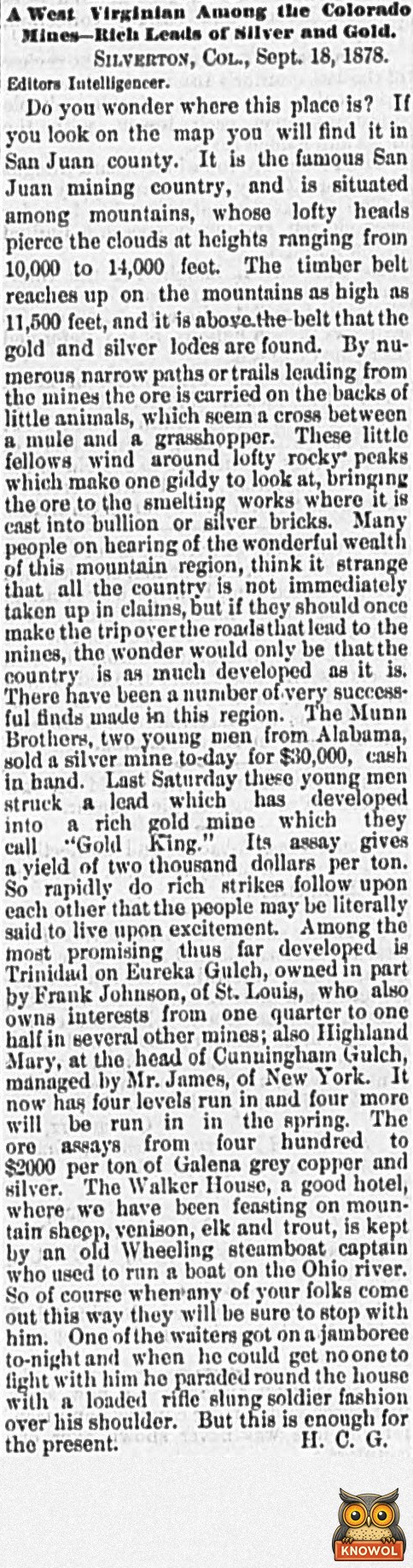
“A West Virginian Among the Colorado Mines.” The whole letter from Silverton, signed H. C. G. Wheeling Daily Intelligencer, Wheeling, West Virginia, September 27, 1878, page 3. Library of Congress, Chronicling America. Click the clipping to read it full size.
Silverton, Colorado, Sat Up Among the Clouds
The mountains around Silverton, H. C. G. wrote, had “lofty heads” that “pierce the clouds at heights ranging from 10,000 to 14,000 feet.” Trees grew up the slopes to about 11,500 feet. Above the trees was bare rock. That was where the treasure hid: “it is above the belt that the gold and silver lodes are found.” A lode is a streak of metal ore running through the rock.
The town itself sat lower, in a flat green valley called Baker’s Park. A Denver and Rio Grande Railroad guidebook from the 1890s put Silverton at 9,224 feet above the sea. That’s about a mile and three-quarters straight up.
Little Animals Carried the Silver Down to Silverton
Getting the ore off the peaks around Silverton was the hard part. Most mines had no roads at all, just “numerous narrow paths or trails.” So the rock rode down “on the backs of little animals, which seem a cross between a mule and a grasshopper.”
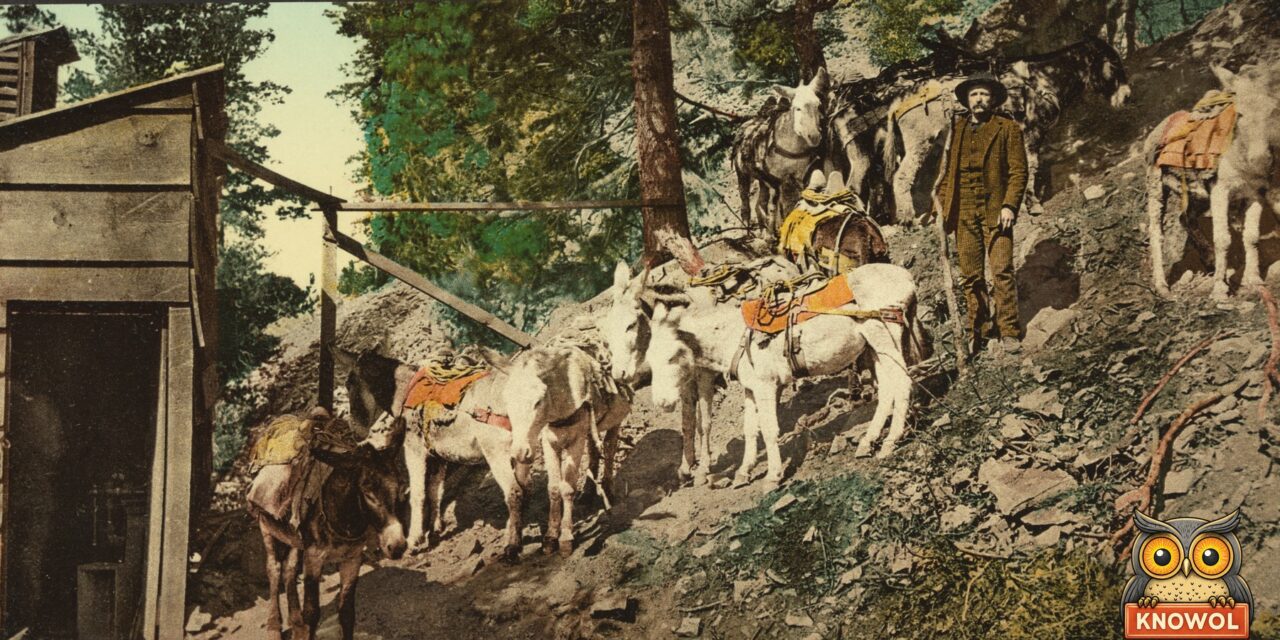
Those little animals were burros, the small donkeys that worked in the Colorado mining camps. You can picture what he meant: long ears like a mule, thin legs like a grasshopper. “These little fellows wind around lofty rocky peaks which make one giddy to look at,” he wrote. Giddy means dizzy. Just watching them made him feel like he might fall.
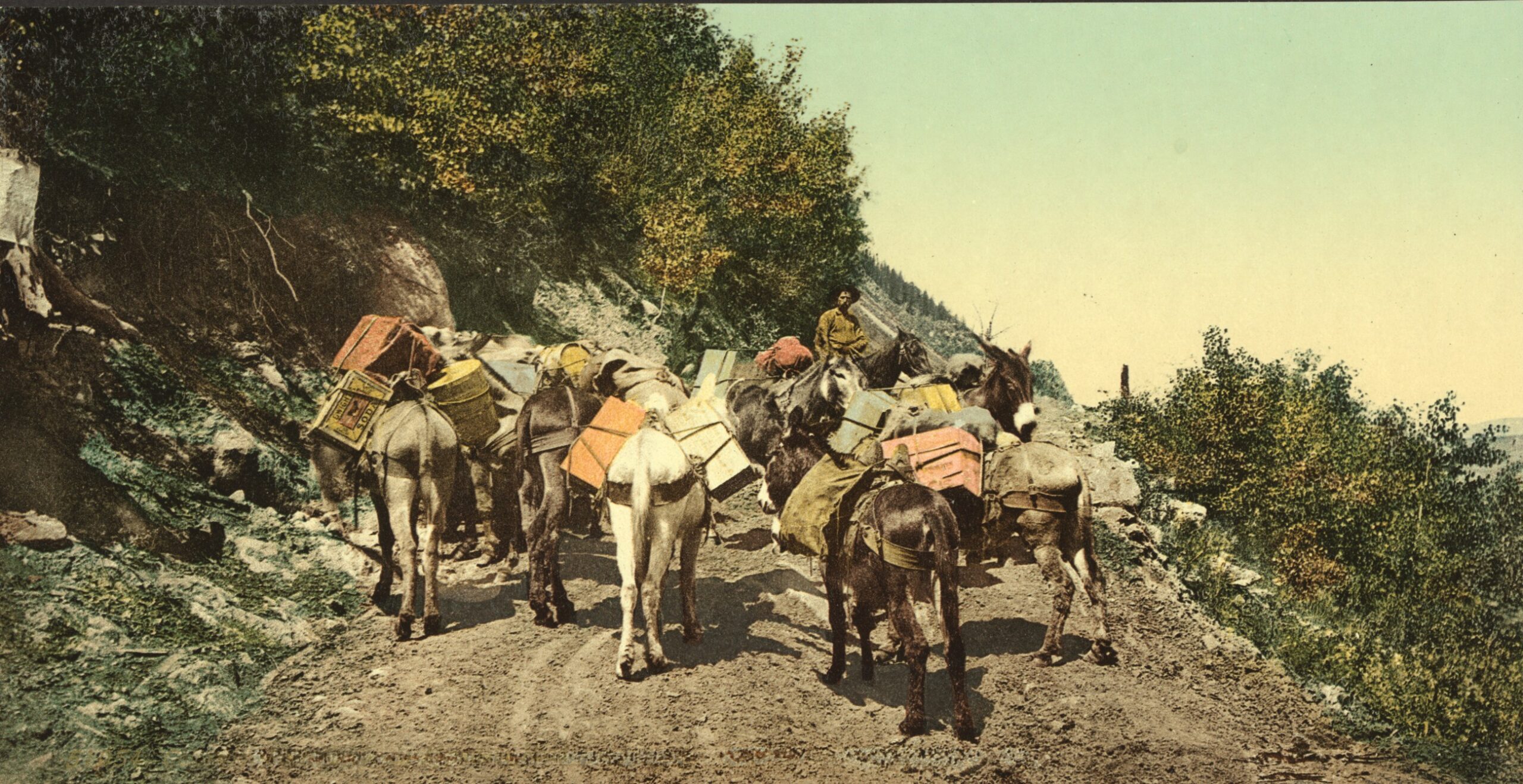
A pack train of burros loaded with boxes and bundles on a narrow mountain road in Colorado. “Colorado. Pack train on mountain road,” a color print by the Detroit Photographic Co., made between 1898 and 1905. It is not Silverton. Library of Congress. Click the picture to see it full size.
The burros carried the ore “to the smelting works where it is cast into bullion or silver bricks.” A smelter is a very hot furnace. It melts the metal out of the crushed rock. The melted silver was poured into molds and cooled into bars, like heavy shiny bricks. That’s what the miners were after.
Two Brothers Struck It Rich Near Silverton
“There have been a number of very successful finds made in this region,” H. C. G. wrote from Silverton. Then he told about the Munn Brothers, “two young men from Alabama.” That very day, they “sold a silver mine to-day for $30,000, cash in hand.”
They weren’t done. The Saturday before, the brothers had “struck a lead.” A lead (say it “leed”) is a streak of ore in the rock that a miner can follow. This one turned into a gold mine, and they named it the “Gold King.” A test of its rock, called an assay, promised “a yield of two thousand dollars per ton.” An assay worked like this: a worker crushed a small piece of the rock and measured how much gold came out of it. Then he figured how much a whole ton would hold.
Big finds came so fast in Silverton that H. C. G. had a way to say it. “So rapidly do rich strikes follow upon each other that the people may be literally said to live upon excitement.” In plain words, people in Silverton almost lived on excitement instead of food. We don’t know what became of the Munn Brothers’ Gold King.
A Wheeling Steamboat Captain Ran a Silverton Hotel
Then H. C. G. got to his Silverton hotel, and the best news for the folks back home. “The Walker House, a good hotel, where we have been feasting on mountain sheep, venison, elk and trout, is kept by an old Wheeling steamboat captain who used to run a boat on the Ohio river.”
Venison is deer meat. Mountain sheep are wild sheep with big curled horns. So the hotel’s table was loaded with wild game and fish. H. C. G. wrote “we,” so he wasn’t traveling alone.
Think about where that captain had been. Wheeling sits right on the Ohio River, and he had steered a steamboat on that big, busy river. Now he was keeping a hotel in a mining camp more than a mile and a half up in the mountains, far from any river a steamboat could use. Silverton history books written many years later name him Captain W. S. Walker. They say he took over the hotel in June 1877, and that’s how it got the name Walker House. We couldn’t find which Ohio River boat he ran.
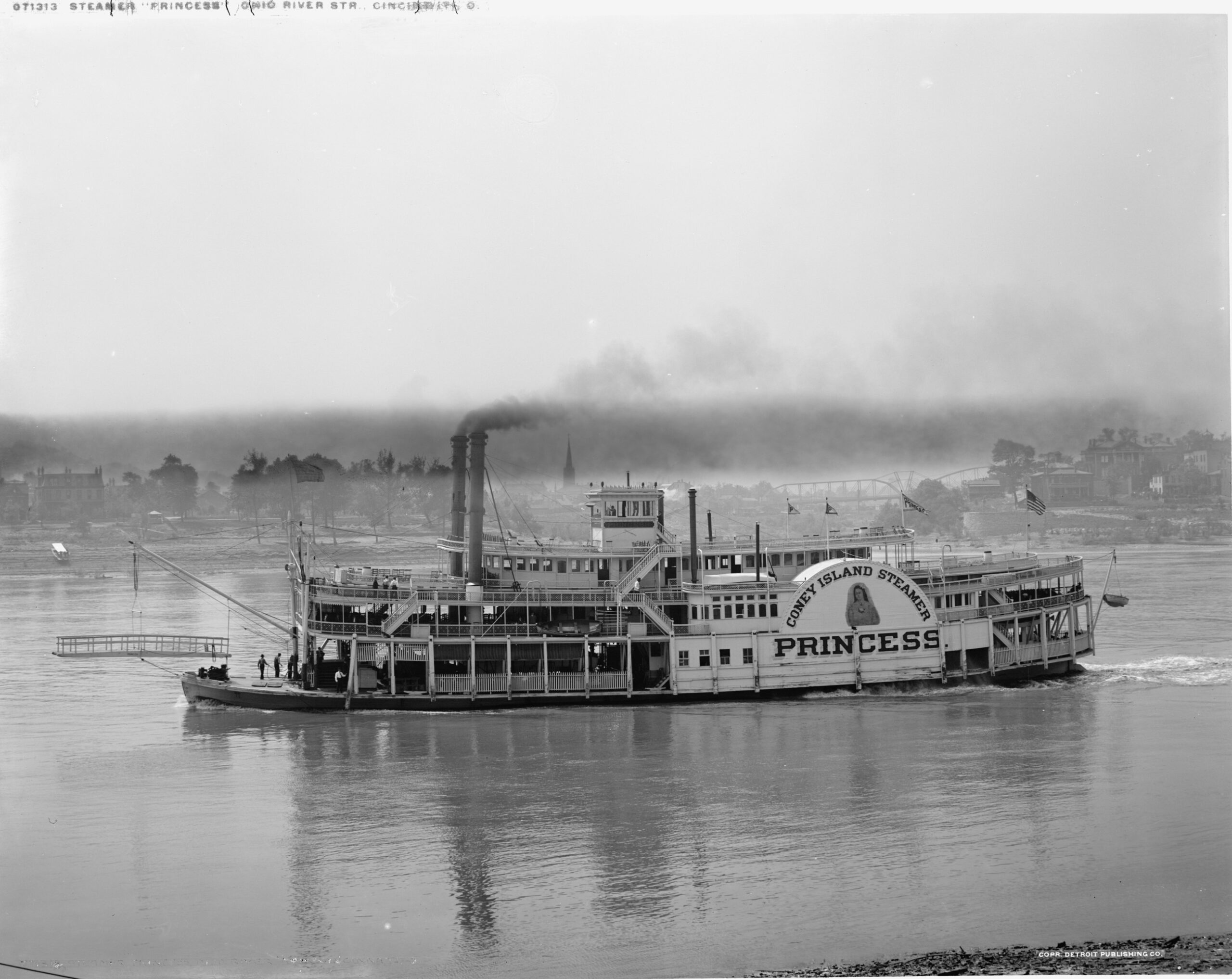
A steamboat on the Ohio River: the excursion steamer Princess at Cincinnati, Ohio, photographed between 1900 and 1910. It is not Captain Walker’s boat. Detroit Publishing Co., Library of Congress. Click the picture to see it full size.
H. C. G. passed along a tip for his readers in Wheeling. “So of course when any of your folks come out this way they will be sure to stop with him.” It was a friend’s tip, 1878 style. If you ever get to Silverton, look up the captain from home. After a bit more news about a rowdy hotel waiter that night, he signed off: “But this is enough for the present.”
Silverton, Colorado, Four Years Later
In the summer of 1882, a writer for the Wheeling Register, another Wheeling daily paper, came through Silverton. By then the railroad had arrived. Silverton, “the beautiful city of Baker’s Park, with its streets as level as a floor,” was now “the terminus of the Denver and Rio Grande railway.” The terminus is the end of the line.
The burros were still on the job. “Here was seen for the first time the renowned pack train,” the 1882 writer said. “Up the principal street came about one hundred donkeys, each with two sacks firmly bound on his back, one on each side.” The sacks held ore from the mines at Ophir, another camp in the mountains nearby.
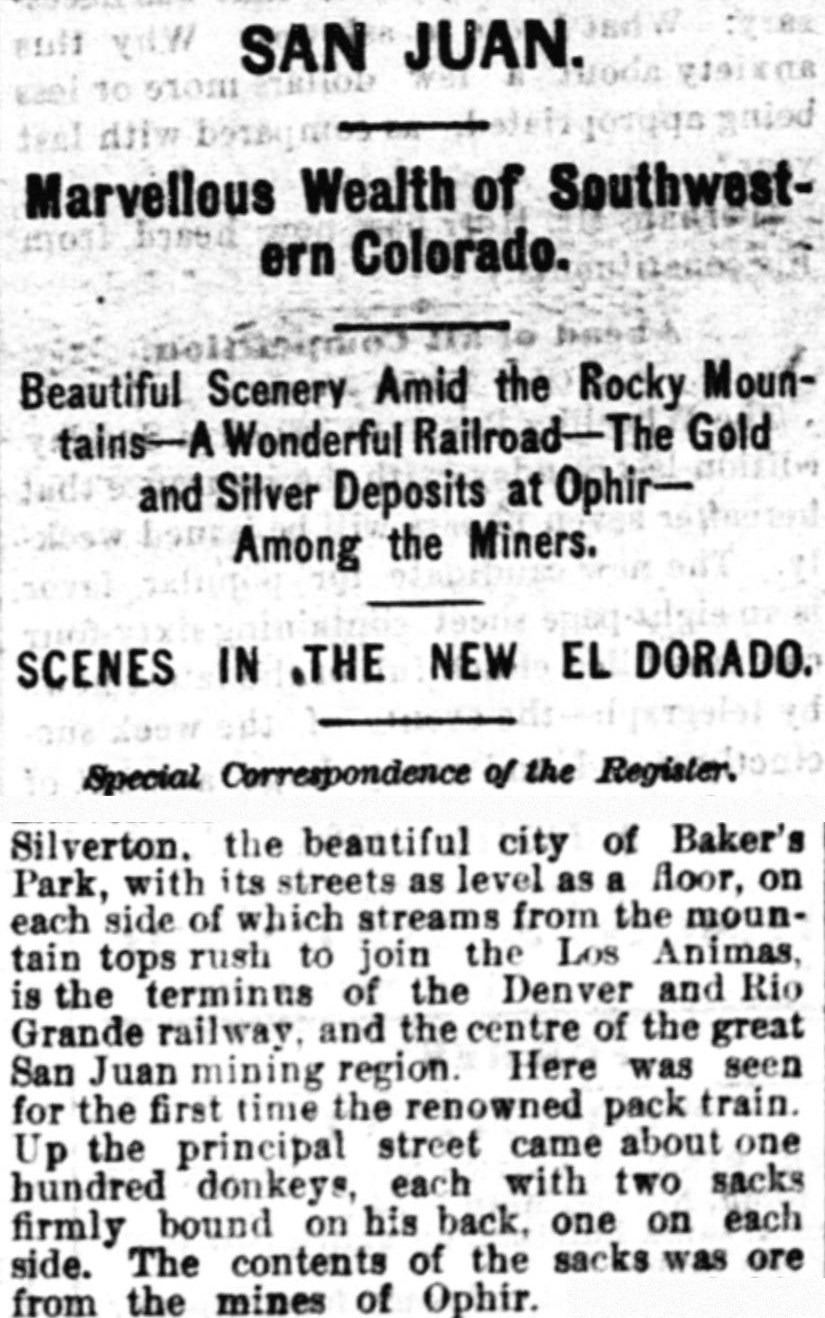
“San Juan. Marvellous Wealth of Southwestern Colorado.” The headline and the Silverton lines of the same letter, joined with nothing changed in either piece. Wheeling Register, Wheeling, West Virginia, August 18, 1882, page 1. Library of Congress, Chronicling America. Click the clipping to read it full size.
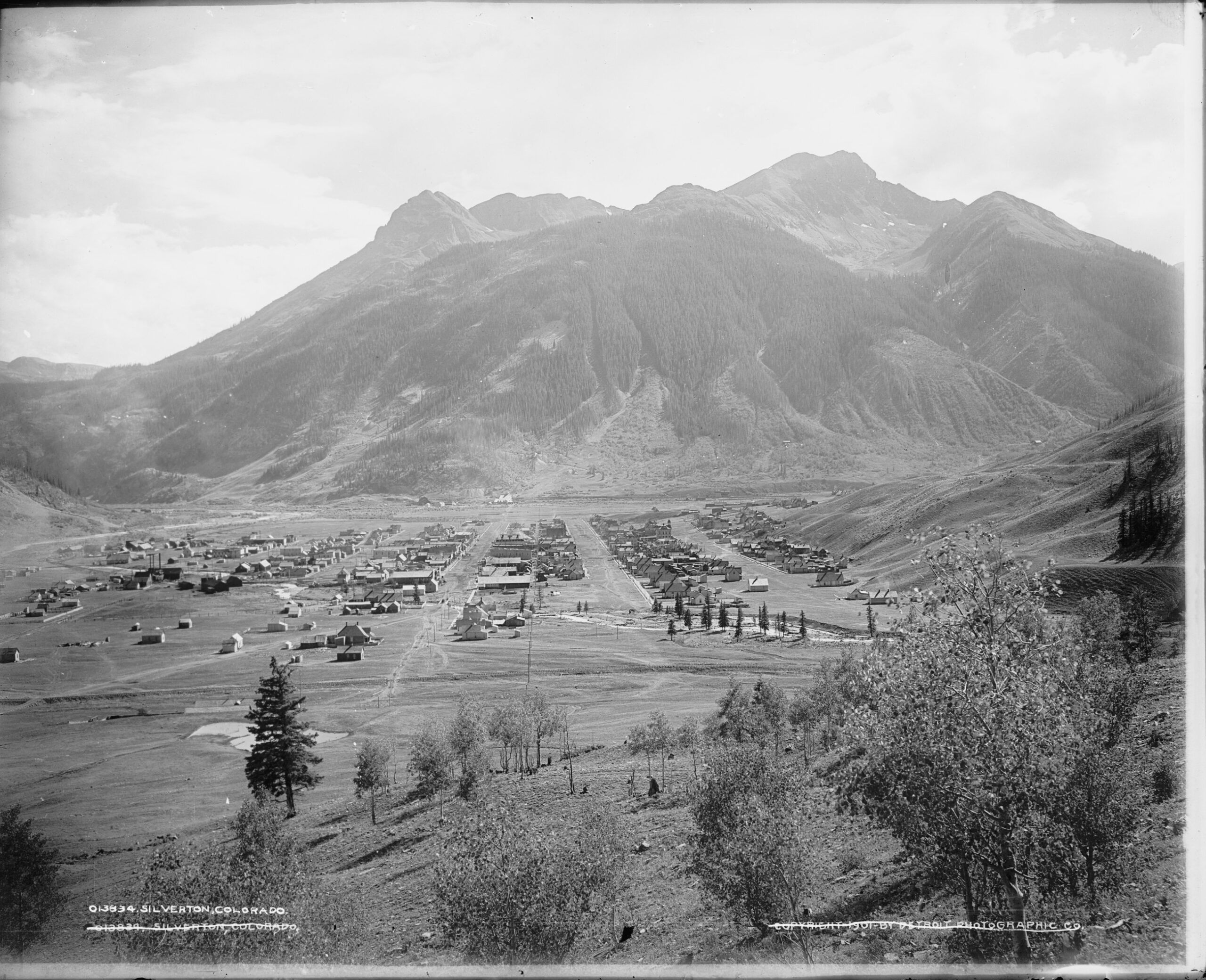
Silverton, Colorado, in its flat valley below the mountains, about 20 years after the letter. Photograph by William Henry Jackson, copyright 1901 by the Detroit Photographic Co. Library of Congress. Click the picture to see it full size.
The Walker House Kept Its Name in Silverton
The captain’s hotel in Silverton lasted, too. A Denver and Rio Grande Railroad guidebook from the 1890s told tourists that Silverton “is well supplied with hotels, at which the traveler will be handsomely entertained.” It named two of them: the Grand Central “and the Walker House.”
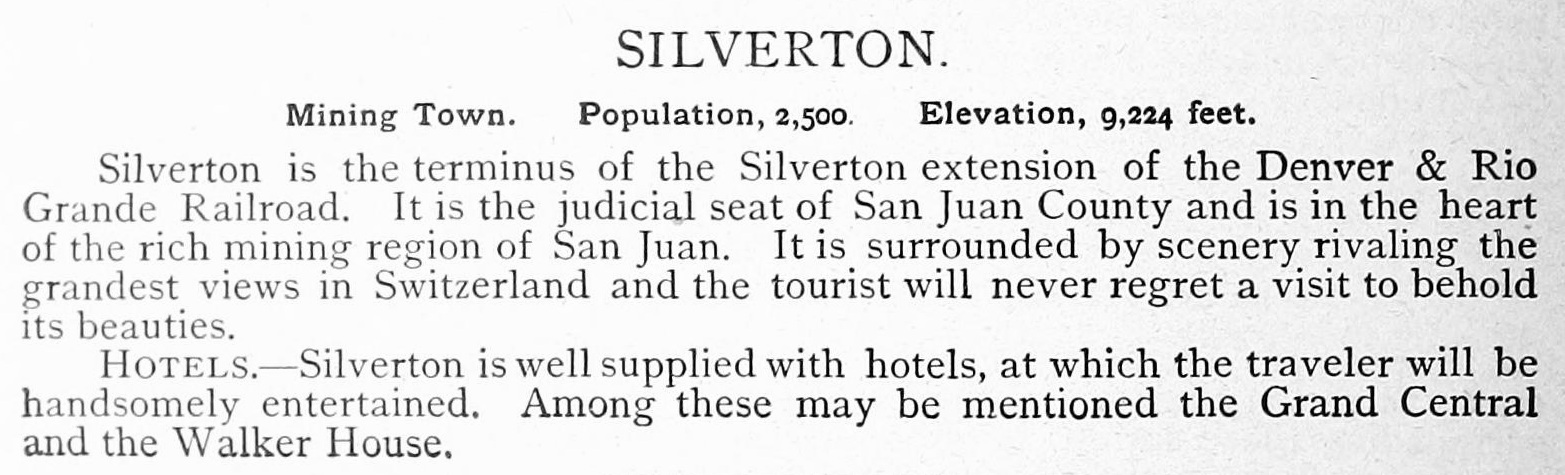
The Silverton page of the Denver and Rio Grande Railroad’s Tourists’ Hand-book (1893), naming the Walker House. Internet Archive, from the State Library of Pennsylvania. Published 1893, public domain. Click the clipping to read it full size.
The picture at the top of this page isn’t Silverton. It’s a color print of burros at a silver mine somewhere in Colorado, made by the Detroit Photographic Co. between 1898 and 1905.
So the Wheeling folks who took H. C. G.’s advice had a place to stay. High in the mountains, beside the burro trails, an old Ohio River man kept a good hotel with a table full of elk and trout. Years later, that hotel still had his name on it.
Sources
- “A West Virginian Among the Colorado Mines. Rich Leads of Silver and Gold,” letter signed H. C. G., Silverton, Col., Sept. 18, 1878, Wheeling Daily Intelligencer (Wheeling, West Virginia), September 27, 1878, page 3. Library of Congress, Chronicling America.
- “San Juan. Marvellous Wealth of Southwestern Colorado,” special correspondence from Ophir, Col., August 13, Wheeling Register (Wheeling, West Virginia), August 18, 1882, page 1. Library of Congress, Chronicling America.
- Tourists’ Hand-book Descriptive of Colorado, New Mexico and Utah (Denver and Rio Grande Railroad, 1893), Silverton. Internet Archive, from the State Library of Pennsylvania.
- Allan G. Bird, Silverton Then and Now (1999). Internet Archive. For the captain’s name and when he took over the hotel; facts only, in our own words.
- Colorado. Burros at silver mine, color print, Detroit Photographic Co., between 1898 and 1905 (the cover). Library of Congress Prints and Photographs Division, Photochrom Print Collection. No known restrictions on publication.
- Colorado. Pack train on mountain road, color print, Detroit Photographic Co., between 1898 and 1905. Library of Congress Prints and Photographs Division, Photochrom Print Collection. No known restrictions on publication.
- Silverton, Colorado, photograph by William Henry Jackson, copyright 1901. Library of Congress Prints and Photographs Division, Detroit Publishing Company Collection. No known restrictions on publication.
- Steamer Princess, Ohio River str., Cincinnati, O., Detroit Publishing Co., between 1900 and 1910. Library of Congress Prints and Photographs Division, Detroit Publishing Company Collection. No known restrictions on publication.
- The newspapers, guidebook and pictures above were published before 1931 and are in the public domain. The 1999 Silverton history is used for facts only.