On a warm Monday afternoon, August 14, 1922, a laundry horse stood eating lunch on West 127th Street in Harlem, in New York City, New York. The laundry that owned him was right there at No. 316, and his wagon was hitched behind him. Over his nose hung a nose bag, a feed bag that lets a horse eat standing in the street. While he ate, the bit was out of his mouth. The bit is the metal bar the reins pull on, so it works like a horse’s steering wheel and brakes.
Then came a sound he didn’t like. The New York Times told it in two short sentences the next morning: “He had just finished his noon oats and the bit was out of his mouth when a siren on an automobile startled him. He shook off the nose bag and bolted.”
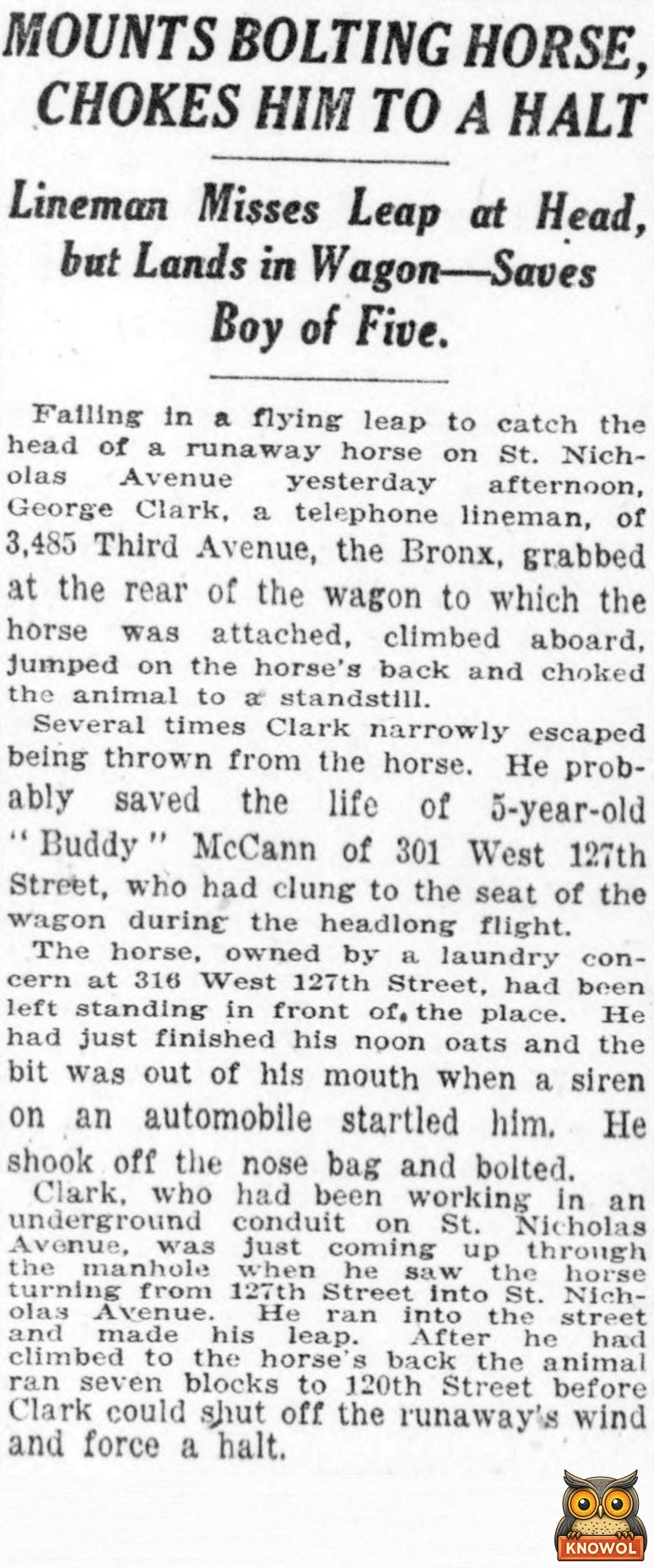
“Mounts Bolting Horse, Chokes Him to a Halt,” the whole story as The New York Times printed it on page 36, Tuesday, August 15, 1922. Internet Archive, public domain. Click the clipping to read it full size.
A Runaway With a Boy on the Seat in Harlem
The runaway horse in Harlem was not pulling an empty wagon. Up on the wagon seat was 5-year-old “Buddy” McCann, who lived on the same block, at 301 West 127th Street. The paper doesn’t say why he was up there. It only says he “had clung to the seat of the wagon during the headlong flight.”
The horse swung around the corner from 127th Street onto St. Nicholas Avenue and kept going. With the bit out of his mouth, the reins were no use.
A Telephone Man Comes Up Out of St. Nicholas Avenue
George Clark was a telephone lineman, a repairman for phone lines, from 3,485 Third Avenue in the Bronx. That afternoon he had been working under St. Nicholas Avenue in an “underground conduit,” the pipes beneath the street that carry telephone wires. The way in and out was a manhole.
Clark “was just coming up through the manhole when he saw the horse turning from 127th Street into St. Nicholas Avenue.” He ran into the street and jumped for the horse’s head, the usual way to grab a runaway. He missed.
So Clark tried something harder. He grabbed the back end of the wagon as it went by, “climbed aboard,” and then jumped from the wagon onto the horse’s back. Now a telephone man was riding a runaway laundry horse bareback down St. Nicholas Avenue, with a little boy hanging on to the seat behind him.
Seven Blocks Bareback, Then a Stop at 120th Street
George Clark’s ride down St. Nicholas Avenue was rough. “Several times Clark narrowly escaped being thrown from the horse,” the Times said. The horse ran seven blocks, from 127th Street down to 120th Street.
The reins were no help, so Clark went after the horse’s wind, which means his breath. The paper says he “choked the animal to a standstill.” He cut off the horse’s air until it could not keep running, and at 120th Street the runaway finally stopped.
The Times gave Clark the credit in one line: “He probably saved the life of 5-year-old ‘Buddy’ McCann.” The headline said it shorter: “Saves Boy of Five.”
Horses and Cars on the Same Streets of New York City
In 1922, horses and cars still shared the streets of New York City, and they didn’t always get along. The Police Department’s report for 1921 counted 355,471 automobiles registered in the New York area. On top of that, it said, there were “some 75,000 horse-drawn vehicles.” That is close to one horse-drawn wagon for every five cars.
The police wanted the horses gone. In his letter at the front of the report, Police Commissioner Richard E. Enright wrote that “the horse, for illustration, must soon be forbidden in the streets,” because one wagon on a crowded street could hold up dozens of cars. Further on, in a part about traffic, the report said it even more plainly. It said the horse “has begun to impede it,” meaning he gets in the way of traffic, “and he must go.”
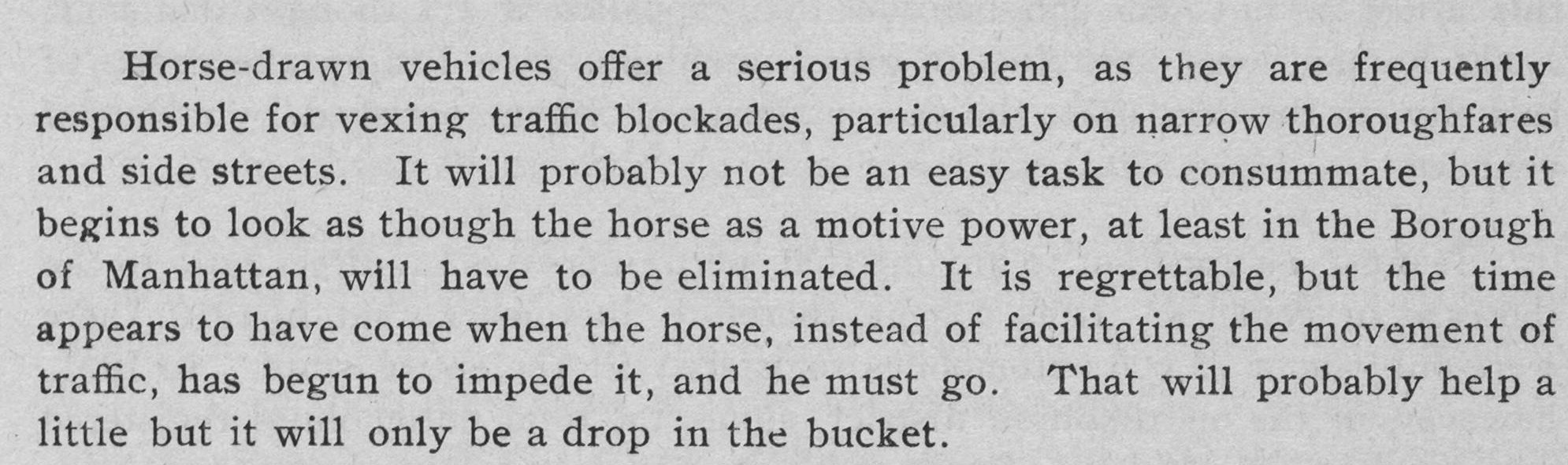
“He must go”: the New York Police Department’s annual report for 1921 on horse-drawn wagons in Manhattan traffic. Annual Report of the Police Department, City of New York, 1921, Internet Archive (Columbia University Libraries copy), public domain. Click the clipping to read it full size.
Runaways were part of that mix. The same report lists police officers who stopped them. On September 13, 1920, Patrolman Arthur J. O’Connell stopped a runaway horse pulling a delivery wagon at 68th Street and Amsterdam Avenue. “Children had just come out of school,” the report says, and they were spared. The report’s medical pages even listed “riding on wagons and stopping runaway horses” among the reasons officers got hurt on duty that year.

Patrolman Arthur J. O’Connell’s runaway horse at 68th Street and Amsterdam Avenue, September 13, 1920, from the Police Department’s annual report for 1921. Internet Archive (Columbia University Libraries copy), public domain. Click the clipping to read it full size.
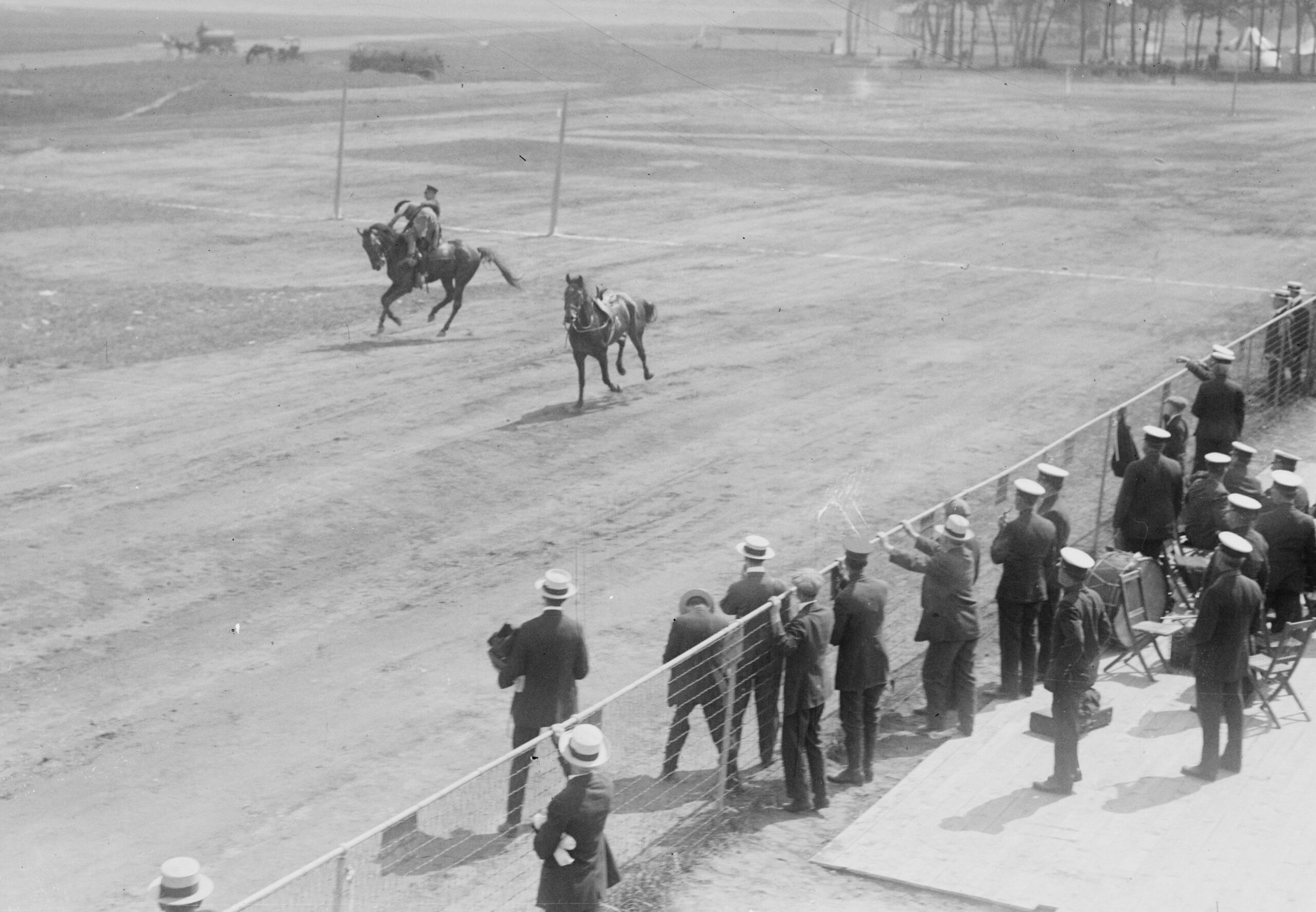
Showing how it’s done: a police show act that Bain News Service titled “Rescuing woman from runaway horse,” between about 1915 and 1920. Place not named. Bain News Service, Library of Congress. Click the picture to see it full size.
George Clark wasn’t a police officer. He was a working man who happened to come up out of the street at the right second. The horse was the old way of getting around, scared by a siren on the new way, and stopped by a man who fixed the wires that carried people’s voices under the city.
What New York Looked Like That Day
The laundry horse in Harlem was one of thousands of work horses still pulling wagons through New York City in the early 1920s. The photo below shows the same kind of city work horse, a delivery horse and wagon in New York’s Work Horse Parade of 1908. It is not the laundry horse.
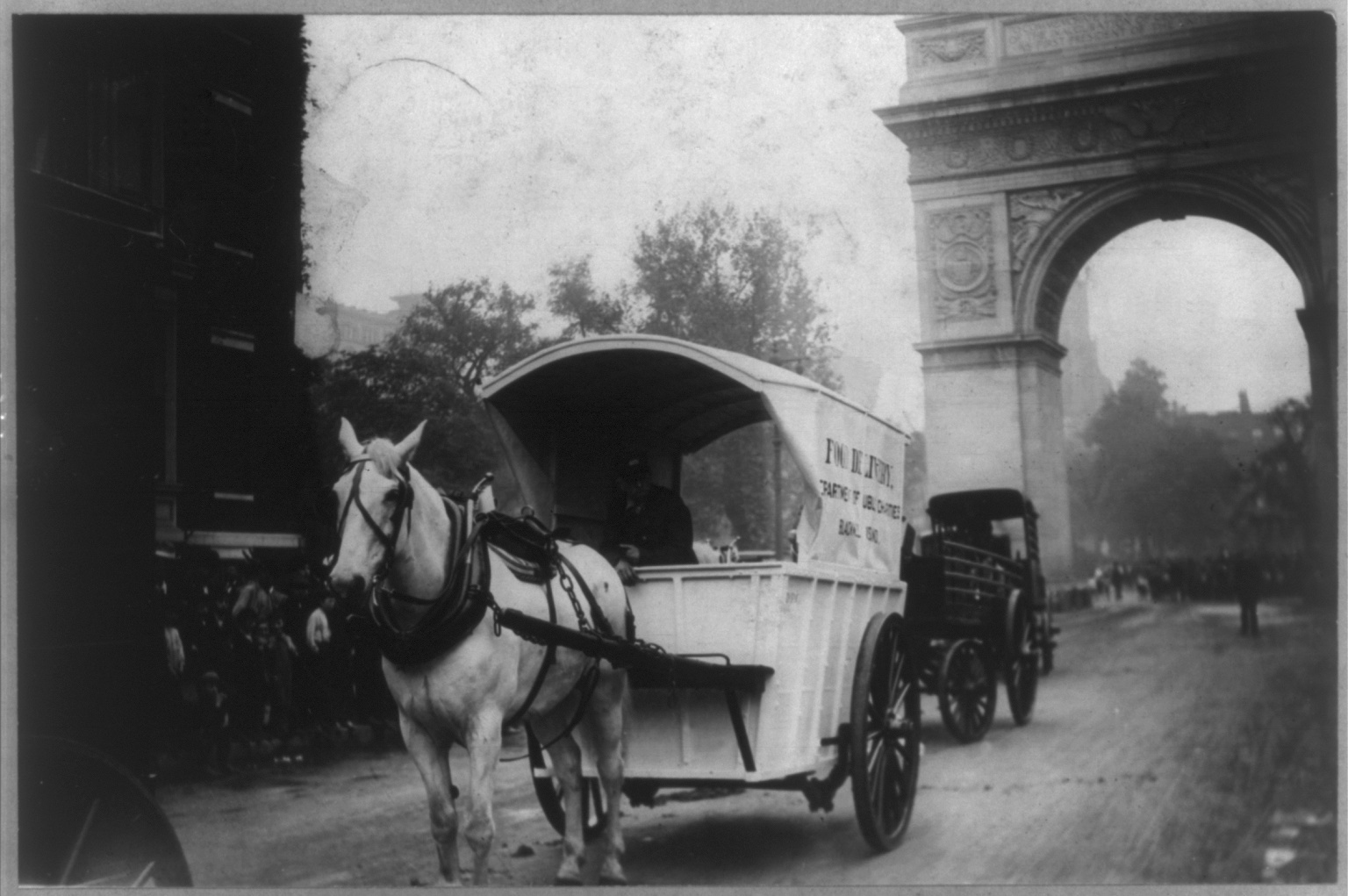
A delivery horse and wagon in New York City’s Work Horse Parade, May 1908. Not the laundry horse in this story, but the same kind of city work horse. Bain News Service, Library of Congress. Click the picture to see it full size.
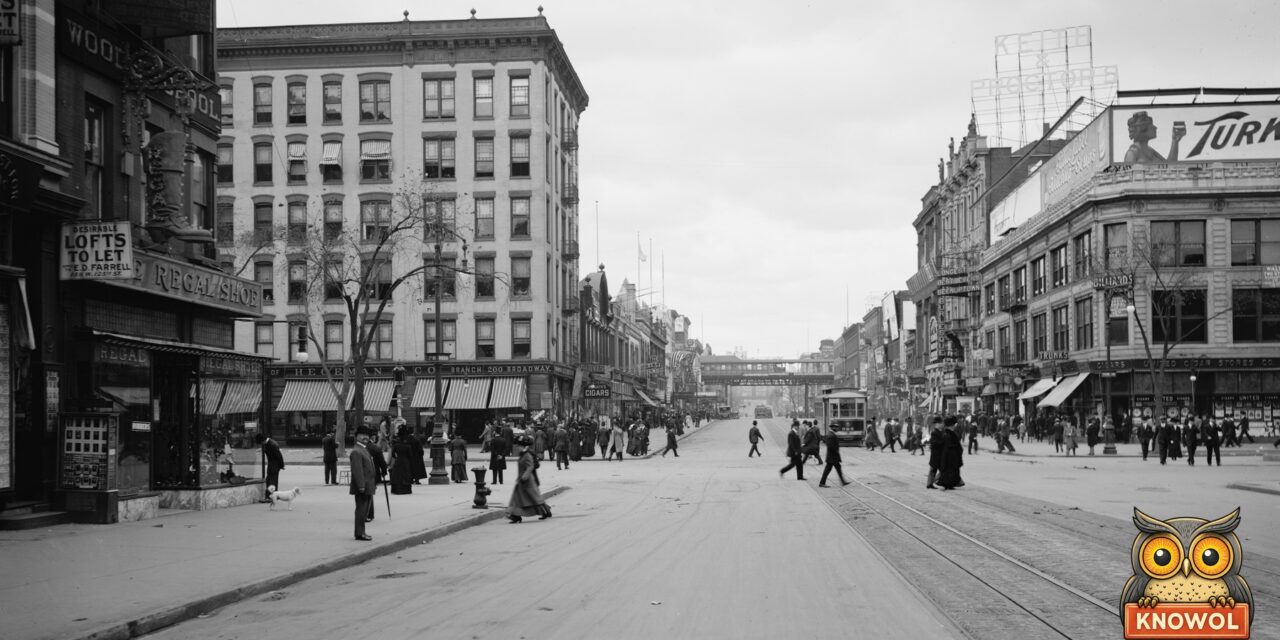
The picture at the top of this story shows 125th Street in Harlem in the 1910s, a few blocks from the laundry. On its run down St. Nicholas Avenue, the horse crossed 125th Street. A few everyday numbers from that day: the high in New York City on Monday, August 14, was 82 degrees. The next morning’s New York Times cost two cents in Greater New York. And the rescue story didn’t make the front page. It ran on page 36, next to the business ads.
Where We Found the Harlem Runaway
We found George Clark’s ride through Harlem in only one paper, The New York Times of August 15, 1922. We went through every page of three other New York papers, the New-York Tribune and the New York Herald of August 15 and The Evening World of August 14, and none of them had it. We don’t know what became of George Clark or Buddy McCann. But on one warm afternoon on St. Nicholas Avenue, a man came up out of a manhole, missed a flying leap, and tried again, and the Times could print four happy words: “Saves Boy of Five.”
Sources
- “Mounts Bolting Horse, Chokes Him to a Halt,” The New York Times, New York, New York, August 15, 1922, page 36: Internet Archive page scan. The weather box and price are on the front page.
- Annual Report of the Police Department, City of New York, for the year 1921, Richard E. Enright, Police Commissioner (Columbia University Libraries copy on Internet Archive): the commissioner’s letter, page 11; horse-drawn vehicles in traffic, “he must go”; vehicle counts, 355,471 automobiles and some 75,000 horse-drawn vehicles; a note in the medical pages on stopping runaway horses; Patrolman O’Connell’s runaway at 68th Street.
- Photo: “Work Horse parade, New York City: horse and delivery wagon,” May 1908, Bain News Service, Library of Congress. No known restrictions on publication.
- Photo: “Police Show: Rescuing woman from runaway horse,” between about 1915 and 1920, Bain News Service, Library of Congress. No known restrictions on publication.
- Cover photo: “125th St., west from 7th [Seventh Avenue], New York, N.Y.,” Detroit Publishing Co., between 1910 and 1920, Library of Congress. No known restrictions on publication.
- Newspaper pages printed before 1931 are in the public domain.