In the first days of December 1877, the men of one neighborhood in Brooklyn, New York, suddenly started looking sharp. This was Williamsburg, the Fourteenth Ward of Brooklyn, and hardly anybody there walked around with a scruffy chin anymore. Boys with barely any whiskers had smooth faces, and so did grown men, with their hair neatly trimmed besides.
A reporter from the New York Dispatch, a Sunday paper, went to find out why, and people sent him to a house on North Fifth Street, near Fifth Street. In the window he saw two signs. One said “SHAVING BY LOUISA, 10 CENTS.” The other said “SHAVING BY LOUIS, 5 CENTS.” That was the whole mystery: Williamsburg had a lady barber.
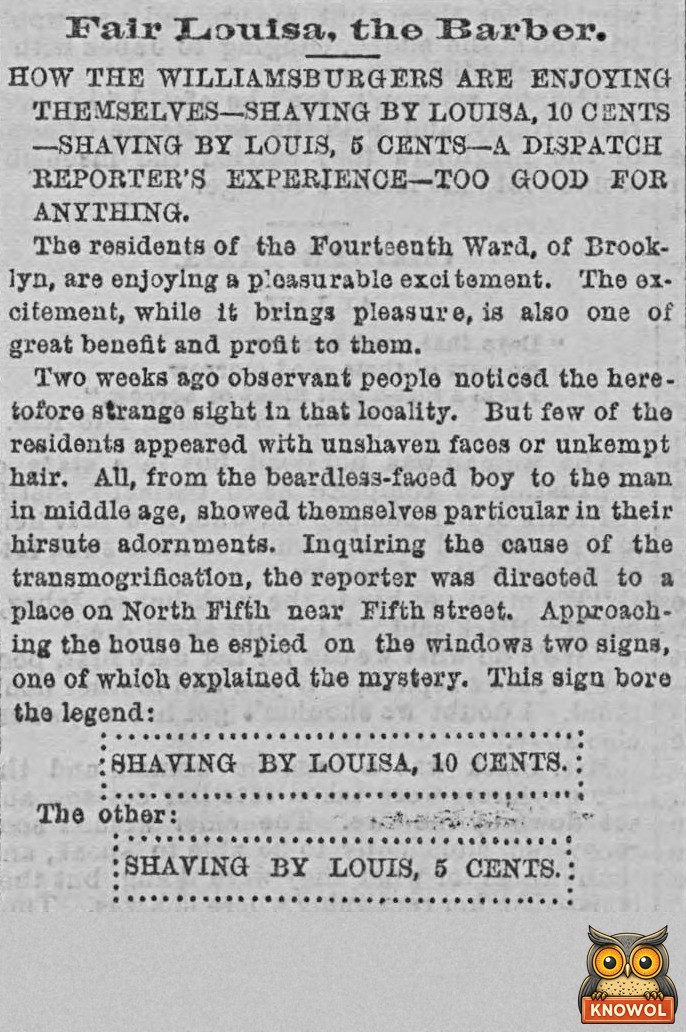
“Fair Louisa, the Barber,” the top of the story in the New York Dispatch, New York, New York, Sunday, December 16, 1877, page 5. Library of Congress, Chronicling America. Click the clipping to read it full size.
Louis Was the New Barber in Williamsburg, Brooklyn
Inside the Williamsburg shop, the Dispatch reporter “found the shop full.” A young woman with light yellow hair was busy at one chair. The paper called her a “daughter of the Rhine,” which was its way of saying she was German. At the other chair stood Louis, “a tall, good-looking young Frenchman,” and nobody was sitting in his chair.
Louis told the reporter how it all started. “I was new here,” he said, and another barber nearby already had all the customers. So Louis decided, “I better get up something new.”
His something new was Louisa. He taught her to shave, and there was only one face handy to practice on. “She learned on me,” Louis said. Think about that for a minute. A barber’s razor is a bare blade as sharp as a knife, and Louis let a beginner practice on his own face until she could do it right. Then he hung up the signs, and “the place fills right up,” he said. “I wish I had a couple of Louisas.”
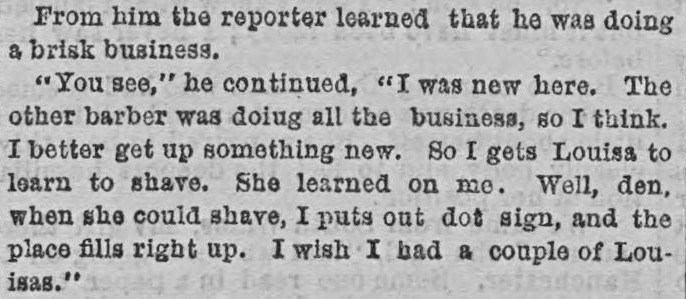
Louis tells the reporter how Louisa learned to shave. New York Dispatch, December 16, 1877, page 5. Library of Congress, Chronicling America. Click the clipping to read it full size.
Why the Dime Beat the Nickel
Look again at the two signs in the Williamsburg window. Louis didn’t make Louisa the cheap barber to pull people in. He made her cost twice as much: a shave from Louis was a nickel, and a shave from Louisa was a dime. You might guess the men would pick the cheaper chair, but they didn’t. When the reporter walked in, Louisa had a customer in her chair and Louis was leaning on an empty one.
It sounds backward, but it worked. Any barber in town could give a man a five-cent shave, but only one shop in Williamsburg had Louisa, and her price said so.
A shave in those days took a few simple tools. The customer leaned back in the chair with a towel tucked around him. The barber whipped up lather in a mug with a round brush, spread it over his cheeks and chin, and then went to work with an open razor, a blade that folded into its handle like a pocketknife.
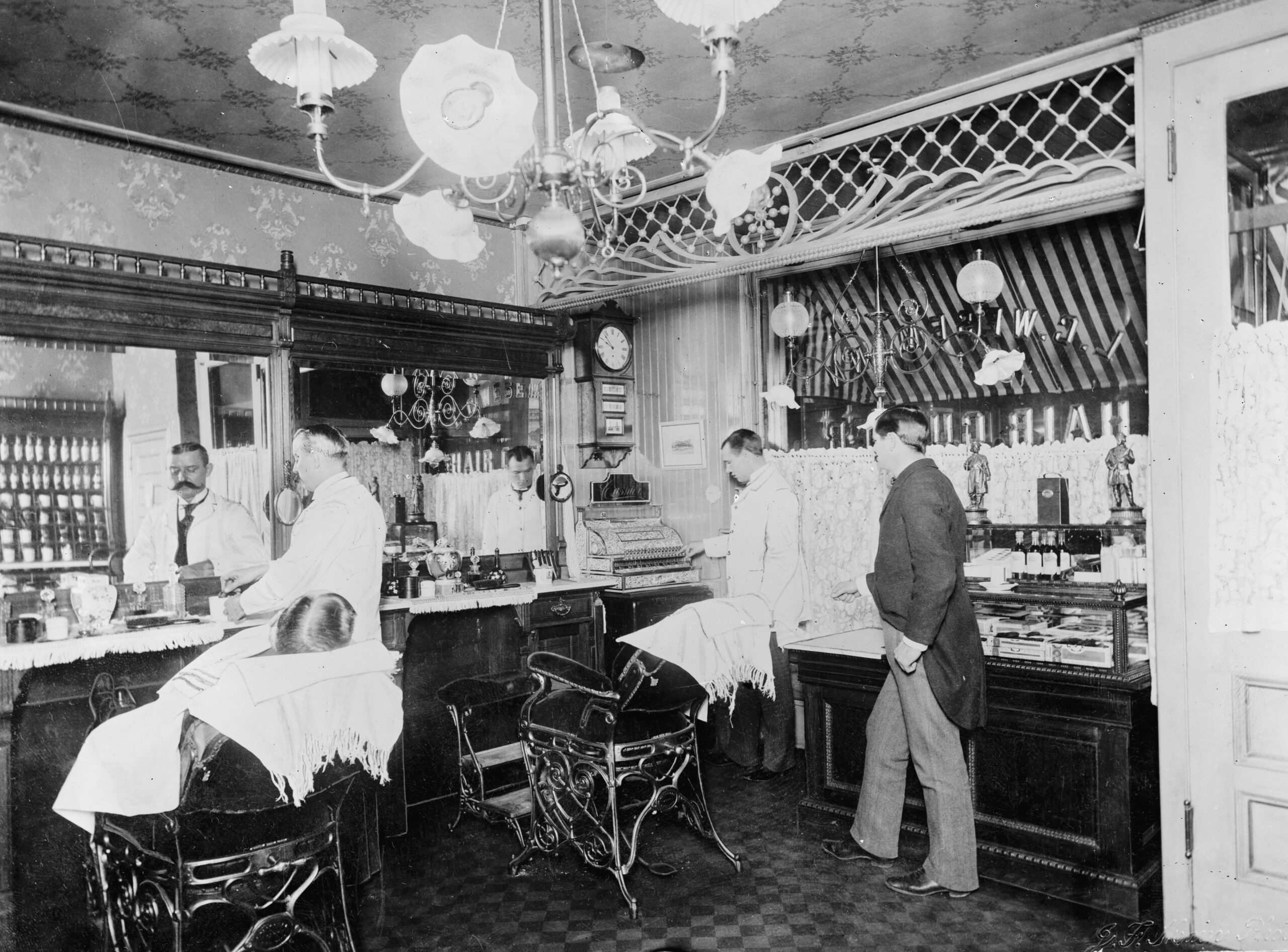
A New York City barber shop some years later: L. C. Wiseman’s shop, with barbers in white coats, customers under fringed towels, a cash register and a tall barber chair. Not Louis and Louisa’s shop. Detroit Publishing Co., between 1895 and 1910, Library of Congress. Click the picture to see it full size.
The Dispatch Reporter Tried Louisa’s Chair
The New York Dispatch reporter didn’t just stand in the Williamsburg shop asking questions. He sat down in Louisa’s chair, and he wrote that he sank “delighted” under her “gentle and delicate touch” and stopped listening to Louis altogether. He didn’t get up until his face was “so close shaven that the slightest draft now gives him the face ache.” His hair came out cut so short “that his hat is too big for him and he’s got a cold.”
He was joking, of course, but under the joke he was telling his readers one plain thing: Louisa knew how to use a razor.
The old barber down the street wasn’t giving up. The Dispatch heard he had a plan to win his customers back: he would give each one “a pint of beer.” The paper didn’t think much of his chances. “This may draw off the old men,” it said, “but it will not take the custom of the younger ones.” In 1877, a barber’s custom meant his regular business.
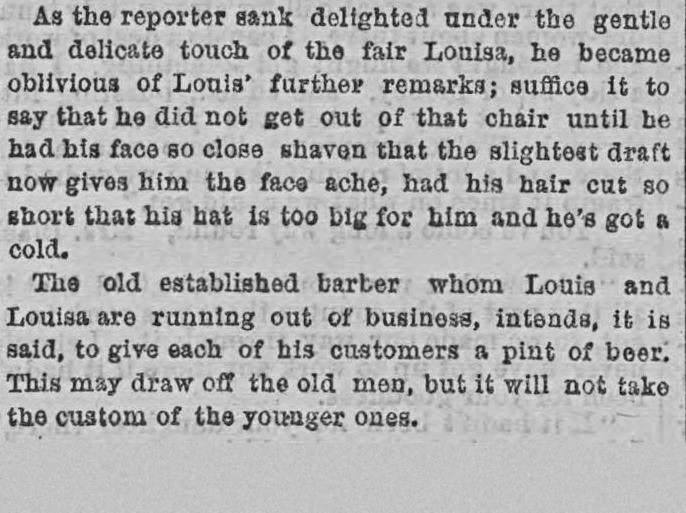
The end of the story: the reporter’s close shave and the old barber’s pint of beer. New York Dispatch, December 16, 1877, page 5. Library of Congress, Chronicling America. Click the clipping to read it full size.
What It Cost in Williamsburg, Brooklyn, in 1877
- A shave from Louis: 5 cents.
- A shave from Louisa: 10 cents, twice as much.
- The old barber’s answer: a free pint of beer for each customer, if the rumor was true.
- The reporter’s bill, by his own account: a face ache, a cold and a hat that no longer fit.
Lady Barbers Were Big News in the 1870s
Louisa of Williamsburg, Brooklyn, wasn’t the only woman with a razor in those years, but lady barbers were rare enough to make the news. In March 1876, the Cincinnati Daily Star printed this little item: “Grand Rapids has a female barber. Let us soap for her success.” (Soap, not hope.) In August 1877, a few months before Louisa, the New York Herald told its readers, “Boston has a pretty female barber.”
By the spring of 1878, the Boston lady barber had become a story that papers passed from town to town. The Worcester Daily Press in Massachusetts said her chair stood close to the shop window. Crowds of Bostonians walking home to supper would “linger away from their cold beans in order that they may pause before this window” and watch her work. The cold beans were a joke about Boston, a city known for its baked beans.
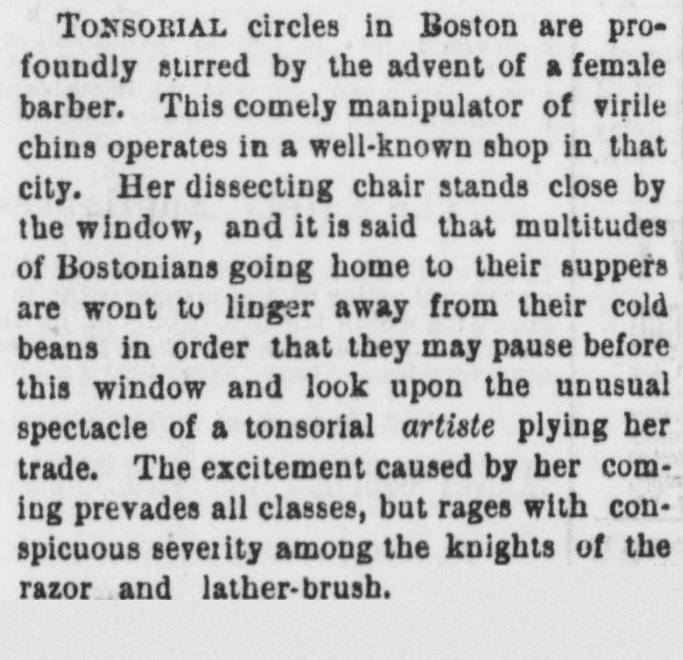
The start of the Boston story, Worcester Daily Press, Worcester, Massachusetts, March 28, 1878, page 2. Library of Congress, Chronicling America. Click the clipping to read it full size.
Not everybody in Boston was pleased. The city’s men barbers, the paper said, all agreed that “the innovation will be short-lived.” In other words, they figured lady barbers were a fad that would soon blow over. In the same story, the paper reported that the newcomer was “doing a lucrative business,” which means she was making good money.
Williamsburg, Brooklyn, in Louisa’s Day
In 1877, Brooklyn was a big city of its own, across the East River from New York City. Williamsburg had once been a separate city too, until it joined Brooklyn in 1855 and became Brooklyn’s “Eastern District,” or “E.D.” for short.
Two years after Louisa’s signs went up, the printmakers Currier & Ives sold a big bird’s-eye picture of the whole city of Brooklyn. Williamsburg is the crowded corner along the river at the upper left, with the Navy Yard docks just to its right.
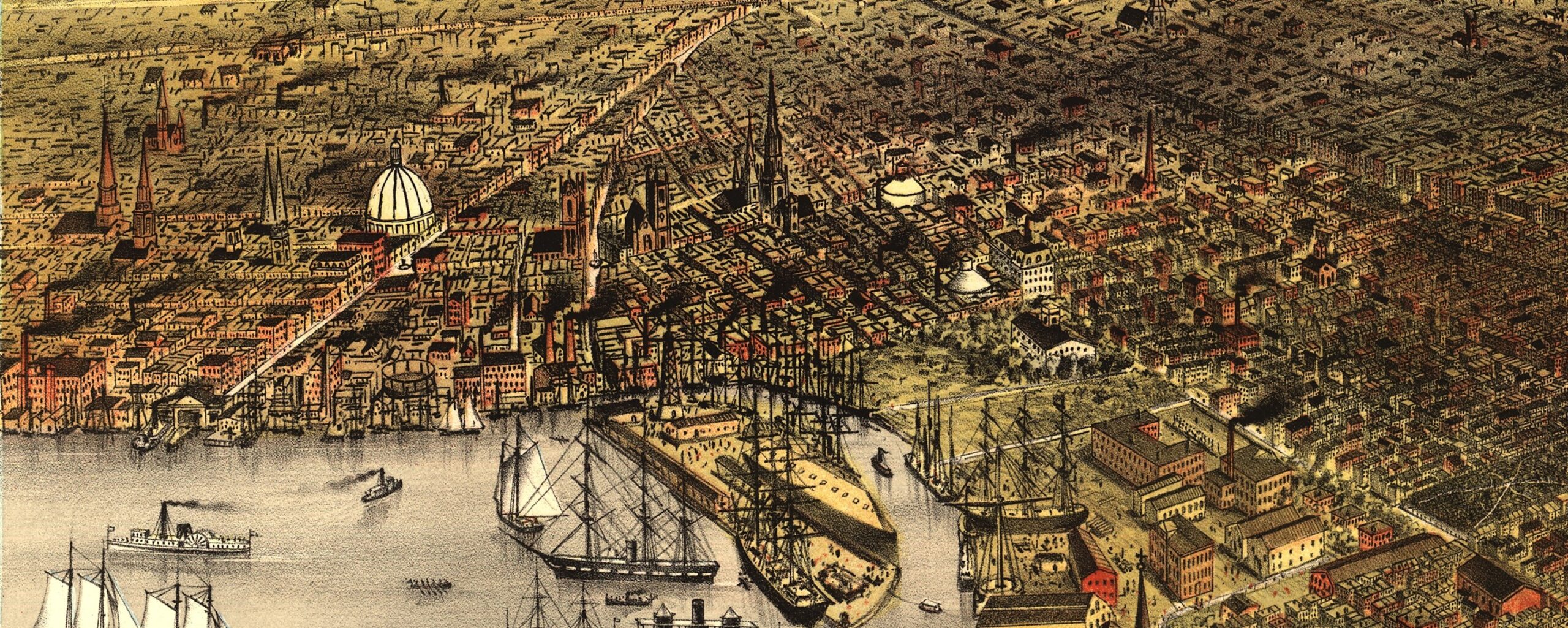
Williamsburg, labeled “Williamsburgh, Brooklyn, E.D.” in the key, at the upper left of Currier & Ives’ bird’s-eye view “The City of Brooklyn,” 1879. Library of Congress, Geography and Map Division. Click the picture to see it full size.
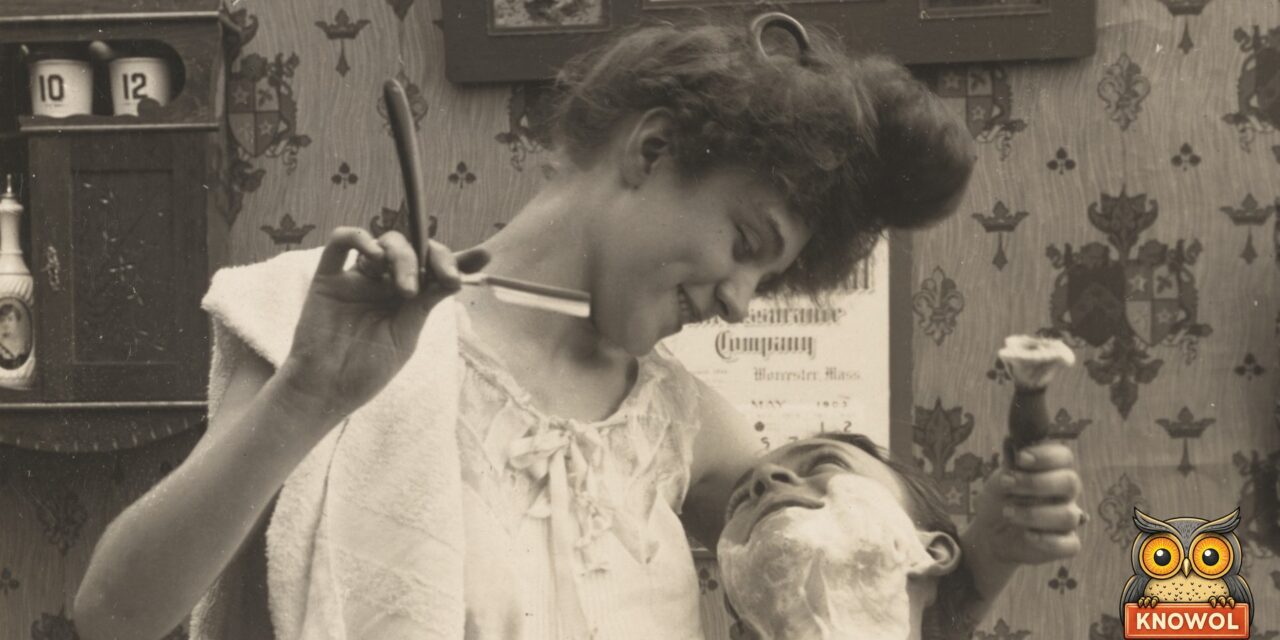
The picture at the top of this story is not Louisa but a stereograph card called “The New Woman Barber,” made in 1903 to sell as a fun picture. Around 1900, people used “the New Woman” to mean women taking up jobs and freedoms that used to belong to men. The card shows the same tools Louisa used: an open razor and a lather brush, with numbered shaving mugs on the shelf behind.
What We Know About Louis and Louisa, and What We Don’t
We found Louis and Louisa, the barbers of North Fifth Street in Brooklyn, in just one paper, the New York Dispatch of December 16, 1877. It never printed their last names, and it never said whether Louisa was Louis’s wife, his sister or a young woman he hired. We don’t know how long the shop lasted, or whether the old barber’s free beer won anybody back.
But we know what happened one December in Williamsburg, when a new barber with an empty chair didn’t lower his price. He taught Louisa to shave, let her practice on his own face, and put her name in the window at twice the price. Then the men of the Fourteenth Ward filled the shop and walked out with clean chins to prove it.
Sources
- “Fair Louisa, the Barber,” New York Dispatch (New York, New York), December 16, 1877, page 5. Library of Congress, Chronicling America.
- Boston’s female barber, Worcester Daily Press (Worcester, Massachusetts), March 28, 1878, page 2. Library of Congress, Chronicling America.
- “Boston has a pretty female barber,” The New York Herald (New York, New York), August 8, 1877, page 4. Library of Congress, Chronicling America.
- “Grand Rapids has a female barber,” The Cincinnati Daily Star (Cincinnati, Ohio), March 4, 1876, page 2. Library of Congress, Chronicling America.
- Eugene L. Armbruster, The Eastern District of Brooklyn (1912), on when Williamsburgh joined Brooklyn and the name “Eastern District.” Internet Archive.
- Cover: “The new woman barber,” stereograph, Great Western View Co., copyright 1903 by B. Y. Young. Library of Congress Prints and Photographs Division. No known restrictions on publication.
- Photo: “L.C. Wiseman, barber shop, New York City,” Detroit Publishing Co., between 1895 and 1910. Library of Congress Prints and Photographs Division. No known restrictions on publication.
- Map: “The city of Brooklyn,” Currier & Ives, drawn by C. R. Parsons, 1879. Library of Congress Geography and Map Division.
- The newspapers, book, stereograph, photograph and print above were all published or made before 1931 and are in the public domain.