On Friday, July 19, 1771, people in Portsmouth, New Hampshire, opened their weekly paper, the New-Hampshire Gazette. On page 2 sat an ad with a name in big curly letters, “John Stavers,” and a first line that said he had kept a stagecoach running to Boston “at a very great Expence.”
Most ads in the paper just listed cloth, cheese or nails for sale, but this one sounded like a man whose feelings were hurt. Stavers ran the Earl of Halifax Tavern, and every Tuesday morning his coach rolled away from its door, bound for Boston. Now other coaches were on his road, and he wanted everyone to know who had been there first.
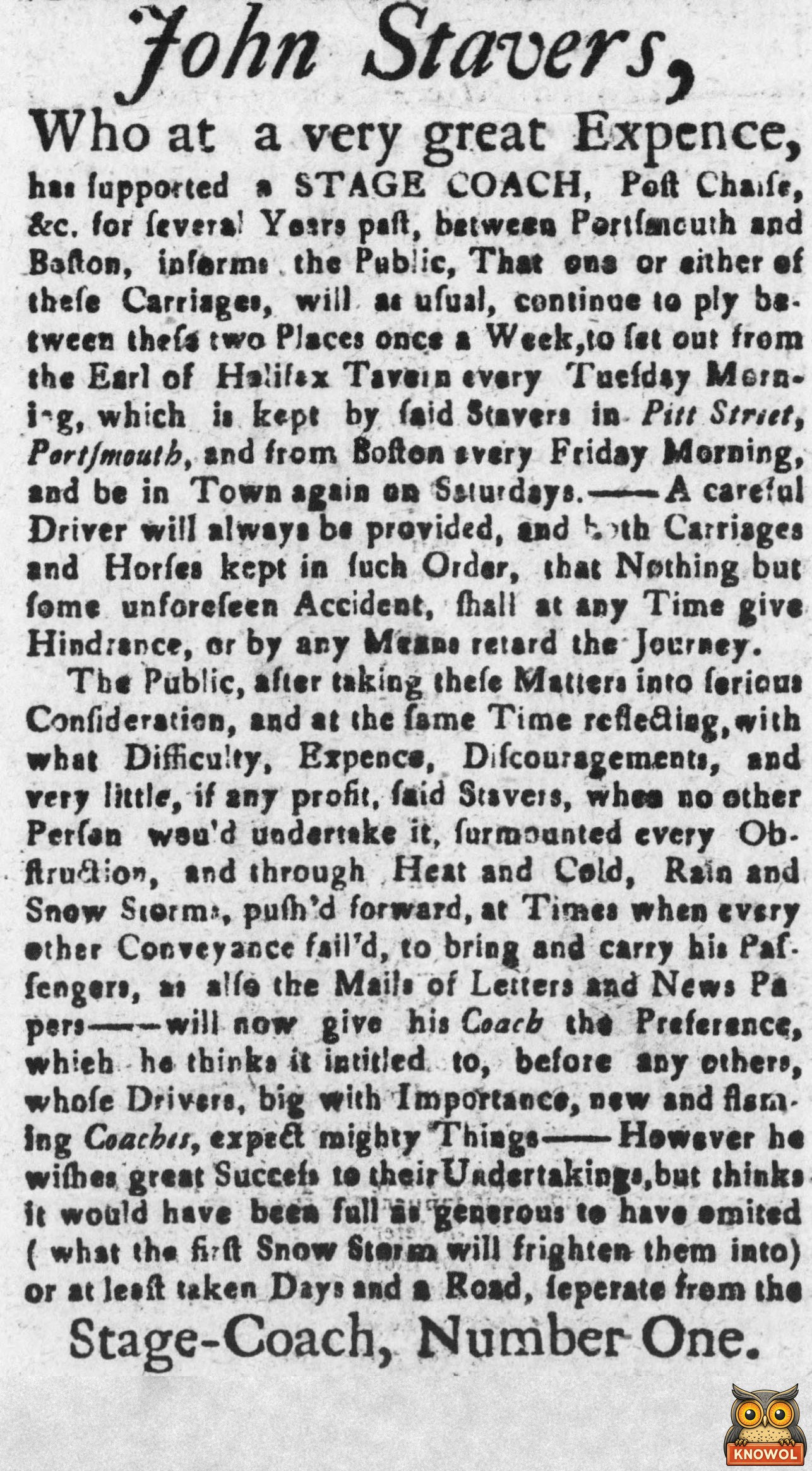
“John Stavers, Who at a very great Expence, has supported a STAGE COACH.” The New-Hampshire Gazette, Portsmouth, New Hampshire, July 19, 1771, page 2. Library of Congress, Chronicling America. Click the clipping to read it full size.
The First Coach From Portsmouth, New Hampshire
Ten years earlier, in April 1761, the paper in Portsmouth, New Hampshire, announced a “Large Stage Chair” with “two good HORSES.” It would leave “from Mr. Stavers Innholder, at the SIGN of the EARL of HALIFAX,” for Boston once a week. A stage chair was a light carriage that ran on a schedule, a little like a bus, and this one could “carry Four Persons besides the Driver.”
The trip took two days, with a night’s stop in Ipswich, Massachusetts. On the second day the riders rolled through Medford to the ferry at Charlestown, across the river from Boston. To get a seat, you signed up at the tavern on Saturday “before Nine o’Clock in the Evening” and paid half the fare, and you paid the rest at the end of the trip.
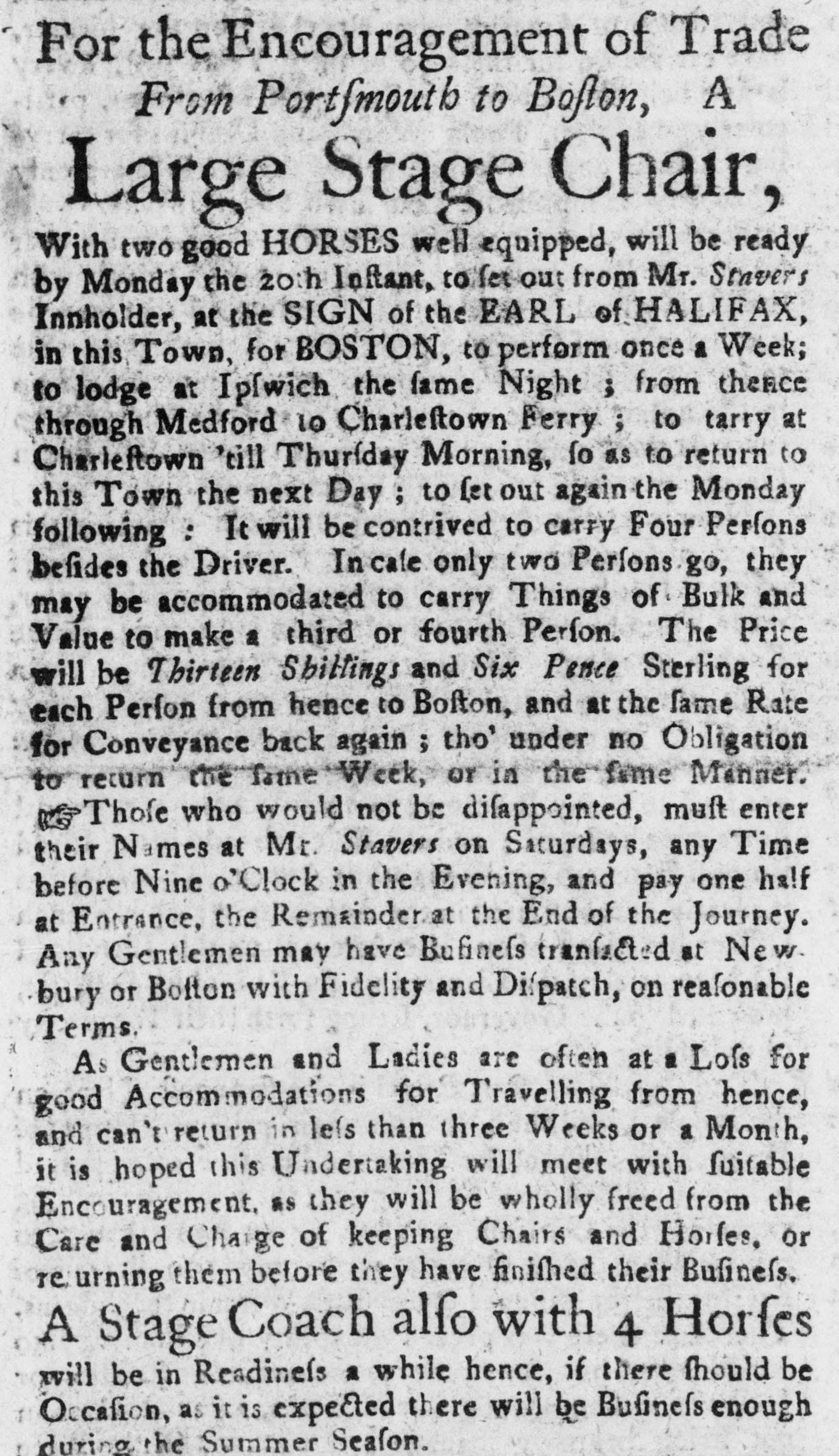
The first coach ad. The New Hampshire Gazette, Portsmouth, New Hampshire, April 3, 1761, page 1. Library of Congress, Chronicling America. Click the clipping to read it full size.
In 1763, a bigger coach came along, “THE PORTSMOUTH Flying Stage-Coach.” It held “Six Persons inside” and ran with “Four or six Horses.” Its master was Bartholomew Stavers, and an 1859 history of Portsmouth called him “the first regular stage driver north of Boston.”
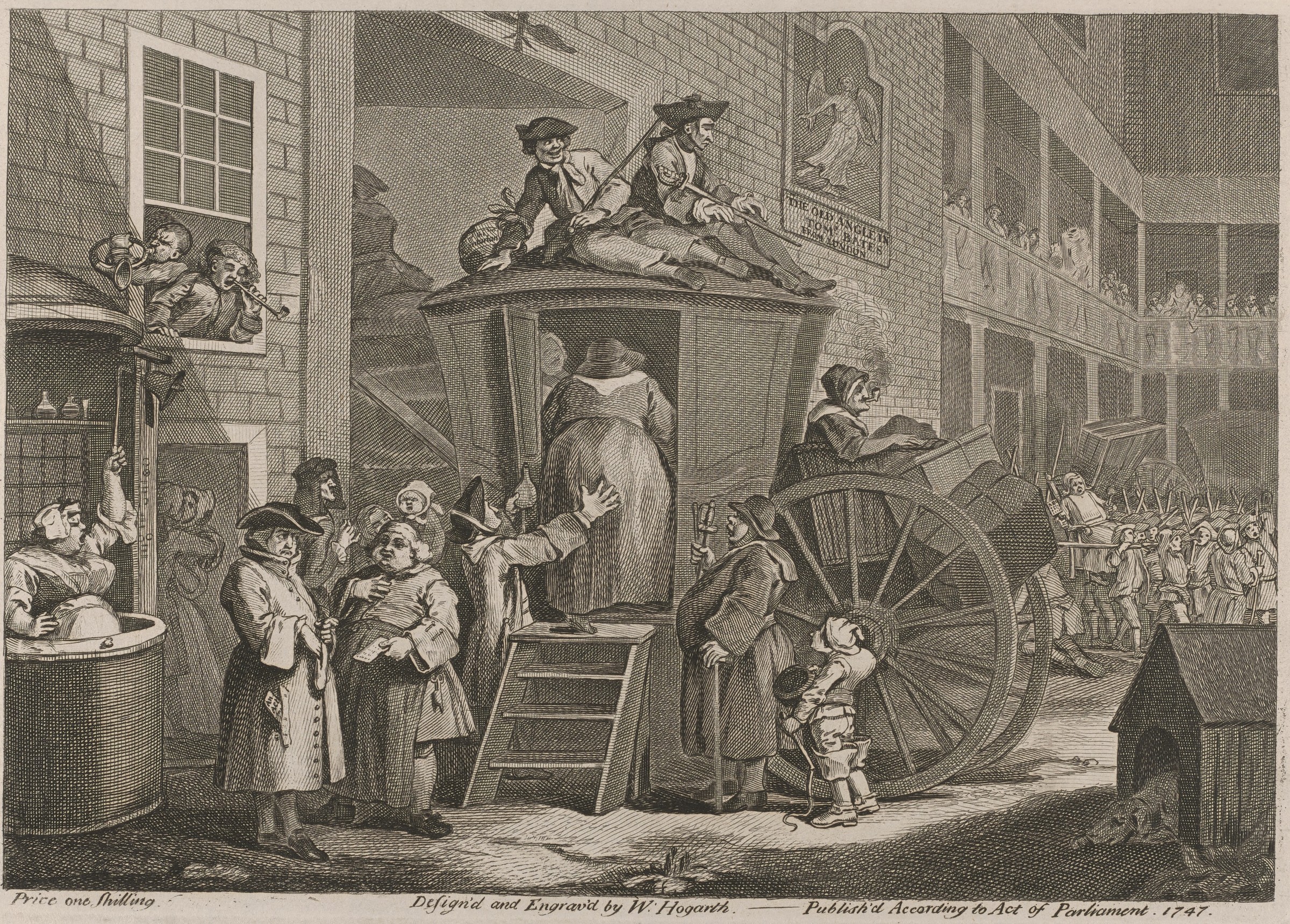
A stagecoach loading up at an English inn, in “The Stage Coach, or the Country Inn Yard,” an engraving by William Hogarth published in 1747. Riders climb in on a ladder, two men sit on the roof, and baggage is piled on the back. Boston Public Library. Click the picture to see it full size.
A Promise to Keep the Coach Rolling
In 1767, Bartholomew Stavers took a new job in Portsmouth, New Hampshire, as the post rider, the man who carried the mail on horseback. Since he now had to travel “with a single Horse,” he put the coach up for sale.
There was a catch: he and John Stavers would sell it cheap, but only to buyers “who shall Promise and engage to improve and proceed with said Carriages once a Week on the same Days as heretofore.” In other words, the coach had to keep running every week, no matter who owned it.
By 1771, John Stavers was running it himself. In his July ad, he said he had kept it going “when no other Person wou’d undertake it,” for “very little, if any profit.” His coach went on “through Heat and Cold, Rain and Snow Storms” and “push’d forward, at Times when every other Conveyance fail’d,” which meant it kept going when every other way of getting around had given up. It carried “the Mails of Letters and News Papers,” too.
Shiny New Coaches in Portsmouth, New Hampshire
John Stavers saved his real point for the end of his ad in Portsmouth, New Hampshire. New coaches had started running on his road, and he was not impressed with the rivals “whose Drivers, big with Importance, new and flaming Coaches, expect mighty Things.” Back then, flaming meant bright and showy, like fresh paint.
He was polite, sort of, and said he “wishes great Success to their Undertakings.” Then he added that it would have been “full as generous” to skip the whole idea, “what the first Snow Storm will frighten them into.” In plain words, he guessed that the first snowstorm would chase them off the road anyway.
If they had to run, he said, they could at least pick other days and another road, away from his own coach, which he proudly called “Stage-Coach, Number One.” He never named the rivals in the ad.
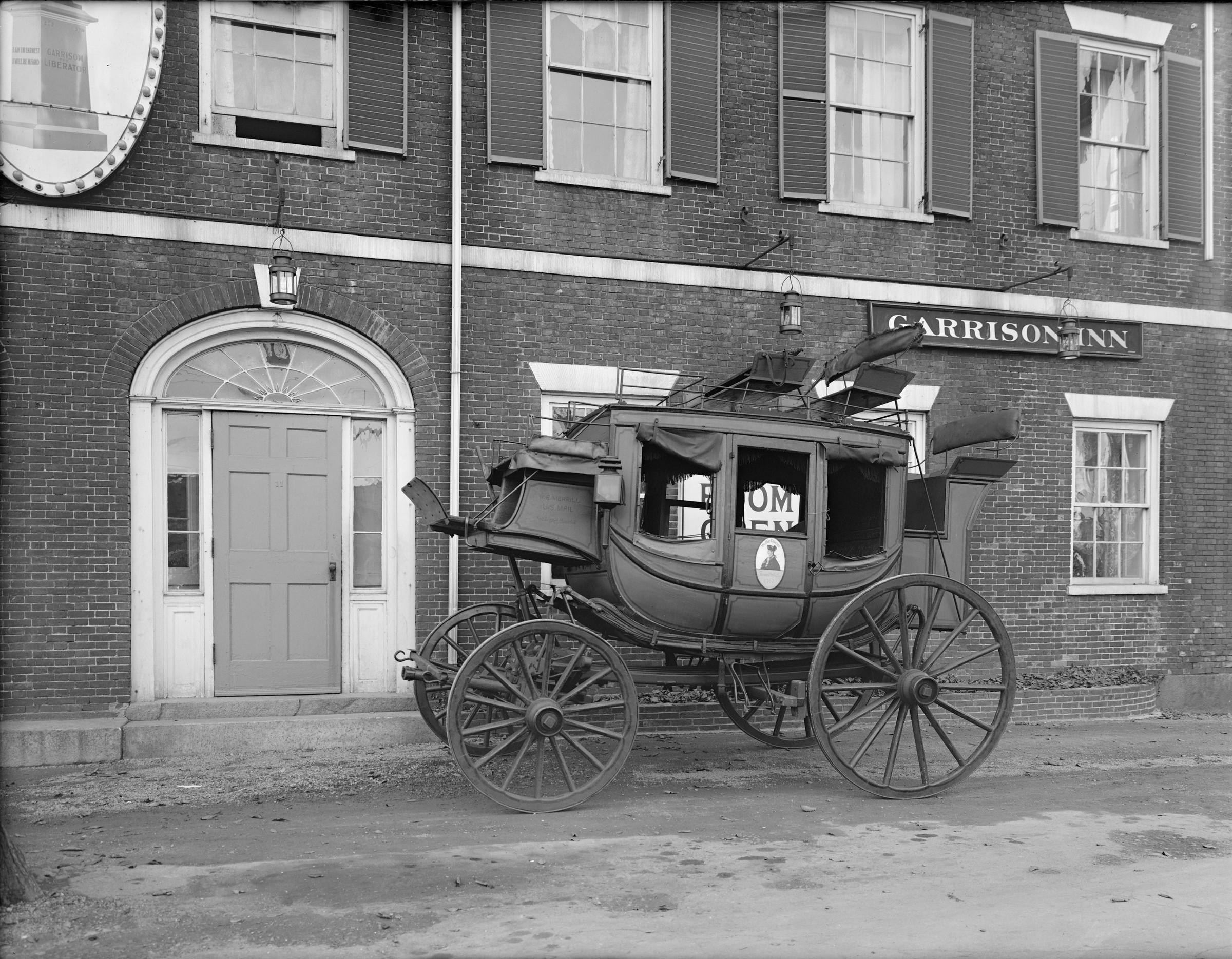
An old stagecoach outside the Garrison Inn in Newburyport, Massachusetts, a town between Portsmouth and Boston, photographed in 1929. It is not John Stavers’s coach. Leon Abdalian Collection, Boston Public Library. Click the picture to see it full size.
The Fare Drops to Two Dollars
Three weeks later, on August 9, 1771, John Stavers’s ad in Portsmouth, New Hampshire, had a new line on top: “For Two Dollars only, Ladies or Gentlemen, carried to, or brought from Boston, which is a Third cheaper then usual.” The usual fare had been three dollars, so he cut it by one dollar.
The low price stuck for a while, and in February 1772 Stavers was still carrying riders “for two Dollars each.” He promised they would be “genteely used,” which meant treated politely.
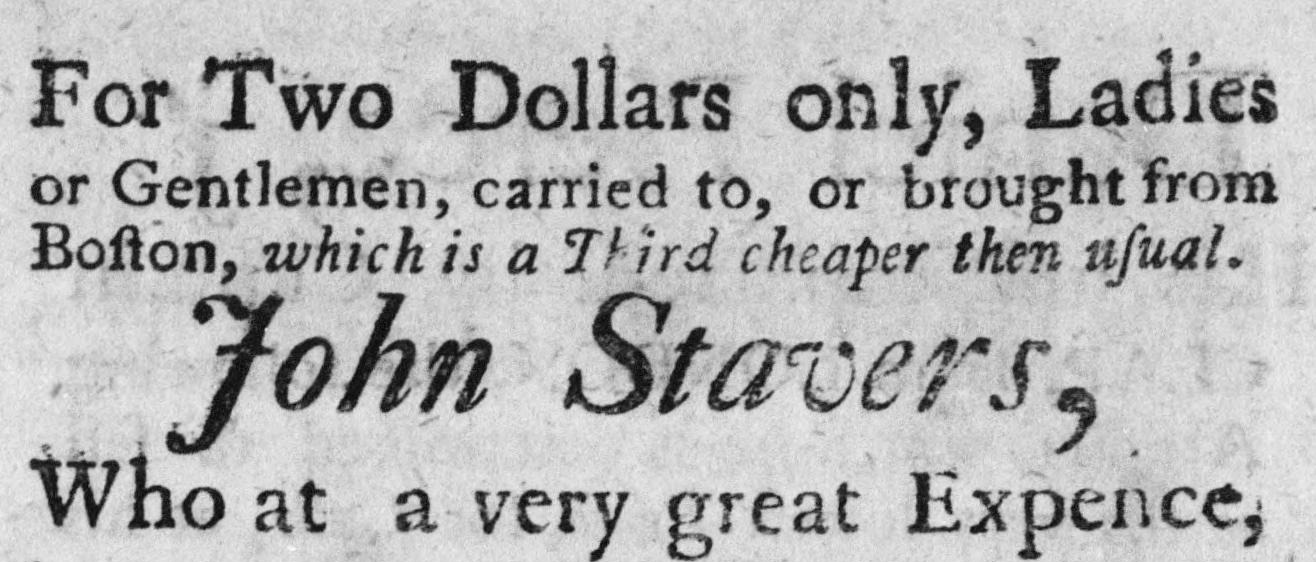
The new top line. The New-Hampshire Gazette, Portsmouth, New Hampshire, August 9, 1771, page 4. Library of Congress, Chronicling America. Click the clipping to read it full size.
Rivals Become Partners
By the summer of 1772, the fight on the road out of Portsmouth, New Hampshire, had turned into a team. An ad that July was signed by two men, “JOHN STAVERS” and “BENJAMIN HART.” Hart had taken over a stagecoach and a post chaise, a light, fast carriage, from a man named John Noble in November 1770, and one of them went to Boston every week.
Now the two men split the week. Stavers’s coach left Portsmouth on Tuesdays, and Hart’s left on Fridays, so travelers had a ride “twice in the Week” each way. The price went back to “the customary price of Three Dollars, which is as low as the Fare for the same Distance in any Stage Coach in America.”
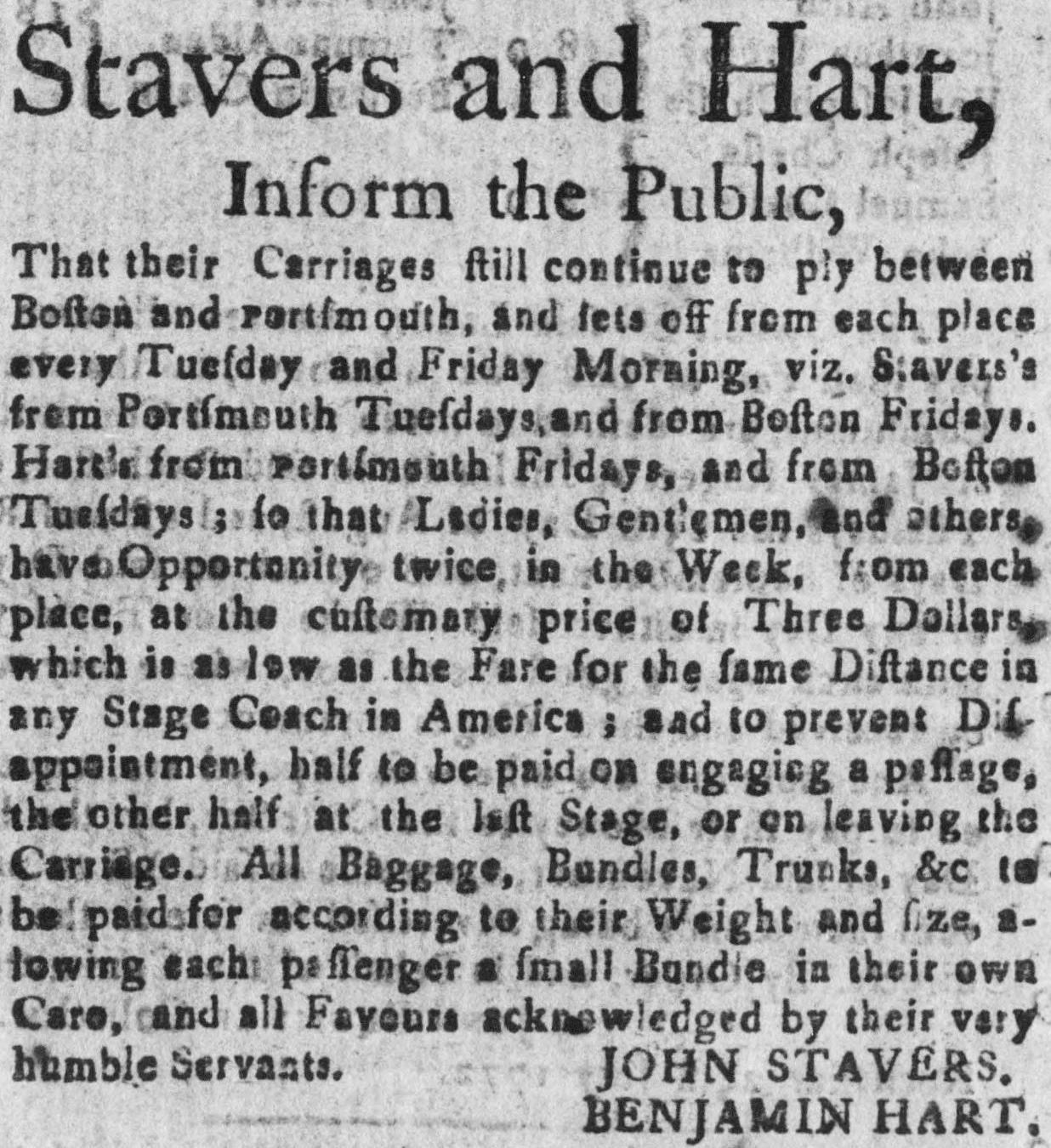
“Stavers and Hart.” The New-Hampshire Gazette, Portsmouth, New Hampshire, July 31, 1772, page 3. Library of Congress, Chronicling America. Click the clipping to read it full size.
Bags, Bundles and Trunks
The 1772 ad from Portsmouth, New Hampshire, had rules that sound a lot like an airline’s: you paid half the fare when you booked your seat and the other half at the end. Big things cost extra: “All Baggage, Bundles, Trunks, &c to be paid for according to their Weight and size.” But each rider could keep “a small Bundle in their own Care” for free, which made it a carry-on bag more than 250 years ago.
Half Price in Portsmouth, New Hampshire
The peace in Portsmouth, New Hampshire, did not last. In January 1773, a new ad ran under a big headline, “Stavers’s Stage, Now carries Passengers for One Dollar & Half,” which was half the usual fare.
Stavers reminded readers that “he was the first Promoter of a Stage Coach in this Province,” so, he said, “he ought to have the Preference.” He asked them not to “countenance others in taking Passengers the beginning of the Week,” which meant not to back anyone else who did that. Someone was taking riders early in the week, but the ad doesn’t say who.
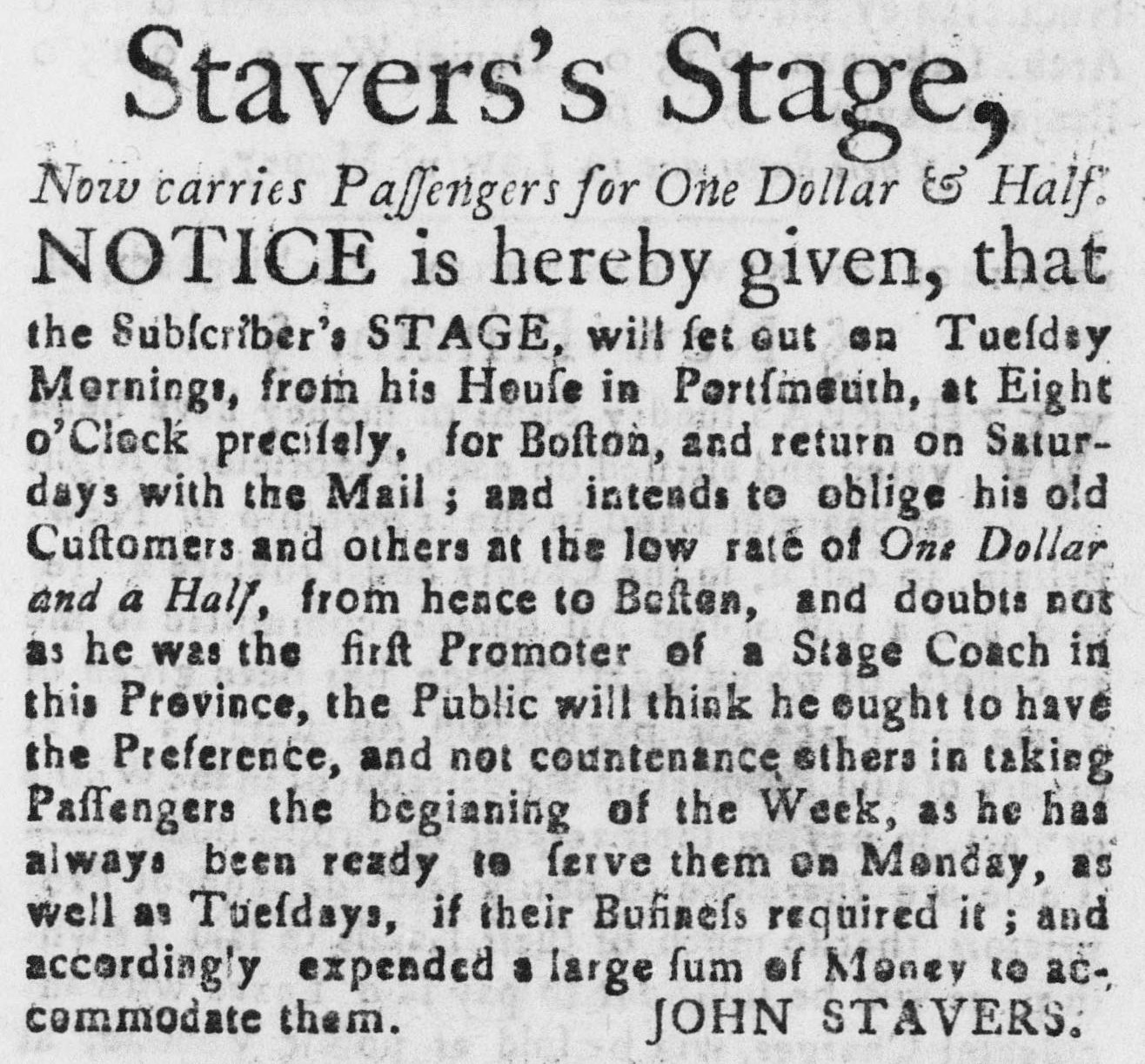
Half price. The New-Hampshire Gazette, Portsmouth, New Hampshire, January 22, 1773, page 4. Library of Congress, Chronicling America. Click the clipping to read it full size.
Within a month, the price went back up, and a February ad said “Stavers’s Stage, At THREE DOLLARS, for Passengers, as usual.” The paper doesn’t say why the price changed again.
Twelve Years Without a Spill
By February 1774, John Stavers was still running his coach out of Portsmouth, New Hampshire, and his ad now said “Stavers’s STAGE-COACH, NUMBER ONE.” The coach ran “with FOUR HORSES, equal to any in AMERICA.” It left on Tuesday mornings at eight o’clock and reached Boston the next day.
The ad ended with a boast every rider wanted to hear: “His Carriages for twelve Years has never been overset, nor any Passengers met with any Hurt.” Overset meant tipped over, and on rough dirt roads, through rain and snow, that was something to brag about.
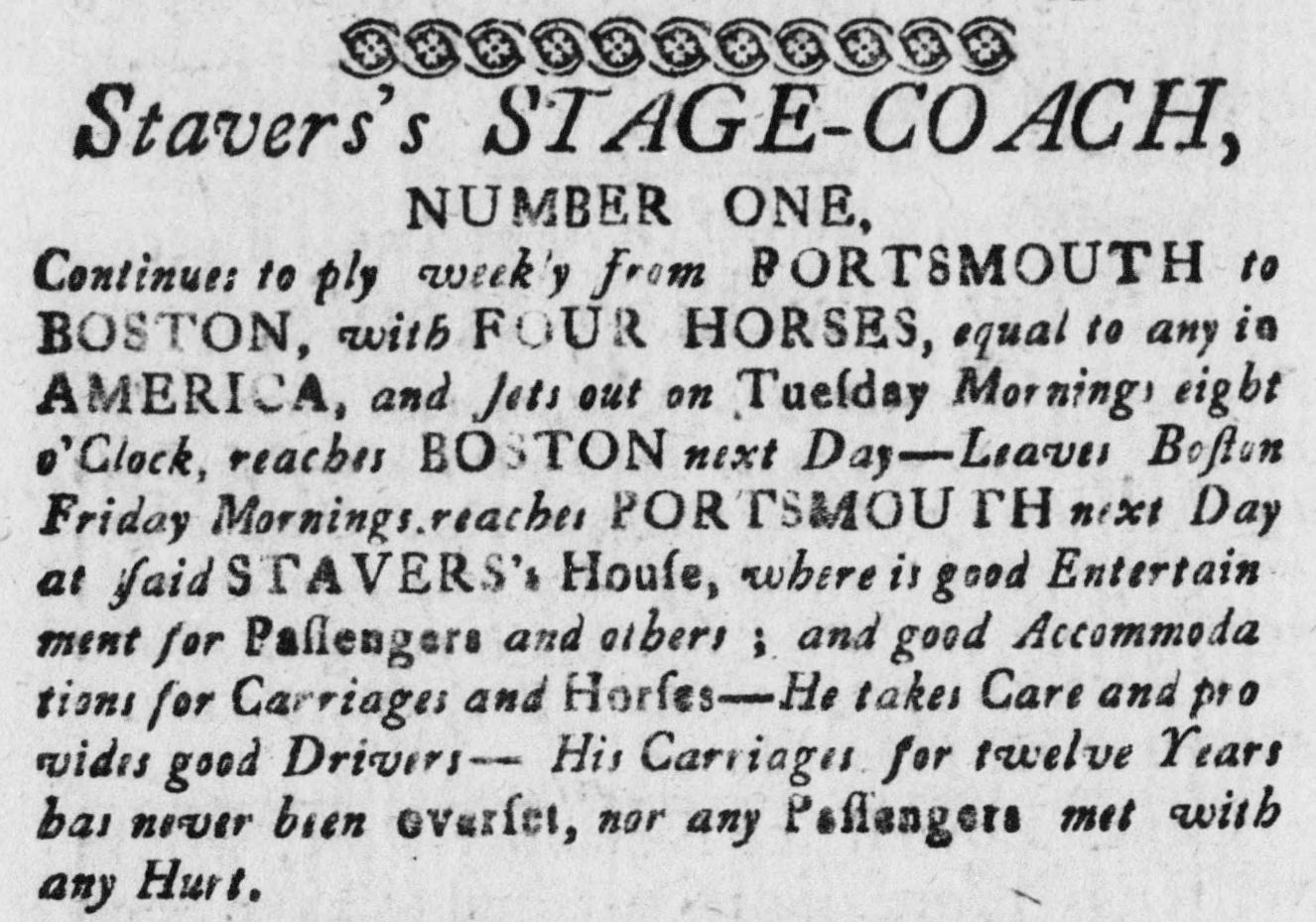
“Never been overset.” The New-Hampshire Gazette, Portsmouth, New Hampshire, February 4, 1774, page 4. Library of Congress, Chronicling America. Click the clipping to read it full size.
John Stavers’s Tavern Still Stands in Portsmouth, New Hampshire
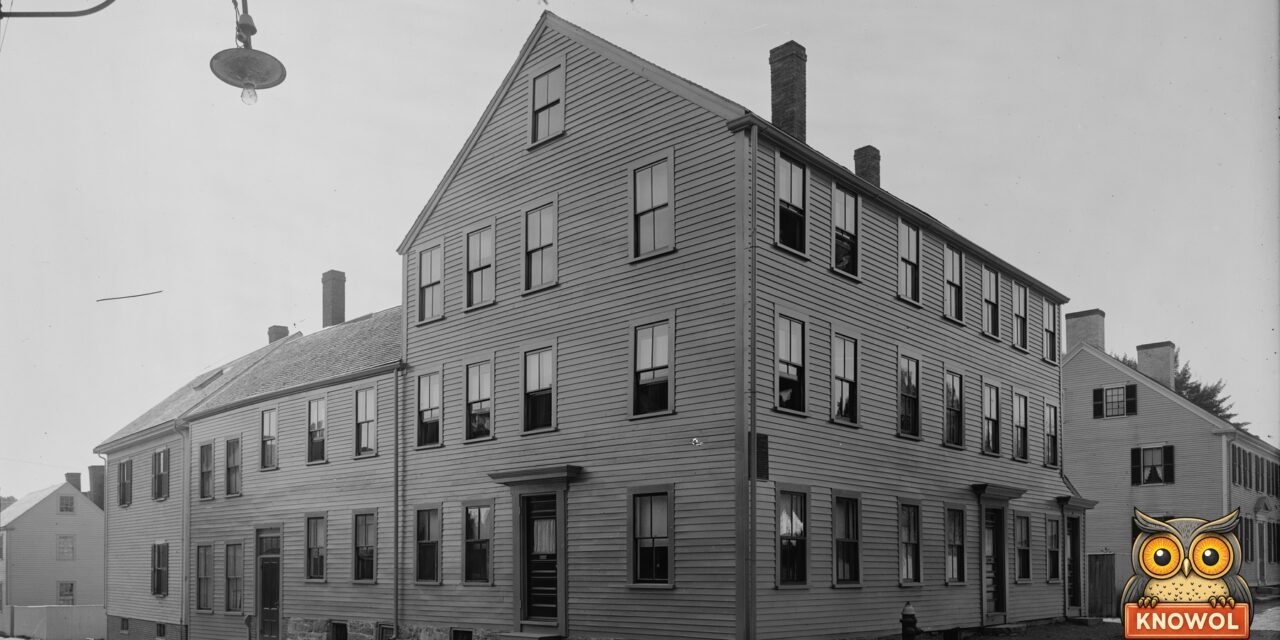
John Stavers’s tavern still stands in Portsmouth, New Hampshire. In December 1766, he told customers he had moved to “his new House in PITT STREET, at the SIGN of the EARL of HALIFAX.” Strawbery Banke Museum, which cares for the building today, says it was built in 1766 and was the Portsmouth end of the Flying Stage-Coach line.
Later the old sign was repainted, and the tavern became the William Pitt Tavern. The 1859 history says the Marquis de Lafayette came there in 1782 to visit French officers who were staying at the tavern. The photograph at the top of this page shows the building about 1907.
Nobody wrote down whether the first snowstorm scared off the shiny new coaches. But Stage-Coach Number One was still rolling in 1774, still leaving John Stavers’s door every Tuesday morning, and still proud that nobody had been hurt.
Sources
- “John Stavers, Who at a very great Expence, has supported a STAGE COACH,” The New-Hampshire Gazette and Historical Chronicle (Portsmouth, New Hampshire), July 19, 1771, page 2. Library of Congress, Chronicling America.
- The same ad with “For Two Dollars only” on top, August 9, 1771, page 4 (the July 19 wording ran unchanged on August 2, 1771, page 3). Library of Congress, Chronicling America.
- John Stavers, “two Dollars each” and “genteely used,” February 14, 1772, page 3. Library of Congress, Chronicling America.
- “Stavers and Hart, Inform the Public,” July 31, 1772, page 3. Library of Congress, Chronicling America.
- “Stavers’s Stage, Now carries Passengers for One Dollar & Half,” January 22, 1773, page 4, and “At THREE DOLLARS, for Passengers, as usual,” February 19, 1773, page 3. Library of Congress, Chronicling America.
- “Stavers’s STAGE-COACH, NUMBER ONE,” February 4, 1774, page 4. Library of Congress, Chronicling America.
- “A Large Stage Chair,” The New Hampshire Gazette (Portsmouth, New Hampshire), April 3, 1761, page 1, and “THE PORTSMOUTH Flying Stage-Coach,” June 3, 1763, page 4. Library of Congress, Chronicling America.
- “John Stavers, Innholder in Portsmouth,” December 5, 1766, page 4; “Barth. Stavers, POST-RIDER,” July 10, 1767, page 4; and “John Noble, Hereby informs the Public,” November 16, 1770, page 3. Library of Congress, Chronicling America.
- Charles W. Brewster, Rambles About Portsmouth (Portsmouth, 1859): the first stage to Boston and Bartholomew Stavers (pages 187 to 189), and the “William Pitt” sign and Lafayette’s visit (page 194). Internet Archive.
- Strawbery Banke Museum, Historic Houses: Pitt Tavern, built 1766, home of John Stavers and the Portsmouth end of the Flying Stage-Coach.
- Detroit Publishing Co., “William Pitt tavern, Portsmouth, N.H., probably erected in 1770,” about 1907 (the cover). Library of Congress Prints and Photographs Division. No known restrictions on publication.
- Leon Abdalian, “Garrison Inn (doorway and stage coach), Newburyport, Mass.,” 1929. Boston Public Library, Digital Commonwealth. No known copyright restrictions.
- William Hogarth, “The Stage Coach, or the Country Inn Yard,” 1747. Boston Public Library, Digital Commonwealth. No known copyright restrictions.
- The newspapers, book, photographs and engraving above were all published or made before 1931 and are in the public domain.