On May 23, 1885, a newspaper letter writer who signed the name “Elroy” wrote the week’s letter to the New Orleans Picayune from Carthage, Mississippi. That week the news was in the dirt. “The ground is full of holes, say a quarter of an inch in diameter,” Elroy wrote. That is about as wide as a pencil.
Cicadas had made the holes, crawling up out of the ground by the thousands. Nobody knew how far down the holes went. So a day or two before, some young men of the town set out to measure one.
“They had a spool of thread, to one end of which they attached a buckshot as a sinker,” Elroy wrote. A buckshot is a lead ball about the size of a pea. The label on the spool said “200 yards warranted,” which meant the store promised 200 yards of thread. The young men let every bit of it run down that one little hole “without touching bottom.”
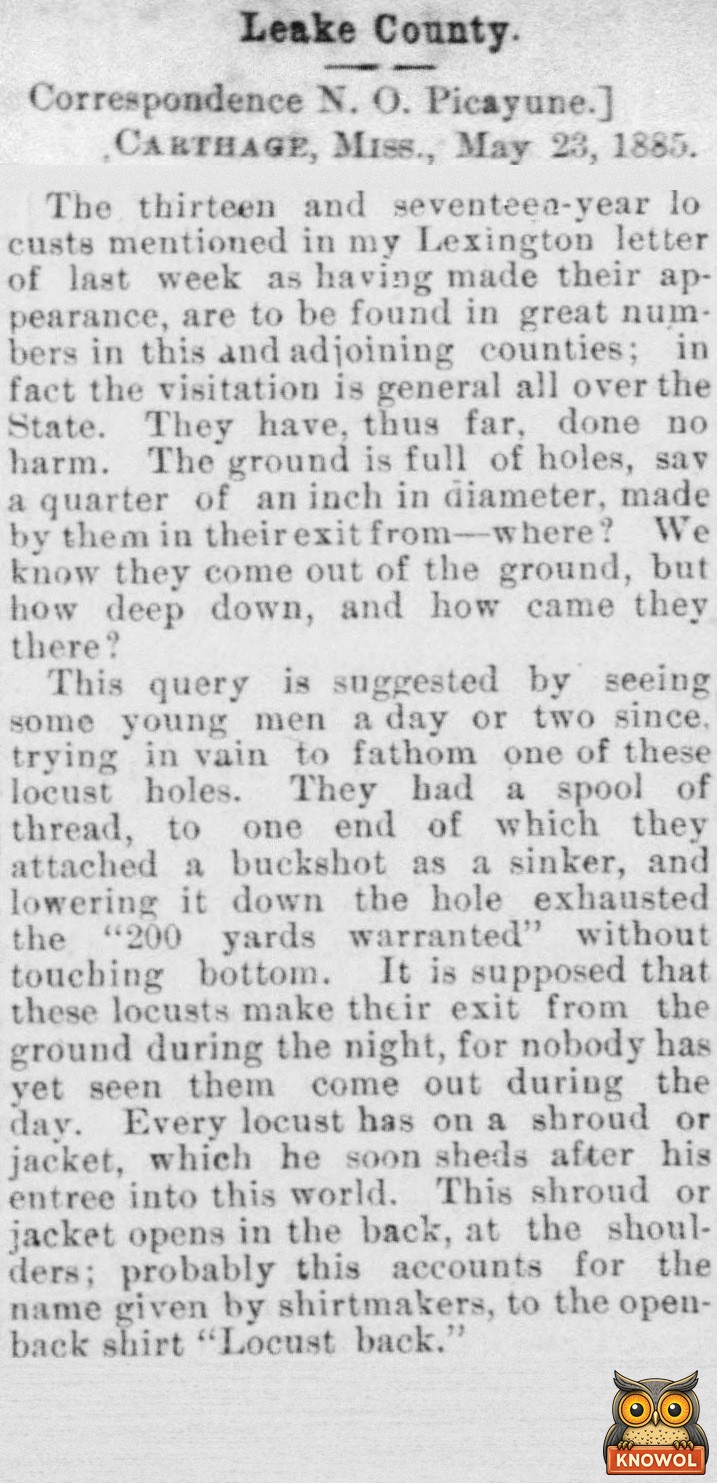
The heading and the spool of thread passage of Elroy’s letter from Carthage, Mississippi, dated May 23, 1885, as reprinted from the New Orleans Picayune in The Clarion, Jackson, Mississippi, June 3, 1885, page 1. Two parts of the letter, joined. Library of Congress, Chronicling America. Click the clipping to read it full size.
The Spring Two Kinds of Cicadas Came Up in Mississippi
The bugs Elroy saw in Carthage, Mississippi, were periodical cicadas. People called them locusts, but a real locust is a kind of grasshopper. A cicada spends years underground as a young bug called a nymph, sipping sap from tree roots. Then the whole crop comes up together in one spring.
Elroy said “the visitation is general all over the State.” It was a big year. On May 25, 1885, the government’s insect scientist, Charles V. Riley, wrote from Washington, D.C., that two “extensive broods” were coming out the same year, “the one a 17-year, the other a 13-year brood.” A brood is one big crop of cicadas. Riley’s list put Mississippi and Arkansas in the 13-year brood. So the Carthage cicadas had gone into the ground as tiny hatchlings in 1872. A young man of 20 holding that spool was 7 years old when they went down.
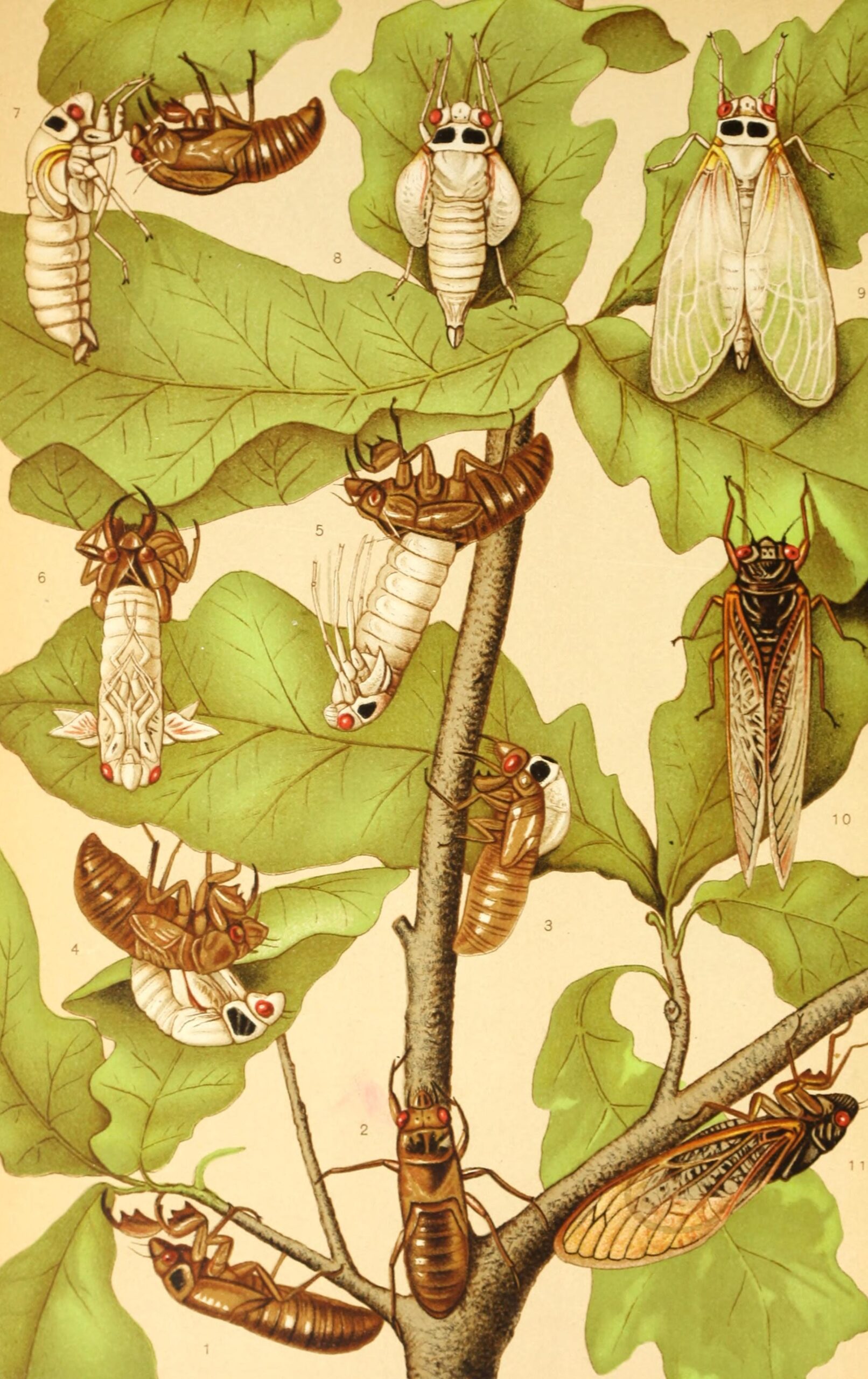
“Transformation of Periodical Cicada,” the color plate at the front of a 1907 government report on cicadas, drawn by C. V. Riley and painted by L. Sullivan. It shows the change step by step, from the brown nymph on a twig to the soft white new cicada and the dark grown one. U.S. Department of Agriculture, Bulletin 71, public domain. Click the picture to see it full size.
What Was Really at the Bottom of a Carthage Cicada Hole
The thread the young men of Carthage, Mississippi, let down was 200 yards long. That is 600 feet, as long as two football fields.
The real holes were not nearly that deep. In 1907 the U.S. Department of Agriculture printed a long report on periodical cicadas by Charles L. Marlatt. It said the young cicadas “have rarely been found at a greater depth than 2 feet below the surface and usually between 6 and 12 inches.” Most likely the buckshot came to rest at the bottom of a short tunnel, and the thread kept piling up on top of it in the dark.
Elroy guessed right about one thing. “It is supposed that these locusts make their exit from the ground during the night, for nobody has yet seen them come out during the day.” Riley had watched them, and Marlatt’s report quotes him. The cicadas “begin to rise as soon as the sun is hidden behind the horizon, and they continue until by 9 o’clock the bulk of them have risen.”
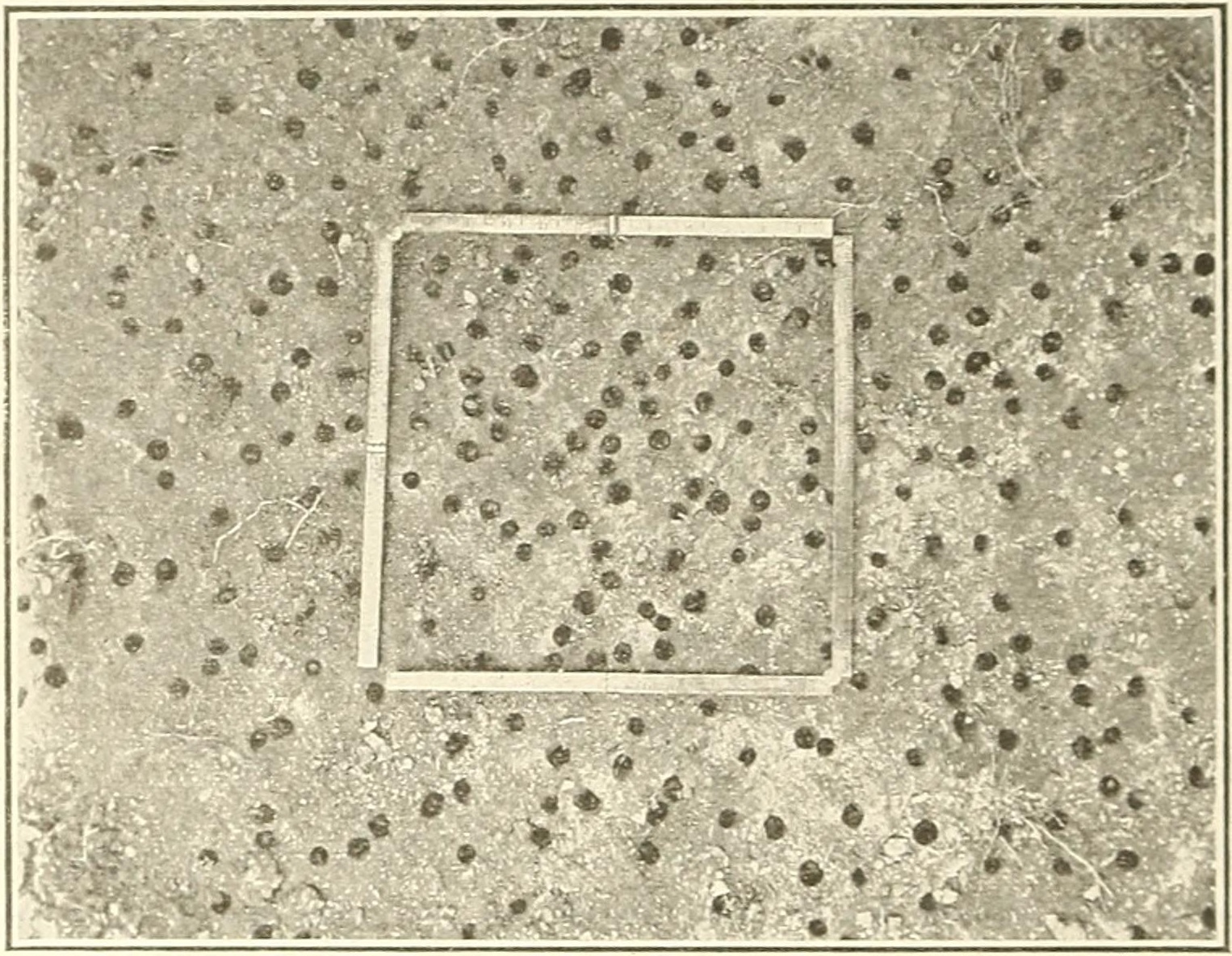
Cicada exit holes around a frame one foot square, photographed by Robert A. Kemp near Frederick, Maryland, in 1902. It is not Carthage, but these are the same kind of holes. U.S. Department of Agriculture, Bulletin 71 (1907), public domain. Click the picture to see it full size.
By the Numbers
- 1/4 inch: how wide Elroy said the holes in Carthage were.
- 200 yards: the thread on the spool, or 600 feet.
- 2 feet: about the deepest young cicadas usually go.
- 84: cicada holes counted in one square foot of ground near Frederick, Maryland, in 1902.
- 9,000: burrows a Mr. McCook counted under a single tree.
- 13 and 17: how many years the two kinds of periodical cicadas stay underground.
The Jacket That Opens Down the Back
Elroy noticed one more thing in Carthage, Mississippi. “Every locust has on a shroud or jacket, which he soon sheds after his entree into this world,” the letter said. “This shroud or jacket opens in the back, at the shoulders.”
That is just how it happens. After a nymph climbs a tree trunk, Riley wrote, “In about an hour after rising and settling, the skin splits down the middle of the thorax,” the bug’s chest. The new cicada pulls itself out of the old brown shell, soft and nearly white, and its wings stretch out.
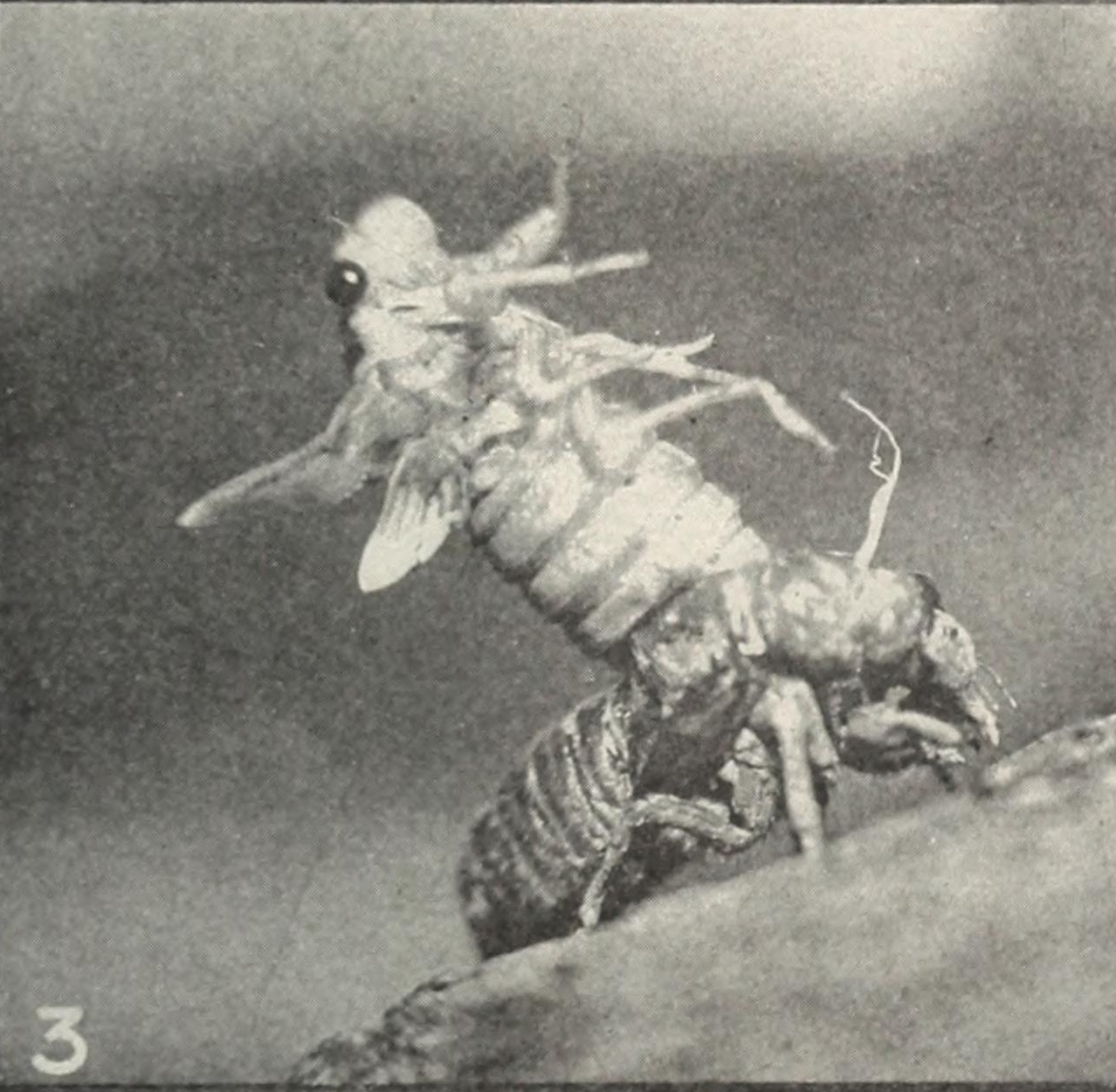
A periodical cicada pulling itself out of its old shell through the split down the back. Photograph by Robert A. Kemp of Frederick, Maryland, in U.S. Department of Agriculture Bulletin 71 (1907). Public domain. Click the picture to see it full size.
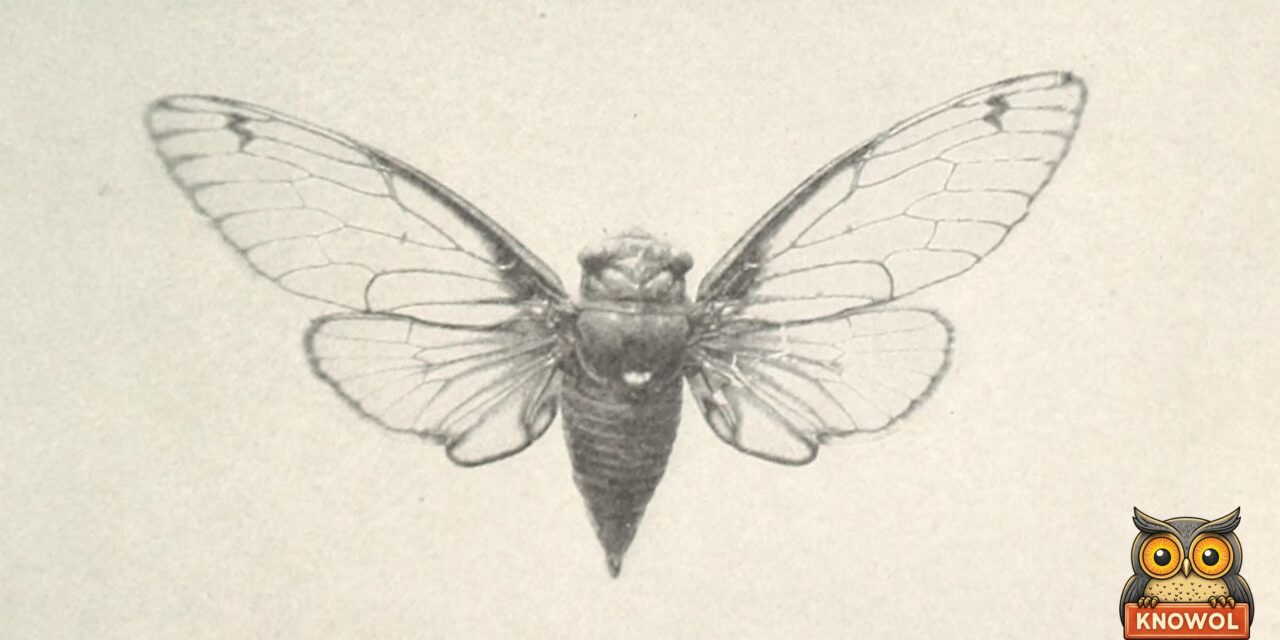
The cicada at the top of this story, with its new wings spread, is another of Kemp’s photos in that 1907 report. Marlatt wrote about a big tree covered with new cicadas. “In the moonlight such a tree looks for all the world as though it were full of beautiful white blossoms in various stages of expansion.”
Then Elroy made a guess about shirts: “probably this accounts for the name given by shirtmakers, to the open-back shirt ‘Locust back.'” Back then, many men’s good white shirts buttoned up the back, so the stiff front stayed smooth. A year earlier, the Brookhaven Leader, another Mississippi paper, ran an ad for Lehman’s Peerless Shirts, “open back or open front,” at “the uniform price of one dollar.” We found no ad that called a shirt a “Locust back,” so we can’t say if shirtmakers really used the name.

Ad for Lehman’s Peerless Shirts, “open back or open front,” The Brookhaven Leader, Brookhaven, Mississippi, May 1, 1884, page 1. Library of Congress, Chronicling America. Click the clipping to read it full size.
A Joke Paper in Little Rock, Arkansas, Noticed the Shirt Too
On June 6, 1885, The Arkansaw Traveler of Little Rock, Arkansas, printed a funny column called “The Locust.” It began, “The thirteen-year locust has made his appearance in Arkansaw.” The Traveler was a weekly humor paper, started in Little Rock in 1882 by its editor, Opie Read, and his brother-in-law, P. D. Benham. A 1922 history of the Arkansas press said “It soon gained a national reputation.”
The column had the shirt, too. “The locust always wears his shirt open in the back,” it said, and a made-up magazine, the “Scientific Insecteferist,” claimed “the locust led to the discovery that shirts which open in the back are the most convenient.”
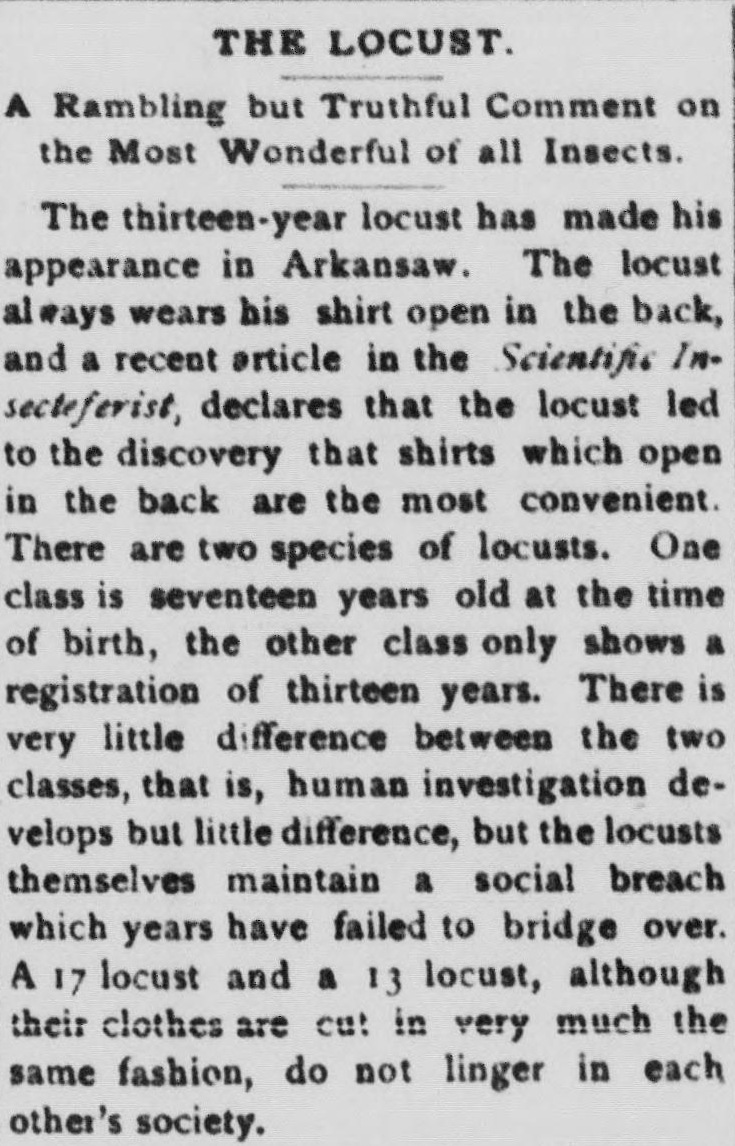
“The Locust,” The Arkansaw Traveler, Little Rock, Arkansas, June 6, 1885, page 1. Library of Congress, Chronicling America. Click the clipping to read it full size.
Many of the Traveler’s jokes had a seed of truth. “A 17 locust and a 13 locust, although their clothes are cut in very much the same fashion, do not linger in each other’s society,” it said. Riley’s report said the two kinds were “good and distinct races which do not cross.” The column said “The locust does not eat corn, cabbages or cucumbers,” and that was true, too.
Then came the big joke. “One time, in Tennessee, locusts were so numerous that the farmers turned them under with a plow to fertilize the ground with them.” In the spring the farmers found “sixteen round holes to the square inch. Since that time the land has produced nothing but holes.”
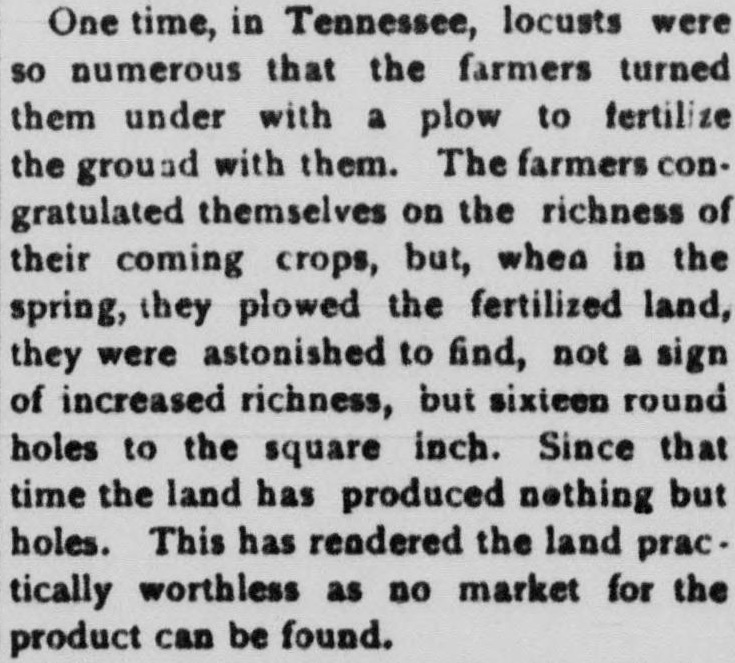
The Tennessee joke from “The Locust,” The Arkansaw Traveler, June 6, 1885, page 1. Library of Congress, Chronicling America. Click the clipping to read it full size.
Sixteen holes to the square inch comes to 2,304 in a square foot, more than 27 times Kemp’s crowded square foot in Maryland. The joke traveled well. Papers as far off as Wisconsin and South Carolina printed “The Locust” that summer.
A Spool of Thread Turned Up Near Athens, Georgia
A spool of thread turned up again that summer, this time near Athens, Georgia. On August 22, 1885, the Madison Times of Tallulah, Louisiana, passed along a list from the Charleston News and Courier of “reasons why the people of South Carolina should be contented with their State and not seek homes elsewhere.” The joke was that the states next door were full of strange goings-on. Georgia had this: “a man living near Athens dropped a spool of thread into a hole from which a locust had just emerged, and the entire spool unwound without reaching the bottom of the hole.”
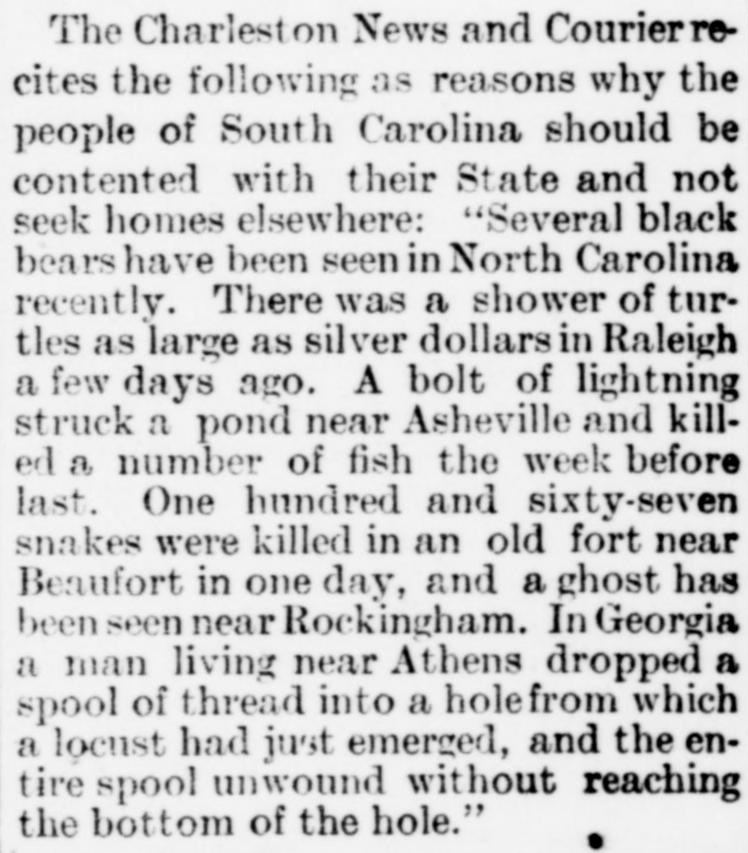
The Charleston News and Courier’s list, as printed in the Madison Times, Tallulah, Louisiana, August 22, 1885, page 1. Library of Congress, Chronicling America. Click the clipping to read it full size.
Maybe a man in Georgia really tried it. Or maybe the Carthage story picked up a new address as it went from paper to paper.
Cicadas for Breakfast
Back in Little Rock, Arkansas, the Traveler had one more joke. “If locusts must be eaten, it is said that they do best in boarding-house soup, for then you get so few of them.” Boarding houses were known for thin soup.
That same summer, Riley’s office tried eating them for real. Leland O. Howard, Riley’s assistant, had Riley’s cook make “a plain stew, a thick milk stew, and a broil,” and they were “served at breakfast time.” The bugs in the stew “were reduced to nothing but bits of flabby skin.” Fried in batter, “they remind one of shrimps.” Howard’s last word was “They will never prove a delicacy.”
Carthage, Mississippi, Waited 13 Years
Elroy’s letter said Carthage, Mississippi, had “a population of about 500, and is a bustling, busy interior town.” Its paper, the Carthagenian, was printed by L. M. Garrett, with “the type-setting being done by his two daughters, 13 and 14 years of age.” The younger girl was born about the year those cicadas went into the ground.
That summer the cicadas laid their eggs in the twigs, and a new crop of tiny nymphs dropped to the ground and dug in. Marlatt’s report says the brood “returned in 1898.” Its 1898 list names Leake County, Mississippi, where Carthage is the county seat, and Pulaski County, Arkansas, home of Little Rock. Count forward 13 years at a time from 1885, and you come to 2028.
The young men of Carthage never found the bottom of that hole. It was there all the same, most likely a foot or so down, where a little bug had waited 13 years in the dark for one warm night in May.
Sources
- “Leake County,” Elroy’s letter from Carthage, May 23, 1885, reprinted from the New Orleans Picayune in The Clarion (Jackson, Mississippi), June 3, 1885, page 1. Library of Congress, Chronicling America.
- “The Locust,” The Arkansaw Traveler (Little Rock, Arkansas), June 6, 1885, page 1. Library of Congress, Chronicling America.
- “The Locust,” Mineral Point Tribune (Mineral Point, Wisconsin), July 30, 1885, page 4, and Pickens Sentinel (Pickens, South Carolina), August 6, 1885, page 1. Library of Congress, Chronicling America.
- The Charleston News and Courier’s list, in the Madison Times (Tallulah, Louisiana), August 22, 1885, page 1. Library of Congress, Chronicling America.
- Lehman’s Peerless Shirts ad, The Brookhaven Leader (Brookhaven, Mississippi), May 1, 1884, page 1. Library of Congress, Chronicling America.
- C. V. Riley, “The Periodical Cicada,” U.S. Department of Agriculture, Division of Entomology, Bulletin No. 8 (1885). Internet Archive.
- C. L. Marlatt, “The Periodical Cicada,” U.S. Department of Agriculture, Bureau of Entomology, Bulletin No. 71 (1907), pages 98, 99, 103 and 124, with Plate VI, figure 40 and the color frontispiece. Internet Archive. The cover photo and the photos above are from this report.
- Fred W. Allsopp, “History of the Arkansas Press for a Hundred Years and More” (1922), page 375, on The Arkansaw Traveler. Internet Archive.
- The newspapers and government reports above were all published before 1931 and are in the public domain.