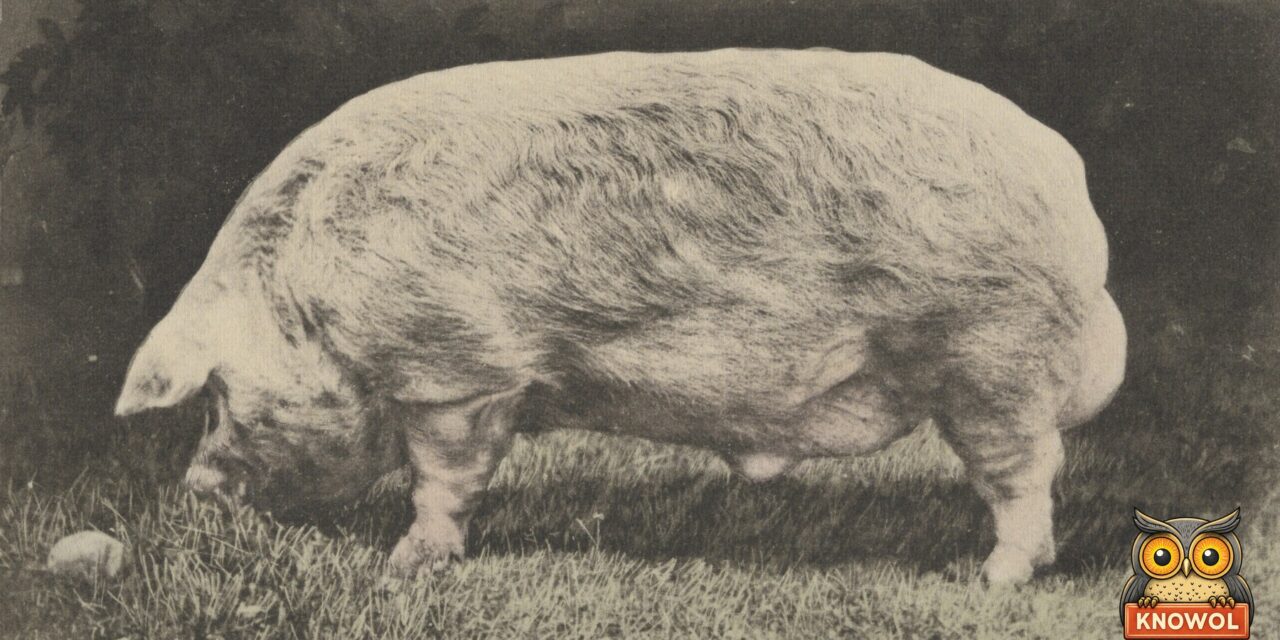
One late-winter day in 1870, a farmer named Joseph Moore had a hog to weigh. Moore lived in St. Clair township in Bedford County, Pennsylvania, and this was no ordinary hog. When it went onto a Fairbanks scale, the scale read 715¾ pounds. That’s about as heavy as four grown men put together.
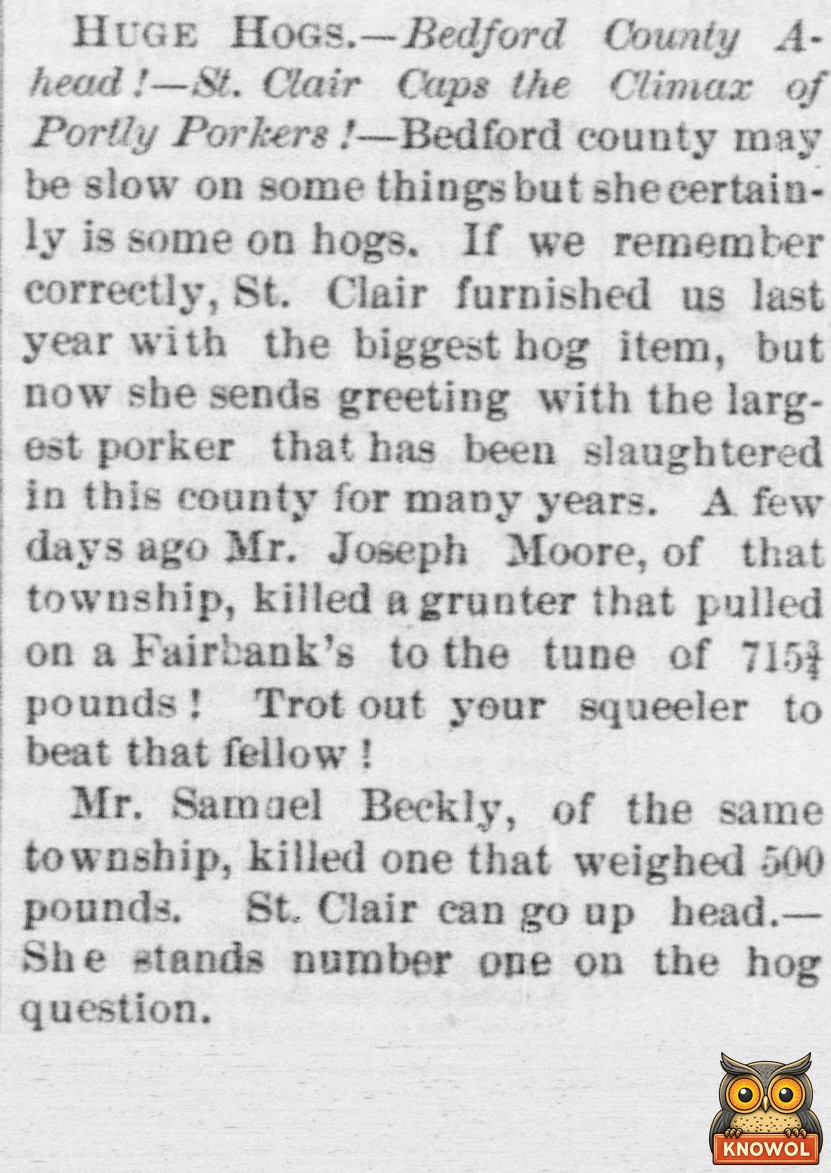
“Huge Hogs.” The Bedford Gazette, Bedford, Pennsylvania, March 3, 1870, page 3. Library of Congress, Chronicling America. Click the clipping to read it full size.
The news reached the town of Bedford, and The Bedford Gazette loved it. On March 3, 1870, the editors printed it under a headline that bragged for the whole county. “Huge Hogs,” it began, and then: “Bedford County Ahead!” Then they threw down a dare to every farmer who read the paper: “Trot out your squeeler to beat that fellow!”
A Winter of Hog Brags in Bedford County
In Bedford County in 1870, a big hog was something to be proud of. Many farm families raised a few. In the cold months they butchered them and salted and smoked the meat to eat all year. A heavy hog meant a full smokehouse, and the local papers loved to print the numbers.
The bragging had started before Christmas. On December 23, 1869, the Gazette reported that its local reporter had “interviewed” four hogs from the Bedford House, a hotel in town. The man who ran it was called “mine host,” an old way to say the friendly fellow who keeps an inn.
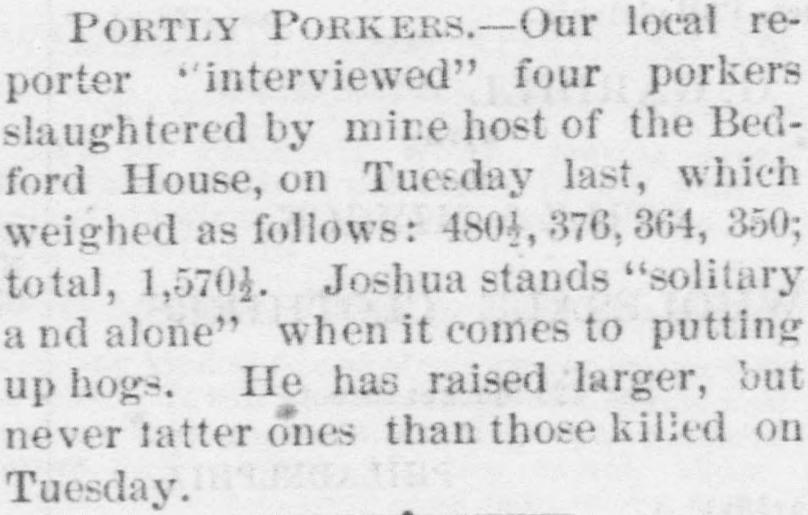
“Portly Porkers.” The Bedford Gazette, December 23, 1869, page 3. Library of Congress, Chronicling America. Click the clipping to read it full size.
His four hogs weighed 480½, 376, 364 and 350 pounds, or 1,570½ pounds in all. The paper said Joshua, the innkeeper, stood “solitary and alone” when it came to “putting up hogs,” which meant turning them into hams, bacon and sausage. In other words, nobody could touch him.
The same column had a stranger brag from Bloody Run, another town in the county. Bloody Run said it had made a sausage “55 feet 6 inches in length.” That’s longer than a city bus. Bloody Run also had a military company, and its captain was the editor of the town’s newspaper, the Press. The Gazette joked that the captain should march out and “make a raid on that elongated hog and things.”
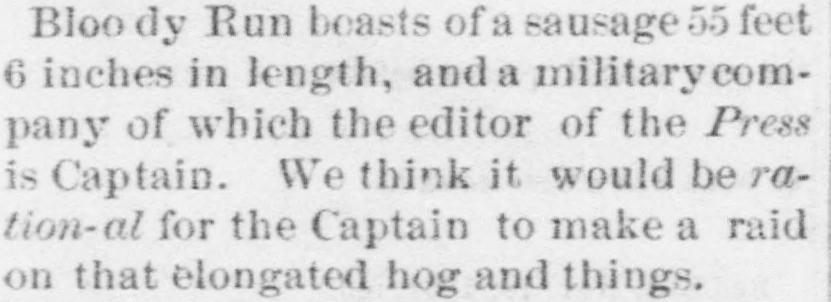
A 55-foot sausage in Bloody Run. The Bedford Gazette, December 23, 1869, page 3. Library of Congress, Chronicling America. Click the clipping to read it full size.
St. Clair Township’s 715¾-Pound Champion
Then came Joseph Moore’s hog, and it beat them all. The Gazette said St. Clair township had given the paper “the biggest hog item” the year before, too. Now it had sent in “the largest porker that has been slaughtered in this county for many years.”
A neighbor in St. Clair, Samuel Beckly, had a 500-pound hog that same season. That was a whopper too, but next to Moore’s it came in second. The Gazette crowned the township: “She stands number one on the hog question.”
The town’s other paper, the Bedford Inquirer, ran the news the next day, March 4, in just three lines. It said “Mr. Jos. Moore of St. Clair tp.” had a hog that “weighed over 700 lbs.” The Inquirer rounded down. The Gazette counted every last quarter pound.

“A Big Hog.” Bedford Inquirer, Bedford, Pennsylvania, March 4, 1870, page 3. Library of Congress, Chronicling America. Click the clipping to read it full size.
How a Fairbanks Scale Settled the Argument
The Gazette made a point of naming the scale. The hog had “pulled on a Fairbank’s,” so the number was no guess. A Fairbanks scale was a platform scale. You set the load on a flat wooden platform, and levers underneath carried its weight to a long arm called a beam. A small sliding weight moved along the beam until it balanced. Then you read the pounds right off the marks.
Before platform scales, people weighed big loads by hanging them from a beam or a “steelyard,” a balancing bar with a hook. A 700-pound hog on a hook is a hard thing to manage. Thaddeus Fairbanks, who made wagons, stoves and plows with his brothers in St. Johnsbury, Vermont, decided there had to be a better way. His company told the story in an 1893 booklet.
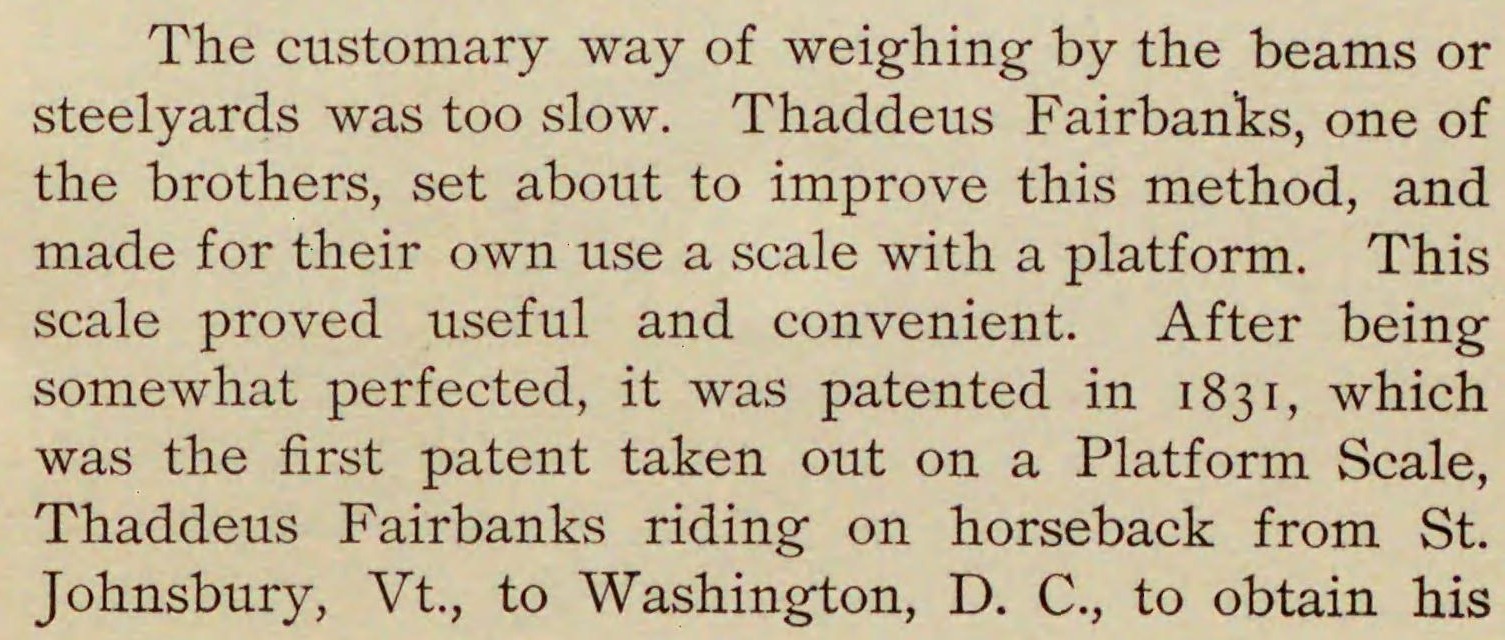
From “Fairbanks’ Scales, the World’s Standard,” E. & T. Fairbanks & Co., St. Johnsbury, Vermont, 1893, page 3. Smithsonian Libraries, via the Internet Archive. Click the clipping to read it full size.
The booklet said the old way “was too slow,” so Fairbanks “made for their own use a scale with a platform.” It was patented in 1831. The booklet called it the first patent ever taken out on a platform scale. Fairbanks rode a horse all the way from Vermont to Washington, D.C., to get it.
By 1893 the company bragged that its scales could weigh “a ship with its cargo, or the lead which wears from one’s pencil in writing his name.”

From “Fairbanks’ Scales, the World’s Standard,” 1893, page 7. Smithsonian Libraries, via the Internet Archive. Click the clipping to read it full size.
What 715 Pounds of Pork Was Worth in Bedford
The Bedford Inquirer printed the town’s prices every week, from G. R. Oster & Co.’s store. Two weeks after Moore’s hog made the paper, on March 18, 1870, pork was 11 cents a pound in Bedford. Butter was 30 cents a pound. A dozen eggs cost 20 cents, and white wheat brought $1.00 a bushel.
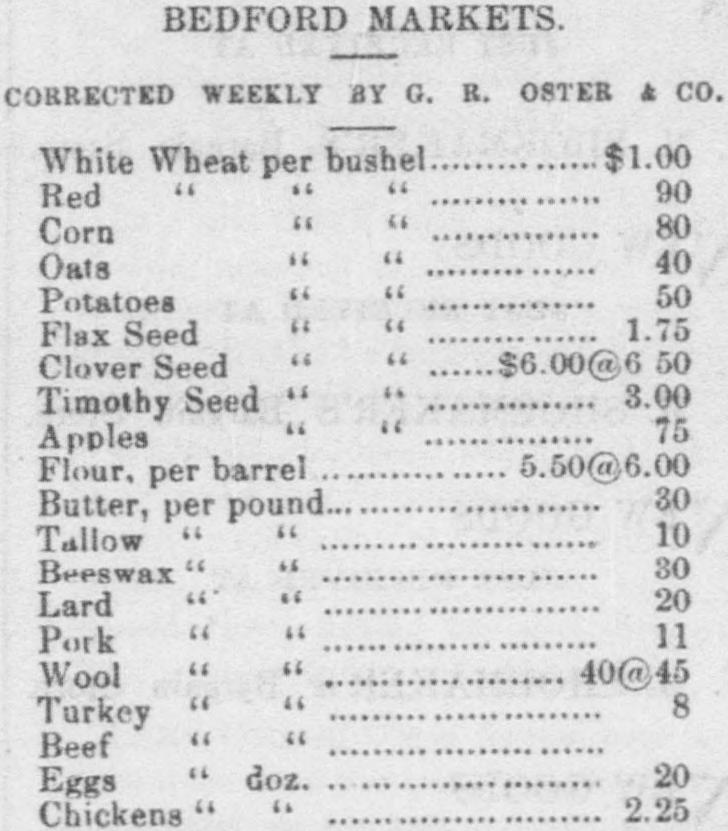
“Bedford Markets.” Bedford Inquirer, March 18, 1870, page 3. Library of Congress, Chronicling America. Click the clipping to read it full size.
If all 715¾ pounds had sold at 11 cents, it would have come to about $78.73. That’s only a rough guess, because not every pound of a hog ends up as pork for sale. Still, it was a lot of hams and bacon for one farm.
Bedford County’s Dare Went Unanswered
The Gazette’s dare was out there for every farmer in the county. We searched the local news pages of both Bedford papers through late March 1870, and we found no answer. No bigger hog came trotting into the Gazette, and nobody wrote in to say a squealer of theirs had topped 715¾ pounds. As far as the papers tell it, Joseph Moore’s hog held the crown.
By spring, Bedford’s hogs had found a new hobby. On March 25, 1870, the Inquirer said “a number of good sized porkers” had been “perambulating our streets for some weeks past.” Perambulating is a fancy word for strolling. The editor guessed the owners had turned them out “as assistant garden makers,” since a hog’s snout digs up the ground like a plow.
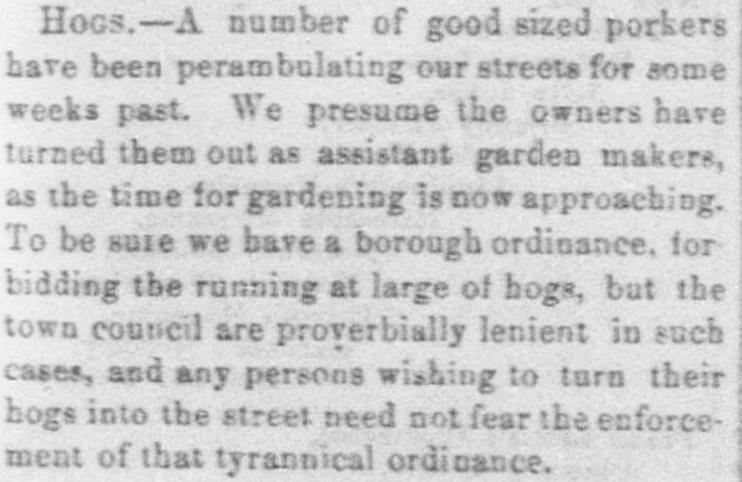
“Hogs.” Bedford Inquirer, March 25, 1870, page 3. Library of Congress, Chronicling America. Click the clipping to read it full size.
The town had a rule against letting hogs run loose. The Inquirer said the council was “proverbially lenient,” which means famous for going easy, so hog owners “need not fear the enforcement of that tyrannical ordinance.” The editor was teasing. In 1870, a hog in the street was just part of life in a Pennsylvania county seat.
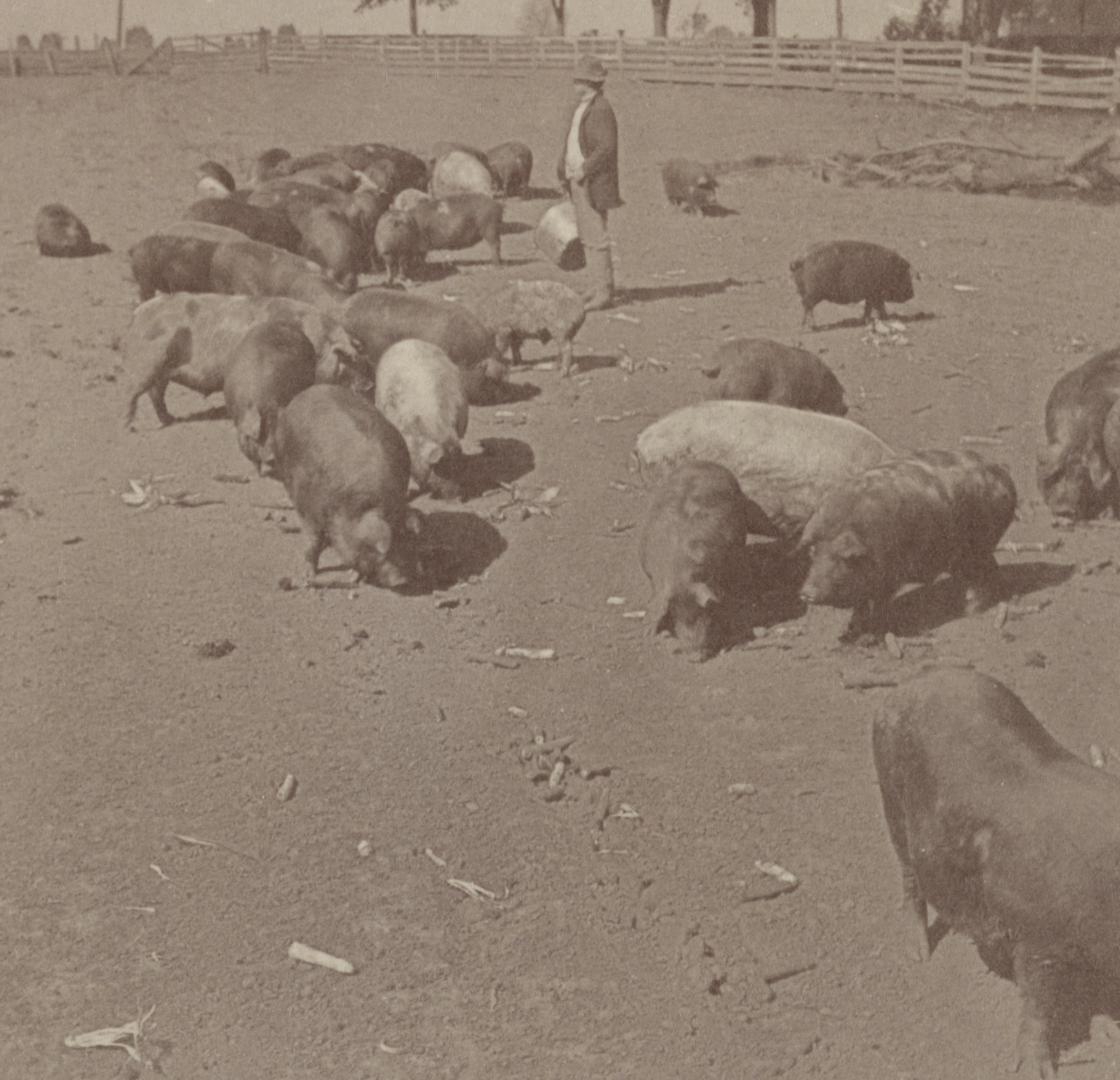
Feeding hogs in an Illinois pasture, 1903. Underwood & Underwood stereograph, Library of Congress. A farm scene like Bedford County’s, but not the same place. Click the picture to see it full size.
The big white hog on the cover isn’t Joseph Moore’s. We know of no picture of his. It’s “Sunny Jim,” a prize Chester White boar at Heart’s Delight Farm in Chazy, New York, on a 1911 postcard. Sunny Jim gives a good idea of what a 700-pound hog looked like, and of why a whole county once stopped to read about one.
Sources
- “Huge Hogs,” “Bedford County Ahead!” The Bedford Gazette, Bedford, Pennsylvania, March 3, 1870, page 3. Library of Congress, Chronicling America
- “Portly Porkers” and the Bloody Run sausage. The Bedford Gazette, December 23, 1869, page 3. Library of Congress, Chronicling America
- “A Big Hog.” Bedford Inquirer, Bedford, Pennsylvania, March 4, 1870, page 3. Library of Congress, Chronicling America
- “Bedford Markets.” Bedford Inquirer, March 18, 1870, page 3. Library of Congress, Chronicling America
- “Hogs.” Bedford Inquirer, March 25, 1870, page 3. Library of Congress, Chronicling America
- The Bedford Gazette, March 10, 17 and 24, 1870, page 3 (no answer to the dare found). Library of Congress, Chronicling America
- “Fairbanks’ Scales, the World’s Standard,” E. & T. Fairbanks & Co., St. Johnsbury, Vermont, 1893, pages 3 and 7. Smithsonian Libraries, via the Internet Archive
- Cover: “Heart’s Delight Farm, Chazy, N.Y., ‘Sunny Jim’ A great pedigreed Chester White Boar,” postcard, 1911. Library of Congress, Prints and Photographs. No known restrictions on publication.
- “Genuine corn-fed pork, feeding hogs in a prairie pasture, Illinois,” Underwood & Underwood stereograph, 1903. Library of Congress, Prints and Photographs. No known restrictions on publication.
- Newspaper pages printed in 1869 and 1870 are in the public domain.