On Sunday afternoon, April 21, 1912, the crowd at Athletic Park in Tulsa, Oklahoma, watched a team of paid ballplayers in deep trouble. It was the bottom of the ninth inning. Tulsa’s team in the Oklahoma State League was losing to the Knights of Columbus, a club of local men who played for fun. Then a catcher named Brown walked up to bat.
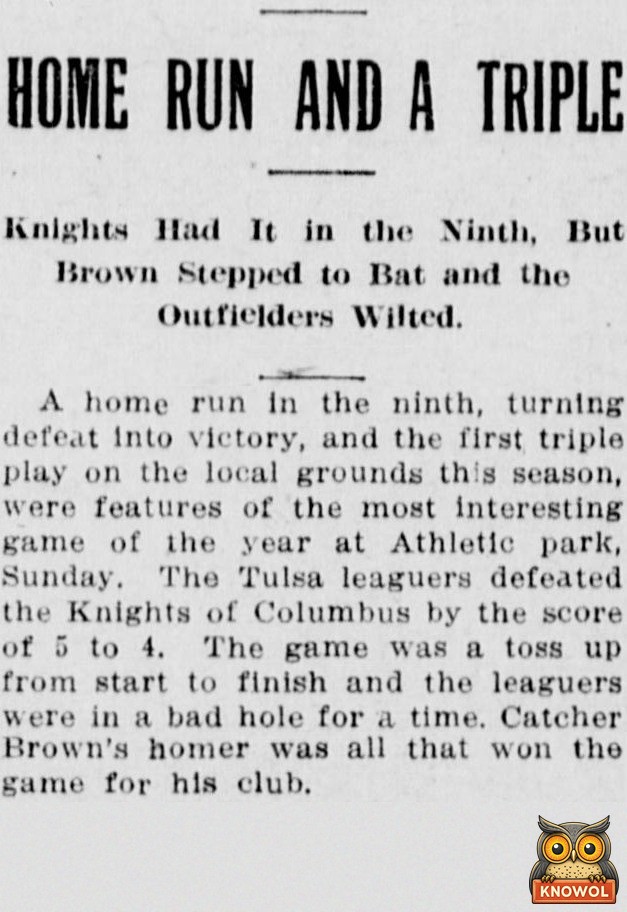
“Home Run and a Triple.” Tulsa Daily World, Tulsa, Oklahoma, April 23, 1912, page 6. Library of Congress, Chronicling America. Click the clipping to read it full size.
The Tulsa Daily World told the story two days later under a big headline: “Home Run and a Triple.” Under it, a second line gave away the ending: “Knights Had It in the Ninth, But Brown Stepped to Bat and the Outfielders Wilted.” The paper called it “the most interesting game of the year.” That was quite a thing to say about a practice game in April.
Pros Against Lodge Men in Tulsa, Oklahoma
In Tulsa in 1912, there were two kinds of baseball. The “leaguers” were the professional team, paid to play in the Oklahoma State League. Their season hadn’t started yet, so they were getting in shape. Manager Price had seventeen players to try out.
The Knights of Columbus were different. The Knights are a Catholic men’s club, and in 1912 their team played in Tulsa’s new City League with clubs from the Elks and the Moose. They were amateurs, local men who played for the fun of it.
So the pros should have won easily. But the Knights had borrowed a good pitcher. His name was Young, and he usually pitched for the Elks. The paper said “Young, the Tulsa Elk’s twirler, worked the entire nine innings in the box for the K. of C’.” A twirler was an old word for a pitcher, and “the box” was the pitcher’s spot.
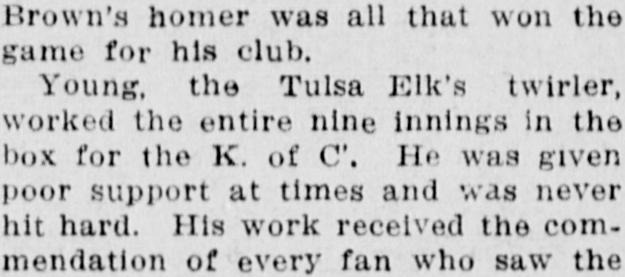
Young, the Elks pitcher, pitched for the Knights. Tulsa Daily World, April 23, 1912, page 6. Library of Congress, Chronicling America. Click the clipping to read it full size.
Young was never hit hard, the paper said. Tulsa’s pros went through three pitchers that afternoon. The score stayed tied until the eighth inning. Then the Knights scored a run and took a 4 to 3 lead.
A Triple Play in Tulsa That Surprised Everyone
In the bottom of the eighth, right after the Knights went ahead, came the strangest play of the day. Tulsa had runners on first and second. A player named Moneymaker (his real name) tried to bunt. He popped the ball up instead, in a soft little fly over the infield.
There’s a rule in baseball for that, called the infield fly rule. If runners are on first and second and a batter pops up an easy fly in the infield, the umpire calls the batter out right away. The rule stops a fielder from dropping the ball on purpose to trick the runners.
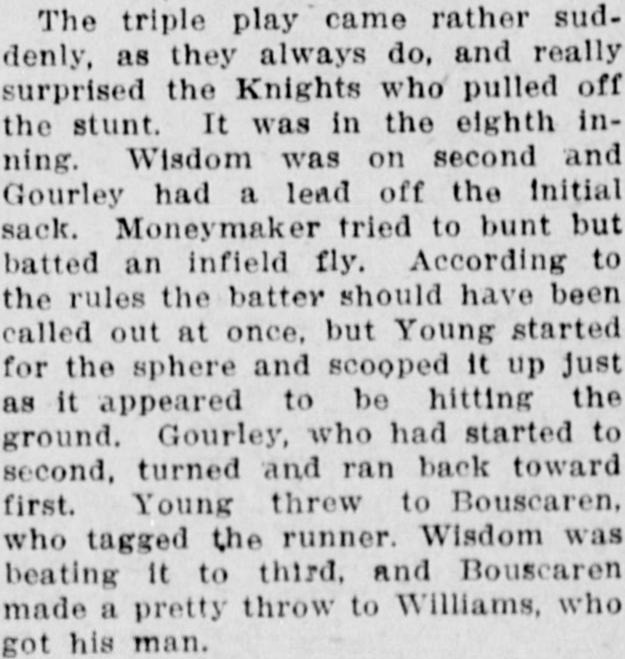
The triple play. Tulsa Daily World, April 23, 1912, page 6. Library of Congress, Chronicling America. Click the clipping to read it full size.
That afternoon, nobody stopped to call it. Young ran in and “scooped it up just as it appeared to be hitting the ground.” The Tulsa runners didn’t know whether to run or stay. Gourley, the runner on first, “turned and ran back toward first.” Young threw to Bouscaren at first base, who tagged him. Wisdom, the runner on second, was racing to third. Bouscaren threw to Williams at third, “who got his man.”
Three outs on one play. It was the first triple play at Athletic Park that season, and the paper said it “really surprised the Knights who pulled off the stunt.” Even the fielders who made it hadn’t seen it coming.
Two Strikes, Three Balls, One Swing
Now it was the last of the ninth, and the Knights led by one run. The first Tulsa batter struck out. Then Kester, the second baseman, hit a double. (His brother was one of Tulsa’s pitchers that day.) Gabriel bunted him over to third base. That made two outs, with a runner on third and Brown at the plate.
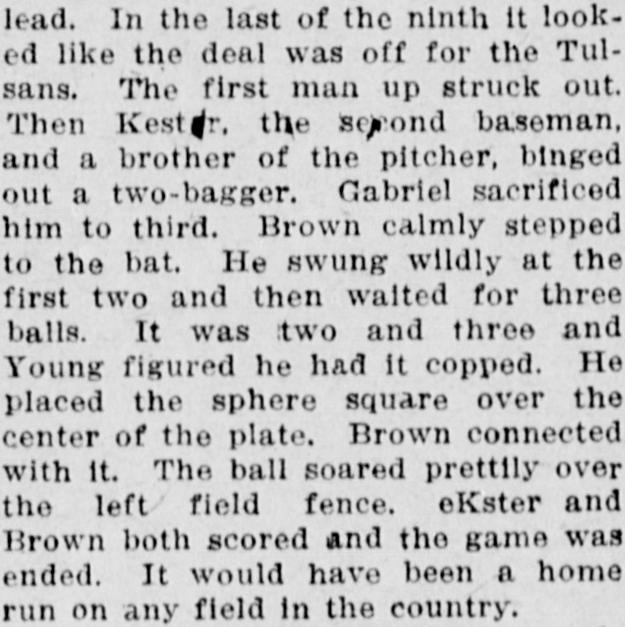
Brown’s turn at bat in the ninth. Tulsa Daily World, April 23, 1912, page 6. Library of Congress, Chronicling America. Click the clipping to read it full size.
The paper said “Brown calmly stepped to the bat.” He swung hard and missed twice. Then he let three balls go by. That’s a full count: one more strike and he was out, one more ball and he walked.
Young “figured he had it copped,” which meant he thought he had Brown beat. He threw the ball “square over the center of the plate.” Brown hit it. “The ball soared prettily over the left field fence.” Kester and Brown both ran home, and Tulsa won, 5 to 4. The paper bragged that “It would have been a home run on any field in the country.”
Who Was Catcher Brown of Tulsa?
The Tulsa Daily World named him a few weeks earlier, when the team was practicing in Chelsea, Oklahoma. In late March it wrote, “Loren Brown, catcher last year with Fort Smith, arrived today.” Fort Smith is just across the line in Arkansas. Before he came to camp, Brown told the paper, he had been working in a mine at McCurtain, Oklahoma.

Tulsa Daily World, March 29, 1912, page 6. Library of Congress, Chronicling America. Click the clipping to read it full size.
Riding the Trolley to the Ballpark
Getting to Athletic Park was part of the adventure. The park was out on the Sand Springs line, so fans rode electric trolley cars from downtown Tulsa. That Sunday, the cars couldn’t keep up. “The car service Sunday was inadequate,” the paper said, because more people than expected rode out to the game and to the town of Sand Springs.
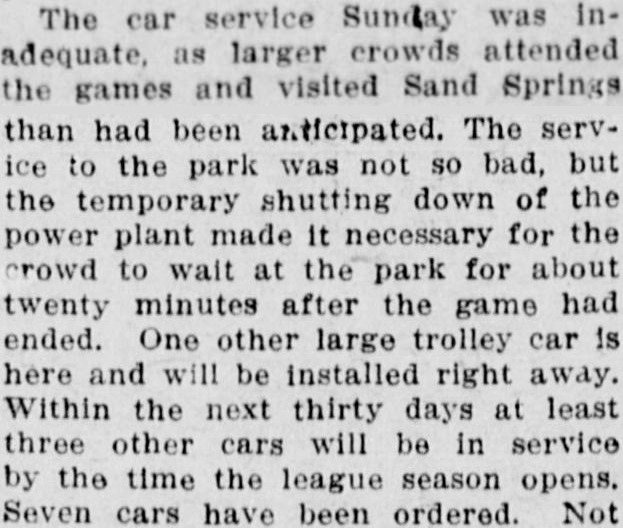
Too many fans for the trolleys. Tulsa Daily World, April 23, 1912, page 6. Library of Congress, Chronicling America. Click the clipping to read it full size.
It got worse after the last out. The power plant shut down for a while, and with no electricity the trolleys couldn’t move. The crowd had to “wait at the park for about twenty minutes after the game had ended.” Help was coming, though. Seven new cars had been ordered.
By Wednesday, the paper promised big cars “capable of seating over a hundred passengers.” They would leave the corner of Fourth and Main streets every thirty minutes. If you caught the 3:30 car, you’d make it to the park in time for the first pitch.

Tulsa from the corner of Main and Second streets, about 1910, with a streetcar on Main Street. Panoramic photo by Clarence Jack, Library of Congress. Click the picture to see it full size.
The Rest of the Tulsa Series
Both managers liked Sunday’s game so much that they set up three more games at Athletic Park. The paper said they “will be splendid practice for both aggregations.” Aggregations was a fancy word for teams.
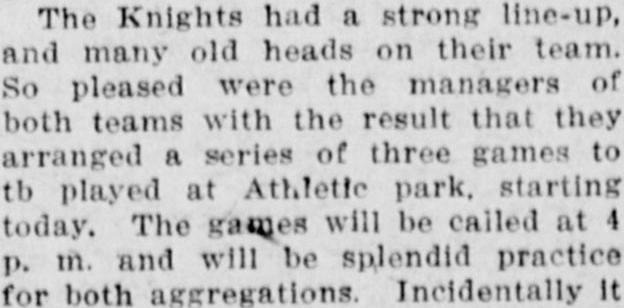
A series of three games. Tulsa Daily World, April 23, 1912, page 6. Library of Congress, Chronicling America. Click the clipping to read it full size.
The pros didn’t let it get close again. On Tuesday they won 15 to 0, and Brown “duplicated his feat of Sunday, by slamming out a home run.” Gabriel, the player who had bunted Kester to third, pitched that day and struck out 12 batters.
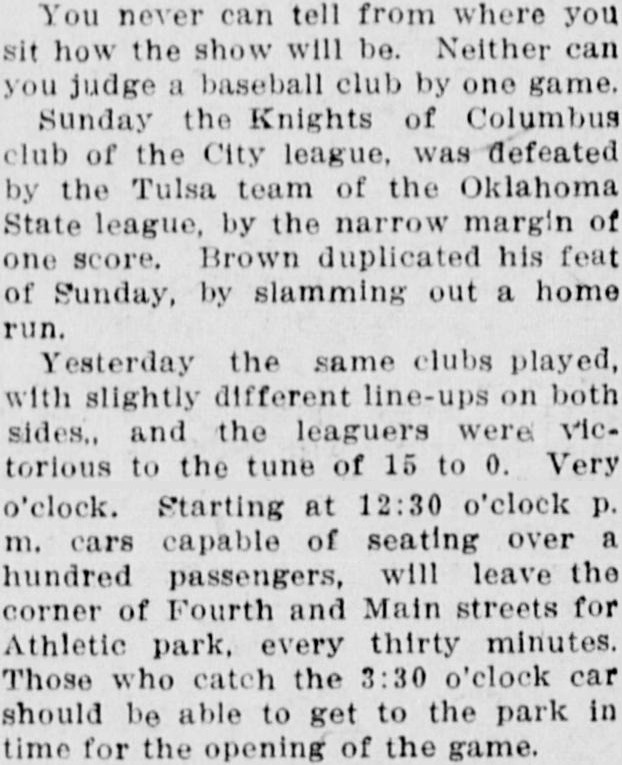
Brown did it again. Tulsa Daily World, April 24, 1912, page 6. Library of Congress, Chronicling America. Click the clipping to read it full size.
On Wednesday, Manager Price even lent the Knights one of his own pitchers, Henderson. It didn’t help much. The Knights’ fielders made ten errors, and Tulsa won 7 to 0. The headline read “Tulsans Again Shut Out Clever Knights.”
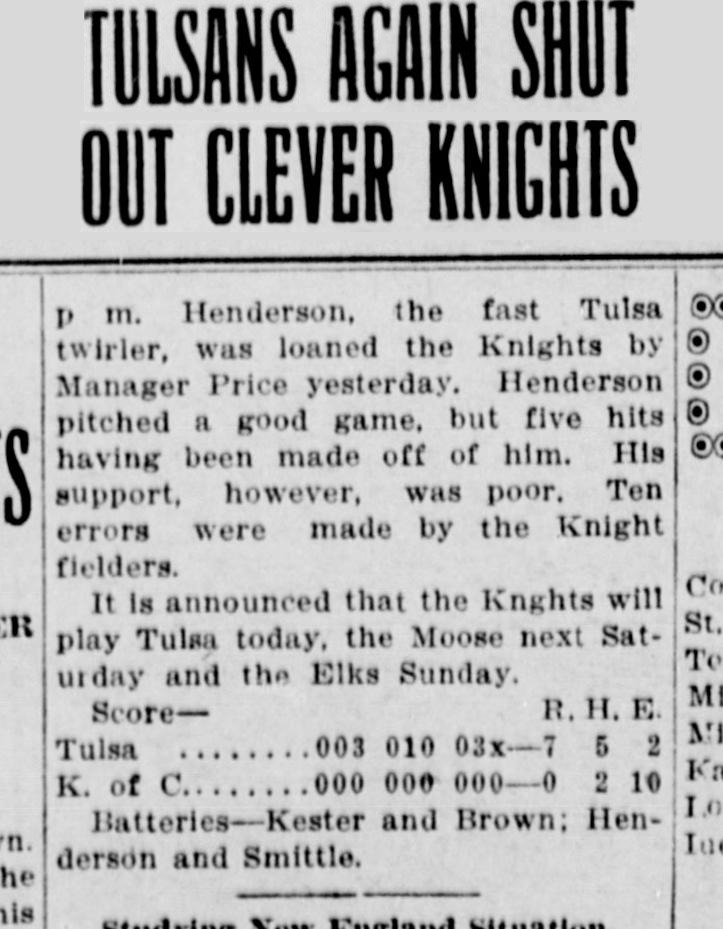
“Tulsans Again Shut Out Clever Knights.” Tulsa Daily World, April 25, 1912, page 6. Library of Congress, Chronicling America. Click the clipping to read it full size.
What Happened to the Tulsa Players
The Knights went back to the City League to play the Moose and the Elks. Tulsa’s pros started their league season that spring. By June, the paper was calling Gabriel “the most sensational twirler that ever played in the state.” He wasn’t just a pitcher. He was the third best hitter in the whole league.
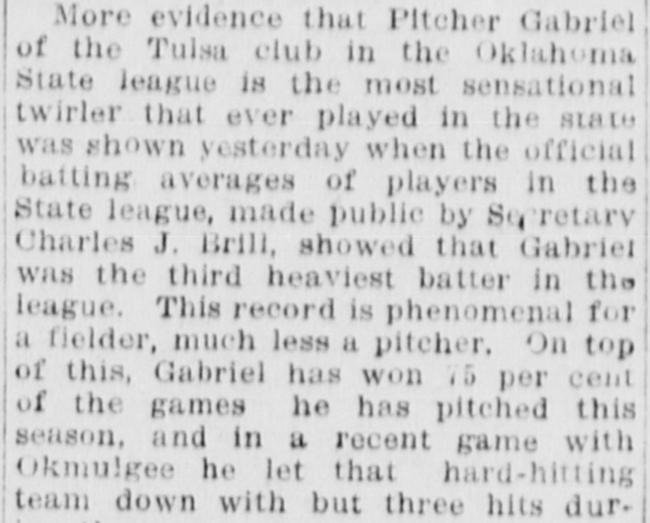
Gabriel’s big season. Tulsa Daily World, June 9, 1912, page 7. Library of Congress, Chronicling America. Click the clipping to read it full size.
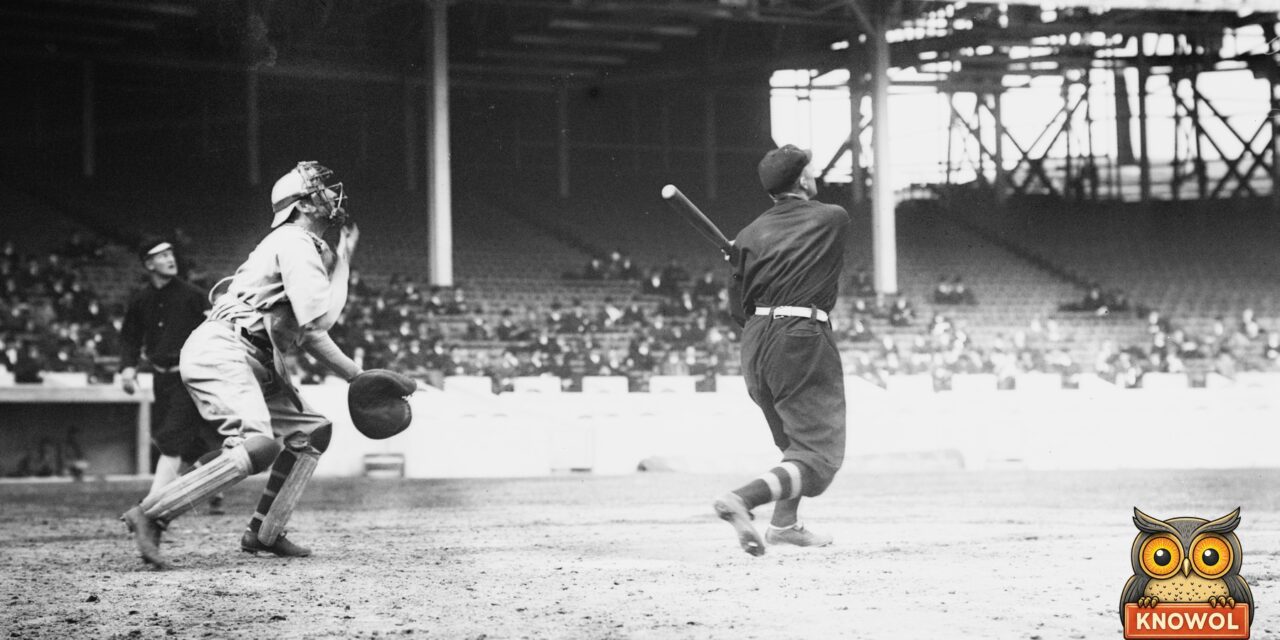
The ballplayer on the cover isn’t Loren Brown. No photo of that Tulsa game is known. It’s Fred Merkle of the New York Giants at the Polo Grounds in New York in 1911, just after a big swing, with the catcher looking up to follow the ball. It shows what Brown’s swing may have looked like when the Knights’ lead sailed over the left field fence in Tulsa.
Sources
- “Home Run and a Triple.” Tulsa Daily World, Tulsa, Oklahoma, April 23, 1912, page 6. Library of Congress, Chronicling America
- Second game and trolley schedule. Tulsa Daily World, April 24, 1912, page 6. Library of Congress, Chronicling America
- “Tulsans Again Shut Out Clever Knights.” Tulsa Daily World, April 25, 1912, page 6. Library of Congress, Chronicling America
- Loren Brown at spring practice in Chelsea. Tulsa Daily World, March 29, 1912, page 6. Library of Congress, Chronicling America
- Gabriel’s season. Tulsa Daily World, June 9, 1912, page 7. Library of Congress, Chronicling America
- Cover: “Fred Merkle (New York NL) at bat, Red Murray (New York NL) walking in background, and unidentified catcher at the Polo Grounds, NY, 1911 World Series,” Bain News Service. Library of Congress, Prints and Photographs. No known restrictions on publication.
- “Tulsa from corner [of] Main and Second Streets,” panoramic photo by Clarence Jack, copyright 1910. Library of Congress, Prints and Photographs. No known restrictions on publication.
- Newspaper pages printed in 1912 are in the public domain.