On Monday night, December 5, 1887, a brand-new bus rolled out of Rock Island, Illinois, headed for Davenport, Iowa, just across the Mississippi River. It had cushioned seats, warm robes for laps and room for 16 riders, and a ride cost only a dime. But guards stopped it on its very first trip.
The guards worked for the U.S. Army. To get from Rock Island to Davenport, Iowa, the road crossed an island in the river, and the island belonged to the Army. It was the home of the Rock Island Arsenal, and the bridges on that road were government bridges. So a ten-cent bus ride turned into a question for the Secretary of War in Washington, D.C.
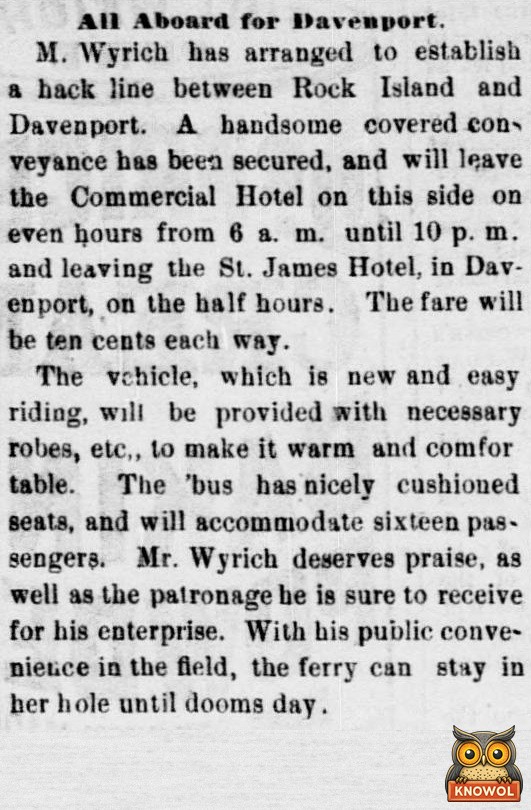
“All Aboard for Davenport.” Rock Island Argus, Rock Island, Illinois, December 3, 1887, page 3. Library of Congress, Chronicling America. Click the clipping to read it full size.
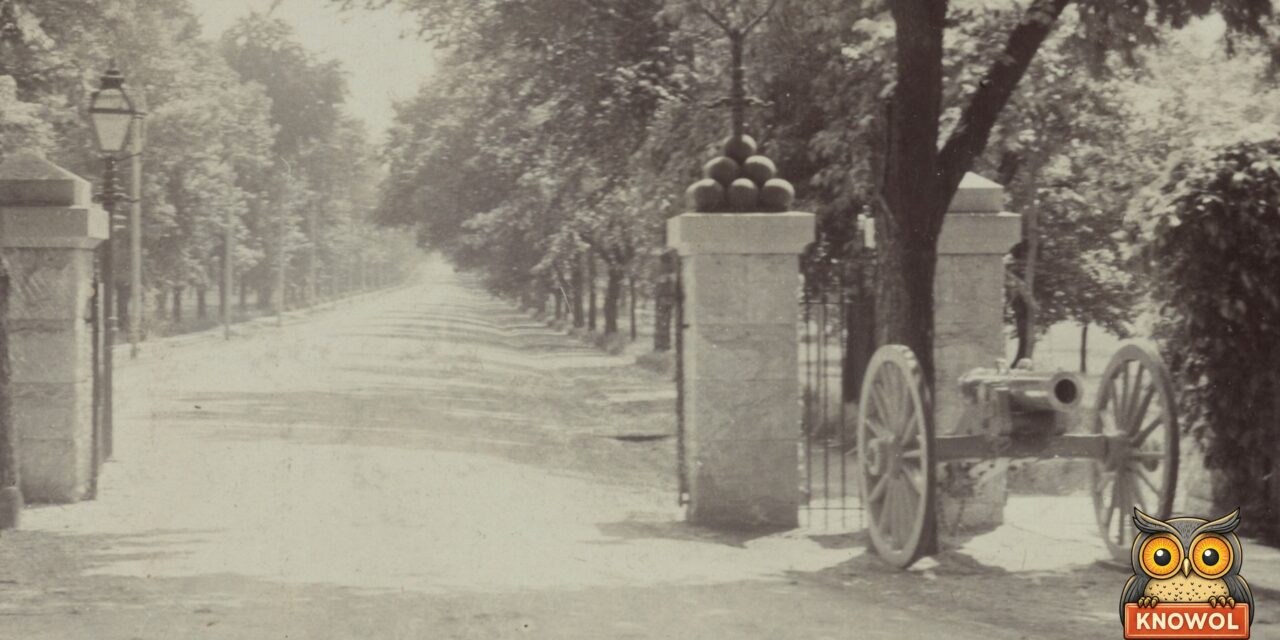
The picture at the top of this story shows an entrance to the government grounds at Rock Island in 1903. Cannonballs are stacked on top of the stone gateposts, and an old cannon sits beside them. It was taken 16 years after the bus story.
Why Rock Island, Illinois, Needed a Way Across
Rock Island, Illinois, and Davenport, Iowa, face each other across the Mississippi River. In the fall of 1887, the river was strangely low. On November 29 the Rock Island Argus asked in a big headline, “IS THE RIVER RUNNING DRY?” An “observing citizen” told a reporter he worried “as to whether or not there will be a water famine here some day.”
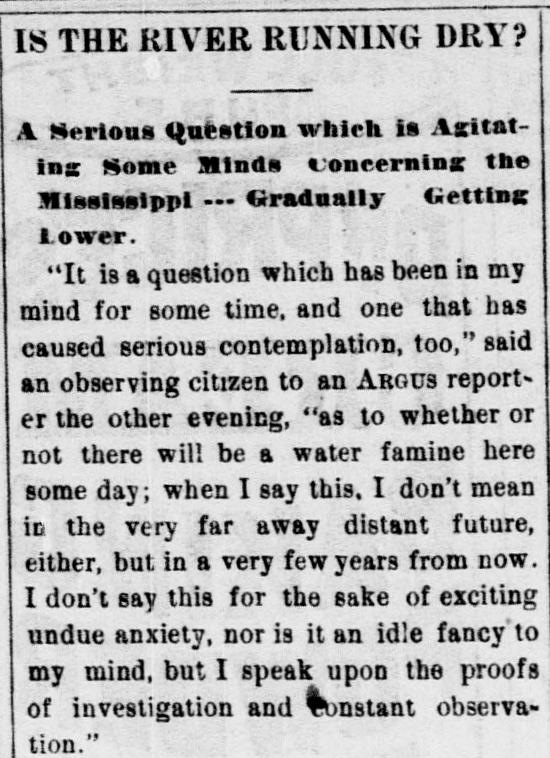
“Is the River Running Dry?” Rock Island Argus, Rock Island, Illinois, November 29, 1887, page 3. Library of Congress, Chronicling America. Click the clipping to read it full size.
Then the cold came, and chunks of ice jammed together in the shallow water and piled up like a dam, which rivermen called an ice gorge. The ferry, a steamboat that carried people between the two towns, got stuck. On December 1 the Argus said it was “hemmed in by a gorge at the lower saw mill, and with the present low water, may not get around again this season.”
A week later the paper said it even more plainly: “The river never was so low at this time of the year in all its history, as far as known by those now living along its banks.”
What a Ride Cost in Rock Island, Illinois
With the ferry stuck, people in Rock Island could walk across the bridges to Davenport, or they could hire a hack. A hack was a carriage with a driver for hire, the taxi of its day, and the Argus thought the hack drivers charged far too much. Readers could “Pay a hackman the extortionate sum of fifty cents or $1, or walk,” it said.
A streetcar ride cost five cents, but no streetcar line crossed the river. The Argus called its story “A PENNED UP PUBLIC,” and it began with a wish people made every winter: “Oh, for the street railway!” Then it asked, “But where are the cars?”
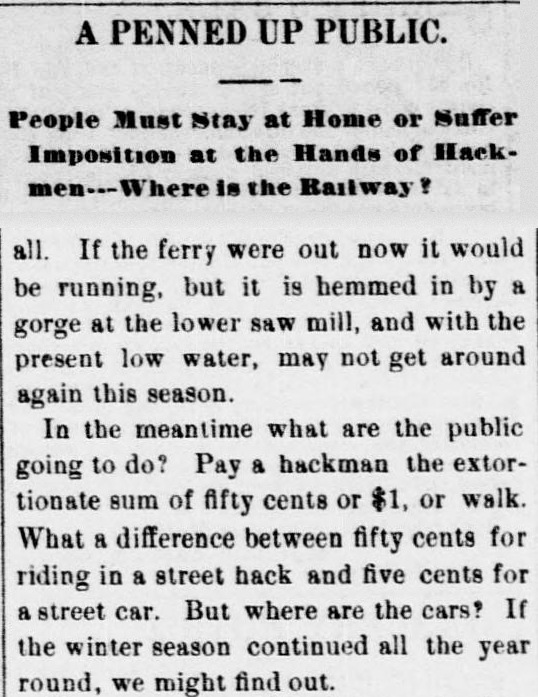
“A Penned Up Public,” Rock Island Argus, Rock Island, Illinois, December 1, 1887, page 3. The headline and a later paragraph of the same story, joined. Library of Congress, Chronicling America. Click the clipping to read it full size.
The next day the Argus printed an idea from a letter writer in Davenport. He wanted someone to run a light wagon with ten seats between the two towns, for ten cents a rider. He even gave it a name, the “Diligence,” an old word for a stagecoach. “Within one week’s time, when it becomes known that the ‘Diligence’ is running on time at ten cents per passenger, a full load will never be lacking both ways,” he wrote.
All Aboard for Davenport, Iowa
One day later, on Saturday, December 3, 1887, the Argus had good news under the headline “All Aboard for Davenport.” A Rock Island man named M. Wyrich had found “A handsome covered conveyance” to run between the two towns. It would leave the Commercial Hotel in Rock Island “on even hours from 6 a. m. until 10 p. m.,” which meant right on the hour, and it would start back from the St. James Hotel in Davenport on the half hour.
“The fare will be ten cents each way,” the paper said. Robes would keep riders “warm and comfortable,” and “The ‘bus has nicely cushioned seats, and will accommodate sixteen passengers.”
That little mark in front of “‘bus” was there for a reason. In 1887, bus was still a short way of saying omnibus, a big wagon with seats for lots of riders, from a Latin word that means “for all.” The Argus was thrilled, and it said that with the bus running, “the ferry can stay in her hole until dooms day.”
The Rock Island Ferry Came Back Fast
The ferry did not stay in her hole. On Sunday, December 4, the day after the bus news, the ferry boat Spencer broke out and started running again between Rock Island and Davenport, the second time she had come out that winter. The Argus noticed the timing. “The establishment of that ‘bus line over the bridge struck a tender spot somewhere,” it said.
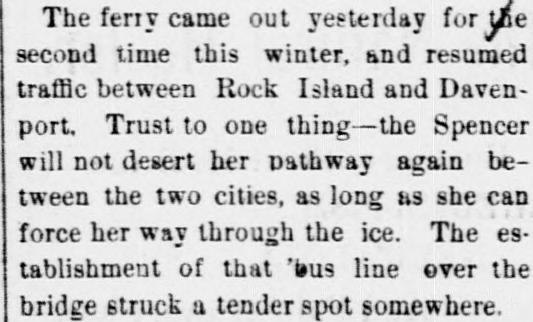
The ferry Spencer comes back out. Rock Island Argus, Rock Island, Illinois, December 5, 1887, page 3. Library of Congress, Chronicling America. Click the clipping to read it full size.
Stopped at the Army’s Bridge in Rock Island, Illinois
Wyrich’s bus made its first run on Monday night, December 5. Its road went over a short government bridge from the city of Rock Island onto the island, across the Army’s grounds, and then over the long government bridge to Davenport. The Army had finished that big bridge in 1872. It had two levels, one for trains and one for wagons and people on foot. One section could swing open to let steamboats pass.
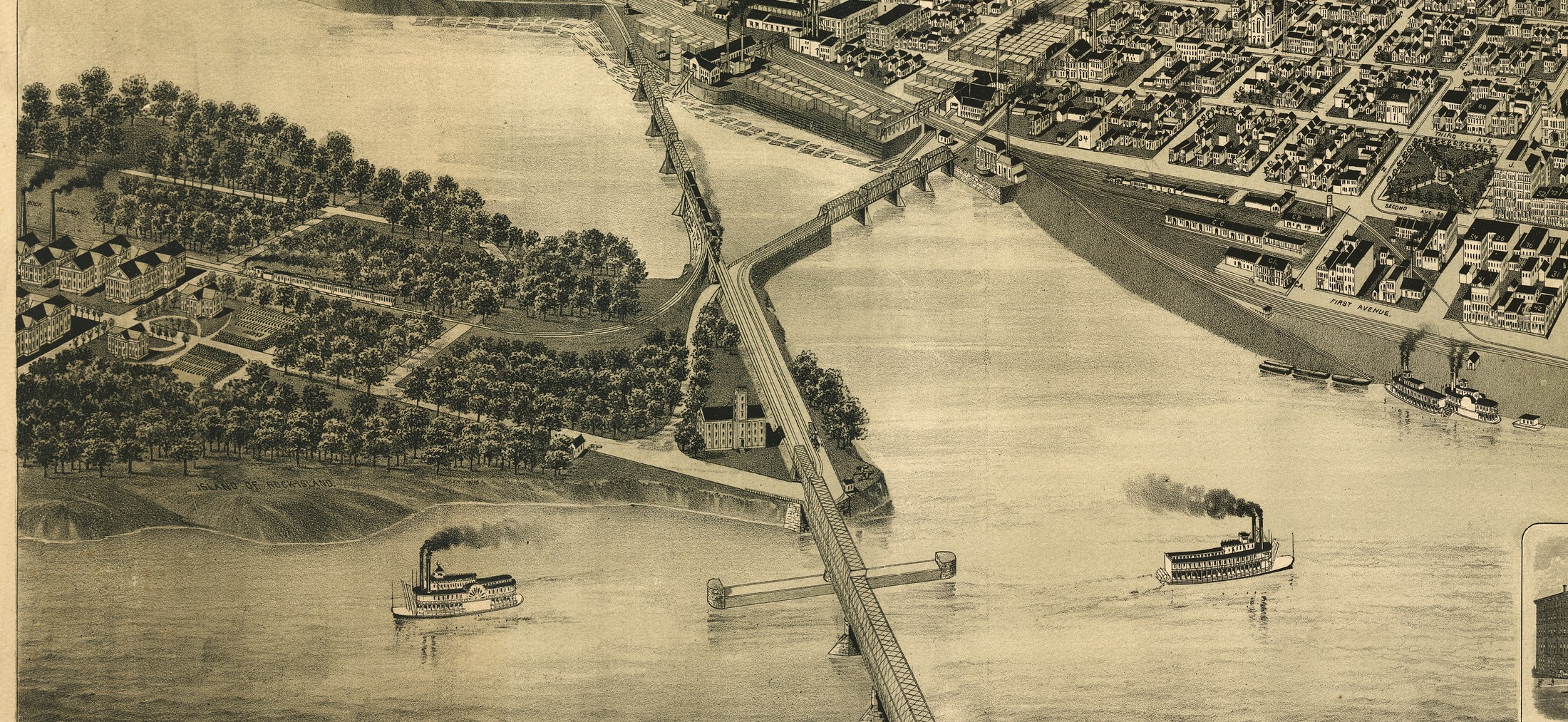
The way the bus had to go, on a bird’s-eye map of Rock Island drawn two years later. A short bridge runs from the city (upper right) onto the Army’s island (left), and the long government bridge heads across the Mississippi toward Davenport (bottom). “Rock Island, Ill.,” American Publishing Co., 1889. Library of Congress Geography and Map Division. Click the picture to see it full size.
The guards on the bridges had orders. “The ‘bus was stopped by the guards on its first trip, and the driver given to understand that he must get a permit from the proper authorities before he could be allowed to pass,” the Argus reported on December 7.
Wyrich didn’t give up right away. He went to the superintendent of bridges, a man named Fleming, who gave him a note telling the guards to let the bus pass for now. But Wyrich also had to see Col. Baylor, the commandant, or officer in charge, of the arsenal. On Tuesday, December 6, he met the colonel at his headquarters on the island. The answer: “permission must be obtained of the secretary of war before the ‘bus could be continued.”
So Wyrich took his bus off the road and asked Washington. The Argus called its story “VANISHING THE VAN,” and it said the bus line’s career “was short, but wholly satisfactory, while it lasted.”
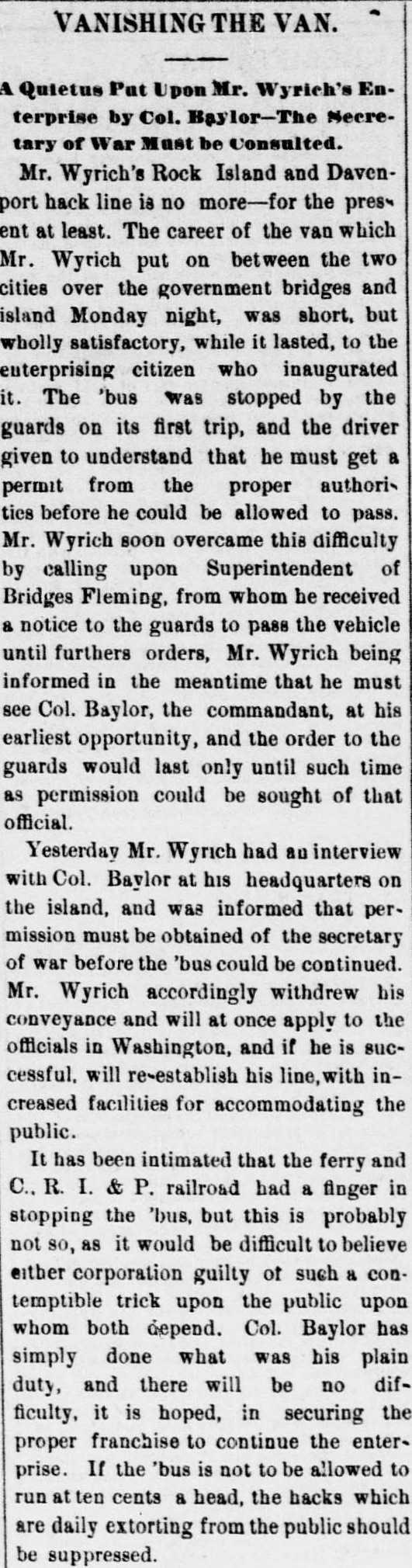
“Vanishing the Van.” Rock Island Argus, Rock Island, Illinois, December 7, 1887, page 3. Library of Congress, Chronicling America. Click the clipping to read it full size.
Some people whispered that the ferry and the Chicago, Rock Island & Pacific railroad, whose trains crossed the big bridge, had “a finger in stopping the ‘bus.” The Argus said that was “probably not so,” and it stood up for the colonel: “Col. Baylor has simply done what was his plain duty.” It had a warning, too. “If the ‘bus is not to be allowed to run at ten cents a head, the hacks which are daily extorting from the public should be suppressed.”
Rock Island, Illinois, Gets an Answer From Washington
The answer came two months later, and it went to a different Rock Island man. On February 11, 1888, the Argus reported that William Huber “has got permission from Secretary of War Endicott,” approved by Col. T. G. Baylor, to run buses between Rock Island and Davenport “over the bridges.” Huber’s buses would “make a trip every half hour, leaving Market square every morning at 7 a. m.” And “The fare will be only ten cents.”
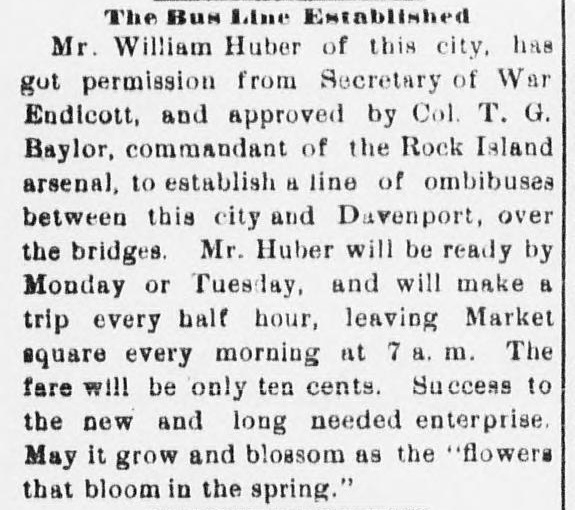
“The Bus Line Established.” Rock Island Argus, Rock Island, Illinois, February 11, 1888, page 2. Library of Congress, Chronicling America. Click the clipping to read it full size.
The paper sent the new bus line off with a line from a song in The Mikado, a popular comic opera of the day: “May it grow and blossom as the ‘flowers that bloom in the spring.'” The papers we found don’t say what became of Wyrich’s own request.
Even the Streetcars in Rock Island, Illinois, Had to Wait
The Army’s island kept slowing things down. In 1891 the street railway in Rock Island and Davenport was switching to electric cars. But the wires that powered them couldn’t cross the government bridge until the War Department said yes. That March the Argus repeated a complaint from the Davenport Democrat: “This order, for some mysterious, red tape reason, does not come, and in the meantime things are standing still.”
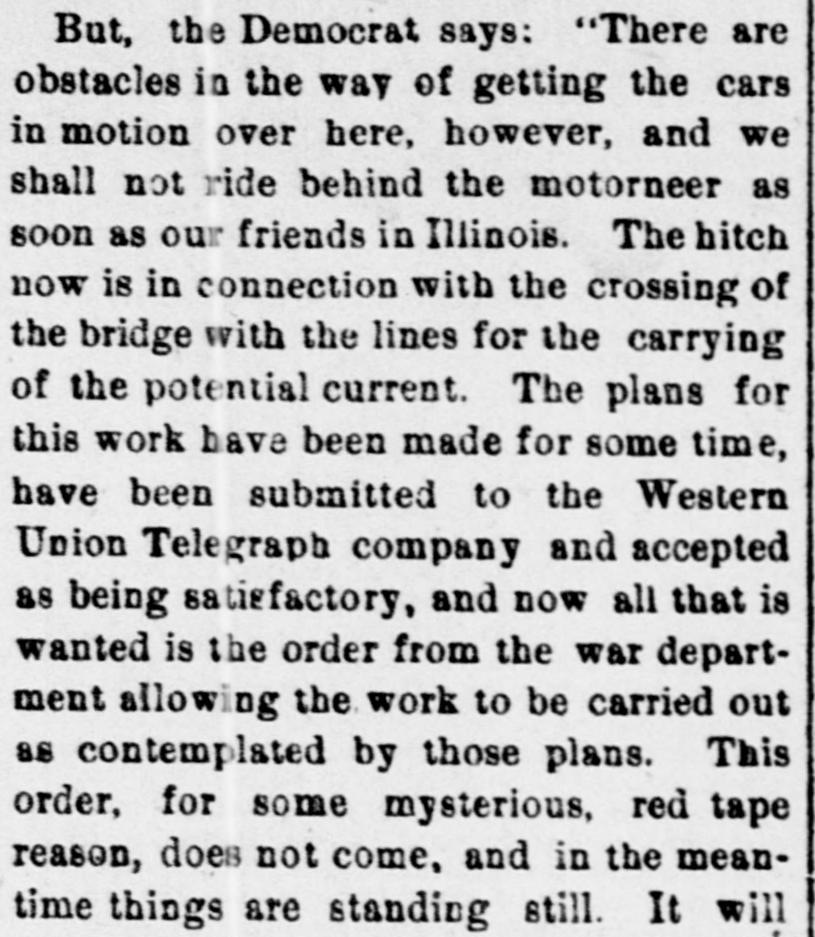
From a story on the new electric streetcars, Rock Island Argus, Rock Island, Illinois, March 11, 1891, page 6, quoting the Davenport Democrat. Library of Congress, Chronicling America. Click the clipping to read it full size.
That June the street railway’s manager, Mr. Louderback, told the Argus his plan for now: electric cars would run up to the bridges on each side, and in between, horses would pull the cars over, with “horses being attached at the approaches to the bridges to cross the same and the island.”
By 1909 the Tri-City Railway had streetcar rails on the big bridge, a government history of the bridge says. The Army rebuilt that bridge in 1896 on the same stone piers, and a government survey in 1985 found it still carrying trains, cars and people across the river. The island is still the Rock Island Arsenal. And it all started one cold December, when the Mississippi ran low, the ferry got stuck, and a Rock Island man with a covered bus and a ten-cent fare found out that the road to Davenport ran through the U.S. Army.
Sources
- “All Aboard for Davenport,” Rock Island Argus (Rock Island, Illinois), December 3, 1887, page 3. Library of Congress, Chronicling America.
- “Is the River Running Dry?” Rock Island Argus, November 29, 1887, page 3. Library of Congress, Chronicling America.
- “A Penned Up Public,” Rock Island Argus, December 1, 1887, page 3. Library of Congress, Chronicling America.
- “One Way of Settling It” (the Davenport letter about the “Diligence”), Rock Island Argus, December 2, 1887, page 3. Library of Congress, Chronicling America.
- The ferry Spencer comes back out, Rock Island Argus, December 5, 1887, page 3. Library of Congress, Chronicling America.
- “Vanishing the Van” and “The River” (the low water), Rock Island Argus, December 7, 1887, page 3. Library of Congress, Chronicling America.
- “The Bus Line Established,” Rock Island Argus, February 11, 1888, page 2. Library of Congress, Chronicling America.
- The electric streetcars wait on the War Department, Rock Island Argus, March 11, 1891, page 6. Library of Congress, Chronicling America.
- “Street Railway Improvements,” Rock Island Argus, June 8, 1891, page 5. Library of Congress, Chronicling America.
- Historic American Engineering Record, “Rock Island Arsenal, Rock Island Bridge” (HAER IL-20-P), 1985. Library of Congress Prints and Photographs Division. The 1872 bridge, its two decks and swing span, the 1896 rebuilding and the Tri-City Railway rails.
- Cover photo: “Looking up the Avenue, Entrance to Government Grounds, Rock Island, Ill.,” stereograph by C. L. Wasson, 1903. Library of Congress Prints and Photographs Division. No known restrictions on publication.
- Map: “Rock Island, Ill.,” American Publishing Co., 1889. Library of Congress Geography and Map Division.
- The newspapers, photograph and map above were all published before 1931 and are in the public domain. The 1985 engineering record is a U.S. government work.