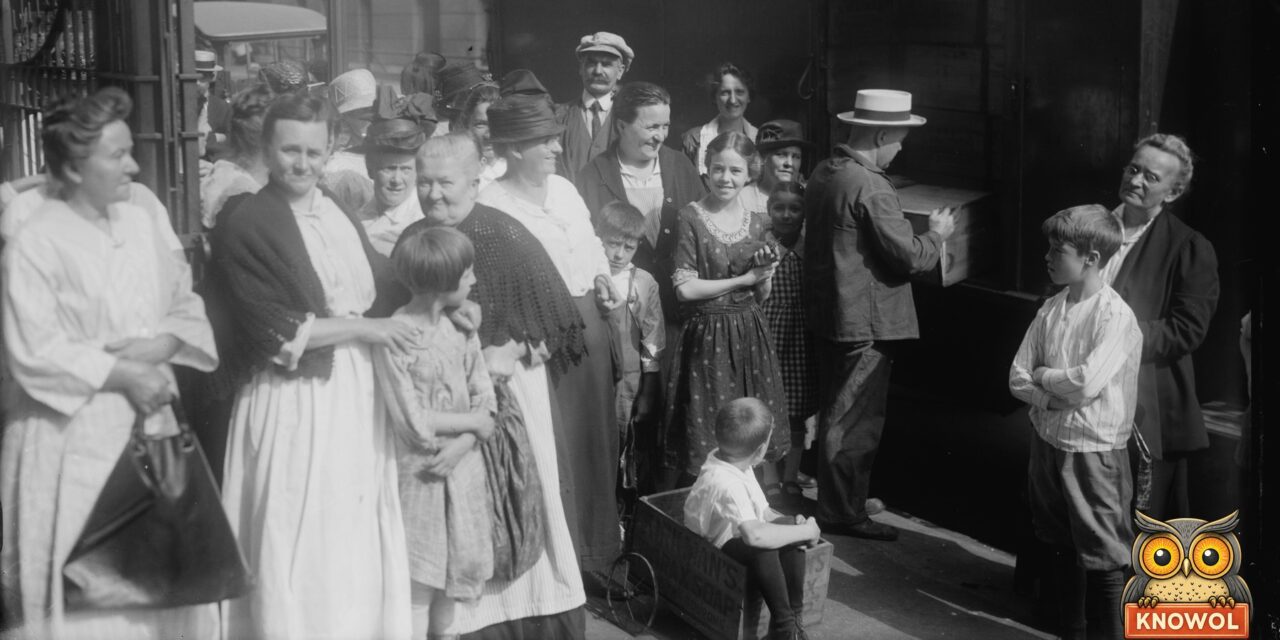
Long before the doors opened at 10 o’clock on Thursday, August 21, 1919, crowds were waiting outside public schools all over New York City. School was out for the summer, so nobody had come to learn. They had come to shop. That morning the city planned to open 58 schools as grocery stores, and their shelves held food the U.S. Army had bought for its soldiers and never used.
The New-York Tribune said the waiting crowd was “mostly women and children, bearing all manner of receptacles.” That is an old way of saying they brought anything that could carry groceries. By the end of the day, the paper said, some 30,000 “perspiring but satisfied householders” had carried off about 1,000,000 pounds of food. The fun part was watching how they got it all home.
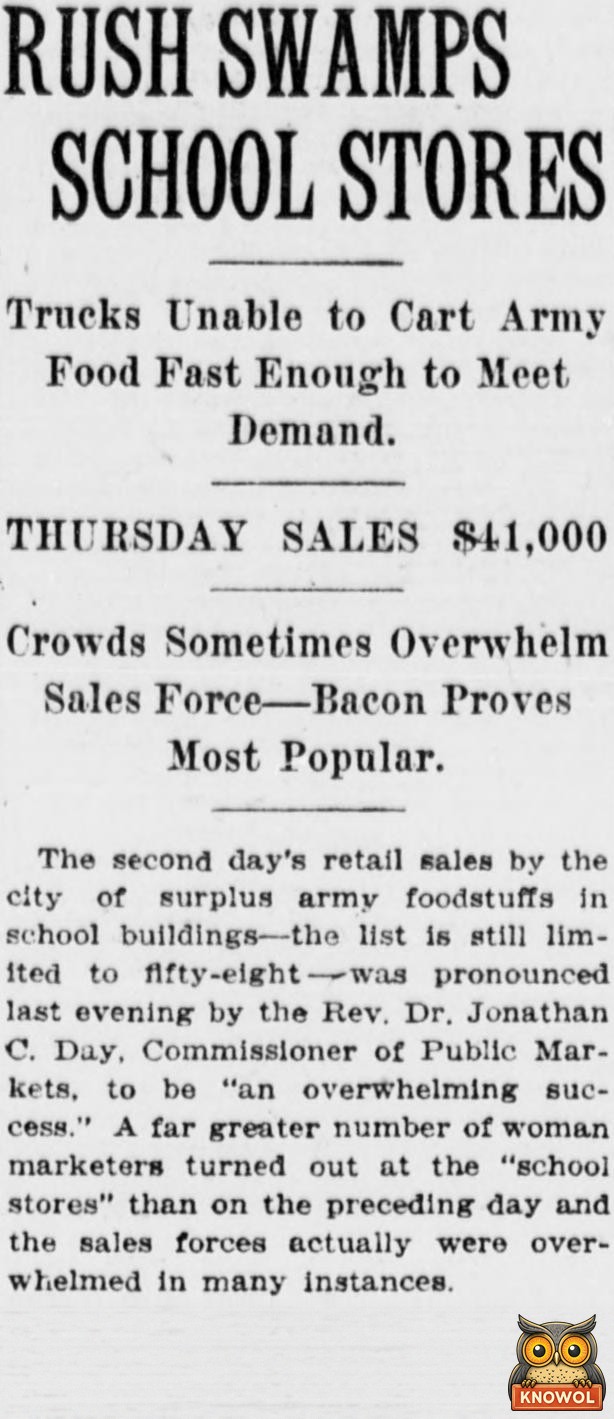
“Rush Swamps School Stores,” The Sun, New York, New York, August 23, 1919, page 1. Library of Congress, Chronicling America. Click the clipping to read it full size.
The picture at the top of this story was taken that same day by Bain News Service, a New York City news photo company. Its glass negative is marked “Food Sale 8/21/19,” and it shows mothers and children waiting their turn while a boy sits in a wagon made from a wooden soap box. The record doesn’t say which school or street it shows.
Why New York City Sold Army Food in Its Schools
In New York City in 1919, shoppers fretted about the “H. C. of L.,” short for the high cost of living. The Tribune wrote about “everyday women who worry seven days a week about the H. C. of L.” The Sun showed how far money had slipped by using a bushel of wheat as a yardstick. In the summer of 1899, it said, wheat sold for 70 cents a bushel. In 1919 the government promised farmers $2.26. The paper’s verdict: “the dollar of 1919 is not the dollar of yore in its power to please.” Yore means long ago.
Meanwhile, World War I had ended in November 1918, and the Army had warehouses full of food it no longer needed. In New York City, the job of selling it went to the Department of Public Markets. Its head was a minister, the Rev. Dr. Jonathan C. Day. His deputy commissioner, Edwin O’Malley, worked out the plan. The Sun said he bargained with War Department officials in Washington and got the prices lowered.
The city sold the food at “20 per cent and more below the prevailing market prices,” the Tribune said. Schools made handy stores. They were spread across all five boroughs, and in August they stood empty.
How a School Store Worked in New York City
At each New York City school store, the Tribune said, the sales room “was usually located in the gymnasium or basement of the school.” A clerk wrote down a shopper’s order on a ticket with a copy. One ticket went to the cashier, who took the money. Then the shopper waited “until his number was called” and picked up the food. Police officers kept order with help from women police reservists, and women’s clubs sent volunteers to do the selling.
The Tribune’s headline said the average purchase was $2. Peas at 11 cents a can “sold faster than anything else.” Bacon at 34 cents a pound was the thing everybody wanted. In the poorer neighborhoods the average sale was three cans, but “A dozen cans was a favorite order.”
Baby Buggies and Coal Buckets on New York City Streets
Getting the cans home took some New York City know-how. “Everything that went on wheels was commandeered,” the Tribune said, “and kiddy-cars, old boxes clumsily put together, suitcases and bags of all kinds were used.” Commandeered means grabbed for the job. A kiddy-car was a little riding toy for small children. “The baby carriage was the most popular conveyance of all,” the paper said, and one baby rode home in its carriage “kicking its pink toes against a wooden box containing cans of tomatoes.”
At a school on Academy Street and Vermilyea Avenue in upper Manhattan, shoppers used baby buggies, wheelbarrows, toy wagons, coal buckets, clothes baskets and laundry bags. There a small woman who “appeared to weigh not more than 100 pounds” asked for “12 cans of tomatoes, 8 cans of peas and 4 cans of baked beans.” Mrs. Robert S. Levy, the head of the volunteers there, told her, “You can’t carry that much.” The woman answered, “Yes, I can.” Then she “whisked a collapsible baby carriage from beneath her apron and proceeded to get it ready for action.”
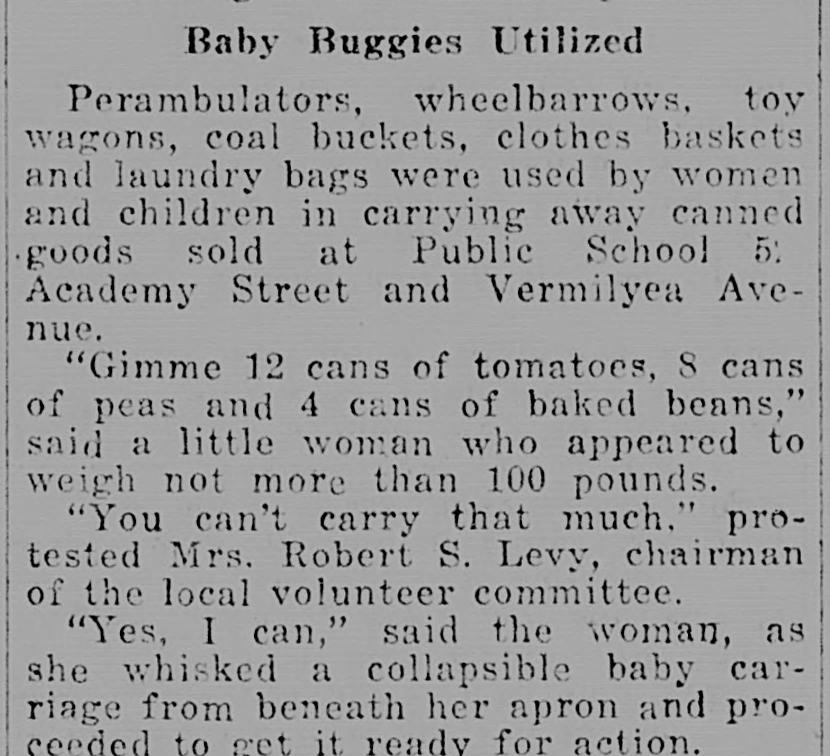
“Baby Buggies Utilized,” New-York Tribune, New York, New York, August 22, 1919, page 4. Library of Congress, Chronicling America. Click the clipping to read it full size.
The Kids’ Pony Express in New York City
New York City kids turned the rush into a business. The Sun reported that “Small boys with express wagons and a great variety of nondescript vehicles organized a pony express delivery service at many of the schools and carried home purchases at 5 or 10 cents a load, depending on the distance.” An express wagon was a sturdy kid’s wagon with a long handle. The boys named their service after the Pony Express, the horseback riders who once rushed the mail across the West. A short haul cost a nickel, the same price as the smallest can of baked beans.
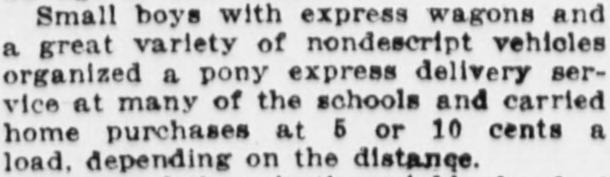
The boys’ “pony express,” from “Rush Swamps School Stores,” The Sun, New York, New York, August 23, 1919, page 1. Library of Congress, Chronicling America. Click the clipping to read it full size.
Other children did the shopping. “Where mother was too busy to be on hand, her small son did the buying for her,” the Tribune said. A few got carried away. Volunteers had trouble “keeping the over-eager children from appropriating more tins of vegetables than their pink slips entitled them to.” In plain words, some kids tried to sneak home extra cans.
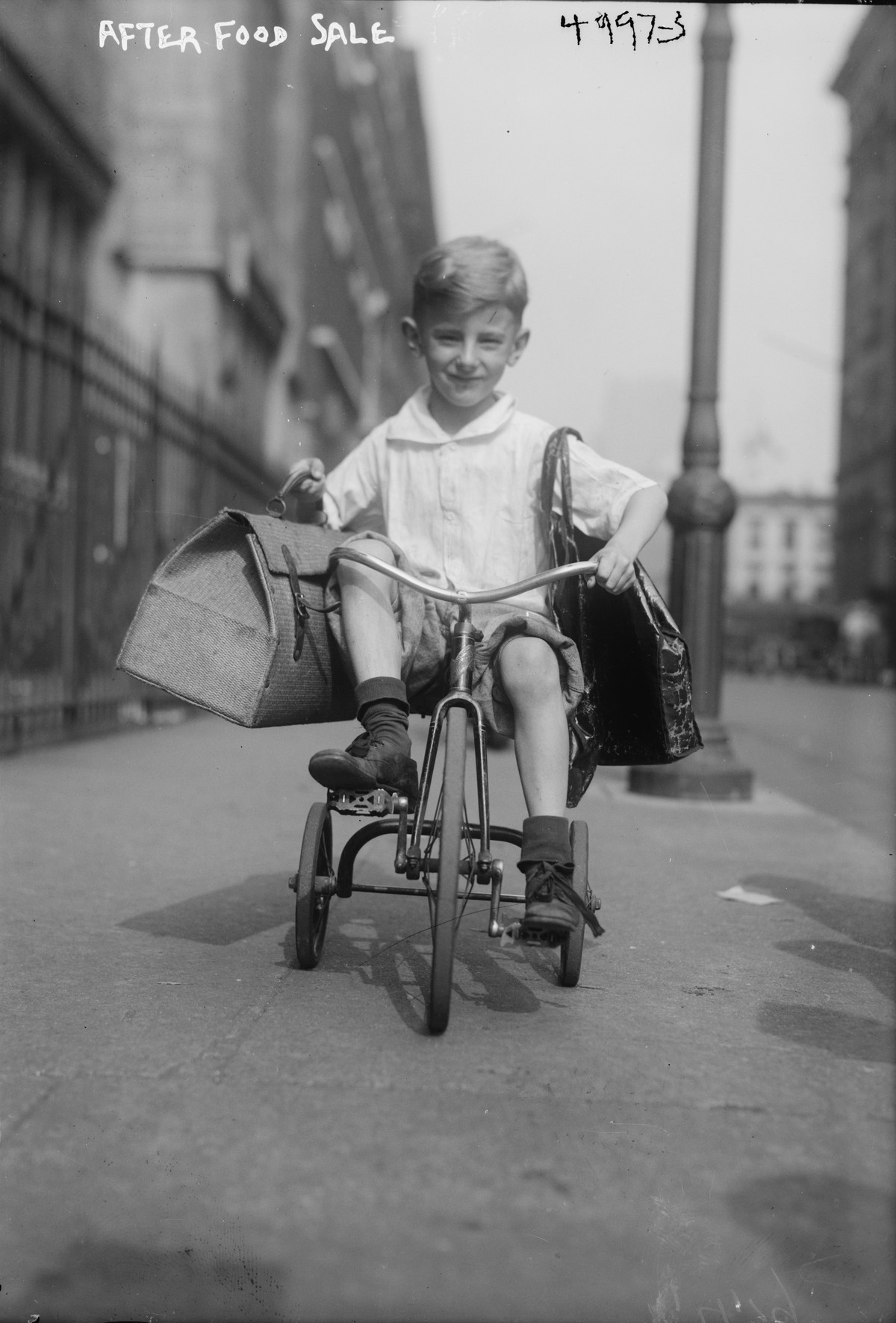
“After food sale,” Bain News Service. It comes from the same set of glass negatives as the August 21, 1919, food sale picture, but its record gives no place or exact date. Library of Congress. Click the picture to see it full size.
Too Many Shoppers for New York City’s School Stores
On the second day, even more New York City shoppers came. Dr. Day called the sales “an overwhelming success,” but his stores couldn’t keep up. “We can’t sell goods fast enough,” he said in The Sun. “At one school one cashier faced 2,500 people who were waiting in the line.” Trucks couldn’t haul food from the Army warehouses fast enough either.
So the city hired more cashiers, and neighborhood groups called Community Councils promised 1,000 volunteers. Dr. Day loved them. “These Community Council folks are so doggone good and are helping us so much and so cheerfully that I wish you newspapermen would give them a good boost,” he said.
The Bronx became the champion shopper. The Sun said it “still leads all the other boroughs in appreciating a good thing.” On Monday, August 25, Bronx families toted home $19,107.58 worth of army food. Manhattan bought $15,316.39.
What It Cost at New York City’s School Stores
The Sun printed New York City’s price list on the first morning. Bacon was 34 cents a pound. Baked beans came in three can sizes, from 5 cents to 11 cents. Peas, sweet corn and string beans were 11 cents a can. Beef, chicken, tomato and vegetable soups were a dime. Mock turtle and oxtail soups were 9 cents. Mock turtle soup was made to taste like turtle soup, with no turtle in it. Sweetened condensed milk was 15 cents a can, and corn syrup was 45 cents.
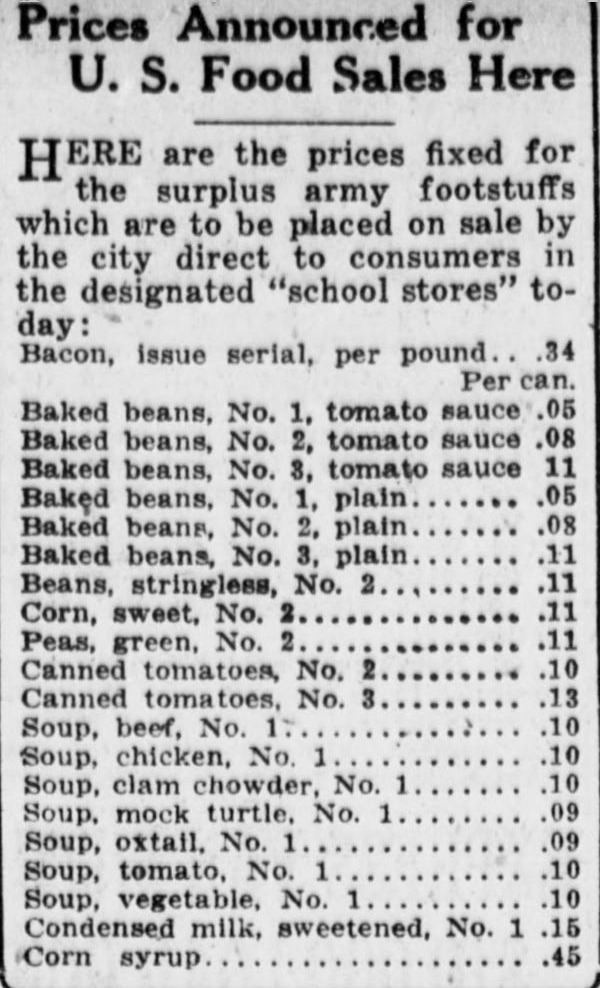
“Prices Announced for U. S. Food Sales Here,” The Sun, New York, New York, August 21, 1919, page 5. Library of Congress, Chronicling America. Click the clipping to read it full size.
When New York City’s Schools Opened Again
In September, with classes about to start again, New York City had a new idea. The Tribune said “The 800,000 public school pupils of the city will be employed to aid in reducing the cost of living for their families.” Teachers would tell the children about the sale. O’Malley explained, “Their parents need only give them the order and the money and the children will bring home the bacon and the other commodities.” To bring home the bacon means to earn a family’s living. These kids would carry the real thing.
The school stores didn’t last forever. In October 1919, Dr. Day announced that the sales in the public schools would end October 27. The Tribune said about $3,000,000 worth of food was expected to be sold by then. A federal store had started selling bacon too, and the Tribune’s headline said it cost “Five Cents a Pound Less Than City’s Price.”
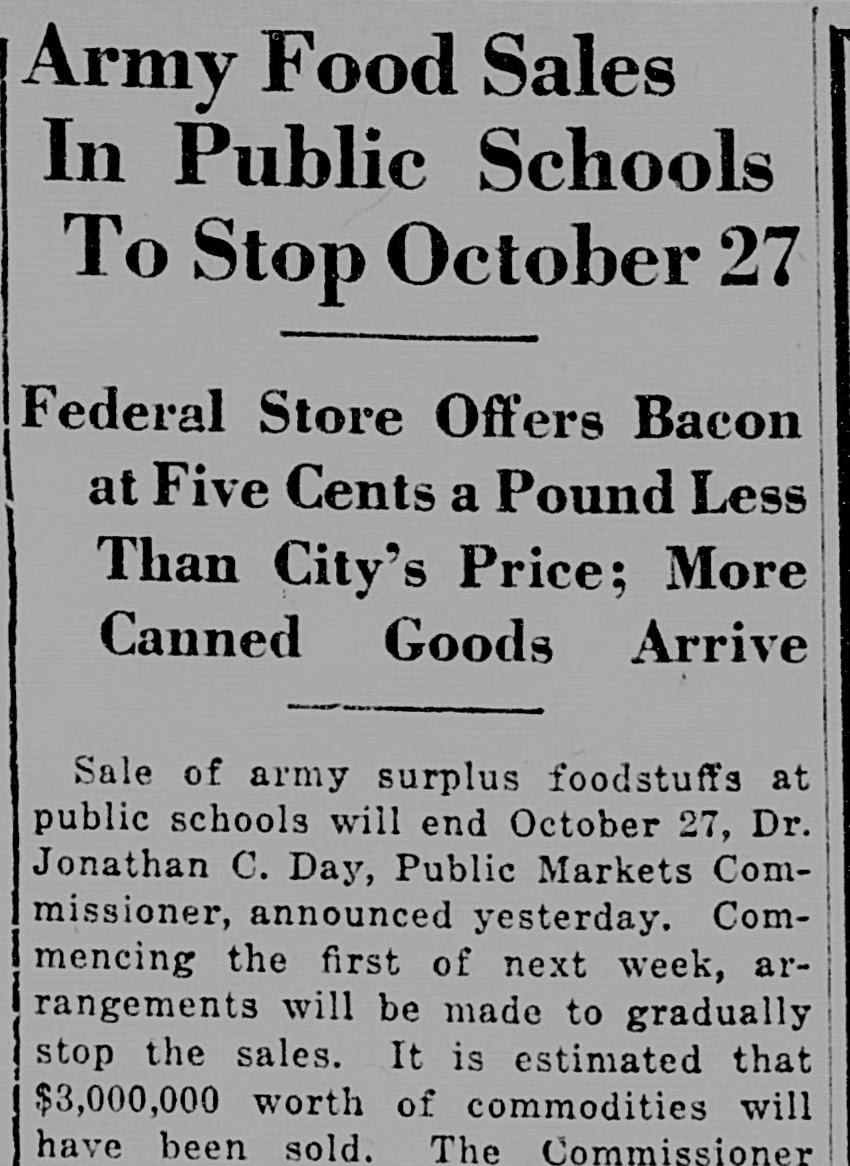
“Army Food Sales in Public Schools to Stop October 27,” New-York Tribune, New York, New York, October 16, 1919, page 5. Library of Congress, Chronicling America. Click the clipping to read it full size.
From late August into late October 1919, New York City’s public schools doubled as grocery stores. And on those first hot August days, the city’s smallest delivery men were boys with express wagons, hauling peas and tomatoes home for a nickel or a dime.
Sources
- “Army Food Sales Begin in City To-day” and “Prices Announced for U. S. Food Sales Here,” The Sun (New York, New York), August 21, 1919, page 5. Library of Congress, Chronicling America.
- “30,000 Rush to Buy U. S. Army Foods,” New-York Tribune (New York, New York), August 22, 1919, page 1, continued with “Woman in Shawl Is Busiest Buyer” and “Baby Buggies Utilized” on page 4. Library of Congress, Chronicling America.
- “Rush Swamps School Stores,” The Sun (New York, New York), August 23, 1919, page 1. Library of Congress, Chronicling America.
- “1,000 Volunteers to Sell Army Food,” The Sun (New York, New York), August 25, 1919, page 2. Library of Congress, Chronicling America.
- “New School Stores May Open in Week,” The Sun (New York, New York), August 27, 1919, page 5. Library of Congress, Chronicling America.
- “The High Cost of Being a Sport,” editorial, The Sun (New York, New York), August 27, 1919, page 8. Library of Congress, Chronicling America.
- “800,000 School Children to Aid Army Food Sale,” New-York Tribune (New York, New York), September 6, 1919, page 7. Library of Congress, Chronicling America.
- “Army Food Sales in Public Schools to Stop October 27,” New-York Tribune (New York, New York), October 16, 1919, page 5. Library of Congress, Chronicling America.
- Cover photo: “Food sale,” Bain News Service, August 21, 1919. Library of Congress Prints and Photographs Division, George Grantham Bain Collection. No known restrictions on publication.
- Photo: “After food sale,” Bain News Service, between about 1915 and 1920. Library of Congress Prints and Photographs Division, George Grantham Bain Collection. No known restrictions on publication.
- The newspapers and photographs above were all published or made before 1931 and are in the public domain.