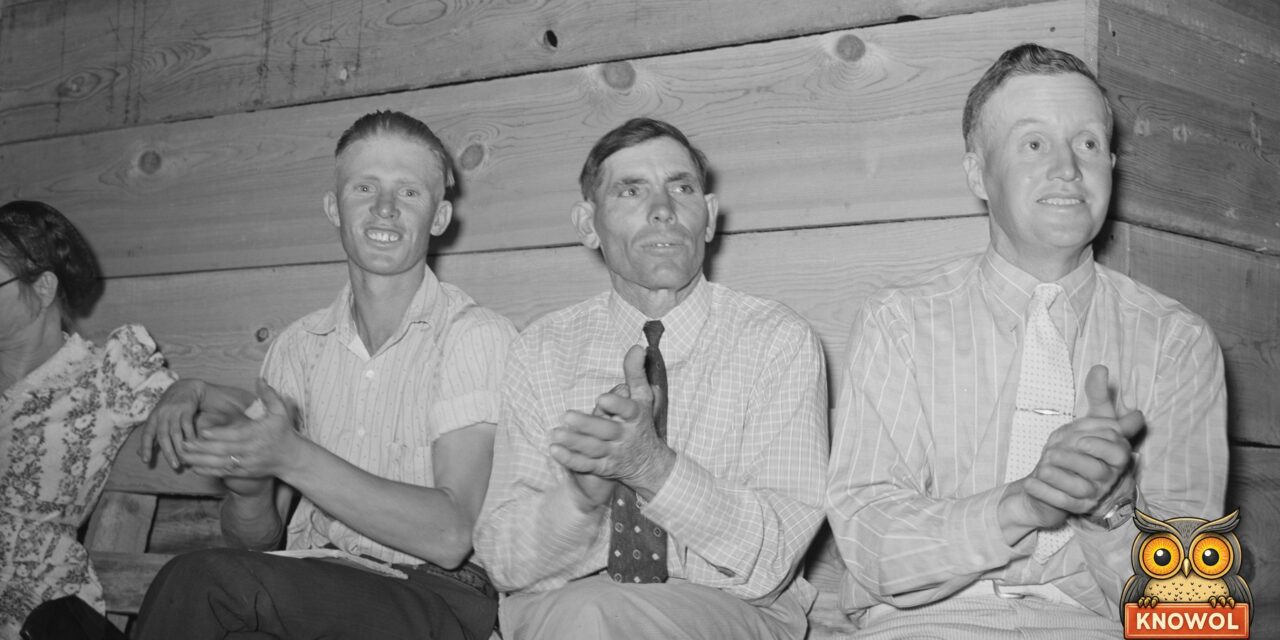
Three farmers sit on a plank bench against a wall of fresh-cut boards, clapping. It’s June 1940 in Pie Town, New Mexico and the men are clapping for the singers up front. The young man on the left is grinning so wide you can see his teeth. The man in the middle has the deep lines and big, rough hands of someone who works outdoors. The man on the right wears a polka-dot tie and a wristwatch, and he looks very pleased. The photographer wrote a short note on the caption card: “All three men are homesteaders.”
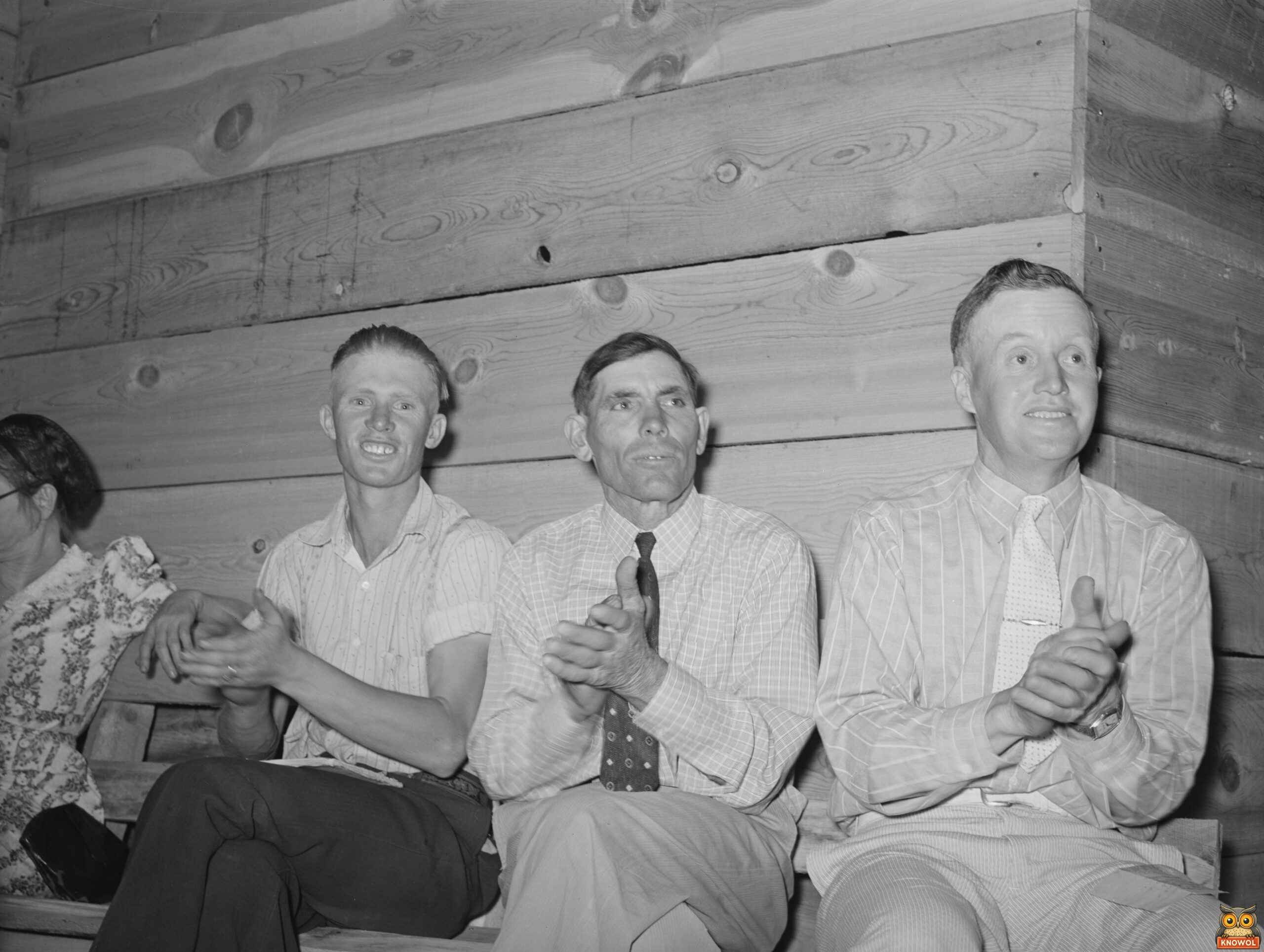
“Spectators clapping for the singers. Community singing, Pie Town, New Mexico. All three men are homesteaders.” Photo by Russell Lee for the U.S. Farm Security Administration, June 1940. Library of Congress, Prints and Photographs Division, FSA/OWI Collection. No known restrictions. Click the picture to see it full size.
Pie Town, New Mexico, Sang for a Prize
The three men in Pie Town weren’t clapping at just any singing, because they were at a contest. The photographer, Russell Lee, took more pictures that day that explain it. On the negative just before this one, a group of men and women stands at a wooden stand with songbooks open. Lee’s card calls them “A group of singers from Quemado who are competing for the Catron County championship at the Pie Town, New Mexico, singing convention.” Quemado is a small town farther west on U.S. Highway 60, and Catron County is the big, empty county where both towns sit.
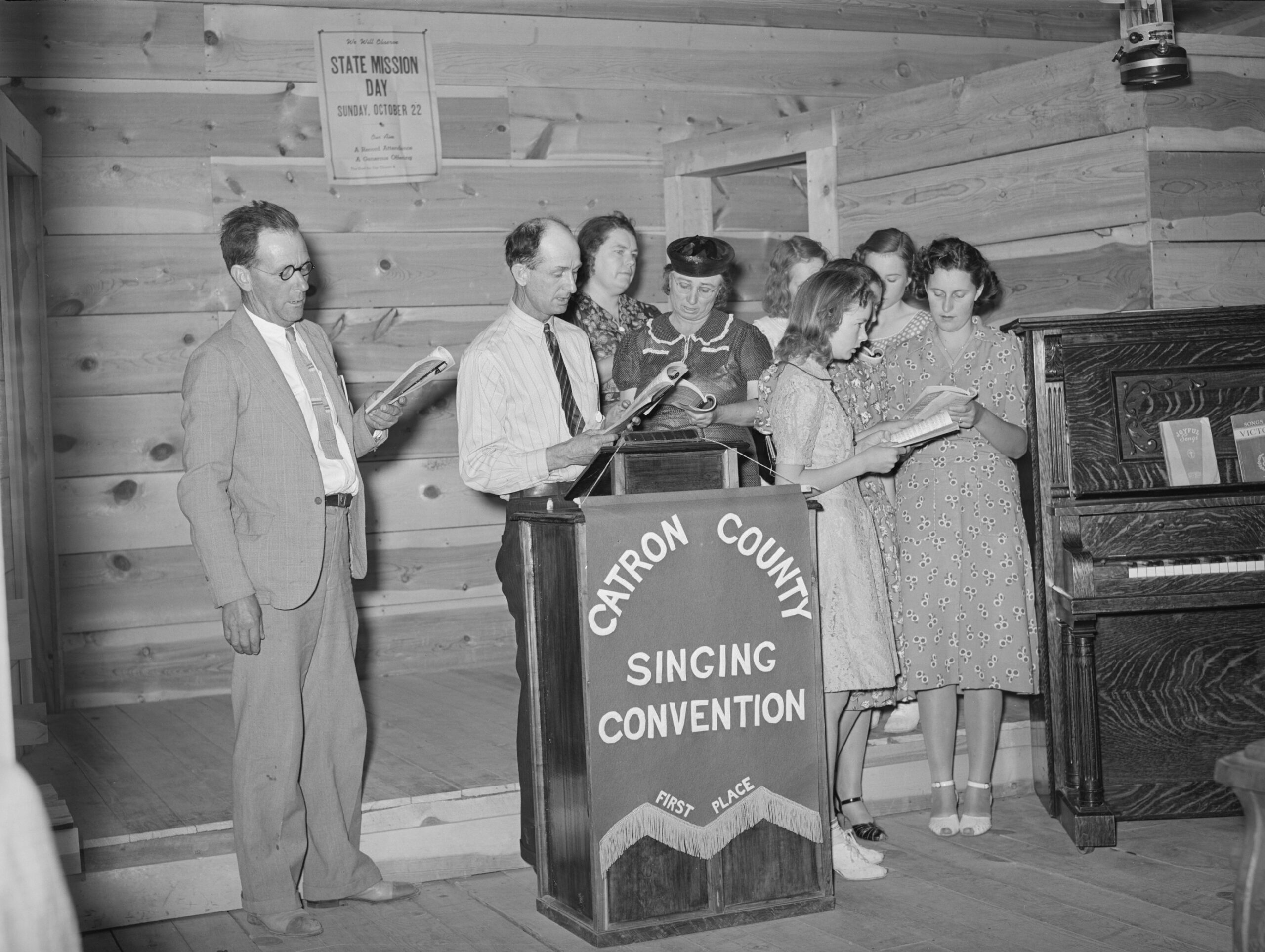
“A group of singers from Quemado who are competing for the Catron County championship at the Pie Town, New Mexico, singing convention.” Photo by Russell Lee, June 1940. Library of Congress, FSA/OWI Collection. No known restrictions. Click the picture to see it full size.
Hanging on the front of that stand is the prize. It’s a banner with a fringed bottom, and its big letters read CATRON COUNTY SINGING CONVENTION, with FIRST PLACE in smaller letters near the bottom. The home team sang too. Another of Lee’s cards says “Pie Town singers who are competing for the championship.” In that picture, three young men in white shirts and four women hold their songbooks open, while a woman plays an old upright piano behind them. On the piano you can read the cover of a songbook: Songs of Victory.
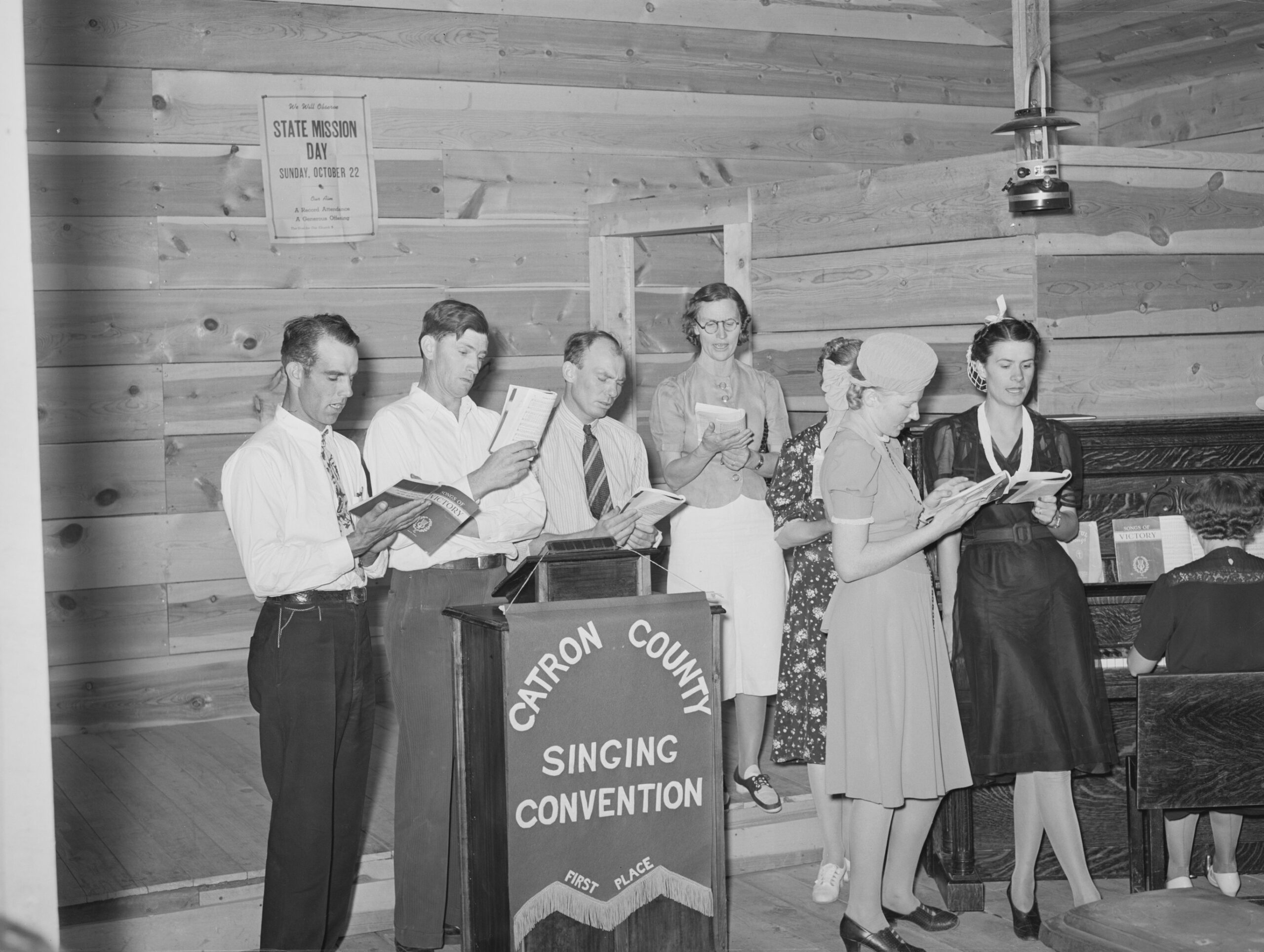
“Pie Town singers who are competing for the championship.” Photo by Russell Lee, June 1940. Library of Congress, FSA/OWI Collection. No known restrictions. Click the picture to see it full size.
Lee never wrote down who won the banner. One card shows the president of the singing convention, also a homesteader, handing the banner to a Mr. Whinery “as representative of one group of the contesting singers.” No card says which group took first place.
The Homesteaders of Pie Town, New Mexico
Pie Town sits about a mile and a half high, near the spot where U.S. 60 crosses the Continental Divide. The story goes that in the early 1920s a man named Norman ran a little store there and baked pies from scratch for travelers. His pies were so good that people started calling the crossroads Pie Town, and when the town asked for a post office around 1927, the people there insisted on keeping that name.
Then, in the 1930s, the Dust Bowl came. Years of drought and dust storms ruined farms on the southern Great Plains. Families from Oklahoma and West Texas packed up and came to Pie Town to file homestead claims on government land, which a homesteader could earn by living on it and farming it. By the mid-1930s, about 250 families lived in the country around the town.
Many of them started with almost nothing, and Lee’s own cards from Pie Town tell how. One family’s first home was a dugout, a room dug partly into the ground with a roof of dirt laid over poles. The father, Jack Whinery, came from West Texas, where he had worked on other men’s farms for day wages. His card says the dugout cost him “thirty cents for nails” and took ten days to build. Its window was made from the windshield of the worn-out car that had carried the family west.
Why the Government Sent a Photographer to Pie Town, New Mexico
Russell Lee worked for the Farm Security Administration, or FSA, a government office that helped struggling farm families. The FSA also sent photographers all over the country with one big job: show how Americans really lived and worked. Today the Library of Congress keeps more than 170,000 of their negatives, and anyone can use them for free.
Lee came to Pie Town in early June 1940 with his wife, Jean, and a trunk full of cameras. His boss in Washington, Roy Stryker, wanted pictures of families trying to build a life on this hard land, so they wouldn’t end up drifting on the highways or living on government relief. Lee took about 600 pictures in Pie Town, some of them on Kodachrome color film, which was still new. He photographed people plowing with burros, hauling water, building houses and going to church.
Then Lee heard about the singing. He wrote to Stryker that Pie Town was holding a big community sing that Sunday, with food, and that it would last all day. He made sure he was there.
The All-Day Sing in Pie Town, New Mexico
An all-day sing in Pie Town was just what it sounds like: families gathered at the little church and sang from their songbooks for hours. Groups took turns up front: Lee photographed duets, a trio, a “Ladies’ quintette” (five women), a “Mixed quartette” (four singers, men and women), and even a “Young farm boy leading community sing.” One card says simply, “This lasts all day.” The pianist and her husband, her card says, were among the first homesteaders in town.
In the middle of the day came what the card calls “Dinner on the Grounds.” Everyone carried food outside to long tables under the pine trees. Lee’s card says the tables stayed there all year, “used frequently by the entire community for picnics and dinners.” He photographed a cake table loaded with layer cakes and pies, with three women cutting slices while children crowded close. In front of the church, a big metal milk can held the drinking water. Water was precious in Pie Town: another card says some farmers couldn’t yet afford to drill a well, so they hauled water home from town.
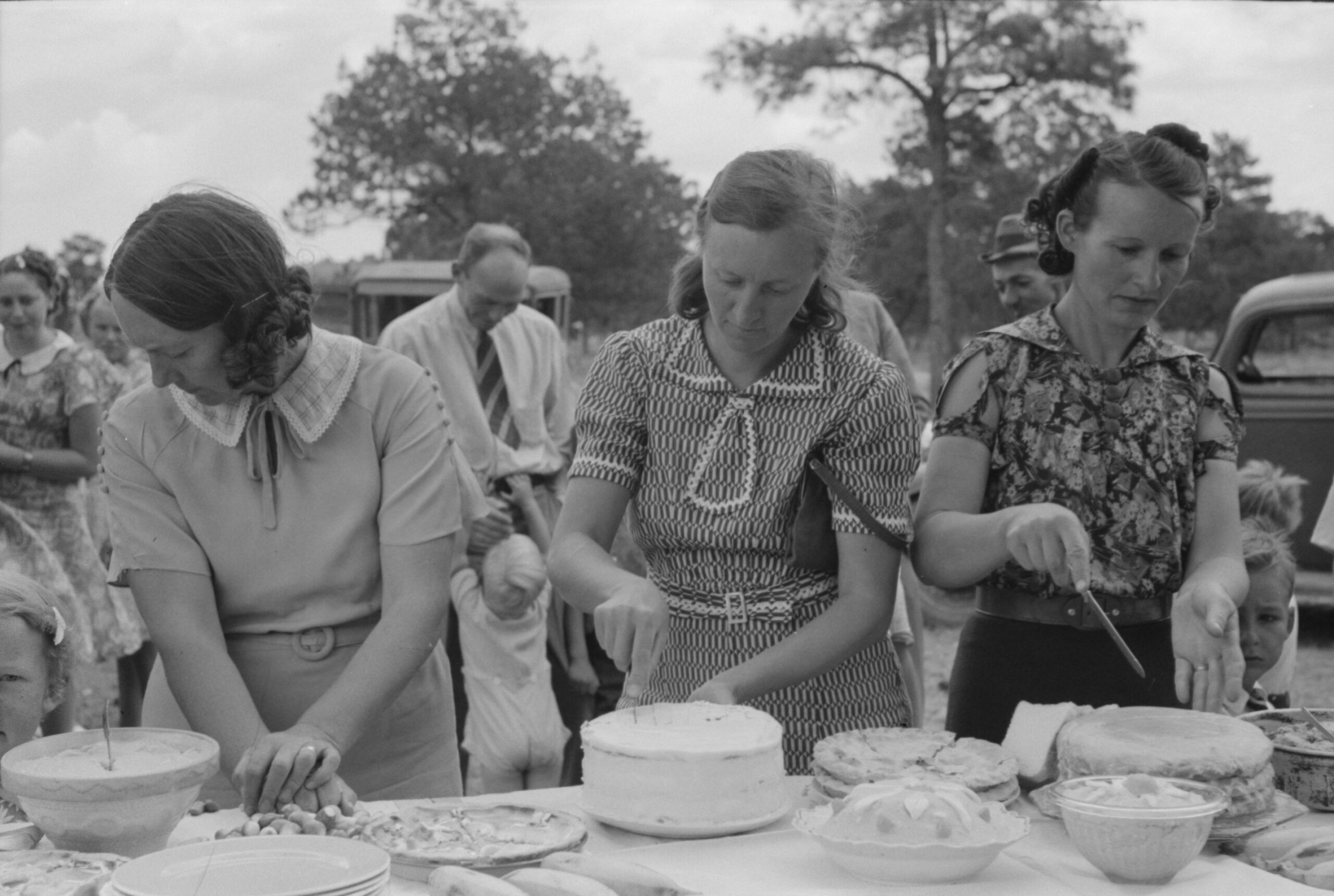
“Cutting cakes, dinner of all day community sing. Pie Town, New Mexico.” Photo by Russell Lee, June 1940. Library of Congress, FSA/OWI Collection. No known restrictions. Click the picture to see it full size.
After dinner, it was back inside for more singing. Look at the room in the pictures: bare board walls, a plank floor and a lantern hanging from the ceiling. Electricity didn’t come to Pie Town until sometime in the 1940s.
What Happened to Pie Town, New Mexico
Lee’s Pie Town pictures became some of the best-known work of his whole career. They showed a town that was poor but proud, where neighbors helped each other build and shared their food.
The good years didn’t last. In 1942 one of the families Lee photographed most, the Caudills, gave up their homestead and moved away. In the 1950s the dry years came back, and many families left for jobs in Albuquerque and California. But Pie Town never emptied out. It still sits on U.S. 60, it still has a cafe that sells pie, and every September it holds a Pie Festival.
The three men on the bench never got their names on the caption card. We don’t know their songs, or which group won the banner. What we do know is that on one Sunday in 1940, high on the Continental Divide, they and their neighbors stopped working long enough to sing all day, share cake under the pines, and clap for one another.
Sources
- Russell Lee, “Spectators clapping for the singers. Community singing, Pie Town, New Mexico. All three men are homesteaders,” June 1940. Caption card title, record and full-size scan: Library of Congress, item 2017786990 (LC-USF34-036846-D). FSA/OWI photographs: no known restrictions.
- Russell Lee, Pie Town, June 1940, same shoot: the Quemado singers, item 2017786989; the Pie Town singers, item 2017787001; the convention president presenting the banner, item 2017786999; “Community sing. Pie Town, New Mexico. This lasts all day,” item 2017787050; the pianist, item 2017787122; dinner on the grounds, item 2017742642; cutting cakes, item 2017742538; the milk can of drinking water, item 2017742578; ladies’ quintette, item 2017787106; mixed quartette, item 2017787109; young farm boy leading, item 2017787121.
- Russell Lee, homesteader pumping water to haul home (“Wells require cash to drill”): item 2017742440.
- Russell Lee, Jack Whinery’s home, Pie Town, 1940 (“thirty cents for nails,” ten days to build): item 2017786675; the window made from the car’s windshield: item 2017786911; Whinery’s work in Texas: item 2017786697.
- Paul Hendrickson, “Savoring Pie Town,” Smithsonian Magazine, February 2005: smithsonianmag.com (the Norman pie story, the post office, the Dust Bowl families, Lee’s visit with Jean Lee, his letter to Roy Stryker about the all-day sing, about 600 Pie Town pictures, the Caudills leaving in 1942, electricity in the 1940s).
- Pie Town today, elevation, the Continental Divide and the Pie Festival: Wikipedia, Pie Town, New Mexico. Russell Lee: Wikipedia.
- About the FSA/OWI photographs and their rights: Library of Congress, FSA/OWI Black-and-White Negatives and rights and restrictions.