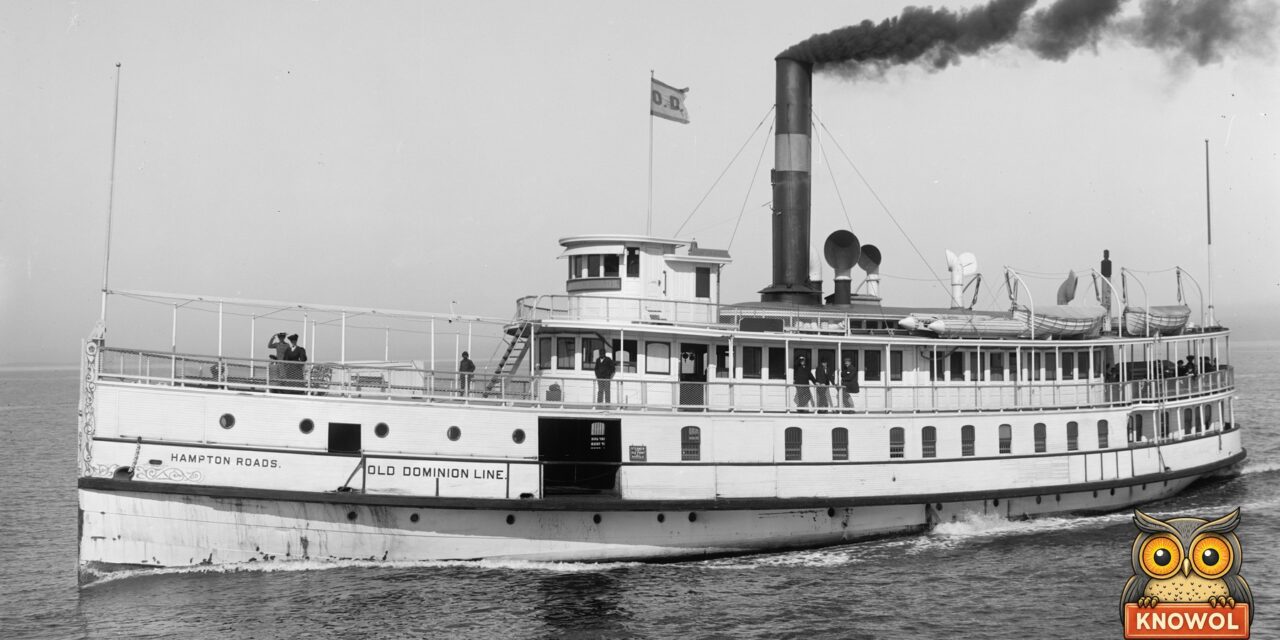
On a Sunday night in October 1913, a white steamboat called the Hampton Roads waited at the dock in Richmond, Virginia, fixed up for a special trip. She had little bedrooms for the guests, a pantry full of food, and her own cooks. On board were three farm experts from the state, the bosses of the Old Dominion steamboat company, and a reporter from the Richmond Virginian named R. W. Vincent. The plan was simple. Sail down the James River, stop at four small river and bay towns, and teach the farmers there how to grow more.
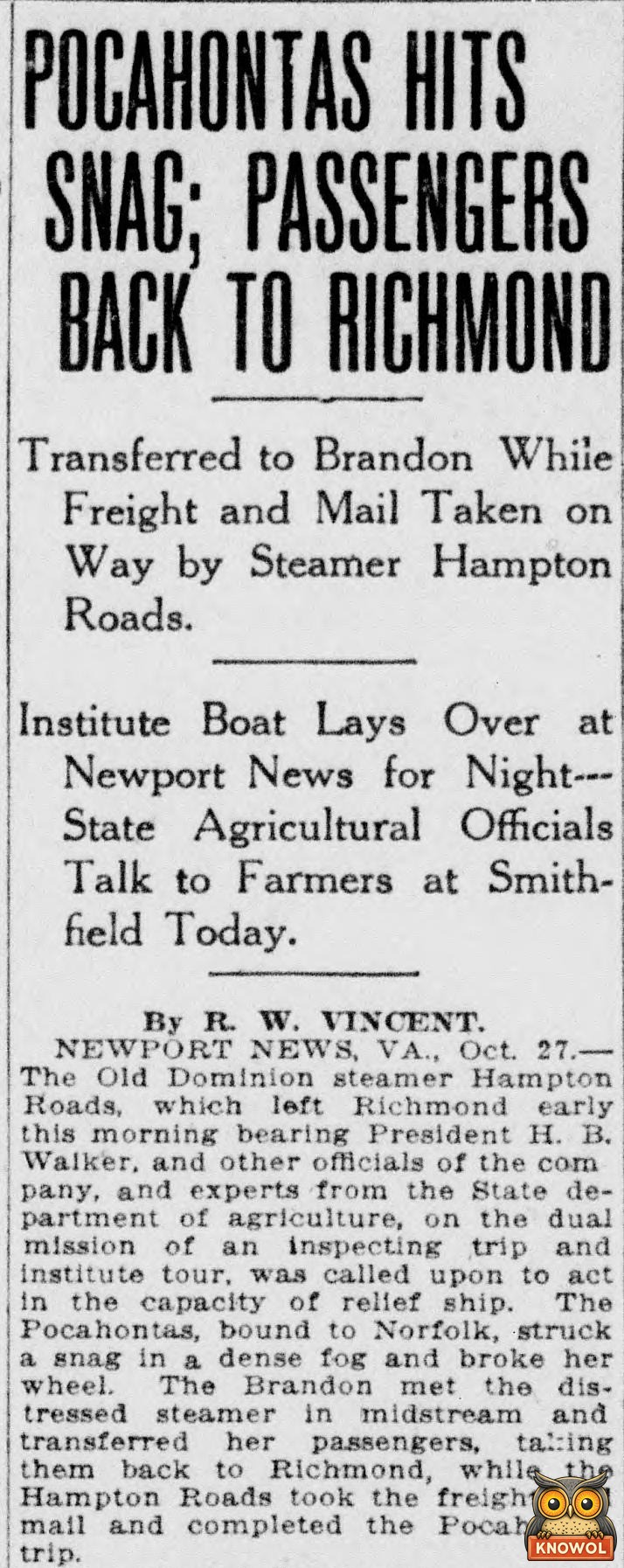
“Pocahontas Hits Snag; Passengers Back to Richmond.” The Richmond Virginian, Richmond, Virginia, October 28, 1913, page 1. Library of Congress, Chronicling America. Published 1913, public domain. Click the clipping to read it full size.
Almost nothing went the way it was planned. By Thursday night the farm teachers had ridden on four different boats, bounced along country roads in buggies and cars, and watched two fishermen get pulled out of Mobjack Bay.
Why Virginia Put a Farm School on a Boat
In 1913, Virginia’s farm department ran something called a farmers’ institute. It was a school that came to you. Experts traveled out to the country, gave talks, showed how things were done, and answered questions. Most of the time they went by train, on what the state called “institute trains.”
But many farms in eastern Virginia sat on rivers and bays, far from any railroad. Out there, boats were how people got around. So on October 20, 1913, the Richmond Virginian announced “a farmers’ institute trip, unique in the history of the State department of agriculture.” The Old Dominion Steamship Company would lend the boat, and in the end it paid every cost of the trip. It would stop at Claremont, Smithfield, Gloucester Courthouse and Mathews Courthouse, one town a day, Monday through Thursday.
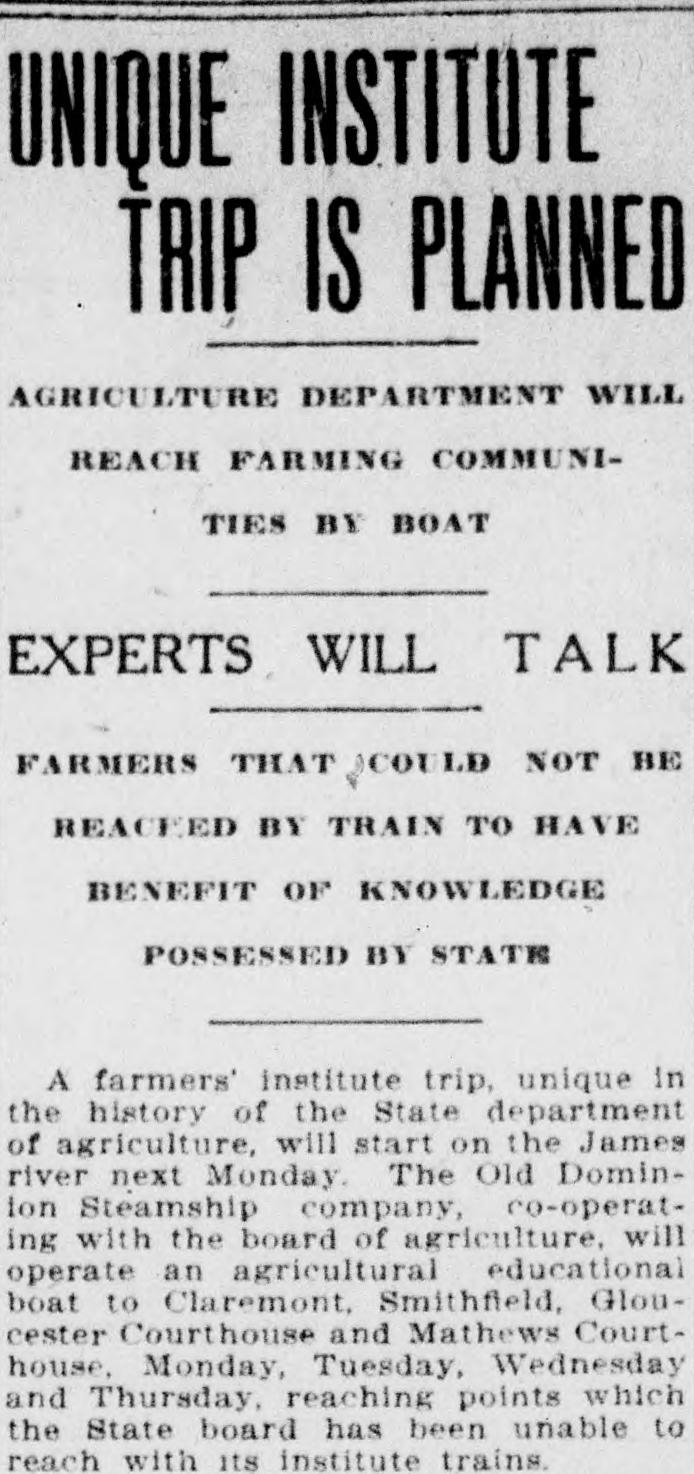
“Unique Institute Trip Is Planned: Agriculture Department Will Reach Farming Communities by Boat.” The Richmond Virginian, Richmond, Virginia, October 20, 1913, page 7. Library of Congress, Chronicling America. Published 1913, public domain. Click the clipping to read it full size.
The talks were aimed at “increasing the yield and quality of farm products.” In plain words: more corn, more vegetables and better cows from the same land. A second notice asked every farmer to come, “bringing with him as many of his neighbors” as he could.
Fog on the James River in Virginia
The party slept aboard the Hampton Roads on Sunday night. The boat slipped away from Richmond in the dark “when all were slumbering.” Then the fog rolled in. Vincent said it was a fog you could have “cut with a knife.”
Ahead of them on the river was another Old Dominion steamer, the Pocahontas, bound for Norfolk. The Pocahontas was a paddle-wheel boat. Big wheels on her sides pushed her through the water, like the wheel on an old mill. In the fog she “struck a snag,” a sunken tree stuck in the river bottom, “and broke her wheel.”
So the farm school had to stop being a farm school, at least for a while. The paper said the Hampton Roads “was called upon to act in the capacity of relief ship.” Another steamer, the Brandon, took the Pocahontas passengers back to Richmond. The Hampton Roads took her freight and the mail and finished her trip. The Pocahontas, Vincent wrote later, “limped on down on one wheel.”
The Farm School Keeps Going, by Rail, Road and Water
The experts didn’t give up. Professor Lyman Carrier of Virginia Polytechnic Institute and Professor T. C. Johnson of the Norfolk truck experiment station “went on by rail” to Claremont. At one o’clock they spoke to “a big crowd of interested farmers.” Carrier talked about growing corn and making the soil richer. Johnson talked about trucking, which back then meant growing vegetables to sell, not driving trucks.
The Hampton Roads had to go back to her regular job, so the rest of the week became a scramble. The party slept at the Warwick hotel in Newport News on Monday night. On Tuesday they took the steamer Ocracoke to Smithfield. On Wednesday the steamer Mobjack carried them to a landing called Dixondale, and they drove across the country to the Gloucester fair grounds. That meeting moved from morning to afternoon because of “Monday’s mishap to the institute boat.”
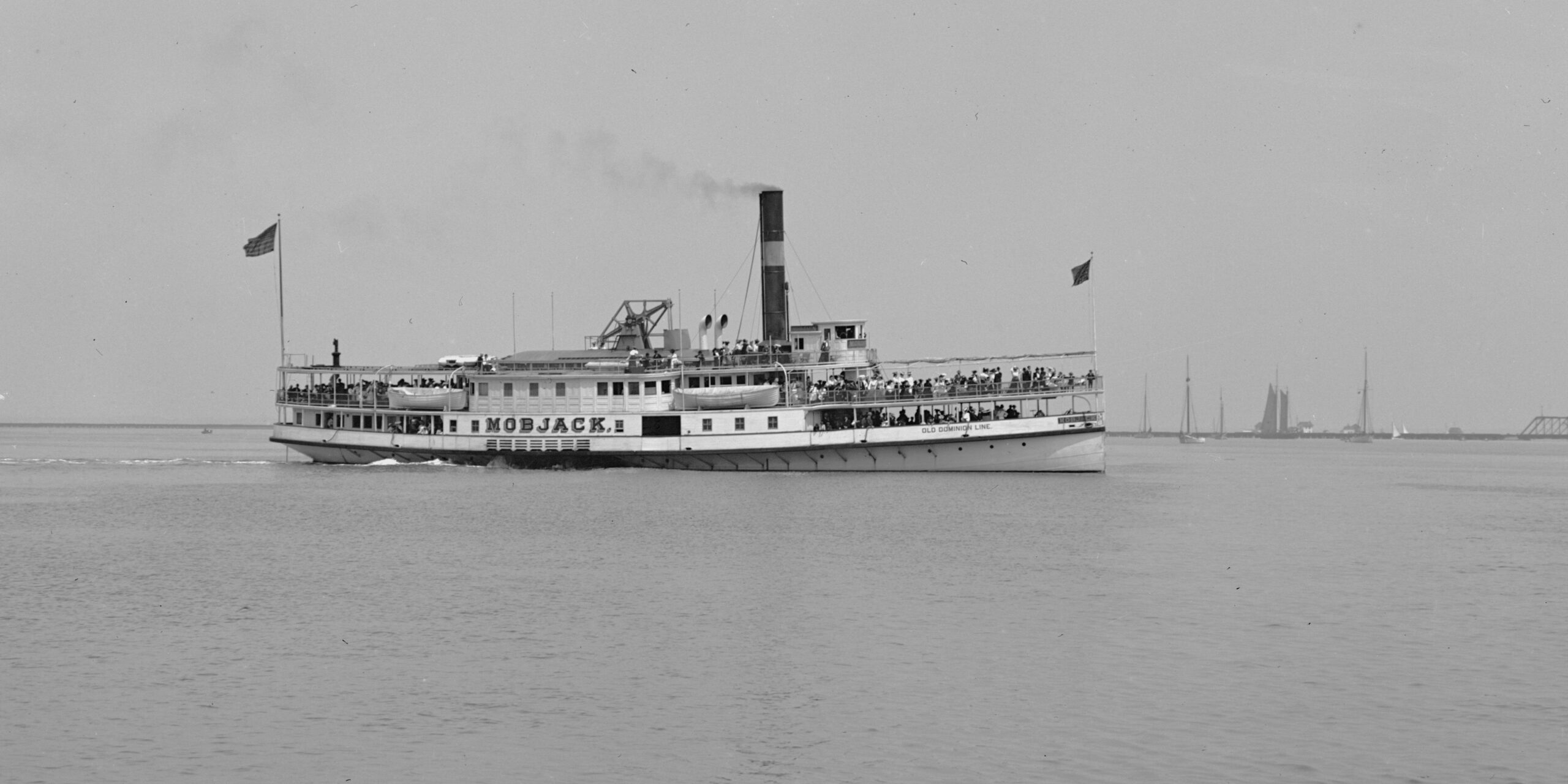
A steamer named Mobjack, with “Old Dominion Line” painted on her side, like the boat that carried the farm experts across the bay in 1913. Detroit Publishing Co., between 1900 and 1910. The Library of Congress record says the picture may have been taken at Rockaway Beach, New York. Library of Congress Prints and Photographs. Click the picture to see it full size.
A Bulldog Named Huck Finn in Gloucester, Virginia
Wednesday night the party stayed at Elmington, a big white-columned house near Gloucester owned by W. DeW. Dimock. Before they left the next morning, the experts lined up on his back porch for a picture, and Mr. Dimock’s dog got in it too.
The paper printed it on November 2. Joseph S. Young Jr., the steamboat company’s passenger agent, looked after the party for the rest of the week. The caption says Mr. Young “is sitting on the right in company with Huck Finn, Mr. Dimock’s famous bulldog, who has won blue ribbons at many shows.”
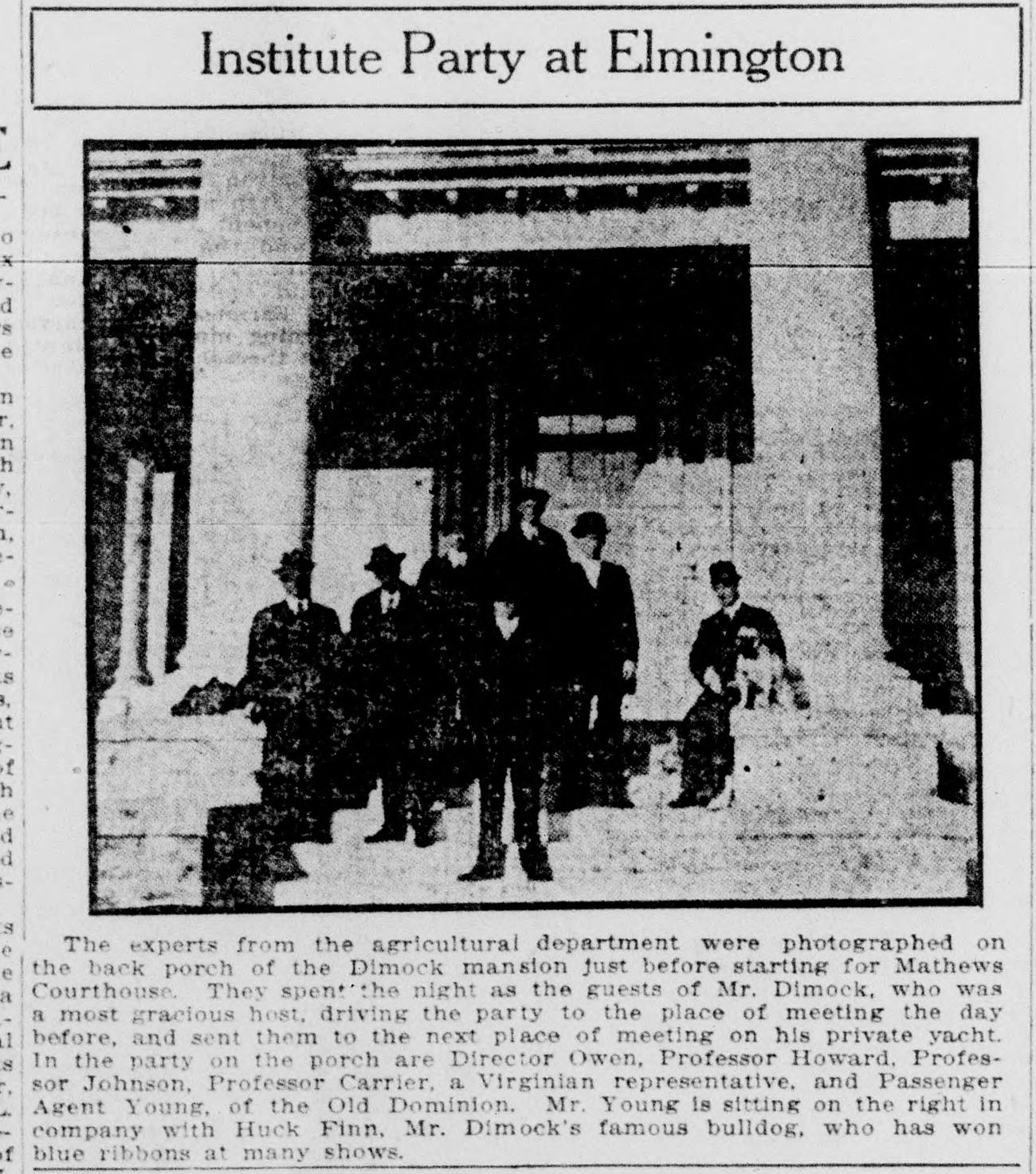
“Institute Party at Elmington.” The farm experts, a Richmond Virginian reporter and Passenger Agent Young, with the bulldog Huck Finn. The Richmond Virginian, Richmond, Virginia, November 2, 1913, page 10. Library of Congress, Chronicling America. Published 1913, public domain. Click the clipping to read it full size.
A Rescue on Mobjack Bay
On Thursday morning Mr. Dimock sent the party across Mobjack Bay in his own yacht, the Yankee. The paper’s headline called it a “rough trip and thrilling experience.” Out on the water, a sailboat with two fishermen in it tipped over right in front of them.
The Yankee turned to help. The paper said she “nobly acted the role of rescuer, taking the shivering men from the bottom of the upturned skiff.” A skiff is a small boat. The two fishermen had been hanging on to its bottom, which was now sticking up out of the water. The paper never printed their names.
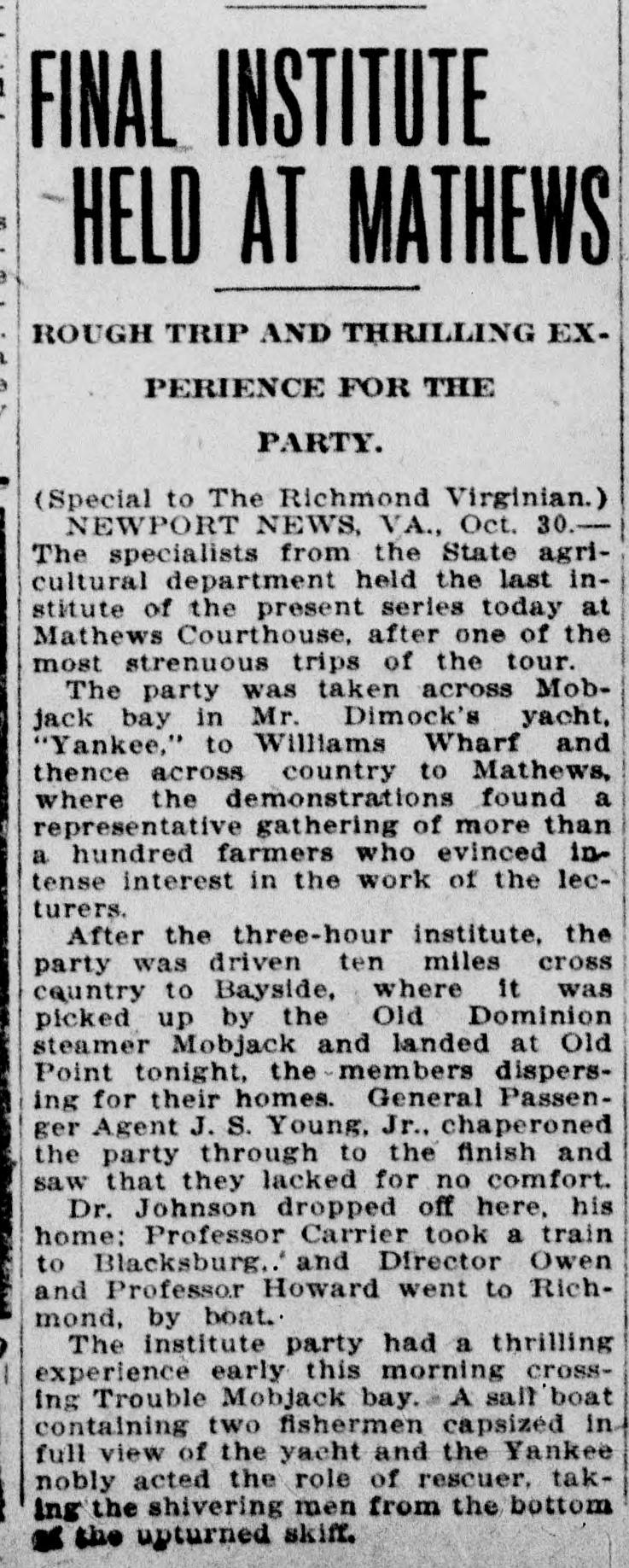
“Final Institute Held at Mathews: Rough Trip and Thrilling Experience for the Party.” The Richmond Virginian, Richmond, Virginia, October 31, 1913, page 3. Library of Congress, Chronicling America. Published 1913, public domain. Click the clipping to read it full size.
Then the farm teachers went right to work. They landed at Williams Wharf, rode to Mathews Courthouse, and held a three-hour meeting for “more than a hundred farmers.” Afterward they were driven ten miles across the county to Bayside, where the Mobjack picked them up again.
What a Cow Was Worth on a Virginia Farm
The dairy expert, Professor A. F. Howard, had the best numbers of the trip. Vincent said Howard’s talk was “the most convincing” he ever heard. Howard said that if a farmer sold $3.85 worth of corn, he took about a dollar’s worth of richness out of his soil. If he kept dairy cows instead, he could put that richness back into the soil, and he could make “700 pounds of butter” worth “say, $210” before the dollar was used up.
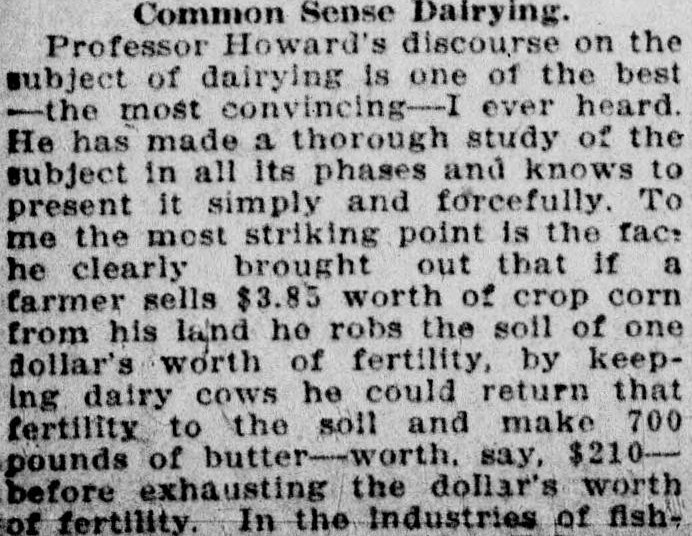
“Common Sense Dairying.” The Richmond Virginian, Richmond, Virginia, November 2, 1913, page 10. Library of Congress, Chronicling America. Published 1913, public domain. Click the clipping to read it full size.
At least one farmer was sold on the spot. At one stop, Vincent wrote, a member of the party “sold to a farmer impressed by Professor Howard’s talk, a registered Jersey bull and four young cows.” Jerseys are small brown cows known for rich, creamy milk. A registered one came with papers showing its family line. “I call that quick results,” Vincent added.
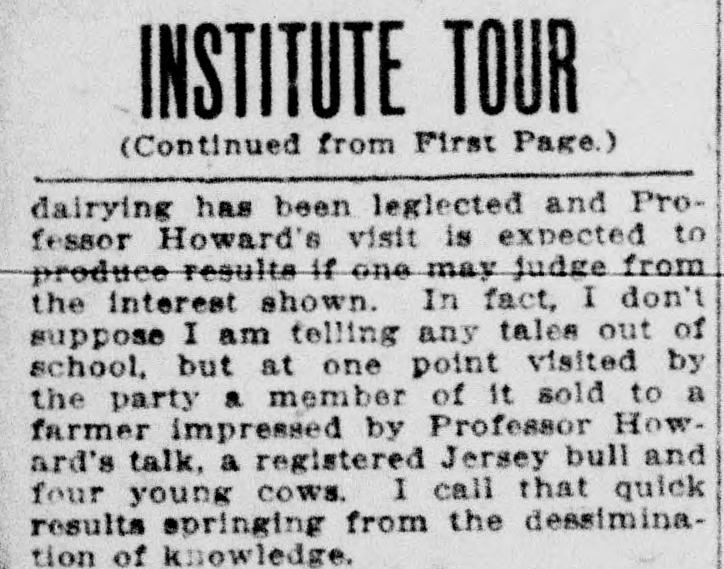
“Institute Tour (Continued from First Page).” The Richmond Virginian, Richmond, Virginia, November 2, 1913, page 12. Library of Congress, Chronicling America. Published 1913, public domain. Click the clipping to read it full size.
The Steamboat Hampton Roads
The picture at the top of this story is the real Hampton Roads, the Old Dominion steamboat that left Richmond with the farm school on board. The Detroit Publishing Company took it around 1905, a few years before the trip, and it is now at the Library of Congress. You can read “Hampton Roads” and “Old Dominion Line” on her side.
Only the Richmond Virginian, which had its own reporter on board, told this story day by day. It was meant to be four quiet days of talks about corn and cows. Instead it brought fog, a broken paddle wheel, borrowed boats, a prize bulldog, a rescue on the bay, and one farmer buying a Jersey bull and four cows on the spot. Vincent decided the mix-up was the fun part. The trip, he wrote, “was just strenuous enough to be thoroughly enjoyable.”
Sources
- “Unique Institute Trip Is Planned.” The Richmond Virginian, Richmond, Virginia, October 20, 1913, page 7. Library of Congress, Chronicling America, page scan
- “Boat Institute Tour Will Start Tomorrow.” The Richmond Virginian, October 26, 1913, page 10. Library of Congress, Chronicling America, page scan
- “Pocahontas Hits Snag; Passengers Back to Richmond,” by R. W. Vincent. The Richmond Virginian, October 28, 1913, page 1. Library of Congress, Chronicling America, page scan
- “Institute Party Returns Tomorrow.” The Richmond Virginian, October 30, 1913, page 4. Library of Congress, Chronicling America, page scan
- “Final Institute Held at Mathews.” The Richmond Virginian, October 31, 1913, page 3. Library of Congress, Chronicling America, page scan
- “Institute Tour of the Tidewater Country Sows Some Good Seed on Fruitful Soil,” by R. W. Vincent, and “Institute Party at Elmington.” The Richmond Virginian, November 2, 1913, Progress Section, page 10, continued on page 12. Page 10 and page 12, Library of Congress, Chronicling America.
- Cover: “O[ld] D[ominion] Line, Str. Hampton Roads,” Detroit Publishing Co., about 1905. Library of Congress Prints and Photographs. Library of Congress record 2016795227: no known restrictions on publication.
- “[Steamer Mobjack, Old Dominion Line],” Detroit Publishing Co., between 1900 and 1910. Library of Congress Prints and Photographs. Library of Congress record 2016809204: no known restrictions on publication.
- Newspaper pages printed in 1913 are in the public domain.