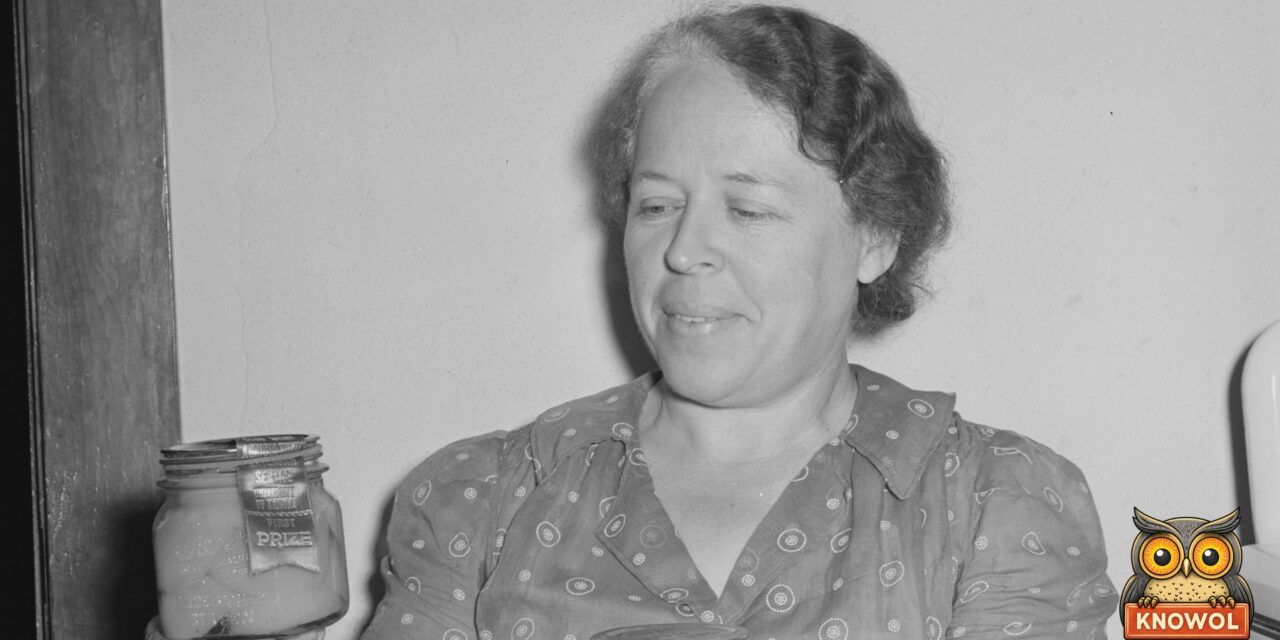
A woman in a polka-dot dress sits on a wooden chair and holds up a glass jar of fruit like it’s a trophy. In a way, it is. A ribbon hangs from the jar’s neck, and the big letters at the bottom read FIRST PRIZE. She’s smiling down at the jar, not at the camera. It’s May 1940, on a brand-new cooperative farm in the desert of Pinal County, Arizona, between the towns of Florence and Coolidge, Arizona. The photographer’s caption card says just what she’s doing: “Wife of member of the Casa Grande Valley Farms, Pinal County, Arizona, displaying canned fruit with which she won first prize at the state fair.”
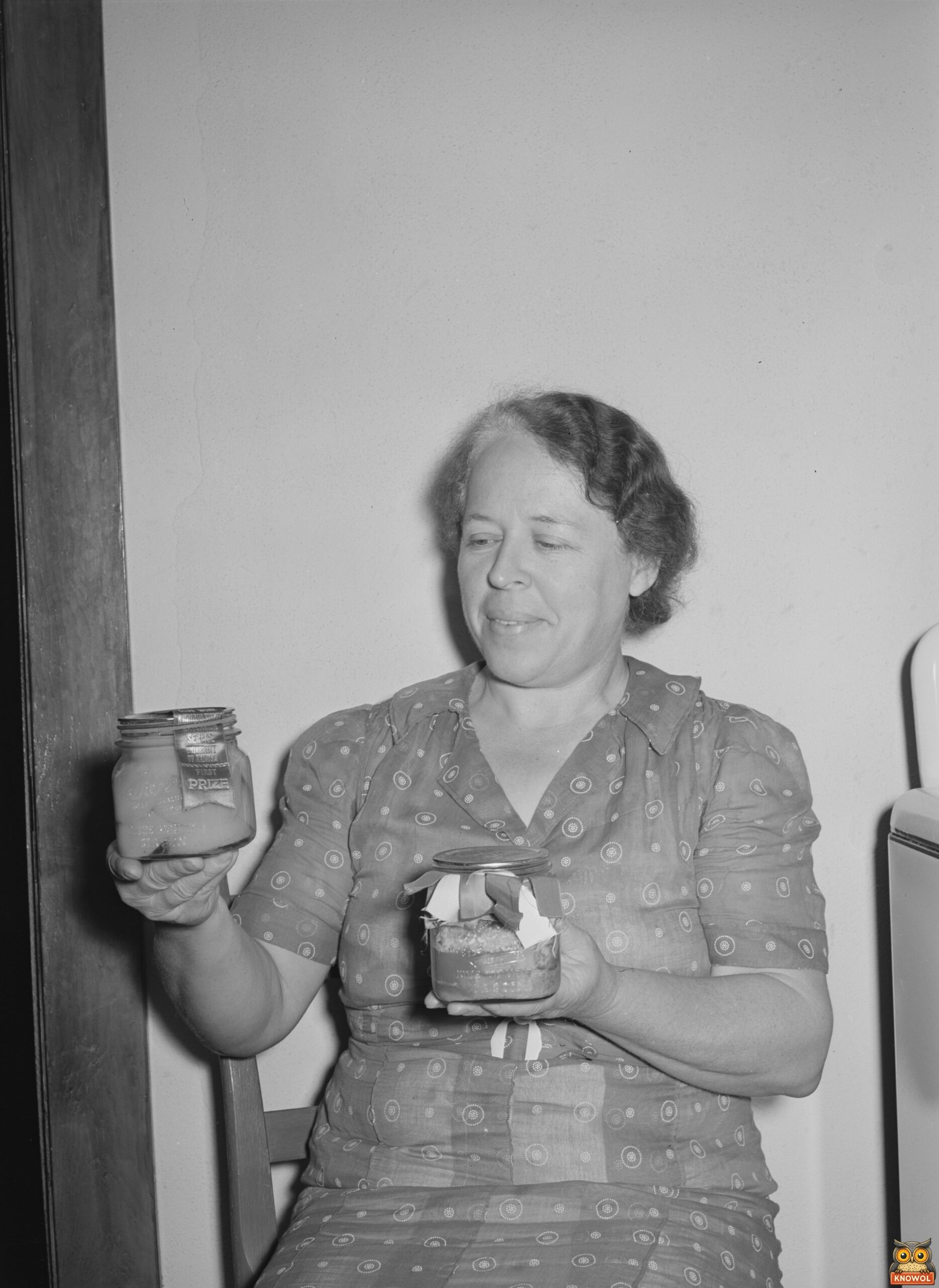
“Wife of member of the Casa Grande Valley Farms, Pinal County, Arizona, displaying canned fruit with which she won first prize at the state fair.” Photo by Russell Lee for the U.S. Farm Security Administration, May 1940. Library of Congress, Prints and Photographs Division, FSA/OWI Collection. No known restrictions. Click the picture to see it full size.
The Ribbon on the Jar From Casa Grande Valley Farms, Arizona
Zoom in on the prize jar in the Arizona photo and the ribbon tells you who handed it out. Under a top line that’s too curled to read, it says AGRICULTURAL EXTENSION SERVICE, then UNIVERSITY OF ARIZONA, then FIRST PRIZE. The Extension Service was a program run with the state university that sent teachers out to farm families. They taught things like raising better crops, sewing, cooking and canning.
Canning is how families saved summer food for winter before most people had freezers. You pack cooked fruit or vegetables into glass jars, heat the sealed jars so the germs inside die, and let the lids seal tight as they cool. Done right, a jar of fruit can sit on a shelf for many months. Done wrong, it spoils. The pale fruit halves in her prize jar are packed neat and even, all the way to the top.
In her other hand she holds a second jar with a bunch of ribbons and paper tucked under its lid. The card doesn’t say what those ribbons were for.
More Prizes on a Tray
The photographer, Russell Lee, liked her jars so much that he took a second picture. In this one she looks right into the camera and holds a whole tray of them: the prize jar of fruit, the jar with the bunch of ribbons, a jar of peas and a jar of something pale, each with a small white tag. This card says she won “prizes,” more than one: “Wife of member of the Casa Grande Valley Farms, displaying canned goods with which she won prizes at the state fair.”
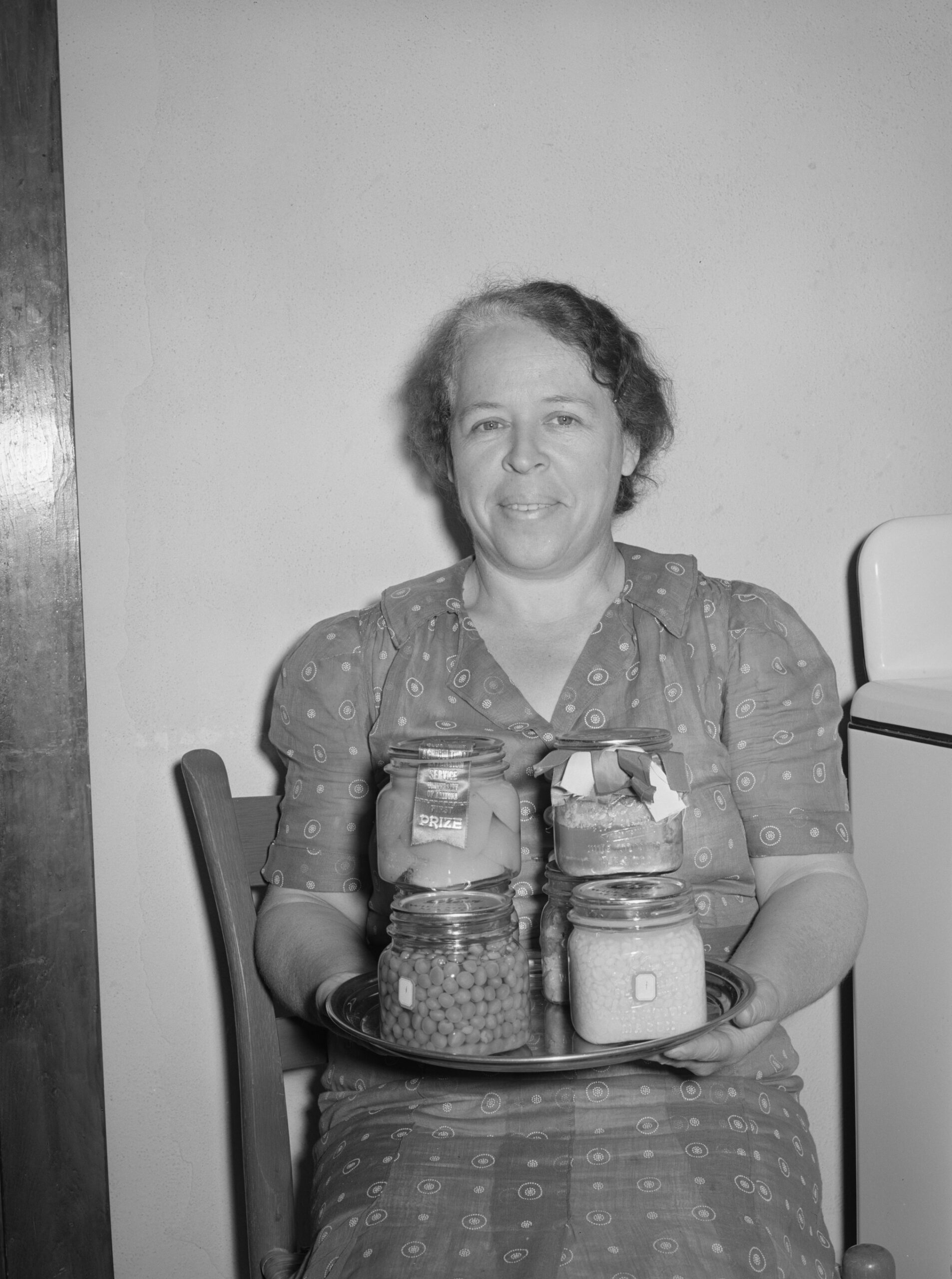
“Wife of member of the Casa Grande Valley Farms, displaying canned goods with which she won prizes at the state fair. Pinal County, Arizona.” Photo by Russell Lee, May 1940. Library of Congress, FSA/OWI Collection. No known restrictions. Click the picture to see it full size.
Lee never wrote down her name, or the year of the fair. The Arizona State Fair was held in Phoenix, and a November 1941 preview in Arizona Highways magazine listed the kinds of contests she would have entered: canned fruit, preserves, jams, jellies, pickles and relishes. It also mentioned “last year’s State Fair,” so there was a fair in the fall of 1940, after this picture was taken. Her ribbon came from an earlier one.
Why Casa Grande Valley Farms, Arizona, Was Brand New
A government booklet from March 1941, “Facts about Casa Grande Valley Farms,” tells how the farm began. Before the project, the land along the Gila River was farmed by tenants and migrant workers who picked cotton for other people. Many lived in awful places. The booklet says some families lived in “shacks made of old flattened tin cans, cardboard, old box wood, discarded iron sheeting or whatever other makeshift materials they could gather.” Of the few houses on the land, it says, “None of the houses had electric lights or telephones.”
So in 1936 the government bought the land, about 4,300 acres. Workers built 60 adobe-brick houses along the main road, and the first family moved in on November 1, 1937. The families came from all over: the booklet counts 18 heads of families from Oklahoma, 12 from Texas, 11 from Arkansas and a few each from Kansas, Illinois, North Dakota, Alabama and New Mexico. Only one was born in Arizona. Most had been farm laborers, and many had once owned or run farms of their own.
Dorothea Lange, another government photographer, visited in June 1938 and wrote on one card that most of the families “are from Oklahoma and Texas. They get to where the land wouldn’t make them anything so they left and came out here.”
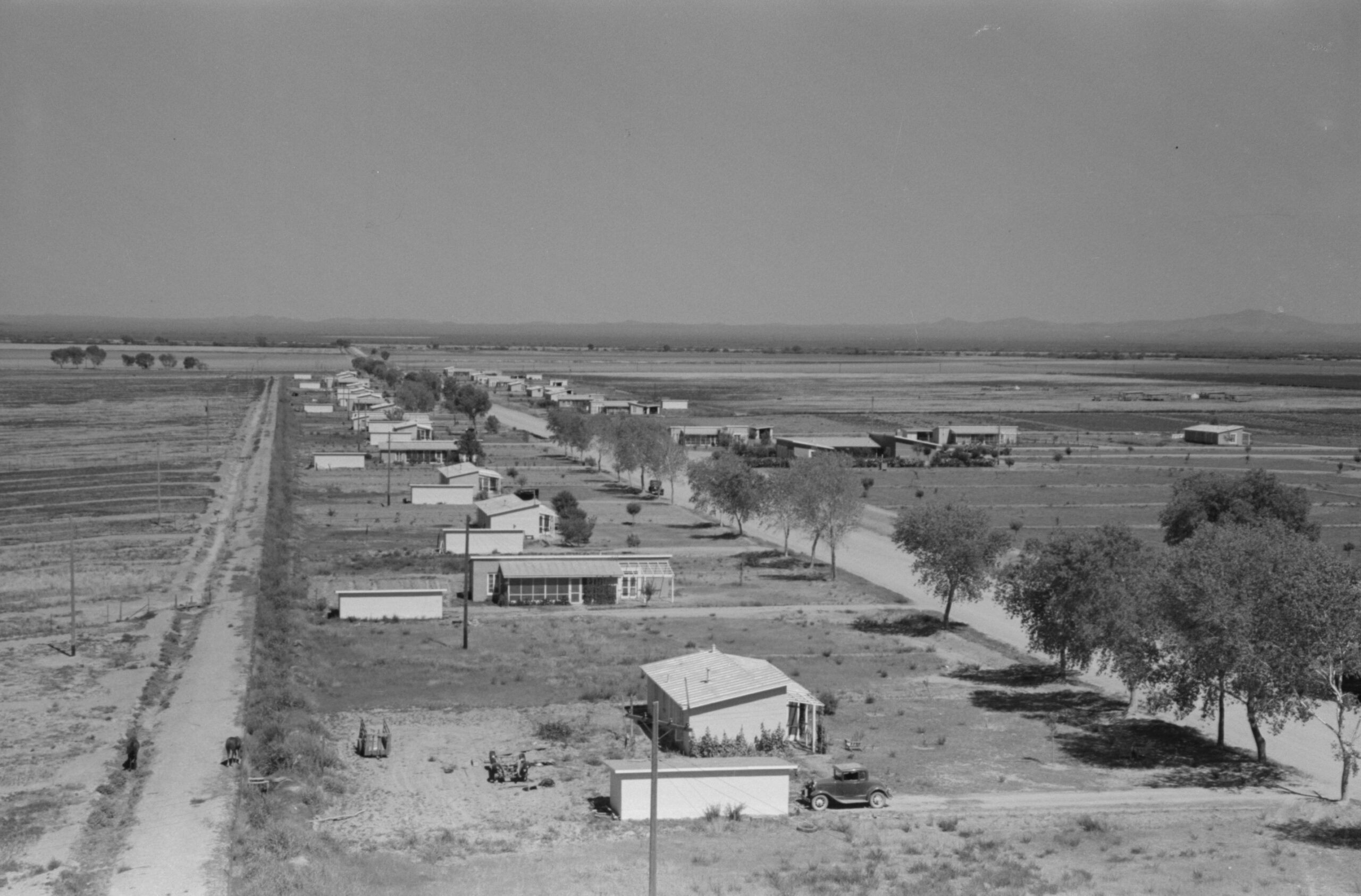
“General view of houses at the Casa Grande Valley Farms, Pinal County, Arizona.” Photo by Russell Lee, May 1940. Library of Congress, FSA/OWI Collection. No known restrictions. Click the picture to see it full size.
A Refrigerator in Every House at Casa Grande Valley Farms
For families who had been working other people’s land as hired hands, the new houses at Casa Grande Valley Farms were a big step up. Each had one to three bedrooms, modern plumbing and a screened porch where people often slept on hot nights. The booklet adds: “Each home is furnished with an electric washing machine, refrigerator, gas range, and essential household furniture.” Rent was $10, $12 or $14 a month, depending on the size of the house.
Look at the right edge of the prize photo. A white, boxy appliance peeks into the frame. It’s probably the refrigerator that came with her house.
The farm itself was run by the families together, as a cooperative. That means the land, machines and animals were worked as one big farm instead of 60 little ones. The men earned a basic wage of $50 a month and shared any profits at the end of the year. They grew wheat, alfalfa, barley, cotton and grain sorghum, and they ran a Grade A dairy that shipped milk to Tucson. A 15-acre community garden grew beets, carrots and cabbage, which went free to the families.
How the Jars Got Filled
That free garden is the last piece of the story. The 1941 booklet says home economics classes were taught on the farm by the Extension Service, the same group named on her ribbon, along with the farm agency’s own home teachers. Then it gives the result: “One result of this instruction has been a great increase in home canning of vegetables from the community and individual gardens.”
So the woman in the photo wasn’t only a good cook. She was part of a whole farm town learning, jar by jar, to put up its own food. The peas on her tray may well have come from that 15-acre garden, though no card says so.
Who Took the Picture in Arizona, and Why
Russell Lee worked for the Farm Security Administration, or FSA, a government office that tried to help struggling farm families during the Great Depression. The FSA also sent photographers across the country to show how Americans lived and worked. Lee had trained as a chemical engineer and then as a painter before he picked up a camera. Today the Library of Congress keeps more than 170,000 FSA and wartime negatives, free for anyone to use.
In May 1940 Lee photographed nearly every corner of Casa Grande Valley Farms: men repairing a hay chopper they had helped invent, little kids napping at the nursery school, a Sunday school, the grocery store and post office, two mule colts named Tom and Jerry, and a Jersey cow named Ronald’s Sybil Frosty, whose card says she gave 14,634 pounds of milk in one year. He wanted the country to see what this experiment looked like up close, and a smiling woman with a first-prize jar showed it better than any chart.
What Happened to Casa Grande Valley Farms, Arizona
The cooperative didn’t last. Members quarreled over wages, over who got to be foreman and over who was boss. In 1943, according to writers who have studied the farm, the members voted to break it up, and the land, animals and machines were sold off. A political scientist named Edward Banfield wrote a whole book about what went wrong, called Government Project, in 1951.
The woman’s name didn’t make it onto either caption card, so we don’t know where she went next. But her jar of fruit still sits in the Library of Congress, ribbon and all, on a May afternoon in 1940 when a farm family starting over in the desert could hold up something it had made and won.
Sources
- Russell Lee, “Wife of member of the Casa Grande Valley Farms, Pinal County, Arizona, displaying canned fruit with which she won first prize at the state fair,” May 1940. Caption card title, record and full-size scan: Library of Congress, item 2017786438 (LC-USF34-036314-D). FSA/OWI photographs: no known restrictions. The ribbon text was read off the full-size scan.
- Russell Lee, same shoot, May 1940: the tray of canned goods, item 2017786491; general view of houses, item 2017742164; woman with her electric washing machine, item 2017742189; the hay chopper, item 2017786356; nursery school naps, item 2017742160; mule colts Tom and Jerry, item 2017742185; the Jersey cow Ronald’s Sybil Frosty, item 2017786462; grocery store and post office, item 2017786362.
- Dorothea Lange, Casa Grande project, June 1938 (“They get to where the land wouldn’t make them anything”): item 2017770624.
- U.S. Farm Security Administration, “Facts about Casa Grande Valley Farms,” March 1941, from the National Agricultural Library: archive.org (location, acres, the 1936 purchase, the shacks, the 60 houses, the first family on November 1, 1937, home states, rents, appliances, wages, crops, the dairy, the community garden, home canning). Quotes read off the page scans.
- “Arizona State Fair” preview, Arizona Highways, November 1941: arizonahighways.com (canned fruit and other contests, “last year’s State Fair”).
- How the cooperative ended: Kevin R. Kosar, “Government Project: Why We Revived This Lost Classic,” 2026, kevinrkosar.substack.com, and Mark Pulliam, “Government Project: The Eternal Folly of Central Planning,” 2024, thedailyeconomy.org, both on Edward C. Banfield, Government Project (1951).
- Russell Lee: Wikipedia. About the FSA/OWI photographs and their rights: Library of Congress, FSA/OWI Black-and-White Negatives and rights and restrictions.