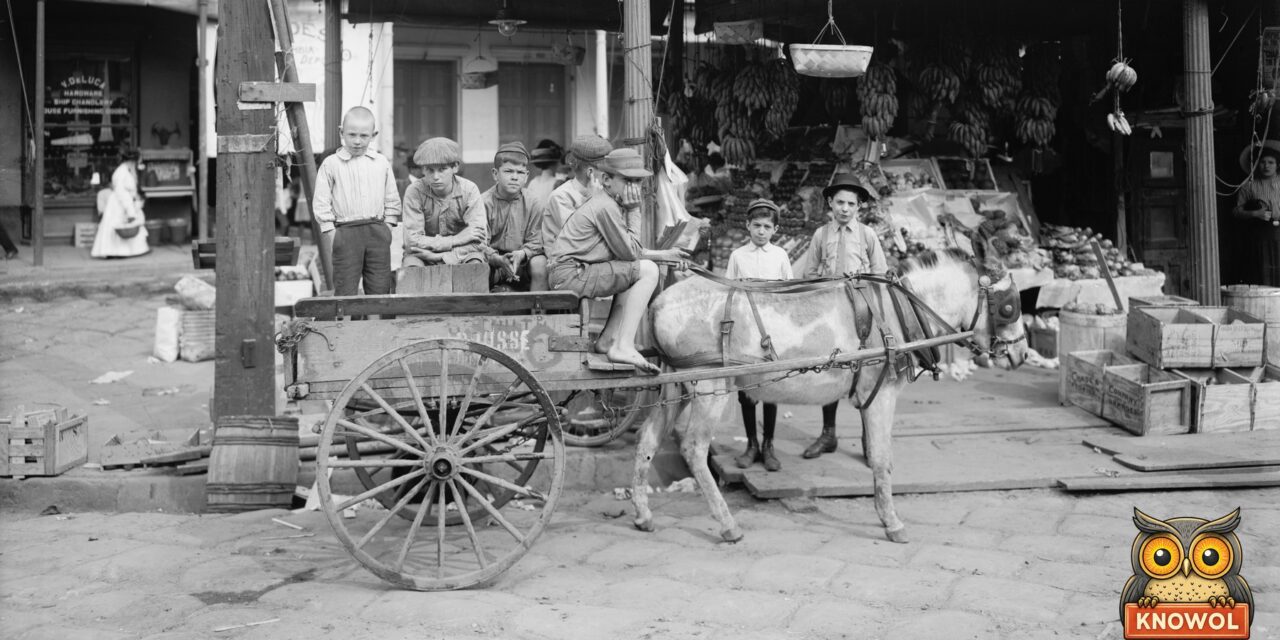
Seven boys are waiting at a corner of the French Market in New Orleans, Louisiana, and every one of them is staring at the camera. Four sit on the side of a wooden cart, and a boy with a shaved head stands in it. The driver is barefoot. He holds the reins in one hand and rests his chin on the other, like he has been waiting a long time. Two more boys stand beside a gray donkey with leather blinders over its eyes. Behind them, bunches of bananas hang from the roof of a fruit stand, so many that they make a green wall.
[IMAGE: photos/french-market-corner-new-orleans-1910-web.jpg | “[New Orleans, La., a corner of the French Market].” Detroit Publishing Co., glass negative, between 1900 and 1910 (probably spring 1910). Photographer not named. Library of Congress, Prints and Photographs Division, Detroit Publishing Company Collection. No known restrictions on publication.]
Who Took the Picture at the French Market in New Orleans
The photo of the French Market corner was made on a big 8 by 10 inch sheet of glass for the Detroit Publishing Company. The company sold pictures of American places as prints and postcards, so people could hang a city on the wall or mail it home. It sent photographers on long trips with heavy cameras on stands. The Library of Congress doesn’t name the person who took this one. Its title comes from the paper sleeve the glass was kept in: “New Orleans, La., a corner of the French Market.”
The record says only that the picture was made “between 1900 and 1910.” But the photographer scratched a number on each plate, and this one says “G 6910.” The plates with numbers close to it give the time away. Plate G 6858 shows a riverboat with a banner that reads “Glad-U Kum, April 10-15, 1910.” Plate G 6839 shows a building with a banner for “Shriners Night, April 14, 1910.” That was the week the Shriners, members of a big men’s club, held a big convention in New Orleans. So the photographer was almost surely in the city in the spring of 1910.
A Theater Poster at the French Market Helps Date the Photo
The very next plate, G 6909, was taken at the same corner of the French Market from farther back. It shows the long market sheds stretching down the street, with women carrying baskets and a dog trotting across the paving stones. Look close at the telephone pole by the corner, and there is a poster on it. It says “J. E. Dodson” and “The House Next Door.”
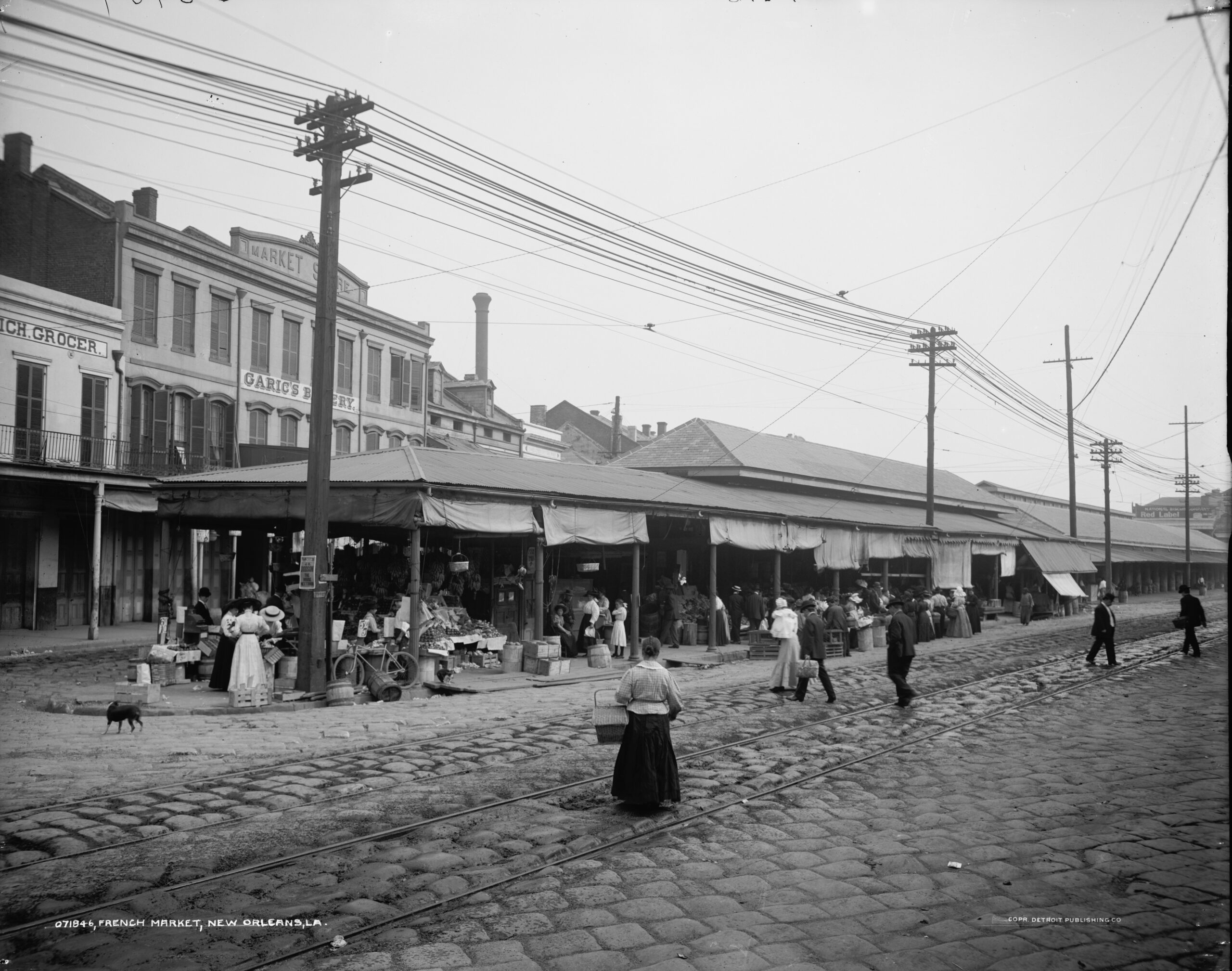
“French Market, New Orleans, La.” Detroit Publishing Co., about 1910, plate G 6909, taken at the same corner from farther back. Library of Congress, Prints and Photographs Division, Detroit Publishing Company Collection. No known restrictions on publication. Click the picture to see it full size.
J. E. Dodson was a well-known actor, and “The House Next Door” was a comedy he took on tour around the country. The show business paper The Billboard printed news from New Orleans in its issue of April 2, 1910. It says the manager of the Tulane Theatre “is offering Mr. J. E. Dodson in The House Next Door as the attraction this week. Business is big.” The same issue lists the show next in Memphis, Tennessee, on March 29 and 30. So the poster on the pole was put up for a show in late March 1910. It may have stayed up a while, but it fits the Shriner banners. The boys on the cart were almost surely photographed that spring.
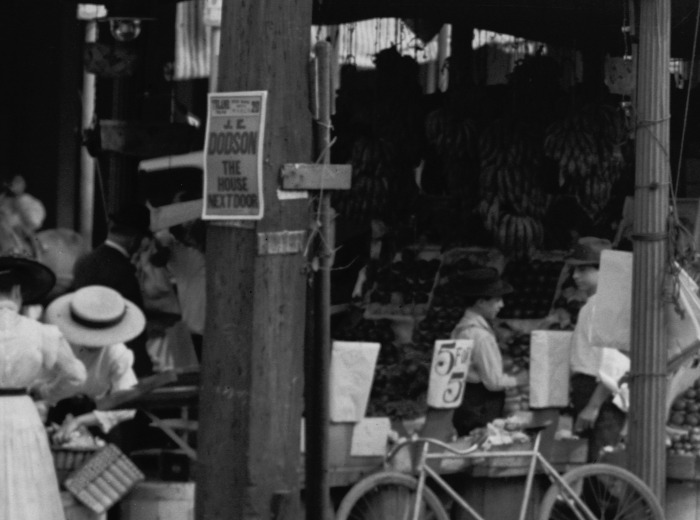
Detail of plate G 6909: the “J. E. Dodson, The House Next Door” poster on the pole, a “5” price card and the bananas at the corner stand. Detroit Publishing Co., about 1910. Library of Congress. No known restrictions on publication. Click the clipping to read it full size.
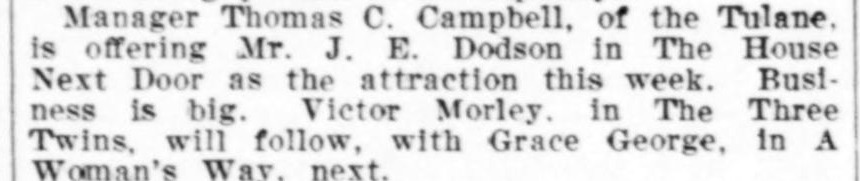
“Manager Thomas C. Campbell, of the Tulane, is offering Mr. J. E. Dodson in The House Next Door as the attraction this week.” The Billboard, April 2, 1910, New Orleans news. Internet Archive. Public domain. Click the clipping to read it full size.
What the Signs Say at the French Market Corner
The photo of the boys is full of signs, and they tell us who worked on this corner of New Orleans. High on the white building, big letters read “921 A. M. Masich Gr,” and the rest is hidden behind the market roof. The plate taken from farther back shows the whole word: “Grocer.” A 1974 history of Croatian and other South Slavic families in Louisiana lists the Masich Grocery at 921 Decatur Street, run by Anthony M. Masich. So the boys were on Decatur Street, the street that runs along the market.
Below the balcony, a long sign says “Stoves & Ship Chand,” and the window under it reads “V. DeLuca, Hardware, Ship Chandlery, House Furnishing Goods.” A ship chandler sold supplies to ships: rope, lanterns, tar, pots and pans. The Mississippi River docks were close by, so ship crews could walk over and stock up. On the right, a sign under the fruit stand’s awning says it belongs to a dealer in fruits and vegetables. The owner’s name on it is too blurry to read for sure.
Who Shopped and Sold at the French Market in New Orleans
The French Market is one of the oldest markets in the country. Part of it has been a market since 1791, when Louisiana belonged to Spain. The oldest building, the meat market, went up in 1813. On city maps from 1895, the vegetable market stood on Decatur Street between St. Philip and Ursulines streets, with fruit stands nearby.
By 1910 many of the people selling fruit in the French Market had come from Sicily, the big island at the toe of Italy. The Louisiana encyclopedia 64 Parishes says New Orleans was a main port for Italians coming to America from 1880 to 1914, and that about 9 in 10 of them were Sicilian. Many opened fruit stands and grocery stores. So many settled in the blocks around the French Market that people called the neighborhood Little Italy. By 1910 about 43,000 Italian immigrants lived in Louisiana.
The Library of Congress record doesn’t name any of the boys in the picture, and nobody wrote down who they were. Some may have been sons of market families. Some may have just been passing by when they saw a man with a big camera and wanted to be in the picture.
Where the Bananas at the French Market Came From
The bananas hanging over the boys came by ship from Central America and the islands of the Caribbean. New Orleans was one of the biggest banana ports in the United States. The same photographer took pictures of the United Fruit Company docks on the same trip. Plate G 6903 shows a tall wooden tower labeled “United Fruit Co. Banana Conveyor No. 1,” next to a white steamship named the Cartaco.
[IMAGE: photos/united-fruit-banana-conveyor-new-orleans-1910.jpg | “[United Fruit Company banana conveyors, New Orleans, La.]” with the ship Cartaco. Detroit Publishing Co., about 1910, plate G 6903. Library of Congress, Prints and Photographs Division, Detroit Publishing Company Collection. No known restrictions on publication.]
A 1923 booklet called The Story of the Banana, put together by a United Fruit official and printed by the government in Washington, tells how those towers worked. It says the docks at New Orleans had unloading machines “each having a capacity of 2,500 bunches an hour.” Long arms reached down into the ship. Then, the booklet says, “at the sound of the gong the wheels start whirring. Suddenly up come the big green bunches in the canvas pockets of the endless chain.” Belts carried them across the dock to railroad cars bound for towns far inland.
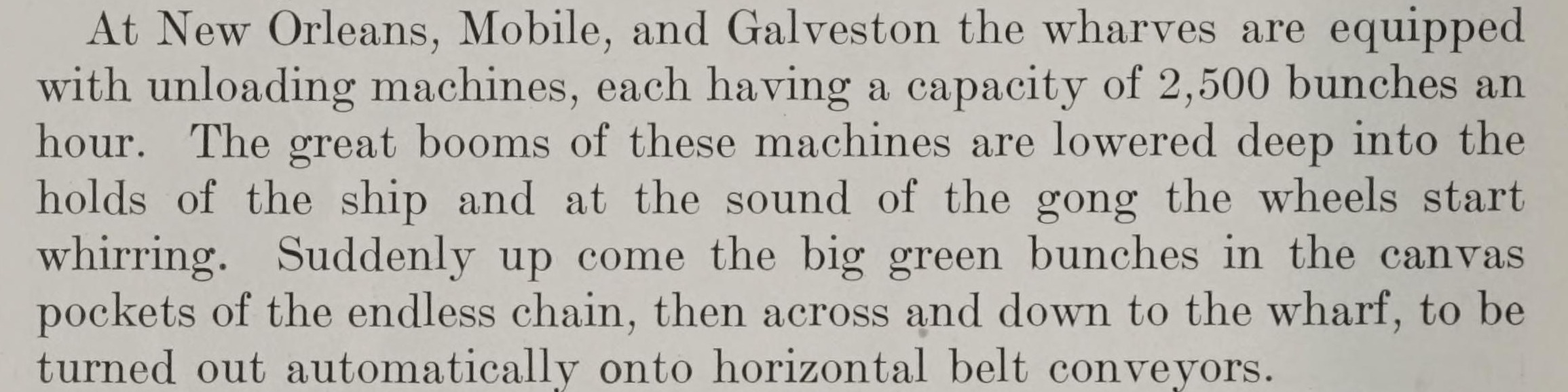
“At New Orleans, Mobile, and Galveston the wharves are equipped with unloading machines, each having a capacity of 2,500 bunches an hour.” The Story of the Banana, Pan American Union (Washington, 1923), page 22. Internet Archive. Public domain. Click the clipping to read it full size.
The bunches came off the ships green and turned yellow later. Some of them stayed in town and ended up hanging at stands like this one.
The Donkey Cart at the French Market
The donkey cart in the picture was the pickup truck of the market. It had two big wooden wheels, a flat bed for crates and sacks, and shafts that hitched it to the donkey’s harness. Faded letters are painted on the side of the cart, but most of the name has worn away. The blinders on the donkey’s bridle kept it looking straight ahead, so the noise and bustle of the market wouldn’t spook it.
The camera needed the boys to hold still, and they did. That is why the picture is so sharp. You can see the checks on one boy’s shirt, the frayed edge of the driver’s short pants, and his bare toes on the cart. Behind them, a woman walking on the sidewalk came out as a soft blur, because she kept moving while the glass plate soaked up the light.
The French Market in New Orleans Today
The sheds where the boys waited are gone. In the 1930s, the Works Progress Administration, a government program that gave people jobs during the Great Depression, did major work on the French Market. Where the meat market of 1813 stood, Café du Monde now serves coffee and powdered-sugar doughnuts called beignets. The French Market still has a farmers market, a flea market and shops, and it still runs along Decatur Street.
Nobody wrote down the names of the seven boys, the donkey or the driver with the bare feet. But on a spring day around 1910, they stood still for a stranger with a camera, right under a wall of bananas. More than a hundred years later, they are still looking right at us.
Sources
- Detroit Publishing Co., “[New Orleans, La., a corner of the French Market],” between 1900 and 1910, “G 6910” on negative, Detroit Publishing Co. no. 039639, 1 glass negative, 8 x 10 in.: Library of Congress, item 2016795648 (LC-D4-39639). No known restrictions on publication.
- Same photographer’s plates: “French Market, New Orleans, La.,” c1910, G 6909: item 2016815371; “[United Fruit Company banana conveyors, New Orleans, La.],” ca. 1910, G 6903: item 2016811156; “[Steamboat seeing New Orleans],” 1910, G 6858, banner “Glad-U Kum, April 10-15, 1910”: item 2016811160; “Washington Artillery Bldg., New Orleans, La.,” G 6839, banner “Shriners Night, April 14, 1910”: item 2016796042. Library of Congress, Detroit Publishing Company Collection. No known restrictions on publication.
- The Billboard, April 2, 1910, New Orleans news (Tulane Theatre, J. E. Dodson, the Shriner convention April 11-15) Internet Archive, page scan; the Memphis Lyceum listing for March 29-30, page scan.
- Philip K. Reynolds, The Story of the Banana (Pan American Union, Washington, 1923), page 22: Internet Archive.
- Masich Grocery, 921 Decatur Street, Anthony M. Masich: Milos M. Vujnovich, Yugoslavs in Louisiana (Pelican Publishing, 1974), Internet Archive.
- Sicilian immigrants, fruit vendors and grocers around the French Market: 64 Parishes, “Italians”.
- The meat market of 1813, the 1895 map, and Café du Monde today: Library of Congress, Inside Adams, “New Orleans Then and Now: The French Market”. The market since 1791 and the 1930s work: Wikipedia, French Market.