
A town made in 1846 from the village of Unionville and pieces of three older neighbors, where the Boston Marathon first started, Henry Warren's electric clocks learned to keep time by the power grid, and a stolen fire engine began a long rivalry with Hopkinton.
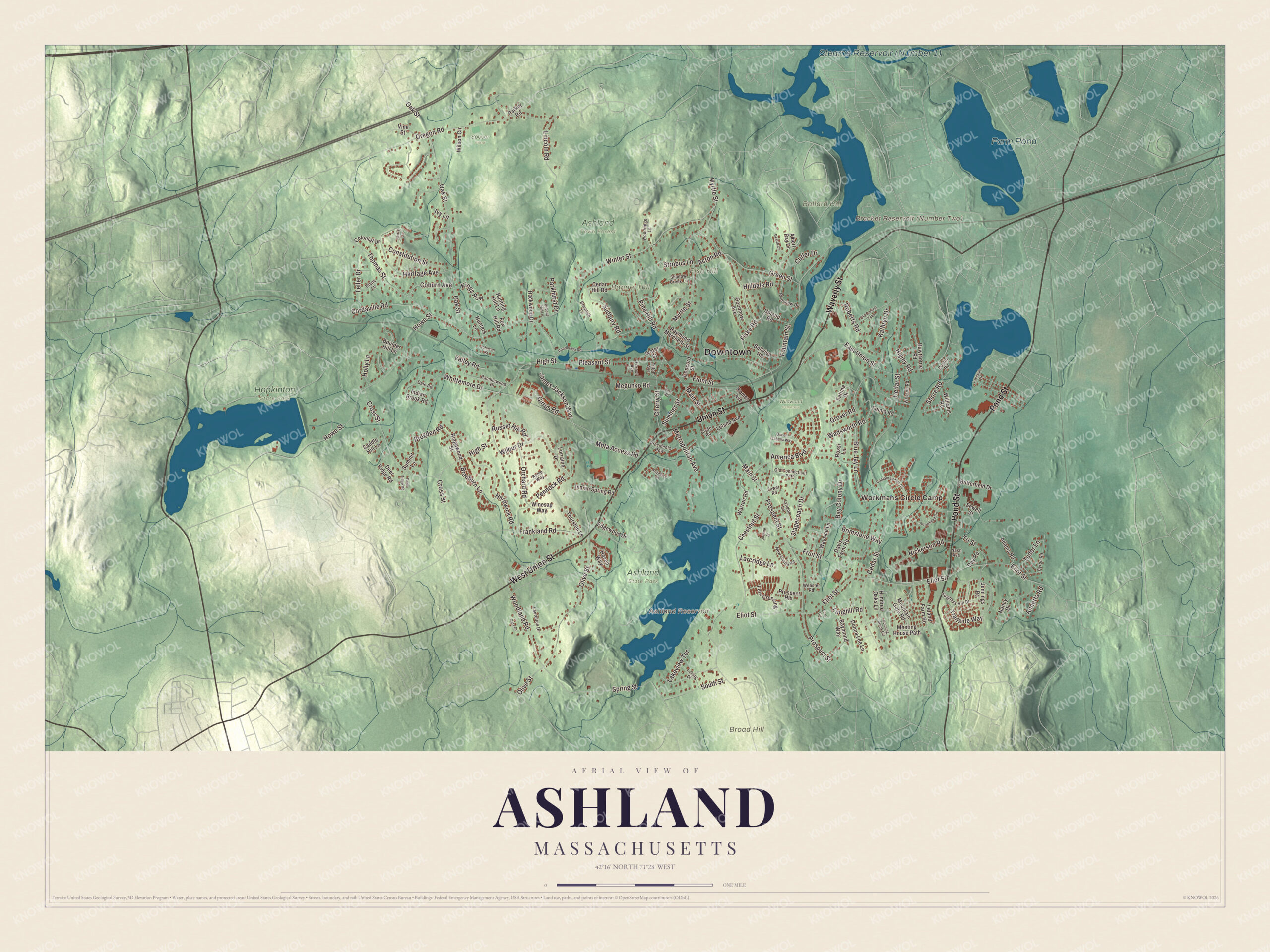
Ashland on the map
Click the map to look closer.
Ashland today
By KNOWOL
Shaded terrain from the Ashland Reservoir and Farm Pond to Ballard Hill, Banner Hill and Broad Hill, with every road from Pond Street and Union Street to Waverly Street, High Street and Cordaville Road.4
The story of Ashland
The night the Magunko tub went missing
When Unionville broke away from Hopkinton in 1846 and became Ashland, it kept the village fire engine, the Magunko tub. Hopkinton taxpayers had paid for it, and it had served as Union Engine Company Number Four of their fire department, so they wanted it back. On the night of August 13, 1846, a party from Hopkinton slipped into the little engine house and hauled the tub away, leaving nothing but bare walls and a roof. Ashland somehow got it back, and young men from Ashland answered by carrying off Hopkinton's Revolutionary cannon. For years that cannon made midnight trips between the towns, until Ashland sank it in a pond and brought it up each Fourth of July eve. The rivalry still lives on in the Thanksgiving football game.5671
Magunco and the cold spring
Long before there was a town, there was Magunco. A little west of today's village, the Rev. John Eliot gathered a praying town by 1669, and in 1675 it held eleven families, about 55 people. The name was said to mean a place of great trees, and a chestnut there still measured 22 feet around in 1874. In 1663 Colonel William Crowne was granted 500 acres near the cold spring, by the old road from Sudbury to Connecticut, and that grant covered all of Ashland village, from Magunko Hill to Cold Spring Brook. His heirs sold it in 1687 to Savil Simpson, a Boston shoemaker, for 30 pounds. Around 1900 you could still follow the worn Connecticut Path from a ford on Cold Spring Brook toward Framingham.8910
The man who set clocks by the power grid
Henry E. Warren came to Ashland in 1904 with the Lombard governor company and settled in 1907 on a farm on Chestnut Street. In the barn behind his house he worked out a clock that keeps time by the steady pulse of the power grid, and he patented it in 1918. For it to work, power plants had to hold their current at a steady sixty cycles a second, and Warren's timer helped them do it. His company, Telechron, went into partnership with General Electric, and in the 1950s it employed 2,000 people, about a third of the town. GE made clocks here until 1979, and the plant closed for good in 1992. The high school teams are still called the Clockers.41
Through the years
25 moments from 1663 to today.
- 1663Colonel William Crowne is granted 500 acres near the cold spring, land that takes in all of today's Ashland village.9
- 1669The Rev. John Eliot sets up the praying town of Magunco just west of the future village.8
- 1687Crowne's heirs sell the tract to Savil Simpson, a Boston shoemaker, for 30 pounds.9
- 1832Captain John Stone builds the Railroad House, today's Stone's Public House.1
- 1834Daniel Webster speaks from the inn's balcony the day the first train arrives.1
- 1835James McIntire is ordained in Chapel Hall as Unionville's first pastor.11
- 1836The meetinghouse that's still the Congregational church is dedicated on January 21.12
- 1846Unionville and its surroundings are incorporated as the town of Ashland on March 16.2
- 1846On August 13 a Hopkinton party carries off the Magunko fire engine in the middle of the night.5
- 1855The Ashland Town House is built on Main Street.13
- 1858The first Catholic Mass in Ashland is said in the town hall on December 20.14
- 1869The Ashland Advertiser, the town's first newspaper, is printed on a hand press in the Jones Building.15
- 1872The Hopkinton Railroad, built in 1871 and 1872, links the Ashland depot to Milford.2
- 1875Ashland counts 2,211 people, nearly double its size at incorporation.2
- 1876Alfred D. Warren starts making spool cotton in Jordan & Marsh's mill buildings here.16
- 1878Boston builds three reservoirs on the Sudbury River, halting work on the Dwight Printing Company's granite mills.1
- 1883The Catholic church on Esty Street is dedicated on December 16.17
- 1885The Ashland Reservoir dam and spillway are built for Boston's water supply.18
- 1897The first Boston Marathon starts in Ashland.1
- 1907Henry E. Warren settles on a farm on Chestnut Street.4
- 1918Warren patents the synchronous electric clock he worked out in his barn.4
- 1924The marathon start moves to Hopkinton.1
- 1947The Ashland Reservoir leaves service and becomes Ashland State Park.18
- 1986The Sri Lakshmi Temple opens on Waverly Street on September 6.1
- 1992The old Telechron clock plant closes for good.4
Places to see
Places worth a visit in Ashland today.
- Stone's Public HouseTown center. Captain Stone's Railroad House of 1832.
- Marathon start parkPleasant Street. Its sign reads It all started here.
- Ashland State ParkWest Union Street. 470 acres around the Ashland Reservoir.Visit their website
- Ashland Dam and SpillwayAshland State Park. Granite spillway built like a stepping brook.
- Ashland Town ForestWoods and hills. 550 acres of trails and caves.
- Warren WoodsSouth side of town. Henry Warren's old land, now trails.
- Sri Lakshmi TempleWaverly Street. Regional Hindu temple opened in 1986.Visit their website
- Megunko HillWest of the village. Named for the Megunko people.
On the National Register
All 3 places in Ashland on the National Register of Historic Places that still stand today, oldest first, and why each one matters.3
-
Ashland Town House
Ashland's town hall, used for town business since 1855 and as a grade school until 1928. It's a Greek Revival building with Italianate brackets, lengthened in 1905, when the Colonial Revival entry was added.13
-
Ashland Dam and Spillway
An earthen dam and a 630-foot granite spillway built for Boston's second major water supply system, the spillway designed to look like a brook stepping down through the landscape. The gatehouse on top was taken down in 1976, but the dam and spillway still stand.18
-
Hopkinton Dam and Spillway
Built between 1891 and 1894 for Boston's water supply, the dam holds back Indian Brook to make the Hopkinton Reservoir, and its 650-foot spillway steps down over granite set in concrete. The dam is in Ashland, while the west end of the reservoir is in Hopkinton.19
In their words
“In retaining the Magunko tub, Ashland kept only that which, with good reason, it believed the town was entitled to have.”
The town archives inventory of Ashland, on the fire engine quarrel of 18466
“Ashland was not ready to resume cordial relations with the parent town”
The town archives inventory of Ashland, on the 1847 town meeting5
“When prosperity shall come again, the enterprise and perseverance of her people will keep Ashland in the line of progress with her sister communities.”
History of Middlesex County, Massachusetts, 18802
Nearby towns
Sources
- Ashland, Massachusetts, Wikipedia
- History of Middlesex County, Massachusetts (1880), on Ashland, Internet Archive
- National Register of Historic Places listings in Middlesex County, Massachusetts, Wikipedia
- Map of Ashland, Massachusetts in 2026, KNOWOL (USGS elevation, Census Bureau roads)
- Inventory of city and town archives of Massachusetts, Ashland (catalog date 1900), on the 1846 raid, Internet Archive
- Inventory of city and town archives of Massachusetts, Ashland (catalog date 1900), on the Magunko tub, Internet Archive
- Inventory of city and town archives of Massachusetts, Ashland (catalog date 1900), on the Hopkinton cannon, Internet Archive
- Colonial Society of Massachusetts Publications (1895), on Magunco, Internet Archive
- Inventory of city and town archives of Massachusetts, Ashland (catalog date 1900), on the Crowne grant, Internet Archive
- Inventory of city and town archives of Massachusetts, Ashland (catalog date 1900), on the Connecticut Path, Internet Archive
- Inventory of city and town archives of Massachusetts, Ashland (catalog date 1900), on the first church, Internet Archive
- Middlesex County and its people; a history (1927), on Ashland's churches, Internet Archive
- Ashland Town House, Wikipedia
- History of Middlesex County, Massachusetts (1890), on the first Mass, Internet Archive
- History of Middlesex County, Massachusetts (1890), on the Ashland Advertiser, Internet Archive
- Encyclopedia of Massachusetts, biographical, genealogical (1916), on the Warren thread business, Internet Archive
- History of Middlesex County, Massachusetts (1890), on the Esty Street church, Internet Archive
- Ashland Dam and Spillway, Wikipedia
- Hopkinton Dam and Spillway, Wikipedia