
A Bristol County city on the Rhode Island line, once called the Jewelry Capital of the World, where the Ten Mile River turned the cotton mills of Dodgeville and Hebronville and jewelry shops crowded the streets beside the railroad.
Then and now
The same town 148 years apart. Click either map to look closer.
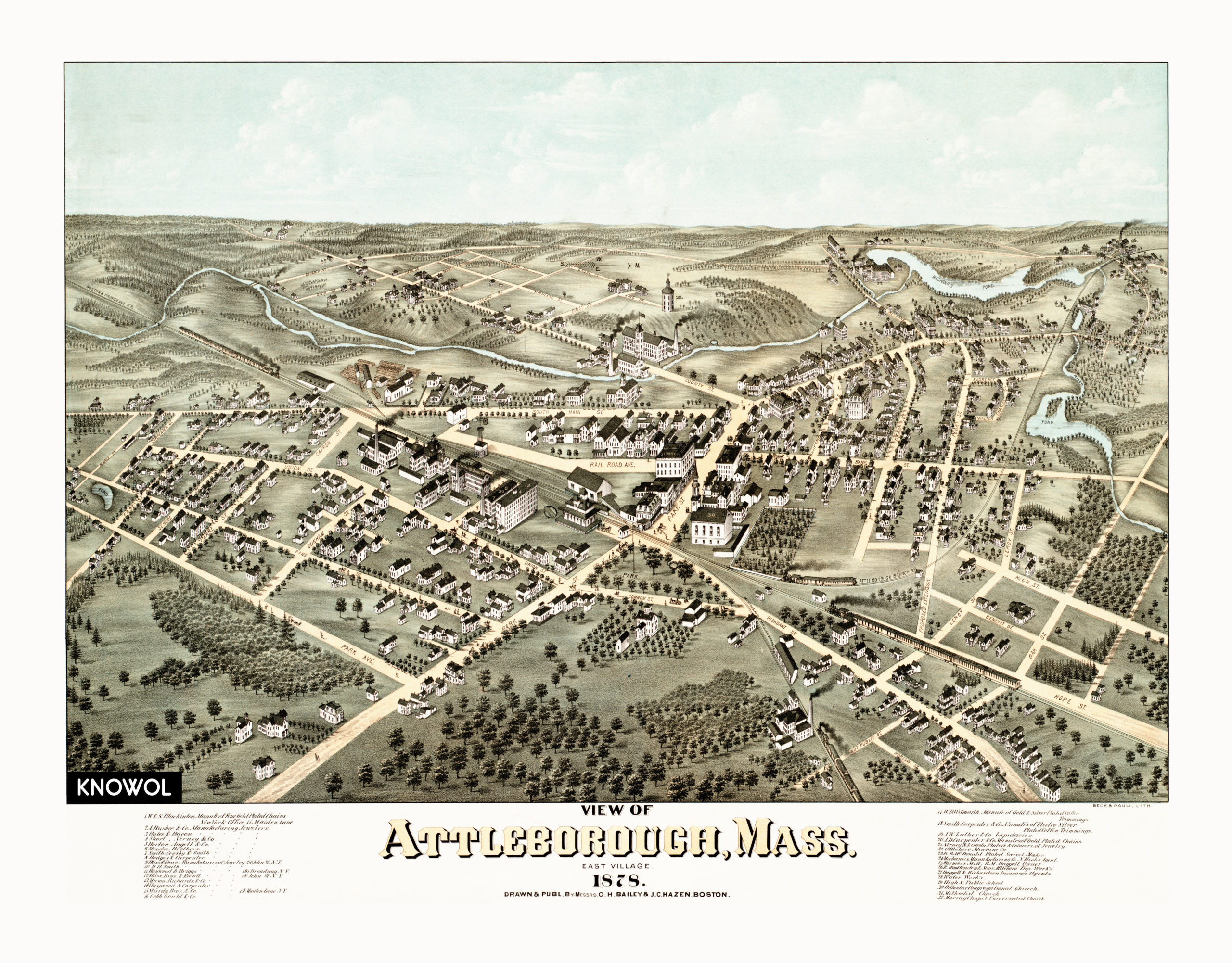
Attleboro in 1878
By O.H. Bailey
Attleboro as it looked in 1878, nine years before North Attleborough split off, with a number of the town's jewelry companies drawn on the map.5
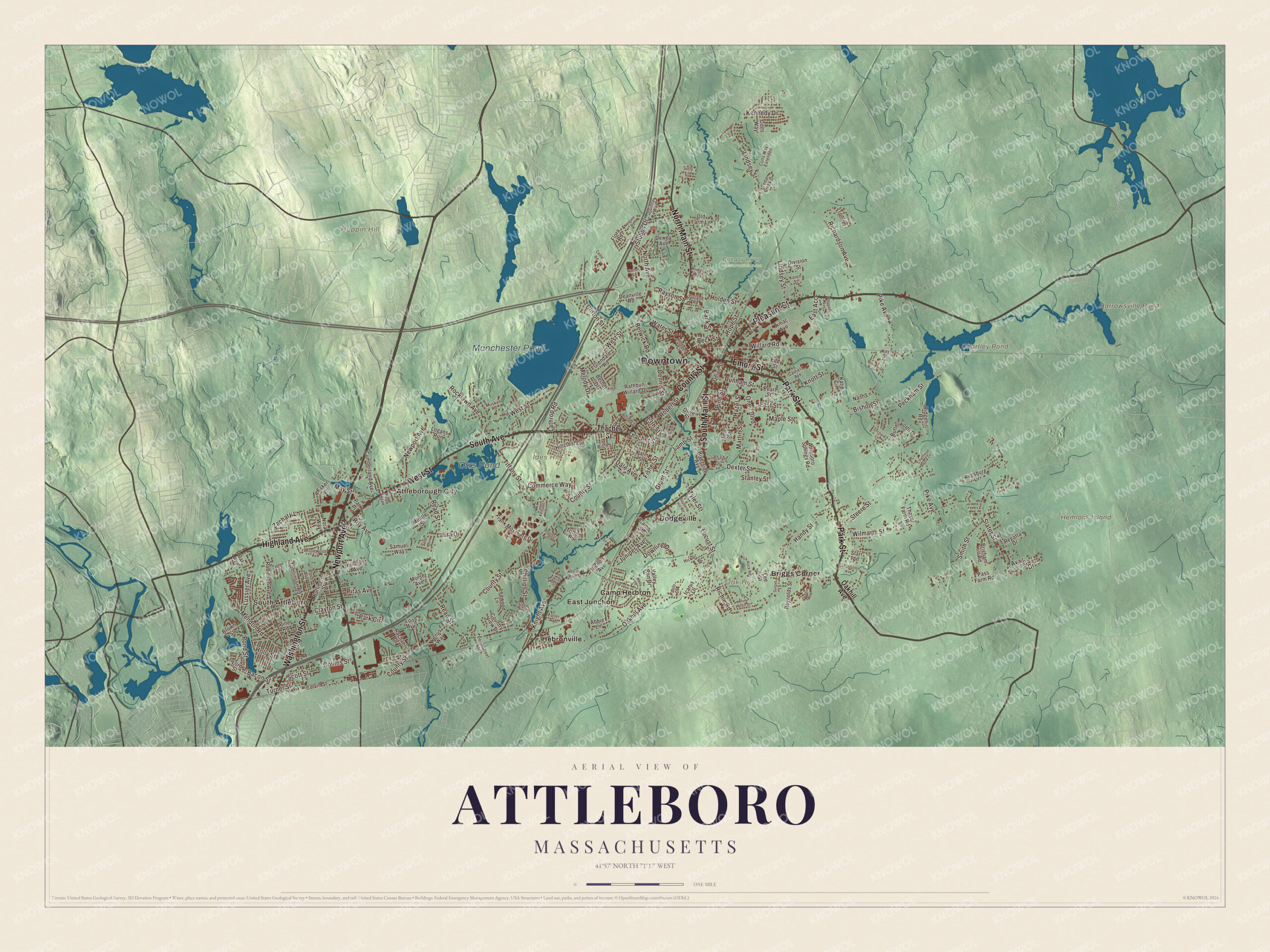
Attleboro today
By KNOWOL
Park Street, Newport Avenue, Washington Street, Pleasant Street, South Avenue and Highland Avenue, with Manchester Pond, Orrs Pond, Hoppin Hill, Ides Hill, Oak Hill and Hemlock Island, over shaded relief from USGS elevation data.6
The story of Attleboro
The Great Freshet of 1886
In February 1886 thirty-six hours of warm rain fell on frozen snow, and every stream in town rose at once. Downtown, Mechanics bridge lifted off its foundation a little after one o'clock and floated away, and firemen were called out to push cakes of ice clear of the bridges and shops. At Hebronville the dam held, but the river ran through the first floor of the mill, soaking about half of more than a thousand bales of cotton. The Dodgeville dam held too, and over a thousand people came out to look. At Orr's mill the granite dam gave way that afternoon and tore four big elms out by the roots. Through it all, the famous selectmen's bridge at Hebronville never turned a hair.7
Two mill villages on the Ten Mile River
Hebronville got its name in 1827, when Rev. Thomas Williams built a small meetinghouse right on the Seekonk line, half in each town. Dodgeville took its name from Nehemiah Dodge, who bought into Ebenezer Tyler's cotton factory about 1815 and put his son John in charge. The Knights bought the Dodgeville mill at auction in 1854, and in 1870 the Hebron Manufacturing Company ran mills in both villages. By 1899 the Hebronville mills had about 600 workers on 21,760 spindles, and the company kept a general store in each village. Many of the mill families came from French Canada, and about 1878 they got their own church, St. Stephen's, on the road between the two villages.891011
How Attleborough became Attleboro
The town of 1694 covered about eighty square miles. Cumberland went to Rhode Island in 1747, and in 1887 the northern half voted itself out as North Attleborough. Town meetings had been held in Agricultural Hall, which now stood in the other town, so the smaller Attleborough held its first meeting in the South Main Street Engine House. Downtown kept growing around the railroad. J. M. Bates built a thousand-seat opera house on Park Square in 1885, and his firm, Bates and Bacon, had about a hundred workers making gold-plated bracelets in the four-story Bates Building beside the tracks. In 1914 the town became a city and dropped the "-ugh," and the jewelry trade made it known as the Jewelry Capital of the World.2112313
Through the years
23 moments from 1634 to today.
- 1634English settlers first arrive, on land deeded by Wamsutta.1
- 1694Attleborough is incorporated, about eighty square miles, named for Attleborough in England.2
- 1747Cumberland, once part of the town, becomes part of Rhode Island.1
- 1809Industry begins at the Dodgeville mill site on South Main Street.14
- 1811A textile maker dams the Ten Mile River at what's now 67 Mechanic Street.15
- 1815About this year Nehemiah Dodge buys into the Dodgeville Cotton Factory, and his son runs it.9
- 1827Rev. Thomas Williams gathers a church on the Seekonk line and names the village Hebronville.8
- 1835The Boston and Providence Railroad opens through town.16
- 1843The East Attleborough Academy is built on Sanford Street.17
- 1854The Dodgeville mill is sold at auction to B. B. and R. Knight.9
- 1870The Hebron Manufacturing Company is formed, with mills at Dodgeville and Hebronville.9
- 1878About this year St. Stephen's Church goes up on the road between Dodgeville and Hebronville.11
- 1878O.H. Bailey publishes his map of Attleboro.5
- 1883The Davis Centenary Methodist church burns two days before Christmas.18
- 1885J. M. Bates opens his thousand-seat opera house on Park Square.3
- 1886The Great Freshet floods the mills at Hebronville and Dodgeville and breaks the dam at Orr's mill.7
- 1887North Attleborough is set off, and the smaller town meets in the South Main Street Engine House.12
- 1899The D. E. Makepeace Company builds its plating plant on Pine Street.19
- 1906The northbound station opens on the new railroad viaduct, and the southbound follows two years later.16
- 1914Attleboro becomes a city and drops the "-ugh" from its name.1
- 1916The limestone post office on Park Street is built.20
- 1937Capron Park Zoo opens on land given by the Capron family.6
- 1953The La Salette shrine opens to the public with a Christmas manger display.1
Places to see
Places worth a visit in Attleboro today.
- La Salette ShrinePark Street. Christmas Festival of Lights since 1953.Visit their website
- Capron Park ZooCounty Street. City zoo, opened in 1937.Visit their website
- Oak Knoll Wildlife Sanctuary1417 Park Street. Mass Audubon's 75 acres on Lake Talaquega.Visit their website
- L.G. Balfour RiverwalkDowntown. Riverfront park on the old Balfour plant site.
- Attleboro Area Industrial MuseumUnion Street. The city's jewelry and industry history.Visit their website
- Hebronville Mill Historic DistrictHebronville. Mill buildings and worker housing.
- Manchester PondNorthern Attleboro. The city's reservoir.
- Oak HillSouthern Attleboro. The city's high point, 249 feet.
- South AttleboroOn the Rhode Island line. Village on the old Boston Post Road.
On the National Register
All 13 places in Attleboro on the National Register of Historic Places that still stand today, oldest first, and why each one matters.4
-
Capron House
One of the town's oldest surviving buildings, built about 1740 by one of the seven children of Banfield Capron, an early settler who gave each child 200 acres of farmland.21
-
Capt. Joel Robinson House
A Federal house with a fanlight over the door, built by Joel Robinson in 1790 and kept by at least ten generations of his descendants.22
-
Dodgeville Mill
Industry on this site goes back to 1809, making it one of the city's oldest. Its frame and brick buildings went up through the 1800s and early 1900s, and textile work, including Fruit of the Loom goods, went on here into the 1970s.14
-
East Attleborough Academy
Built in 1843 as a private academy, it later held the town's first public high school and is the only Greek Revival temple front in town. It now houses the local historical society.17
-
Blackinton Houses and Park
Willard Blackinton built his house at 200 North Main Street in 1849 and the duplex across the road for his two sons. The family made shuttles for power looms, and the park was a gift from Mayor Harold Sweet in 1937.23
-
Attleboro Jewelry Industry Historic District
Brick, frame and concrete factory buildings of the city's old Jewelry District, mostly on Union Street, built from the middle 1800s to the middle 1900s. The jewelry trade grew up here after the Boston and Providence Railroad came through.24
-
Hebronville Mill Historic District
The Hebronville mill complex with its factory buildings and worker housing. From the late 1920s to the early 1950s the mill reprocessed cotton waste from 20 other company mills in Rhode Island and Massachusetts.25
-
Watson, Newell & Company Factory
Built from 1889 to 1947 on the site of the city's first textile mill, where the Ten Mile River was dammed in 1811. Watson and Newell made silver buttons, pins, flatware and souvenir spoons here, with more than 200 workers, until 1955.15
-
D. E. Makepeace Company
One of the city's best jewelry factory buildings of its time. Makepeace plated precious metals for other jewelry firms and was one of the leading employers in the city; the plant became homes in 1984.19
-
Robinson Building
A building at 37 to 41 Union Street in the old Jewelry District, listed on the National Register in 2023.4
-
Northbound and Southbound Stations
Two-story Romanesque station buildings on either side of the tracks, built when the railroad raised its line on a viaduct and removed 13 grade crossings. Trains have stopped downtown since 1835.16
-
Herbert A. Sadler House
One of the city's most elaborate Colonial Revival houses, built in 1906 for Herbert Sadler of Sadler Brothers, one of the leading jewelry firms, with a two-story porch of Ionic columns.26
-
US Post Office, Attleboro Main
A Classical Revival post office faced in Indiana limestone, built in 1916 for $85,000. It is now offices for the city and Bristol County.20
In their words
“Those who should know pronounce Attleboro and her opera-house the best one or two-night stand in New England.”
Inland Massachusetts illustrated, 1891, on the Bates Opera House3
“The famous selectmen's bridge at Hebronville stood through it all, and never turned a hair,”
A sketch of the history of Attleborough, 1894, quoting a resident after the Great Freshet of 18867
“Its reputation, with that of North Attleborough, is world-wide as one of the largest jewelry manufacturing centers of the country.”
Our county and its people, Bristol County, 189927
Nearby towns
Sources
- Attleboro, Massachusetts, Wikipedia
- Inland Massachusetts illustrated (1891), on the town of Attleborough, Internet Archive
- Inland Massachusetts illustrated (1891), on the Bates Opera House, Internet Archive
- National Register of Historic Places listings in Bristol County, Massachusetts, Wikipedia
- Old map of Attleboro, Massachusetts from 1878, restored by KNOWOL
- Map of Attleboro, Massachusetts in 2026, KNOWOL (USGS elevation, Census Bureau roads)
- A sketch of the history of Attleborough, from its settlement to the division (1894), on the Great Freshet of 1886, Internet Archive
- A sketch of the history of Attleborough, from its settlement to the division (1894), on Hebronville's church, Internet Archive
- Our county and its people: Bristol County, Massachusetts (1899), on the Dodgeville and Hebronville mills, Internet Archive
- Our county and its people: Bristol County, Massachusetts (1899), on the villages of Attleborough, Internet Archive
- A sketch of the history of Attleborough, from its settlement to the division (1894), on St. Stephen's Church, Internet Archive
- A sketch of the history of Attleborough, from its settlement to the division (1894), on the division of 1887, Internet Archive
- Leading manufacturers and merchants of eastern Massachusetts (1887), on Bates and Bacon, Internet Archive
- Dodgeville Mill, Wikipedia
- Watson, Newell & Company Factory, Wikipedia
- Northbound and Southbound Stations, Wikipedia
- East Attleborough Academy, Wikipedia
- Our county and its people: Bristol County, Massachusetts (1899), on Attleborough's churches, Internet Archive
- D. E. Makepeace Company, Wikipedia
- US Post Office, Attleboro Main, Wikipedia
- Capron House, Wikipedia
- Capt. Joel Robinson House, Wikipedia
- Blackinton Houses and Park, Wikipedia
- Massachusetts Historical Commission, minutes of March 12, 2025 (Attleboro Jewelry Industry Historic District nomination)
- Hebronville Mill Historic District, Wikipedia
- Herbert A. Sadler House, Wikipedia
- Our county and its people: Bristol County, Massachusetts (1899), on the town of Attleborough, Internet Archive